
The worst Step 3 decision you can make is picking a test date based on vibes instead of data.
You should delay Step 3 if your Q‑bank scores are truly low and not trending up. But “low” has a specific meaning here, and delaying is not always the smart move. Sometimes you are better off tightening your prep and taking it. Other times, postponing is the only rational choice.
Let me walk you through exactly how to decide.
Step 3 and Low Q‑Bank Scores: The Core Rule
Here’s the simple rule most residents never get told clearly:
If you would clearly fail a Step 3-style self-assessment today, you should strongly consider delaying.
If you are hovering in the borderline-but-rising zone, you probably do not need to delay—you need to adjust how you study.
The hard part is figuring out which group you’re actually in.
What Counts as a “Low” Q‑Bank Score?
Do not guess. Use numbers.
For most major Step 3 Q‑banks (UWorld, AMBOSS, etc.), here’s a practical (not perfect, but field-tested) framework:
| Avg Correct on Mixed, Timed Blocks | Risk Level | Typical Advice |
|---|---|---|
| < 50% | Very High | Strongly consider delaying |
| 50–57% | High | Delay or change strategy + reassess soon |
| 58–65% | Moderate | Usually OK if trending up and self-assessments near/pass |
| 66–75% | Low | Reasonable to stay on schedule |
| > 75% | Very Low | You’re overshooting; just solidify and test |
A few critical points:
- These are averages on mixed, timed blocks, not cherry-picked easy systems or tutor mode.
- Your trend matters more than a single snapshot.
- Self-assessments (NBME if available, UWorld/AMBOSS SA) matter even more than the raw Q‑bank average.
If you’re at 47% and flat for three weeks on mixed blocks? You are not “one good weekend away” from being ready.
If you’re at 55% but went from 45 → 50 → 55% over 3–4 weeks with better timing? Very different story.
First, Answer These 7 Questions Honestly
Before you touch your Prometric date, sit down and answer these:
- What’s your average % correct on mixed, timed Q‑bank blocks from the last 10–15 blocks?
- What’s the trend over the last 3–4 weeks? Up, flat, or down?
- Have you done any self-assessment that gives a predicted pass/fail or 3‑digit score?
- How many total Q‑bank questions have you completed? (Out of the bank’s total.)
- How much time per week can you realistically study in the next 4–6 weeks?
- Are there external deadlines? (Visa, promotion to next PGY, licensing, program requirement.)
- How’s your test endurance? Can you handle long testing days without totally falling apart?
Now you can actually make a rational call.
A Clear Decision Framework: Delay or Not?
Use this as a rough triage. It’s not perfect, but it’s better than guessing.

| Step | Description |
|---|---|
| Step 1 | Low Q-bank Scores |
| Step 2 | Strongly consider delaying |
| Step 3 | Optimize study, likely do not delay |
| Step 4 | Delay or add 3-4 focused weeks + reassess |
| Step 5 | Mixed, timed avg >= 58%? |
| Step 6 | Avg >= 50% AND rising? |
| Step 7 | Self-assessment near/pass? |
Scenario 1: You Should Very Seriously Consider Delaying
You’re in this group if:
- Mixed, timed Q‑bank average: < 50–52%,
and - No real upward trend over 3+ weeks,
and/or - Any self-assessment suggests high risk of failing.
In real life, this looks like:
- PGY1 on nights, “studying” on days off, stuck at 48%.
- You’ve done 1,000+ UWorld questions, still getting destroyed by CCS and biostats.
- You’re not finishing blocks on time. Guessed on 10–15 questions per block.
If that sounds like you, forcing the exam usually leads to one of two outcomes:
- Fail Step 3 → now you’re juggling residency plus a retake plus the psychological hit, or
- Barely scrape by, but you’ve burned months in anxiety for no reason.
Delaying here is not weakness. It’s damage control.
Scenario 2: You Probably Do NOT Need to Delay (Yet)
You’re here if:
- Mixed, timed Q‑bank average: 58–65%,
and - Clear upward trend (example: 52 → 56 → 60%),
and - A self-assessment shows you around or slightly above the passing range.
Or:
- You have hard external deadlines: employment, contract, promotion, visa, or state licensing that requires Step 3 by a date.
- You can’t simply push “a few months”; your leash is shorter.
In this group, the move is not delay-by-default. It’s:
- Tighten your schedule
- Focus your weak zones
- Use one more self-assessment 2–3 weeks before test day to confirm
You’re nervous, not doomed.
Scenario 3: In the Gray Zone
This is where most people are:
- Mixed, timed Q‑bank average: 50–57%,
- Trend is slightly up or flat,
- No formal self-assessment or one that’s borderline.
Here, the smart play is:
- Add 3–4 weeks of truly focused, higher-intensity studying.
- Take a real self-assessment under exam-like conditions.
- Decide based on that data, not your anxiety.
How Much Do Self-Assessments Matter?
Self-assessments are your reality check. They’re not perfect, but they’re better than vibes.
For Step 3, consider:
- UWorld Self-Assessment (if available)
- AMBOSS Self-Assessment
- Any NBME Step 3-style forms (if offered currently)
Use them like this:
- Take one 4–6 weeks before test day.
- If result suggests clear fail risk → strongly consider delaying.
- If result is borderline but close, and you have time to add 3–4 weeks of strong studying → adjust and repeat assessment or at least track Q‑bank trend.
- If result suggests comfortable pass → stay the course.
The Hidden Variable: Time and Energy in Residency
Here’s what I see residents constantly misjudge: their real capacity over the next month.
If you are:
- On ICU, wards, or night float with 70–80+ hour weeks,
- Coming home exhausted, barely able to do 10 focused questions,
- Getting interrupted by codes, family issues, or childcare—
Your “4 weeks until exam” is not actually 4 weeks of study. It’s probably more like 8–10 true study days total.
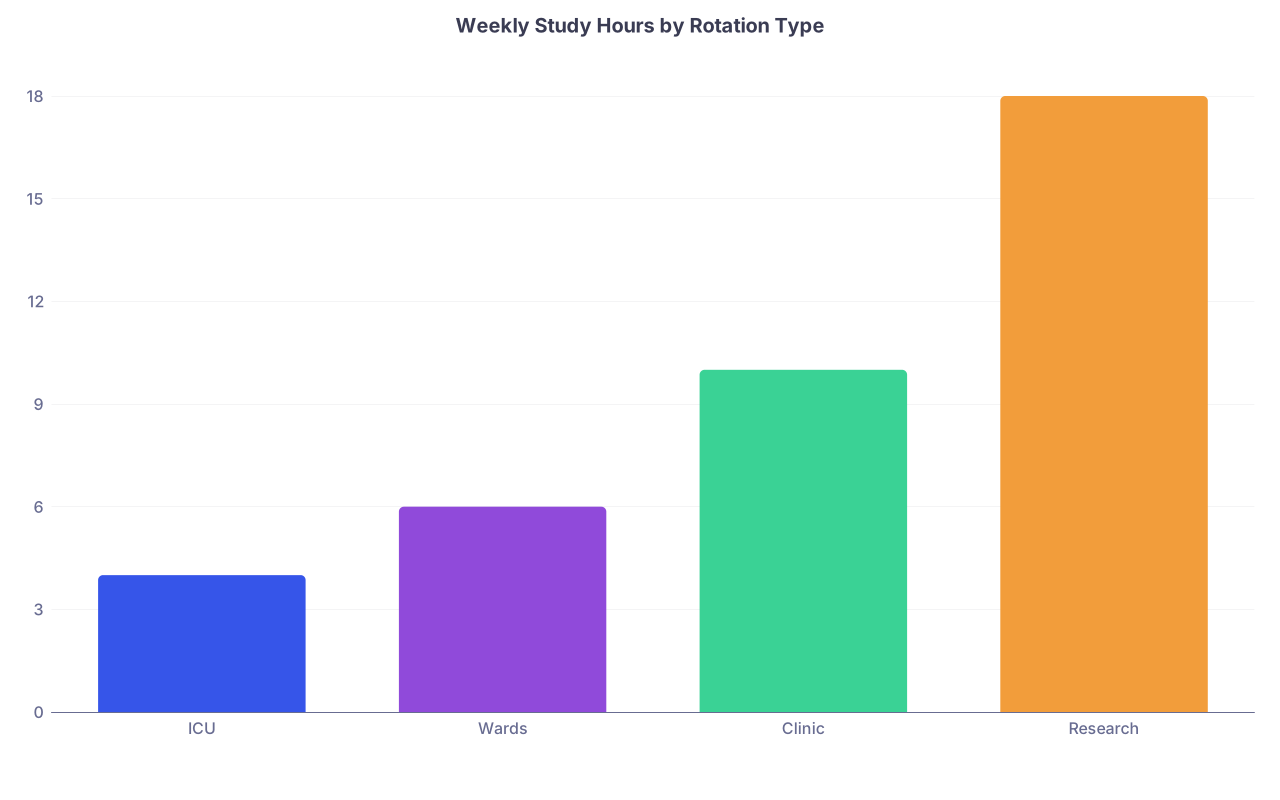
| Category | Value |
|---|---|
| ICU | 4 |
| Wards | 6 |
| Clinic | 10 |
| Research | 18 |
If you are in a lighter rotation (clinic, electives, research):
- You may gain 3–4 hours per day for studying.
- That’s enough time to make real improvement.
Do not plan as if future-you will be a completely different human with perfect willpower and no fatigue. Look at your schedule, look at your last 2–3 rotations, and be honest.
What To Do If You Decide to Delay
Delaying alone does not fix low scores. You have to change how you study, not just how long you study.
Here’s what actually moves the needle in the next 4–8 weeks:
Switch to mixed, timed blocks only
No more “I’ll just do cardiology in tutor mode to feel better.” That’s how people plateau at 52%.Aggressive review of explanations
For each missed question, ask:- Did I not know the content?
- Did I misread the question?
- Did I fall for a trap answer?
- Was it time pressure?
Fix CCS now, not later
Many otherwise-prepared people bomb Step 3 because they never took CCS seriously.
Do:- Several full CCS cases per week
- Practice early orders: ABCs, monitoring, basic labs, imaging
- Learn the “tempo” of outpatient vs inpatient cases
Target your worst 2–3 domains
Stop pretending you’ll fix every weakness equally.
Common killers:- Biostats / ethics / risk-benefit
- Inpatient management details (vent, pressors, sepsis bundles)
- Preventive care guidelines (screening/vaccines by age)
Schedule the test strategically
Move it to:- A lighter rotation, or
- Immediately after a lighter stretch, not mid-ICU.
What To Do If You Decide NOT to Delay
If you keep your date, you need discipline, not denial.
Over the next 3–4 weeks:
- Commit to daily mixed, timed blocks (at least 1–2).
- Do full-length practice days once a week to build endurance.
- Tackle CCS every 2–3 days so you’re not seeing it fresh on exam day.
- Sleep. You cannot cram your way out of cognitive exhaustion on a 2‑day test.
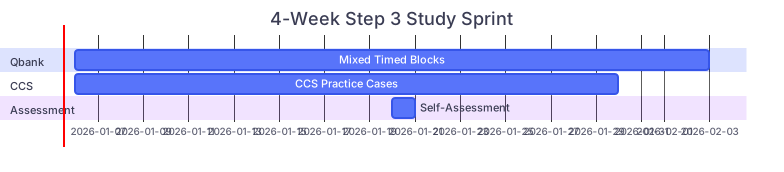
| Task | Details |
|---|---|
| Qbank: Mixed Timed Blocks | a1, 2026-01-06, 28d |
| CCS: CCS Practice Cases | a2, 2026-01-06, 24d |
| Assessment: Self-Assessment | a3, 2026-01-20, 1d |
Common Myths About Delaying Step 3
Let me quickly kill a few bad ideas I hear constantly:
“If I delay, I’ll magically be more motivated later.”
No you won’t. If anything, anxiety will drag longer. Motivation comes from a tight, concrete plan, not a new date.“Programs will be mad if I delay.”
Most PDs care that you pass and do not screw up licensing/future applications. They don’t care if you took it in March instead of January—unless they explicitly set a deadline.“Everyone else just winged it and passed.”
You are not “everyone else.” And plenty of people fail Step 3 quietly and do not advertise it.“I just need to ‘get it over with.’”
That’s how people create a failed attempt on their record. Future credentialing and some fellowships do look at this.
Red Flags That You’re Not Ready (Regardless of % Correct)
Even if your raw percentage looks borderline acceptable, delay is on the table if:
- You routinely run out of time and guess on the last 5–10 questions.
- You cannot stay focused for an entire 4-block practice day.
- You are guessing on basic bread-and-butter management:
- New-onset chest pain workup
- Sepsis initial orders
- DKA management
- Basic prenatal care
- You have zero CCS practice and the exam is in < 2 weeks.
If that’s you, more days of casual questions will not magically fix things.
Putting It All Together: A Quick Reality Check Grid
Use this to pressure-test your decision.
| Metric | Likely Action |
|---|---|
| Mixed timed avg < 50% | Strongly consider delay |
| 50–57% and flat trend | Add 3–4 weeks, reassess |
| 58–65% and rising | Usually keep date |
| Self-assessment clear fail | Delay or major overhaul |
| Self-assessment borderline | Short delay + focused study |
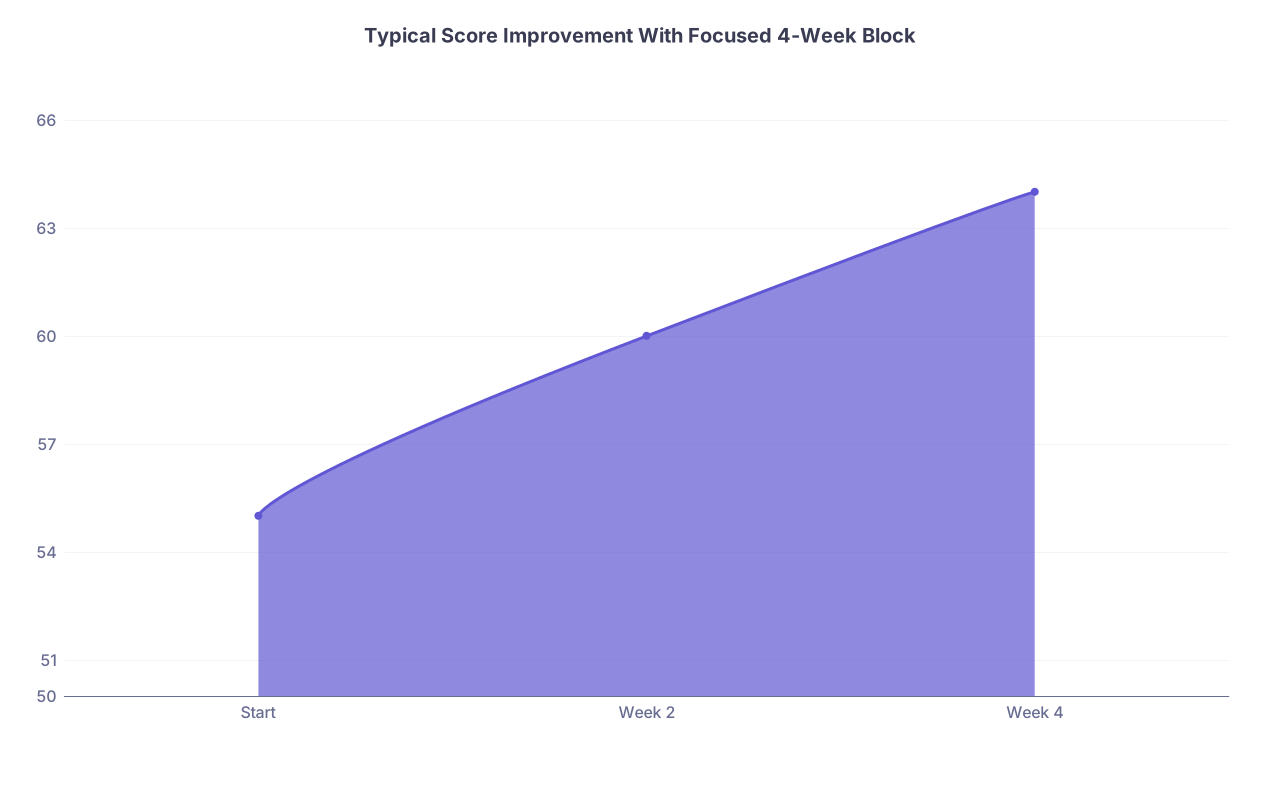
| Category | Value |
|---|---|
| Start | 55 |
| Week 2 | 60 |
| Week 4 | 64 |
Bottom Line Answer
You should delay Step 3 if:
- Your mixed, timed Q‑bank average is below ~50–52% with no upward trend,
- A self-assessment suggests likely failure,
- And you don’t have a hard external deadline forcing your hand.
You probably should not delay just because you feel uncomfortable if:
- Your average is in the high 50s to mid 60s,
- It’s been rising,
- And a self-assessment shows you close to or above passing.
The real mistake is delaying without changing your study approach—or refusing to delay when all the data is screaming that you are not ready.
FAQ: Step 3 Delay and Low Q‑Bank Scores

1. What exact Q‑bank percentage means I must delay Step 3?
There’s no single magic cutoff, but below 50% on mixed, timed blocks with no improvement over several weeks is a huge red flag. In that range, most people are not just “a little anxious”—they are at real risk of failing. If you are below 50% and have already done several hundred questions, you should strongly consider pushing your test and rebuilding with a more structured plan.
2. How many Q‑bank questions should I finish before deciding to delay?
If you’ve only done 200 questions, your percentage is basically noise. Once you’ve done at least 800–1,000 questions (ideally from a high-quality bank like UWorld) in mixed, timed mode, your average starts to mean something. Make your delay decision after you’ve:
- Hit that volume window,
- Looked at your 3–4 week trend,
- And (ideally) taken a self-assessment.
3. What if my program wants Step 3 done by a specific date, but my scores are low?
You’re in a squeeze. Be proactive rather than hiding:
- Talk to your chief or program director early.
- Show them your plan: extra study time, schedule adjustments, practice scores.
- Ask if there is any flexibility on the date.
Many programs would rather shift your schedule than add a Step 3 failure to their stats. But they cannot help you if you pretend everything is fine until a week before.
4. Can I realistically improve from ~50% to a passing level in 4 weeks?
Sometimes, yes—but only under the right conditions:
- You’re going into a lighter rotation (clinic/elective/research),
- You can commit 2–4 focused hours per day,
- You switch to mixed, timed blocks only, review rigorously, and practice CCS.
If you’re heading into heavy ICU or nights and barely holding 50%, a 4‑week miracle jump is unlikely. In that case, delaying until you have a saner schedule is usually more realistic.
5. Is it better to just take Step 3 and risk a low pass than delay and maybe fail later?
No. A fail is worse than a delay almost every time. A low pass is usually fine, but you do not get to choose “low pass vs high pass” when you’re underprepared—you’re choosing “possible low pass vs real risk of fail.” Programs and licensing boards care a lot more about failed attempts than about when you took the test, as long as you meet their deadlines.
Open your Q‑bank right now and look at your last 15 mixed, timed blocks. Calculate the average and check the trend. Based on those numbers—not your fear—decide whether you’re going to tighten your next 4 weeks or move the exam and build a smarter plan.