
It is 8:45 p.m. You just signed out, wolfed down something vaguely resembling dinner, and your brain is already halfway to sleep. Step 3 is in three weeks. Your UWorld reset is only 30% done. Your CCS cases? Basically untouched.
You keep telling yourself you will “study on my days off.” Those days off keep disappearing into sleep, laundry, and fixing whatever your last rotation broke in your personal life.
This is where most residents fail Step 3 prep: they think they need long, perfect study days. You do not. What you need is a ruthless system that turns random scraps of time into high-yield, repeatable 3‑hour “micro-blocks.”
That is what we are going to build: a Step 3 framework that actually fits a resident’s life. Not fantasy-land. Reality: Q3–Q6 call, random golden weekends, 28‑hour calls, and a brain that is rarely at 100%.
The Core Model: The 3-Hour Micro-Block
Here is the backbone: you stop thinking “I’ll study when I have time” and instead run your prep in 3-hour blocks that you can drop into mornings, evenings, or post‑call windows.
Each 3-hour block has one primary job:
- Block Type A: Question Engine (MCQ focus)
- Block Type B: CCS Engine (cases focus)
- Block Type C: Review/Repair (weakness repair + light content)
You do not mix all three in one block. That is the mistake. You do one job per block, intensely, then stop.
Anatomy of a 3-Hour Micro-Block
Think in phases, not minutes. But here is the rough scaffold:
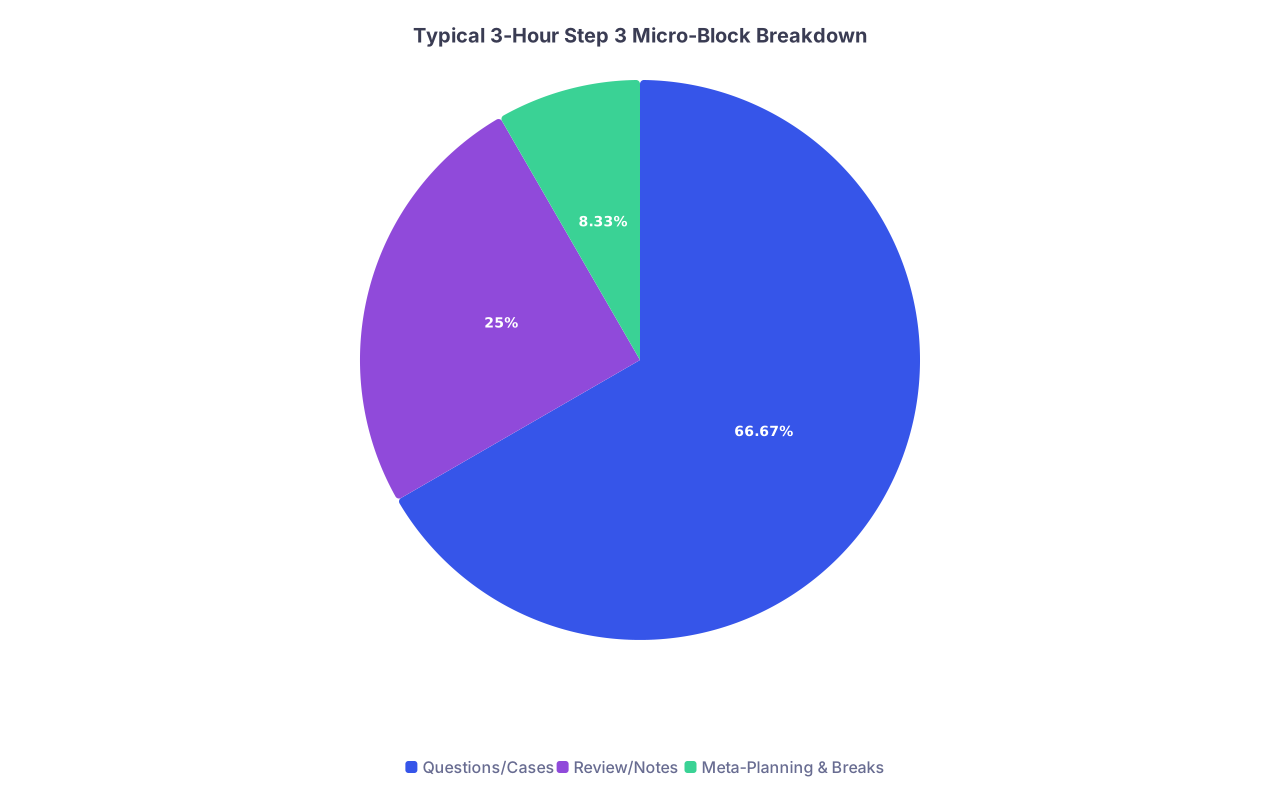
| Category | Value |
|---|---|
| Questions/Cases | 120 |
| Review/Notes | 45 |
| Meta-Planning & Breaks | 15 |
That is the template. Now let us get specific.
Step 1: Choose Your Block Type Intentionally
Do not sit down and “see what you feel like.” That is how people drift into mindless reading and call it studying.
Before the week starts, you decide:
- Which blocks will be MCQ-heavy
- Which will be CCS-focused
- Which (fewer) will be content/review
Block Type A: MCQ Engine (UWorld / NBME-style)
Use this for the majority of your blocks, especially early.
Structure:
Phase 1 – Timed Block (60–75 minutes)
- 20–25 questions, timed, mixed, on UWorld
- Highlight similar to real exam: 1 minute 15 seconds / question
- No pausing to review mid-block; just keep going
Phase 2 – Active Review (45–60 minutes)
For each question:- Read explanation
- Ask yourself:
- Did I miss the diagnosis or the management step?
- Did I fail due to knowledge, attention, or trick wording?
- Capture only:
- 1–2 actionable bullet points per missed question (max)
- Dump them into:
- A running “Step 3 Fix List” in Notion/Google Docs/Word
- Or a targeted Anki deck if you actually stick with Anki
Phase 3 – Pattern Lock-in (30 minutes)
- Quickly scan your Fix List from previous days
- For the current session, write down 3–5 patterns you want to never miss again. Example:
- “Unstable angina + ST depression + normal troponin = heparin + admit, NOT outpatient stress test.”
- “In pregnancy: avoid ACEi/ARBs, use labetalol/nifedipine/hydralazine.”
Run this type of block 3–5 times per week depending on your exam date and rotation intensity.
Block Type B: CCS Engine (Simulation Focus)
Most residents underestimate CCS. Then they get blindsided. Do not.
You will run CCS blocks differently depending on your familiarity.
Structure:
Phase 1 – Warmup Case (20–30 minutes)
- Do 1 interactive CCS case
- Focus on:
- Ordering basic initial orders correctly
- Not forgetting monitoring: vitals, IVF, NPO, pulse-ox
- Advancing time logically
Phase 2 – Focused Drills (60 minutes)
- Pick one theme per block:
- ER acute: chest pain, shortness of breath, trauma
- Outpatient: diabetes follow-up, HTN, depression
- Inpatient: sepsis, pneumonia, GI bleed
- Run 2–3 cases in that theme
- After each case:
- Ask: “What did I not order that I should have?”
- Write a mini-checklist per theme
- Pick one theme per block:
Phase 3 – Checklist Consolidation (30–40 minutes)
- Build or refine a short CCS order checklist by scenario type:
- ER chest pain initial orders
- Unstable vs stable GI bleed
- Suspected meningitis in child vs adult
- This should eventually become a 1–2 page CCS cheat sheet that you reread before every CCS session and before the exam.
- Build or refine a short CCS order checklist by scenario type:
Early on, do 2–3 CCS blocks per week. Closer to the exam, you can tilt more heavily toward CCS if MCQs are in decent shape.
Block Type C: Review / Repair (Light but important)
Reserve this for post‑call or days when your brain is half-functional.
Structure:
Phase 1 – Triage Weaknesses (20–30 minutes)
- Open your Fix List / wrong answers notebook
- Sort issues into 3 buckets:
- Core internal medicine (CHF, COPD, CKD, DM, sepsis)
- Bread-and-butter Step 3 “adulting” (preventive care, screening, ethics)
- Specialty edges (OB, peds, psych, derm, neuro nuance)
Phase 2 – Short, Targeted Content Hits (60–90 minutes)
For each weakness:- Read only what fixes that specific gap
- Good sources:
- UWorld explanations (still the best)
- Online MedEd clips for Step 2 topics that carry over
- A slim Step 3 review book (not 600 pages; that is a trap)
- Force yourself to write:
- A 1–2 line rule
- A representative example case
Phase 3 – Micro-Testing (30 minutes)
- Do 5–10 topic-specific questions (if available)
- Or mentally rehearse:
- “If they give me X scenario tomorrow, what would I do?”
These blocks are where your raw information gets turned into usable intuition.
Step 2: Weekly Scheduling that Survives Residency
This is the part where everything usually collapses: planning that ignores your call schedule.
You do it differently:
- Start with your actual schedule (nights, calls, clinics).
- Drop in 3–5 micro-blocks for the week.
- Label each block by type before the week starts.
Example: Heavy Inpatient Week (Q4 call, 6 days)
Let us say:
- 1 golden day off
- 1 post-call afternoon
- 4 regular long days (6:30 a.m. – 6 p.m.)
- 1 call day
You can realistically fit:
| Day | Time Slot | Block Type | Realistic Goal |
|---|---|---|---|
| Post-call | 2–5 p.m. | B (CCS) | 2–3 CCS cases, light checklist work |
| Weekday 1 | 8–10 p.m. | A (MCQ) | 20–25 UW questions + review |
| Weekday 3 | 8–10 p.m. | A (MCQ) | 20–25 UW questions + review |
| Day Off | 9 a.m.–12 p.m. | A (MCQ) | 30–40 UW questions + deeper review |
| Day Off | 1–4 p.m. (optional) | C (Review) | Fix List review + light content |
If you do nothing else but 3 MCQ blocks + 1 CCS block + 1 Review block per week for 6–8 weeks, you are already far ahead of most of your peers who “plan to binge study later.”
Example: Clinic Week (more humane)
More predictable schedule? Then push closer to 5–7 blocks/week:
- 3–4 MCQ blocks
- 2 CCS blocks
- 1 Review block
The pattern is the same. The volume changes.
Step 3: Phasing Your Preparation (6–8 Week Plan)
Let me lay this out in phases so you can see where you are and what to do next.
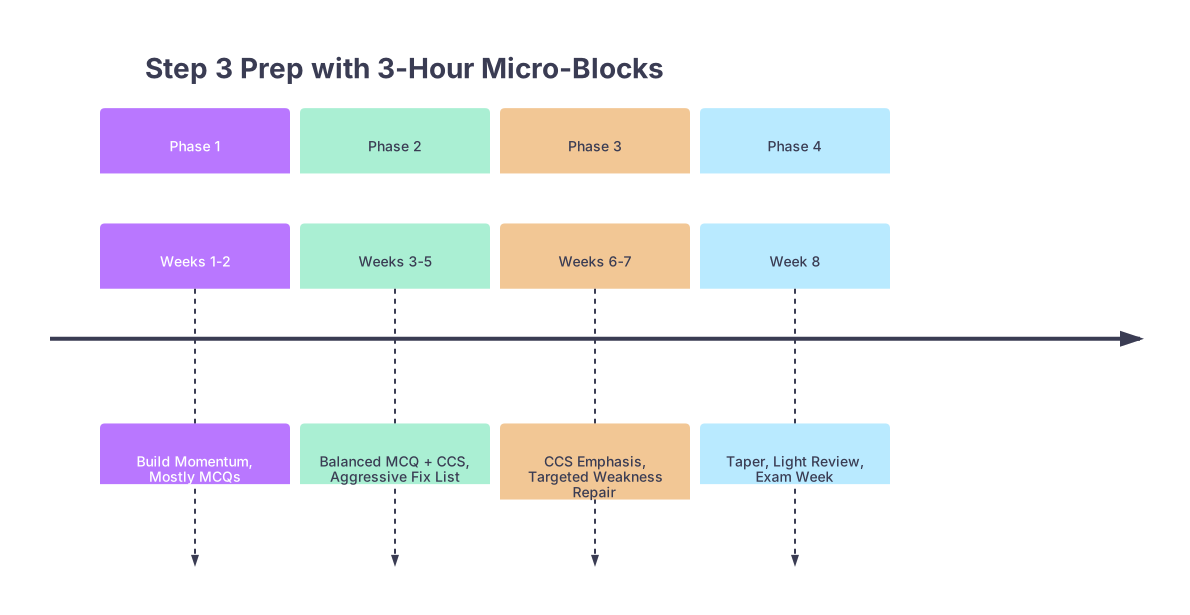
| Period | Event |
|---|---|
| Phase 1 - Weeks 1-2 | Build Momentum, Mostly MCQs |
| Phase 2 - Weeks 3-5 | Balanced MCQ + CCS, Aggressive Fix List |
| Phase 3 - Weeks 6-7 | CCS Emphasis, Targeted Weakness Repair |
| Phase 4 - Week 8 | Taper, Light Review, Exam Week |
Phase 1 (Weeks 1–2): Build the Habit, Not Heroics
Goal: Turn micro-blocks into a reflex.
- Target:
- 3 MCQ blocks/week
- 1 CCS block/week
- 1 light Review block if possible
- Focus:
- Getting used to timed 20–25 question blocks
- Starting your Fix List
- Learning the CCS interface without anxiety
Phase 2 (Weeks 3–5): Volume + Feedback
Goal: See a large chunk of UWorld. Start structural CCS learning.
- Target:
- 4 MCQ blocks/week
- 2 CCS blocks/week
- 1 Review block/week
- Focus:
- Mixed blocks (all systems)
- Aggressive pattern recognition:
- “Every time I see X, I miss Y.”
- CCS: build scenario-type checklists
Phase 3 (Weeks 6–7): Sharpen and Specialize
Goal: Shift focus toward CCS and persistent weaknesses.
- Target:
- 3 MCQ blocks/week
- 3 CCS blocks/week
- 1 Review block/week
- Focus:
- Timing and stamina on MCQs
- CCS: speed + completeness
- Weak areas:
- Preventive care schedules
- OB/peds management sequences
- Ethics/professionalism questions
Phase 4 (Week 8 / Exam Week): Taper and Tighten
Goal: Stop trying to “learn everything.” Lock what you already know.
- Target (depending on call days):
- 2 light MCQ blocks
- 2 CCS sessions
- Short daily Fix List review
- Focus:
- Rereading CCS checklists
- Quick hits of your weakest topics
- Sleep and circadian rhythm if you can manage it
Step 4: CCS – How to Get Good Without Wasting Hours
The biggest time sink I see is people doing CCS cases like they are Netflix episodes. Mindless, hours gone, nothing retained.
You are going to do it differently.
Build Scenario Buckets
Think in buckets like this:
- ER / unstable (immediate ABC, ICU/OR/telemetry decisions)
- Stable inpatient (diagnostic workup, ward orders)
- Outpatient adult (chronic disease management, screening)
- OB/GYN
- Peds
- Psych / neuro
For each bucket, you create:
Default Orders Pack
Example: ER chest pain- Cardiac monitor, pulse oximetry, IV access, O2
- EKG, troponin x2–3, CBC, CMP, CXR, aspirin, nitro (if not contraindicated), morphine for persistent pain, beta-blocker if indicated
- Admit vs discharge criteria
Red Flag / Must Not Miss Items
- Pregnant → avoid certain meds (ACEi, warfarin, etc.)
- Diabetic with infection → check for DKA / HHS
- Fever + stiff neck → do not delay abx excessively when meningitis suspected
Time Advancement Rules
- After initial orders: advance time 30–60 minutes to see effect
- After imaging/labs: advance time to results
- Stable clinic: advance weeks–months appropriately
During CCS blocks, you are not just finishing cases. You are iteratively building and refining these “packs.”
Use your 3-hour CCS blocks to run reps across buckets, not random scatter.
Step 5: Data, Not Vibes – Tracking Just Enough
You do not have time for a fancy spreadsheet with 20 variables. Track 3 things:
Percent correct by block (very rough)
- Just to make sure you are not stuck at 40–50% forever.
Top 3 failure reasons per week
- “Missing preventive care”
- “Forgetting next imaging step”
- “Weak in OB triage”
Cumulative Fix List (living document)
- One doc, continuously updated
- Group by system:
- Cards, Pulm, Renal, Endo, OB, Peds, Psych, Ethics, Preventive
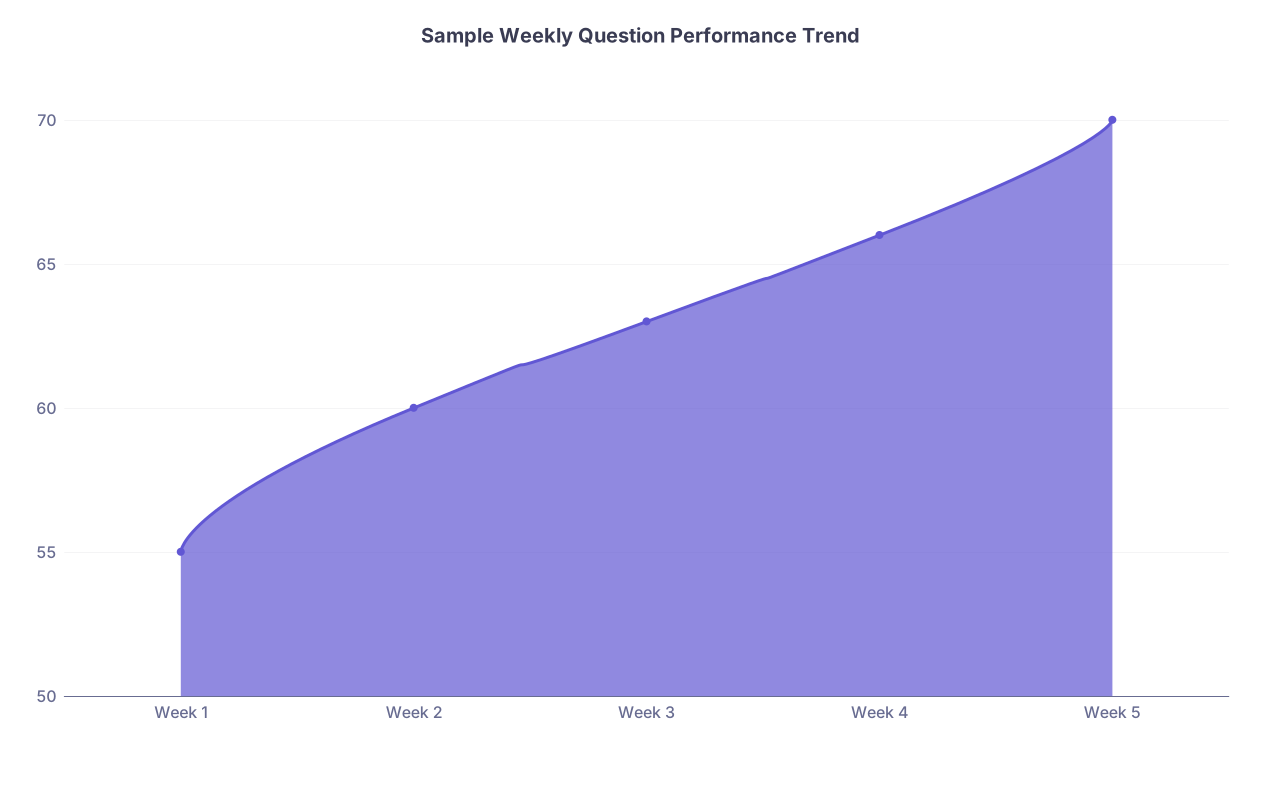
| Category | Value |
|---|---|
| Week 1 | 55 |
| Week 2 | 60 |
| Week 3 | 63 |
| Week 4 | 66 |
| Week 5 | 70 |
If your weekly trend is creeping up and your Fix List is shrinking in “new” items, you are on track. It does not need to look pretty.
Step 6: Matching Micro-Blocks to Your Energy States
Resident life is not just about time availability. It is about which version of your brain you have.
Here is how to match block types to your state:
| Energy State | Ideal Block Type | Example Time |
|---|---|---|
| Sharp, rested | A (MCQ) | Morning on a day off |
| Medium, functional | B (CCS) | Post-call midday, quiet evening |
| Fried but awake | C (Review) | Late night, start of post-call day |
Do not force 25-question timed blocks post-call after a code-heavy night. That is how you burn out and quit the plan entirely.
Step 7: Mistakes Busy Residents Make (And Fixes)
I have watched this movie many times. Here is how it usually goes wrong—and what you do instead.
Mistake 1: “I’ll wait for an easier rotation to really start.”
Translation: “I will never start.”
Fix:
Commit to 2–3 micro-blocks per week no matter the rotation. Scale up or down, but never drop to zero.
Mistake 2: Binge-reading review books without questions
People love this because it feels productive and safe. Then the exam slaps them.
Fix:
Rule: No pure reading days.
Every 3-hour block:
- Either starts with questions
- Or is sandwiched: short reading after you have been burned by a question.
Mistake 3: Ignoring CCS until the last week
Classic. And destructive.
Fix:
Start CCS by Week 2.
Even if just 1 block/week. Build comfort with the interface and mental templates early.
Mistake 4: Over-tracking and over-planning
You can waste an hour color-coding your Anki tags. That hour could be a micro-block.
Fix:
One running Fix List. Rough weekly trend. That is it.
Step 8: The 48 Hours Before Each Step 3 Test Day
Step 3 is split. You must survive two big days, often separated by 1–3 days, while on service.
Treat each test day like a big OR case.
Two Days Before Day 1 (MCQs heavy)
- 1 light MCQ block (15–20 questions, untimed, just to keep your head in it)
- 30–45 minutes scanning:
- Fix List highlights
- Preventive care tables
- USMLE’s official sample questions if you have not looked at them
Night Before Day 1
- No full blocks. Stop around 7–8 p.m.
- Confirm logistics:
- ID, test center location, snacks, caffeine plan
- Sleep. Non-negotiable.
Between Day 1 and Day 2 (CCS heavy)
If there is a gap:
- 1–2 short CCS tune-up sessions (30–45 minutes each)
- Run through your CCS checklists
- Maybe do 1–2 practice cases
- No long MCQ blocks. Your brain does not need more random noise.
Night Before Day 2
- Quick read of CCS checklists
- Visualize a few core scenarios:
- Sepsis
- Chest pain
- COPD exacerbation
- Pregnancy + bleeding
- Pediatric fever
- Sleep again. Under-sleeping wrecks performance more than missing 20 extra questions of prep.
Sample 10-Day Snapshot: On a Realistic Rotation
Let me show you what this looks like for a PGY‑1 on wards with Step 3 in 3 weeks.

| Step | Description |
|---|---|
| Step 1 | Day 1 Post-call |
| Step 2 | Block B: CCS 2-5 p.m. |
| Step 3 | Day 2 Long Day |
| Step 4 | Block A: MCQ 8-10 p.m. |
| Step 5 | Day 3 Long Day |
| Step 6 | No Block - Rest |
| Step 7 | Day 4 Clinic |
| Step 8 | Block A: MCQ 7-10 p.m. |
| Step 9 | Day 5 Long Day |
| Step 10 | Block C: Review 8-9:30 p.m. |
| Step 11 | Day 6 Call |
| Step 12 | Day 7 Post-call |
| Step 13 | Block B: CCS 2-4 p.m. |
| Step 14 | Day 8 Day Off |
| Step 15 | Block A: MCQ 9-12 |
| Step 16 | Block C: Review 2-4 |
| Step 17 | Day 9 Long Day - No Block |
| Step 18 | Day 10 Clinic - Block A 7-10 p.m. |
Notice:
- Some days: no studying at all. That is fine.
- Post-call: CCS or Review, not heavy MCQ.
- Day off: double block, but still within a structured plan.
This is sustainable. That is why it works.
FAQs
1. How many total UWorld questions should I aim for before Step 3?
If you are a busy resident, 2,000–2,400 questions (one full pass of the main Step 3 QBank) is a solid, realistic target.
You do not need 2.5 complete passes. I would rather see:
- One thoughtful pass with consistent review
- Plus strong CCS practice
- Plus a living Fix List
than some half-finished second pass where you barely review explanations.
2. What if my baseline scores are low and I only have 4–5 weeks?
Then your plan is simple: you compress, but you do not abandon structure.
- 4–5 MCQ blocks per week, 1–2 CCS blocks
- Minimal content days; almost everything flows from questions and CCS
- Ruthless focus on:
- Internal medicine, cards, pulm, renal
- Preventive and outpatient management
- OB/peds bare essentials
You cannot fix everything. You focus on what USMLE leans on heavily and get those solid.
3. Is it worth using extra resources beyond UWorld and CCS cases?
For most residents: No, not many.
Core stack that actually gets used:
- UWorld Step 3 QBank
- Official USMLE CCS cases/practice software
- One light supplemental resource:
- Online MedEd videos (for weak Step 2 foundations)
- Or a slim Step 3 review book for quick lookups
Every extra book or QBank you add has a cost. It dilutes your attention and chews up your limited micro-blocks. Master one main QBank and CCS. Then, if you somehow have surplus time and energy, layer something else.
Key Takeaways:
- Treat Step 3 prep as a series of 3-hour micro-blocks, not mythical full study days.
- Assign each block a single role: MCQ, CCS, or Review—no multitasking, no drifting.
- Start now with a minimal, consistent weekly quota, then scale up when rotations allow.