
The way people say they treat residents who fail Step 3 is not how it actually works on service. The truth is colder, quieter, and mostly happens in side conversations you are not in the room for.
Let me walk you through what really happens behind closed doors when a resident fails Step 3, and how that failure actually changes the way attendings, co-residents, and leadership see you. Because it does. Not always permanently. But it does.
The Moment People Find Out (And Who Actually Knows)
The first myth: “No one will know unless I tell them.”
Wrong.
On most services, the moment a resident fails Step 3, at least these people know:
- Program director
- Associate PDs
- Chief residents
- Your faculty advisor or mentor (if assigned one)
- Often: chief of your home department’s residency education committee
And depending on how your program runs, one more critical person:
- The rotation scheduler
Here’s how it really plays out.
The NBME report or state medical board notification triggers an email to GME or the program office. You’re sent a short, boilerplate “Let’s meet to discuss next steps” message. That same morning, I’ve seen PDs walk into the chief’s office, close the door, and say a single sentence: “We lost one on Step 3.”
That launches a quiet triage conversation:
- Do we have to change their schedule?
- Are they safe for independent call?
- Are they at risk for not getting licensed on time?
- Do they have other red flags already?
Here’s the part nobody tells you: the failure doesn’t live in a vacuum. It gets interpreted in the context of your existing reputation.
If you’re already seen as:
- Reliable, smart, clinically sharp → the failure is framed as “bad test taker, life stress, fluke.”
- Disorganized, behind on notes, easily overwhelmed → the failure is seen as proof. “We knew it.”
Same exam result. Completely different narrative.
How Attendings Actually Talk About It

Attendings don’t send out emails: “Resident X failed Step 3, adjust expectations.” That’s not how this works.
What happens is more subtle.
Picture a standard mid-rotation precepting room: three attendings, one chief, coffee, half-open EPIC windows on their laptops. Someone brings up coverage for an upcoming senior night float block.
One attending: “What about [your name]?”
Chief: slight pause. Then a careful answer.
“They’re fine, but they just had some issues with Step 3. We’re working on it.”
That phrase—we’re working on it—is the coded signal. It does not end your career. But it shifts how some people categorize you:
From: “Strong resident I don’t think about twice.”
To: “Resident I should keep an eye on.”
I’ve heard versions of these exact lines:
- “They failed Step 3 but they’re solid on the wards. I’m not worried.”
- “They failed Step 3 and their notes are always late. That fits.”
- “They failed Step 3. I want them to present the next admission to me before staffing.”
For most attendings, the failure is a data point, not a verdict. But the ones who already doubted you? They suddenly feel validated.
Day-to-Day On Service: What Actually Changes
Here’s the honest breakdown of how your life on service shifts after a Step 3 fail. Not hypothetical. I’ve watched this happen over and over.
1. Trust on Call
The main question faculty and chiefs ask each other:
“Can this resident safely be on independent call or night float?”
If you were borderline before, the failure can push you into the “needs closer supervision” bucket.
Concrete changes I’ve seen:
- A resident who was supposed to start senior night float gets moved to a day-time elective “to study.”
- An attending who used to sign notes late in the evening starts logging in early to double-check your orders.
- Chiefs quietly pair you with a stronger co-resident on high-acuity rotations.
No one announces, “We don’t trust you anymore.” They just change who’s on what schedule.
2. How Much Rope You Get for Mistakes
Everyone makes mistakes on service. Orders missed, labs not followed up, sloppy notes.
For most residents with clean records, the first mistake gets this response:
“Ok, you’re overwhelmed, fix it, don’t do it again.”
When you’ve failed Step 3, the same mistake gets filtered through a different frame:
- “Is this a pattern of poor knowledge?”
- “Is this judgment, or just being rushed?”
- “Were they out late ‘studying’ or actually studying?”
I watched an attending say, almost word-for-word:
“If it were [top-performing resident], I wouldn’t care. But given the Step 3 thing, I’m more concerned this reflects their baseline.”
That’s the reputational reality: the benefit of the doubt shrinks.
3. How Your Clinical Reasoning Is Perceived
This is where it stings.
You could be making the same plans, the same presentations. Before the failure, your differential on a COPD exacerbation is “solid.” After the failure, the same differential can earn you:
“Let’s slow down—walk me through your thinking.”
That “walk me through your thinking” is both an educational gesture and an assessment. Some attendings will now probe more:
- “Why that antibiotic?”
- “What’s the evidence for that dose?”
- “What guideline are you using?”
To them, they’re just checking. To you, it feels like being under a microscope. Because in a way, you are.
How Chiefs and PDs Quietly Reclassify You
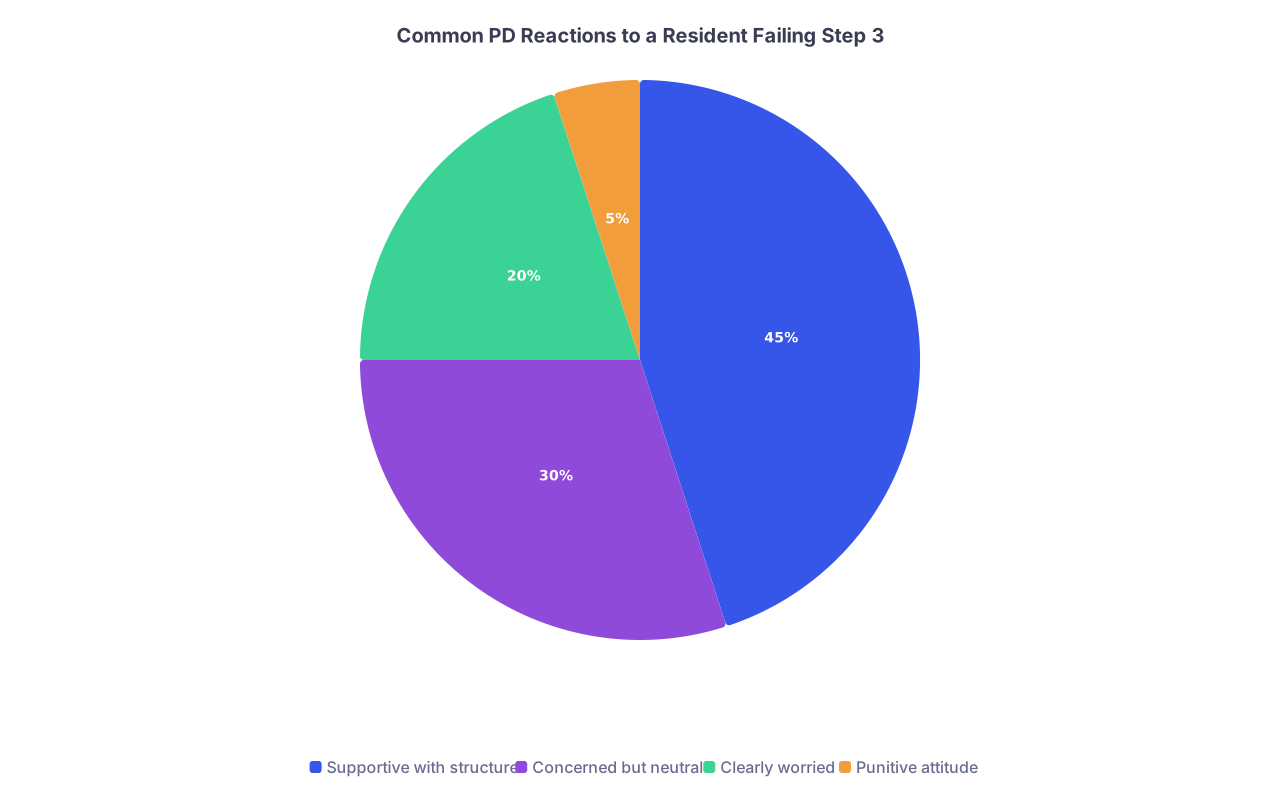
| Category | Value |
|---|---|
| Supportive with structure | 45 |
| Concerned but neutral | 30 |
| Clearly worried | 20 |
| Punitive attitude | 5 |
Chiefs and program directors don’t see a failed Step 3 and immediately think “problem resident.” They think:
“Is this a one-off, or is this another brick in a wall I already see forming?”
Here’s the internal classification system people rarely tell you about.
You get mentally sorted into one of four buckets:
The Fluke
Strong resident. Good feedback. Maybe some life stuff going on—family illness, breakup, new baby, depression, whatever.
The narrative becomes: “They’ll pass next time. We just need to support them.”The Chronic Underperformer
Already had marginal ITE scores, multiple “needs improvement” comments, slow notes, or professionalism dings.
The narrative: “This fits the pattern. This is a risk we have to manage.”The Test-Phobic but Clinically Fine
Very engaged, works hard, good with patients, gets good clinical comments, but repeatedly underperforms on standardized tests.
The narrative: “We need a test plan, but I’m not worried about them killing a patient.”The Wildcard
Inconsistent. Brilliant one day, spacey the next.
The narrative: “I don’t know what we’ll get on any given call night.”
Your real fight after failing Step 3 isn’t just to pass the exam. It’s to get yourself reclassified out of buckets 2 and 4 into bucket 1 or 3.
And the only way to do that? How you show up on service after the failure.
The Ugly Part: Gossip, Fair or Not

Residents talk. Of course they do.
The official line is: “This is confidential.” The real line is:
“If your co-resident disappears from call for an emergency meeting with the PD, people will notice.”
Common pattern I’ve seen:
- You mention to one friend you failed.
- They’re supportive, genuinely.
- They tell one more co-resident “so we can help cover” or “so we understand why they’re off elective.”
- By the end of the month, half your class knows.
Most of them do not care as much as you fear. They’re drowning in their own rotations and anxieties. What they do notice is how you act afterward.
Residents judge much more harshly on these:
- Are you suddenly using “I have to study for Step 3” as an excuse to dump work?
- Are you chronically late now because “I was doing UWorld last night”?
- Are you flakier on notes and pages?
If you combine a Step 3 failure + visibly lower work output on service, that’s when co-residents start resenting you. Not for failing. For shifting the burden.
I’ve seen almost no long-term stigma for someone who failed once, owned it, fixed it, and kept grinding on the wards.
I’ve seen a lot of quiet resentment for someone who failed, spiraled, and then started disappearing from the team under the banner of “studying.”
How Much This Hurts You Long-Term (Fellowship, Jobs, Licensing)
| Scenario | Typical Long-Term Impact |
|---|---|
| Single fail, quick pass next try | Minimal; often viewed as a blip |
| Fail twice, pass on third | Noticeable; red flag for competitive fellowships |
| Fail once + weak clinical evals | Significant concern for PDs and letter writers |
| Fail once, then strong ITE and evals | Usually reframed as “test fluke” |
| Never pass before graduation | Licensing delays, job offers at risk |
Here’s the brutal but accurate breakdown.
One Failure, Then a Pass
If you fail once and then pass Step 3 within 6–12 months, especially with a clear plan and no additional issues, the long-term stain on your reputation is small. For most PDs and future fellowship directors, it becomes a footnote.
When you’re applying for fellowship, the bigger red flag isn’t the failure. It’s the pattern:
- Did your In-Training Exam (ITE) scores improve afterward?
- Did your evaluations get stronger or weaker after the incident?
- Do your letters frame you as resilient and capable, or as someone who limped through?
I have sat in meetings where someone says, “They failed Step 3 once but crushed the ITE this year. Not worried.” That happens all the time.
Multiple Failures
Repeated failure is different. You get re-labeled as a risk.
Direct quote from a fellowship director I know:
“I can work with a resident who failed once and learned. Multiple fails suggest they’re not safe without a lot of hand-holding.”
That perception bleeds into:
- Concerns about board certification.
- Worries about state licensing in more restrictive states.
- Fear of you becoming the person they have to keep remediating once you’re hired.
If you’re gunning for competitive fellowships, a multi-fail story can be survivable—but only if your clinical performance is absolutely stellar and your narrative is airtight.
What Actually Helps Repair Your Reputation

| Step | Description |
|---|---|
| Step 1 | Fail Step 3 |
| Step 2 | Immediate Meeting with PD |
| Step 3 | Create Structured Study Plan |
| Step 4 | Be Hyper-Reliable on Service |
| Step 5 | Pass Step 3 on Retake |
| Step 6 | Seek Strong Clinical Evaluations |
| Step 7 | Address Failure Honestly in Future Conversations |
Reputation isn’t fixed by emails. It’s rebuilt shift by shift.
These are the moves that actually change how people see you.
1. The PD Meeting: How You Handle It Matters
PDs are not just checking content; they’re checking insight.
They’re listening for:
- Do you own the failure, or do you blame everything else?
- Do you have a concrete plan beyond “I’ll study more”?
- Are you panicking or thinking?
If you come in saying:
“I don’t know what happened; I just got unlucky,”
you look naïve.
If you come in with:
“I was doing question blocks but not reviewing explanations deeply. I left too much for the last month. I also was covering extra shifts. This is what I’m changing…”
now you sound like someone who can course-correct.
That meeting gets summarized—formally or informally—later. I’ve watched PDs tell faculty, “They were very reflective. I think they’ll be fine.” That sentence buys you back a lot of credibility.
2. Overcorrect on Reliability, Not on Drama
The instinct after a failure is to announce your crisis to everyone. Do not do that on service.
Colleagues don’t need your emotional processing; they need you to:
- Answer pages.
- Finish notes.
- Show up on time.
- Know your patients cold.
The best residents I’ve seen climb out of a Step 3 hole did something very simple:
They became boringly dependable.
No theatrics. No “woe is me.” Just:
- Always pre-rounding thoroughly.
- Having a clear plan and backup plan on every patient.
- Asking focused, high-yield questions that showed they were reading.
Within a month, the same attendings who muttered about the failure were saying, “They’ve really stepped up lately.”
3. Use the Exam Prep to Sharpen Your Clinical Game
The smartest play is to explicitly tie your Step 3 studying to better patient care.
That means:
- When you read a UWorld explanation about DKA management, you look at your actual DKA patient’s orders that day and tighten them up.
- When you review CHF medications, you scrub your list on rounds and suggest guideline-directed med changes.
Then, out loud but casually, you link it:
“I was reviewing some Step 3 questions last night on sepsis bundles, and I realized we should probably repeat a lactate on Mr. X.”
That single sentence sends a very specific signal:
“This failure is making me better, not worse.”
You’re turning a reputational liability into a visible asset.
The Licensing Clock No One Warned You About
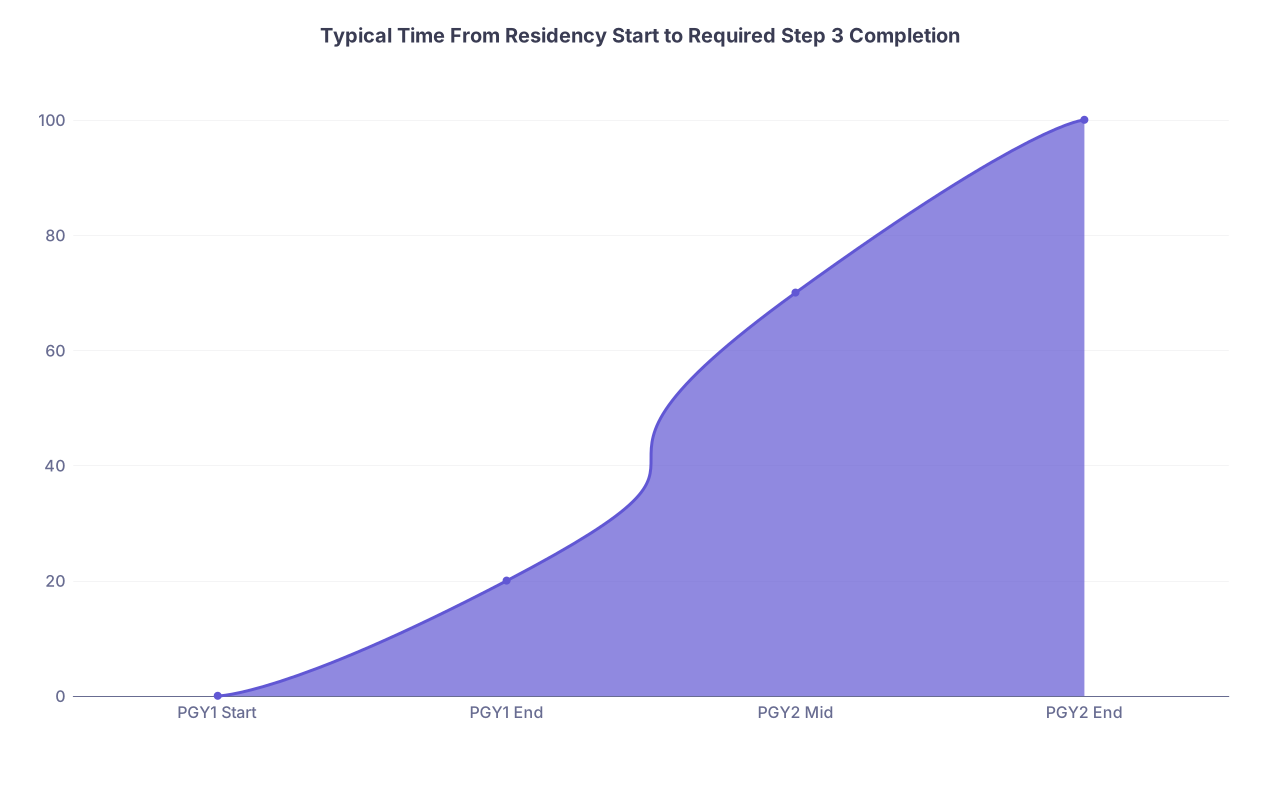
| Category | Value |
|---|---|
| PGY1 Start | 0 |
| PGY1 End | 20 |
| PGY2 Mid | 70 |
| PGY2 End | 100 |
Every program has a hard line, even if they never talked about it during orientation:
“Step 3 must be passed by X point in training.”
For many internal medicine and pediatrics programs, that’s by the end of PGY-2. For surgical specialties, sometimes even earlier, because of state licensing requirements and credentialing for moonlighting or senior responsibilities.
If you fail Step 3, that isn’t just a reputation hit. It starts the licensing clock ticking louder. Conversations you’re not in:
- “If they don’t pass by [date], they can’t get a training license renewed.”
- “We can’t schedule them as a supervising resident without this done.”
This is where residents get blindsided. They think it’s just an exam. The program sees it as a legal credentialing problem.
I have seen residents forced to delay graduation or blocked from moonlighting for a year because Step 3 dragged on. Those stories spread fast among faculty. They remember who cost them weeks of schedule rework.
How To Talk About It Later (Without Tanking Yourself)

Eventually you’ll sit in a fellowship or job interview and someone will ask:
“I see you had to retake Step 3. Tell me about that.”
They already know the score history. They’re not testing your memory. They’re testing three things:
- Ownership
- Insight
- Trajectory
The answer that helps you:
“I failed Step 3 the first time during a very heavy inpatient block when I didn’t structure my studying well. I changed my approach completely—daily smaller review blocks, question review with explanations, and I made sure my clinical duties stayed solid. I passed comfortably on the second attempt, and my in-training scores went up as well. The process forced me to tighten my study habits and I think it actually improved my clinical reasoning.”
Short. Clear. Shows growth. Ties back to performance.
The answer that quietly kills you:
“I don’t know, I’m just a bad test taker. I did my best.”
Nobody wants to hire “I don’t know.”
The Bottom Line: What Failing Step 3 Really Does
Let’s cut through the noise.
Failing Step 3 doesn’t automatically destroy your reputation on service. But it does three very real things:
- It shrinks your margin for error.
- It changes how uncertain attendings feel about you.
- It forces your program to think harder about your trajectory and licensing.
Your job isn’t to hide the failure. You can’t. Your job is to make every attending, chief, and co-resident quietly say the same thing a few months later:
“They failed Step 3 once, yeah. But they’re clearly solid now.”
If you want one simple framework to walk away with, it’s this:
- Own it clearly.
- Study smarter, not louder.
- Let your day-to-day work on service be the strongest argument that the exam was a temporary problem, not your permanent ceiling.