
The way most people “practice CCS” for Step 3 is lazy and ineffective. A few random cases the week before the exam, some frantic Googling of orders, and hoping the software isn’t too weird on test day. That’s how you leave points on the table.
You need a structured, week-by-week CCS plan that ramps up intensity and mirrors the actual exam. Not vibes. Not guesswork. A schedule.
Below is a 4‑week, week‑by‑week, then day‑by‑day CCS practice plan leading up to Step 3. If you’ve got more time, stretch it. If you’ve got less, compress the early weeks and keep the final 7–10 days intact.
I’m assuming:
- You’ve already started general Step 3 prep (MCQs)
- You’re within 4–6 weeks of your test date
- You have access to at least one CCS platform (NBME CCS cases, CCS Cases software, Archer CCS, etc.)
Overview: 4-Week CCS Structure
At this point, you should see the month before Step 3 in clear blocks:
| Week | Focus | Approx Cases |
|---|---|---|
| Week 4 | Orientation & Foundations | 8–10 |
| Week 3 | Bread-and-Butter Cases | 12–16 |
| Week 2 | Complexity & Speed | 16–20 |
| Week 1 | Simulation & Refinement | 18–24 |
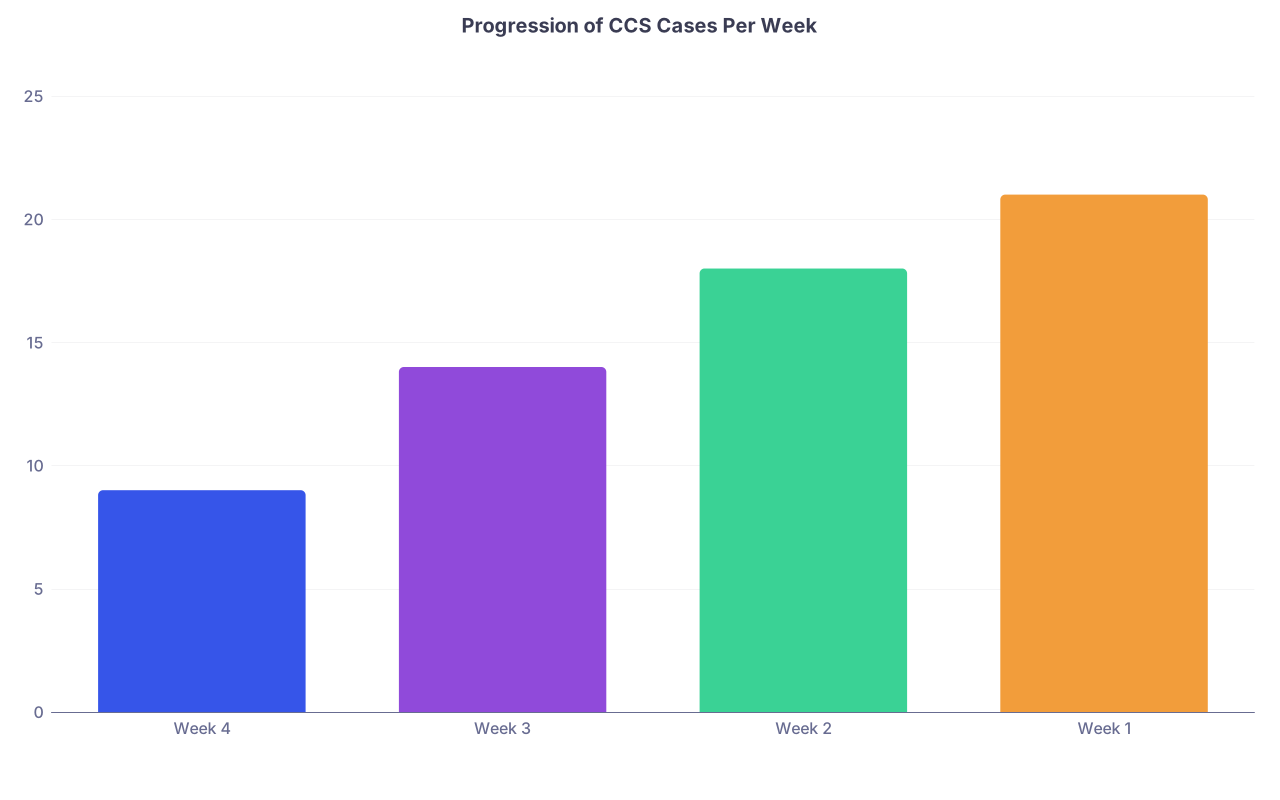
| Category | Value |
|---|---|
| Week 4 | 9 |
| Week 3 | 14 |
| Week 2 | 18 |
| Week 1 | 21 |
Your goals across the month:
- Early: Learn the software, build standard order sets, stop making rookie mistakes.
- Middle: Expand to more scenarios and start caring about speed and efficiency.
- Final: Full, exam-like CCS blocks + tight, repeatable routines.
Week 4 Before Step 3: Orientation & Foundations
At this point, you should stop ignoring CCS and treat it like a separate mini-exam.
Main goals this week
- Learn the CCS interface cold so nothing surprises you on test day.
- Build 3–5 reusable order templates in your head.
- Get comfortable moving the clock and changing settings (location, monitoring).
Target: 8–10 cases total, low intensity, high learning.
Early Week 4 (Days 1–2): Know the Software
You start with mechanics, not content.
Today or tomorrow:
- Log in to the official NBME Step 3 CCS practice (the free sample cases).
- Click around without caring about score:
- Where to admit (ED vs. floor vs. ICU vs. office).
- How to change time (advance clock, “Go to next available result,” etc.).
- How to order STAT vs routine.
- How to order nursing, diet, activity, consults.
- Where to enter your final diagnosis.
Run 2 sample cases start-to-finish, pausing frequently just to explore.
At this point your checklist is:
- I know how to open the order list and search quickly
- I know how to upgrade level of care (ED → ICU, etc.)
- I know how to order common monitoring (pulse ox, telemetry, etc.)
- I know how to advance time to see results
- I know where and how to discharge
If any of those are fuzzy, repeat 1–2 more practice cases just to drill the interface.
Mid Week 4 (Days 3–4): Build Your Core Templates
Now you start building core case patterns. You’re not chasing obscure zebra scenarios yet.
Focus on these 4–5 archetypes:
- Chest pain (possible ACS)
- Shortness of breath (COPD/asthma vs PE vs CHF)
- Abdominal pain (appendicitis, cholecystitis, pancreatitis)
- Fever/sepsis
- Uncomplicated clinic case (like new-onset diabetes, HTN, hypothyroidism)
Run 1–2 cases per archetype, slowly, with heavy pausing and reflection.
For each archetype, write a mini-template (paper or digital). For example:
Chest pain / ACS template (ED)
- Initial:
- Place on monitor, O2, IV access, pulse ox, BP cuff, cardiac monitor
- Focused exam + full vitals
- Immediate orders:
- EKG, cardiac enzymes, CXR, CBC, BMP, coags
- Aspirin, nitro if not hypotensive, morphine PRN pain, beta-blocker (if appropriate)
- Next steps:
- Admit to telemetry, serial troponins, repeat EKGs
- Cardiology consult, consider heparin, statin, ACEi if indicated
You don’t need a 3-page flowchart. You need a pattern in your brain so you aren’t reinventing the wheel when the timer is counting down.
By the end of Day 4 you should have:
- 4–5 written templates.
- Done 4–6 total cases.
Late Week 4 (Days 5–7): Clean Up Rookie Errors
Now you tighten basic habits.
Spend these days doing 1–2 cases per day, but with a post-case review ritual:
After each case, ask yourself:
- Did I stabilize ABCs quickly?
- Did I put the patient in the right location?
- Did I order fundamental tests? (CBC, BMP, pregnancy test if applicable, etc.)
- Did I remember basic nursing orders? (IVF, diet, activity, DVT prophylaxis, pain control)
- Did I advance time appropriately or leave results sitting?
Make a short list: “My top 5 misses so far.” That might look like:
- Forgot pregnancy test in reproductive-age female
- Didn’t order DVT prophylaxis on admitted patient
- Left patient in ED instead of admitting
- Didn’t advance time after initial orders
- Forgot to address pain and nausea
You’ll use this in future weeks.
Target by end of Week 4:
- 8–10 total cases completed
- Zero fear of the CCS interface
- 4–5 reusable case templates in your notes
Week 3 Before Step 3: Bread-and-Butter Expansion
At this point, you should move from “How do I click this?” to “How fast can I manage the common stuff?”
Main goals:
- Increase volume.
- Hit all the common exam scenarios.
- Start practicing some cases close to real speed.
Target: 12–16 cases this week.
Early Week 3 (Days 1–2): System-Based Focus
Pick 2 systems per day and do 2–3 cases per system. For example:
Day 1: Cardio + Pulm
- ACS, CHF exacerbation, atrial fibrillation
- COPD exacerbation, asthma attack, PE
Day 2: GI + ID
- Appendicitis, pancreatitis, GI bleed
- Pneumonia, pyelonephritis, meningitis, cellulitis
While doing these cases:
- Still allow yourself to pause and think.
- But begin timing how long it takes to put in an initial bundle of orders (aim for 2–4 minutes).
Mid Week 3 (Days 3–4): Add Outpatient and OB/Gyn
Step 3 loves outpatient and OB/Gyn. Ignore those and you’re asking for trouble.
Focus these days on:
- Outpatient:
- New diabetes, uncontrolled HTN, hypothyroid, depression, preventive visit (vaccines, screening)
- OB/Gyn:
- Prenatal care visit
- Vaginal bleeding in pregnancy
- Preeclampsia workup
- Ectopic vs threatened abortion
Do 3–4 cases per day, mixing inpatient and outpatient.
Specific at-this-point tasks:
- Make an OB template:
- Prenatal labs, Rh status, ultrasound, folate, prenatal vitamins
- BP checks, urine protein, fetal monitoring when appropriate
- Make a preventive care checklist:
- Vaccines by age
- Cancer screening (mammograms, colonoscopy, Pap smears)
- Smoking cessation, BMI counseling, etc.
Late Week 3 (Days 5–7): Mini-Blocks
Now you start training your brain for exam flow.
On two days this week, run mini-blocks:
- 3–4 CCS cases in a row
- Give yourself a short 5–10 min break between cases
- Don’t analyze until after you finish the mini-block
After each mini-block:
- Write down 2 things you did well and 2 things that slipped:
- Good: “Admitted quickly, remembered VTE prophylaxis.”
- Bad: “Forgot to counsel on smoking; didn’t change to NPO before surgery.”
By the end of Week 3, cumulative total:
- Around 20–25 CCS cases completed
- You’ve seen common inpatient, outpatient, and OB/Gyn at least once
Week 2 Before Step 3: Complexity & Speed
At this point, you should already be comfortable. Now you push: more complex cases, higher pace.
Main goals this week:
- Increase speed without losing thoroughness.
- Practice managing messy, multi-problem patients.
- Start to simulate near-real exam conditions.
Target: 16–20 cases during this week.
Early Week 2 (Days 1–2): Timed Runs
Two days in a row, run:
- 3 cases back-to-back
- Aim to finish each within the actual case time (usually 10 or 20 minutes on the exam, depending on practice source)
No pausing “to think” for 5 minutes. You move.
Focus case types:
- Shock/sepsis
- Diabetic emergencies (DKA, HHS)
- Neurologic: stroke, seizures, altered mental status
Right after each timed session:
- Review orders: Did you over-order labs? Miss something obvious?
- Pay attention to:
- Time until first critical order
- Time until you move to the right location (ICU vs floor vs ED)
Mid Week 2 (Days 3–4): Complex and Multisystem
Here you deal with the “train wreck” patients.
Case themes to prioritize:
- Elderly patient with multiple comorbidities
- Polytrauma / multi-injury scenarios
- Post-op complications (PE, wound infection, ileus)
- Psych cases (suicidal ideation, psychosis, withdrawal)
Do 3–4 cases per day. For at least one case daily:
- After you finish, replay the first 5 minutes mentally and ask:
- Could I have grouped orders better (panels instead of fishing tests one by one)?
- Did I forget comfort orders (pain, nausea, bowel regimen)?
- Did I handle safety (suicide precautions, sitter, restraints when appropriate)?
Late Week 2 (Days 5–7): Full Sim Blocks
Time to feel what exam fatigue plus CCS feels like.
Twice this weekend (e.g., Saturday and Sunday):
- Run a full CCS-style block:
- 4–6 cases in one sitting
- Use real timing per case
- No long breaks between them (just a couple of minutes)
You’re training:
- Mental stamina
- Fast pattern recognition
- Not spiraling if one case feels “bad”
After each block:
- Quickly mark cases in 3 categories:
- A: I’d be happy if this appeared on test day
- B: I survived but was sloppy
- C: I felt lost or slow
Next week, your focus will be cleaning up those B and C patterns.
By the end of Week 2, cumulative:
- ~35–40 total cases completed
- You’ve had at least 2 full simulated blocks
Week 1 (Final Week) Before Step 3: Simulation & Refinement
At this point, you should stop “learning CCS” and start performing CCS. New information is low priority; execution is high priority.
Main goals:
- Run exam-style CCS practice in realistic conditions.
- Refine your first-5-minutes routine.
- Fix your personal recurring mistakes.
Target: 18–24 cases total this week, front-loaded earlier, tapering right before exam.
Day-by-Day Breakdown
7 Days Before Exam (Day -7)
Run your first full CCS exam simulation:
- 2–3 hours
- 6–8 cases (depending on your platform)
- Realistic timing and minimal breaks
After the block:
- Do a structured debrief:
- List your top 3 strengths (e.g., “quick ABCs, good location choices, consistent prophylaxis”)
- List your top 3 weaknesses (e.g., “forget final counseling, slow with OB, underuse consults”)
Those six items drive the rest of your week.
6 Days Before Exam (Day -6)
Lighter day: 3–4 cases max, targeted.
Choose cases that:
- Directly hit your weaknesses from yesterday
- Include at least one outpatient and one OB/Gyn if those felt shaky
After each case, run a 30-second checklist:
- ABCs stabilized early?
- Appropriate monitoring and location?
- Essentials covered: diagnostics, treatment, prophylaxis, comfort?
- Time advanced logically?
- Final diagnosis and disposition clear?
5 Days Before Exam (Day -5)
Focus on speed and polish.
Do:
- 4–5 cases in one stretch (mini-block)
- Intentionally push your initial order entry speed:
- Try to get first full bundle of orders in by minute 2–3
You’re not cutting corners on quality; you’re trimming indecision.
If a case goes poorly, write one sentence summarizing the failure:
- “Spent too long debating CT vs US.”
- “Forgot pregnancy test and got burned.”
- “Didn’t admit to ICU when clearly unstable.”
That sentence is more useful than a page of notes.
4 Days Before Exam (Day -4)
This is your last heavy CCS day.
Plan:
- One near-full block: 5–7 cases in a row
- Then stop. No extra “just one more.”
Post-block, do a macro review of your whole CCS prep:
- Where were you Week 4 vs now?
- What mistakes are gone?
- Which 1–2 still show up under fatigue?
Create a 1-page CCS cheat sheet (handwritten is ideal):
- Top 5 templates (ACS, sepsis, DKA, prenatals, outpatient chronic)
- Common labs/monitoring you always want
- High-yield “never forget” items (pregnancy test, DVT prophylaxis, suicide precautions, NPO before surgery, etc.)
This will be your mental anchor.
3 Days Before Exam (Day -3)
Volume comes down. Precision goes up.
Do:
- 3–4 cases, all targeted at your weak patterns
- One case should be something you haven’t seen recently (e.g., pediatric fever, asthma, epilepsy)
Then:
- Review your 1-page CCS sheet
- Mentally rehearse the first 5 minutes of 3–4 archetypal cases without opening the software:
- “Patient with chest pain walks into ED, I click… then order… then admit…”
2 Days Before Exam (Day -2)
This is not the day to grind 10 cases. You’re in “light, confident rehearsal” mode.
Do:
- 2–3 cases max, preferably easy-to-moderate difficulty
- Focus on clean execution, not challenge
Then close the software and:
- Read through prior case notes / error lists briefly
- Revisit your OB, outpatient, and preventive care mental frameworks
Stop CCS work by early evening.
1 Day Before Exam (Day -1)
No full cases.
At this point, you should:
- Skim your 1-page CCS sheet once.
- Maybe briefly walk through 1–2 cases in your head without touching a computer.
- Confirm you remember:
- How to move time
- How to admit/discharge
- How to order nursing/monitoring
Then you rest. Real rest, not “let me just open one more case.”
Morning Of Exam (Specific CCS Habits)
On test day, when a CCS case starts, your brain should automatically run this script:
Stabilize and orient (first 30–60 seconds)
- Check vitals, appearance, mental status.
- Move to appropriate setting (ED, ICU, floor, office).
- Order immediate ABC support if needed (O2, IV lines, monitor).
Initial bundle orders (next 1–3 minutes)
- Focused H&P.
- Core labs + imaging appropriate to complaint.
- Nursing orders, diet, activity, pain/nausea, DVT prophylaxis if inpatient.
Advance time wisely
- Don’t just sit there. Move time to when tests come back.
- Reassess vitals, adjust treatment, re-check labs as needed.
Close the loop
- When stable and treated: disposition (discharge vs admit vs ICU)
- Final diagnosis document
- Counseling and follow-up if outpatient or discharge
You’ve rehearsed all of this already if you stuck to the plan.
If You Have Less Than 4 Weeks
Quick note: If you’re reading this and your exam is in 2 weeks, don’t panic. Compress:
- Combine Week 4 + Week 3 into 4–5 days:
- 2 days of interface + templates
- 3 days of core bread-and-butter
- Use remaining 9–10 days to follow Week 2 + Week 1 schedule, but trim volume by ~20–30%.
The non-negotiables:
- Interface familiarity
- 3–5 core templates
- At least two exam-like CCS blocks before test day
Visual: Your 4-Week CCS Timeline
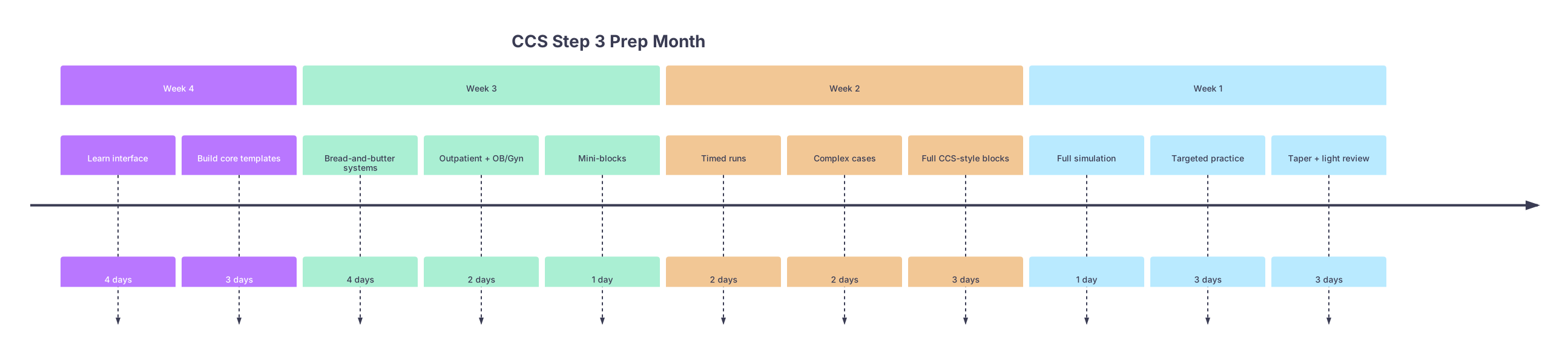
| Period | Event |
|---|---|
| Week 4 - Learn interface | 4 days |
| Week 4 - Build core templates | 3 days |
| Week 3 - Bread-and-butter systems | 4 days |
| Week 3 - Outpatient + OB/Gyn | 2 days |
| Week 3 - Mini-blocks | 1 day |
| Week 2 - Timed runs | 2 days |
| Week 2 - Complex cases | 2 days |
| Week 2 - Full CCS-style blocks | 3 days |
| Week 1 - Full simulation | 1 day |
| Week 1 - Targeted practice | 3 days |
| Week 1 - Taper + light review | 3 days |
Quick Comparison: “Random Practice” vs This Plan
| Approach | Volume | Realistic Blocks | Template Use |
|---|---|---|---|
| Random | 10–15 | Rare | Inconsistent |
| Last-minute cram | 5–8 | None | Weak |
| Structured 4-week | 40–60 | Multiple | Strong |
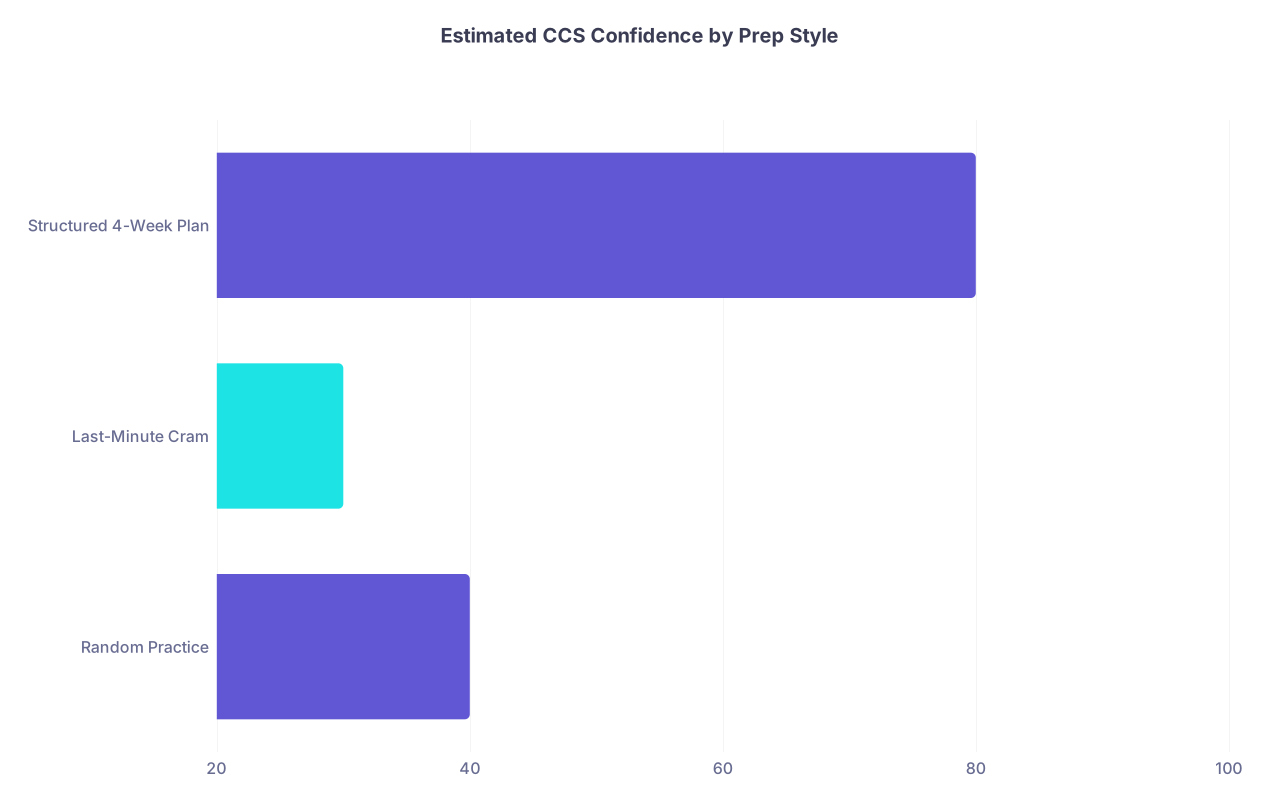
| Category | Value |
|---|---|
| Random Practice | 40 |
| Last-Minute Cram | 30 |
| Structured 4-Week Plan | 80 |
Today, don’t “research more resources.” Don’t reorganize your Notion board. Just schedule your first CCS block: open your calendar, pick two hours in the next 48 hours, and block it off as “CCS – interface + 2 sample cases.” Then show up to that session and start your Week 4 plan.