
The worst Step 3 and COMLEX Level 3 mistake is simple: taking them “whenever I get around to it.”
If you treat these exams as afterthoughts, they will wreck your intern year. If you time them strategically, they become paperwork. Your choice.
Below is a concrete, time-stamped roadmap from late MS4 through early PGY2: when you should schedule Step 3 and Level 3, how to align them with rotations, and what to do each month and week so you are not cramming at 2 a.m. on a Q4 call schedule.
Big-Picture Timing: When These Exams Should Happen
Let us start with the end points. Programs, licensing boards, and reality put guardrails on you.
| Exam | Recommended Window | Absolute Latest Commonly Accepted | Ideal Goal |
|---|---|---|---|
| USMLE Step 3 | PGY1 mid-year to early PGY2 | Before start of PGY3 | PGY1 months 6–10 |
| COMLEX Level 3 | PGY1 mid-year to early PGY2 | Before full independent practice | PGY1 months 5–10 |
Reality check:
- Many residency contracts or promotion policies expect Step 3 / Level 3 passed by end of PGY2.
- Competitive subspecialties and fellowships strongly prefer these done by early PGY2.
- Some states require Step 3/Level 3 for an unrestricted license earlier than you expect.
So the core principle:
Take Step 3 / Level 3 once you have 4–6 months of real inpatient experience, but before fellowship application season heats up (if relevant).
For most people that means: schedule the exam between December of PGY1 and September of PGY2. The roadmap below pushes you toward the earlier side of that range so the exams never hang over your head during fellowship apps or senior resident responsibilities.
Late MS4: Set the Foundation (6–12 Months Before Exam)
At this point you should not be “studying” for Step 3 or Level 3. You should be choosing your future exam window and building the conditions to make that window survivable.
6–12 Months Before Target Exam (Usually Late MS4)
You are still in medical school. You think you are done with standardized tests. You are not.
At this point you should:
Clarify requirements with your future program
- Email or ask at your second look:
- “By when do residents need to pass Step 3 / Level 3?”
- “Do we get dedicated days off for the exam?”
- “Any rotations better or worse for taking it?”
- I have seen programs where:
- Internal medicine: Expect Step 3 passed by end of PGY1.
- Surgery: “Strongly recommend” Step 3 by start of PGY2.
- FM/IM with osteopathic tracks: Expect Level 3 by mid-PGY2 at the latest.
- Email or ask at your second look:
Rough-in your ideal exam month
- You do not need an exact date, but you must choose:
- Option A: Late PGY1 (months 5–9) – my preferred.
- Option B: Very early PGY2 (months 13–15) – acceptable if PGY1 is brutal and your program is flexible.
- Write this down. Treat it as real.
- You do not need an exact date, but you must choose:
Preserve your test-taking skills
- You do not need question blocks daily, but:
- 1–2 mixed Step 2 CK-style blocks per week is enough to keep the muscles warm.
- For DO students, sprinkle some COMBANK/TrueLearn COMLEX-style items to remember how bizarre some stems can be.
- Use:
- UWorld Step 2 CK (or leftover Qs).
- Amboss mixed questions.
- Goal: Maintain stamina and clinical reasoning, not memorize content.
- You do not need question blocks daily, but:
Plan your MS4 schedule with intern year in mind
- Aim for sub-I’s in IM, surgery, or EM where you actually manage patients.
- Add an elective in critical care or wards-heavy IM if you feel weak. Step 3/Level 3 is mostly inpatient adult medicine disguised as a test.
- Avoid back-to-back fluff rotations that let your clinical brain go to sleep.
At this stage, the key is not grinding yet. It is avoiding the classic disaster: “My program needs Step 3 passed by June, I have no vacation until May, and I have not seen a UWorld question in 18 months.”
PGY1 Year Overview: When to Actually Schedule
Now we get specific. Intern year will not respect your study plans. So you build your exam timing around the schedule you can somewhat control.
Ideal Rotation Types for Exam Month
You want the exam during:
- An elective rotation (gold standard).
- A lighter ambulatory block (primary care clinic, consult-light month).
- A night float month if the days are free and the nights are predictable (some people like this; many regret it).
- Never during:
- ICU.
- Surgical nights.
- Q4 or Q5 28-hour call.
- A brand-new service you have never done.
At this point, assume your first 4–5 months of PGY1 are too early. You will still be learning to write notes, survive nights, and not drown.
So, the standard play:
Aim to schedule Step 3 / Level 3 for months 6–10 of PGY1, tied to a lighter month.
Month-by-Month: From PGY1 Start to Exam Day
Assume a July 1 PGY1 start. Adjust by a month if your start is different. Assume you are targeting a March exam (month 9 of PGY1) for concreteness. I will show how to adjust.
PGY1 Months 1–2 (July–August): Survival Mode, Not Exam Mode
At this point you should:
- Focus on becoming a competent intern:
- Learn to present efficiently.
- Learn to manage cross-cover issues.
- Do zero formal Step 3/Level 3 prep beyond:
- Occasionally reading UpToDate on real patients.
- Skimming a quick board-style explanation when you look something up.
If you have energy, once every week or two, do:
- One 10–20 question block of:
- UWorld Step 3 (for MDs).
- COMQUEST/TrueLearn Level 3 (for DOs).
- Timed, mixed, random mode.
But if you are barely sleeping, skip this. Competent intern > tired question zombie.
PGY1 Month 3 (September): Choose and Book Your Exam Window
This is where most residents screw up: they keep “waiting to see the schedule.” By then, all decent exam dates are gone.
At this point you should:
Look three to six months ahead at your rotation schedule
- Identify:
- Lightest month.
- Any elective or research block.
- Example:
- January: ICU (no).
- February: Wards (no).
- March: Ambulatory (yes).
- April: Elective (yes).
- Identify:
Pick an exam month and pencil in exact days
- For a 2-day Step 3:
- Ideal: Mon–Tue or Thu–Fri with a weekend buffer.
- For 1–2 days of Level 3 (depending on format in your state):
- Similar strategy: cluster days with at least one rest day before the first.
- For a 2-day Step 3:
Get program approval for those exam days
- Tell your chief / program coordinator:
- “I plan to take Step 3 March 10–11, during ambulatory. OK to request those days off?”
- Do this now, not two weeks before.
- Tell your chief / program coordinator:
Schedule the exam with the testing service
- Prometric and NBOME dates fill early.
- Do not assume you can test in your city unless you book early.
Your goal by the end of Month 3:
- Exam month chosen.
- Specific test days requested or approved.
- Seat reserved.
Now you have a fixed target. Good. You will work backward from this date.
PGY1 Months 4–5 (October–November): Light Warm-Up
You are 4–5 months from exam. You still do not need a full-on cram schedule, but now you start structured exposure.
At this point you should:
Start consistent but light questions
- Target: 80–120 questions per week.
- Break it down:
- 2–3 blocks of 40 Qs per week on less intense days.
- For MDs:
- UWorld Step 3 primary bank.
- For DOs:
- Split ~70% UWorld Step 3 + 30% COMLEX-specific (COMQUEST/TrueLearn).
Track weak systems
- Keep a short note on your phone:
- “Weak: OB triage, diabetes meds, psych side effects, pediatric rashes.”
- After each block, write 2–3 bullet reminders from missed questions.
- Keep a short note on your phone:
Use real patients as Step 3/Level 3 reps
- Every time you discharge someone:
- Ask yourself: “If this case showed up on Step 3/Level 3, what would they test?”
- VTE prophylaxis? Antibiotic choice? Disposition? Follow-up?
- Every time you discharge someone:
Time investment:
- 3–4 hours per week. Manageable.
The Final 3 Months Before the Exam
Now we get granular. Assume exam is in March (Month 9).
Month 6 Before Exam (December, Month 6 PGY1): Ramp Up
At this point you should:
Increase question volume
- Target: 120–160 questions per week:
- 3–4 blocks of 40.
- Still timed, mixed.
- Target: 120–160 questions per week:
Layer in a concise resource
- For Step 3:
- Consider Master the Boards Step 3 or First Aid Step 3 as a reference, not a cover-to-cover textbook.
- For Level 3:
- Use COMQUEST/TrueLearn explanations as your “textbook” plus OMT review resources.
- Spend 15–20 minutes each day with one system (e.g., OB in one week).
- For Step 3:
Start thinking about CCS (Step 3) / CDM (Level 3)
- Do not ignore the interactive cases.
- In December:
- Do 1–2 CCS cases per week (USMLE).
- Do 5–10 CDM-style cases (COMLEX) to get used to the interface and the annoying “Write orders / Justify diagnosis” format.
Month 7 Before Exam (January, Month 7 PGY1): Structured Plan
If you are on ICU in January, adjust volume downward. But the structure holds.
At this point you should:
Set a weekly minimum regardless of rotation
- Busy month:
- Minimum 80 questions/week.
- Light month:
- Aim for 160–200 questions/week.
- Busy month:
Finish at least 60–70% of your primary Qbank
- If you are far behind, you need to increase frequency on lighter weeks.
Add practice CCS / CDM sessions
- Step 3:
- 4–6 CCS cases this month, including at least one emergency case (chest pain, sepsis).
- Level 3:
- 2–3 sets of CDM cases, reading model answers carefully.
- Step 3:
Clarify exam logistics
- Confirm your time off is approved.
- Plan:
- Travel time.
- Where you will sleep.
- Your schedule the day before (try to have that day off or very light).
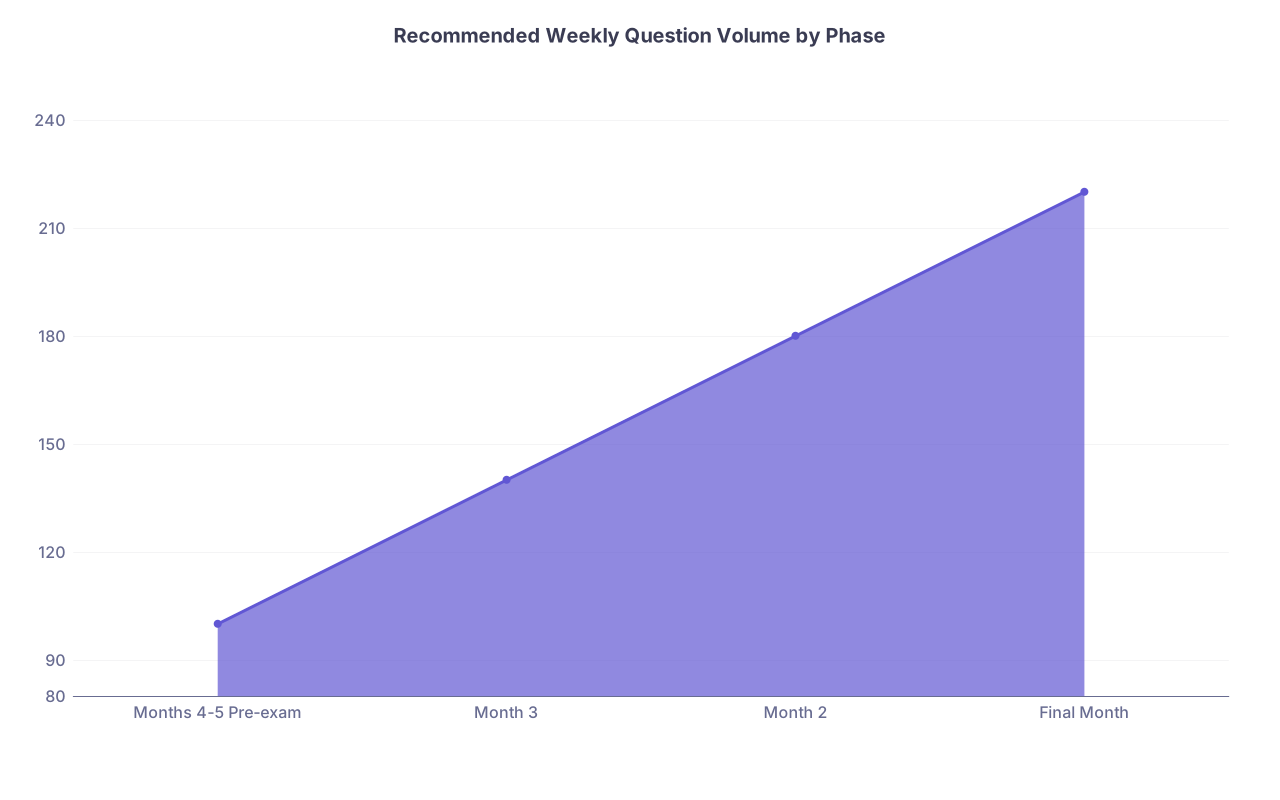
| Category | Value |
|---|---|
| Months 4-5 Pre-exam | 100 |
| Month 3 | 140 |
| Month 2 | 180 |
| Final Month | 220 |
Month 8 Before Exam (February, Month 8 PGY1): Full Push
You are now 4–6 weeks out. This is the true Step 3 / Level 3 study block, layered on top of intern life.
At this point you should:
Aim for near-daily questions
- Target: 180–220 questions per week.
- Pattern:
- 1 block (40) most weekdays.
- 2 blocks on 1 weekend day.
- Always timed, random, mixed.
Complete your primary Qbank
- Finish UWorld Step 3 or COMLEX bank at least 1–2 weeks before the exam.
- Do not rush explanations; skip “reading every word” if you already know it.
Simulate exam blocks
- At least two times this month:
- Do 3–4 blocks back-to-back with short breaks to mimic mental fatigue.
- Note when your brain crashes (block 2? block 3?) and adjust:
- Caffeine timing.
- Snack strategy.
- At least two times this month:
Focus CCS / CDM practice
- Step 3:
- Total goal by exam: 15–20 CCS cases, including a mix of inpatient, outpatient, and ER.
- Level 3:
- At least 40–60 CDM cases completed and reviewed.
- Step 3:
Tighten your weak spots
- Pick 2–3 systems where your percentages are lowest.
- Spend 3–4 focused hours per system:
- Guidelines.
- High-yield algorithms (e.g., chest pain workup, prenatal labs).
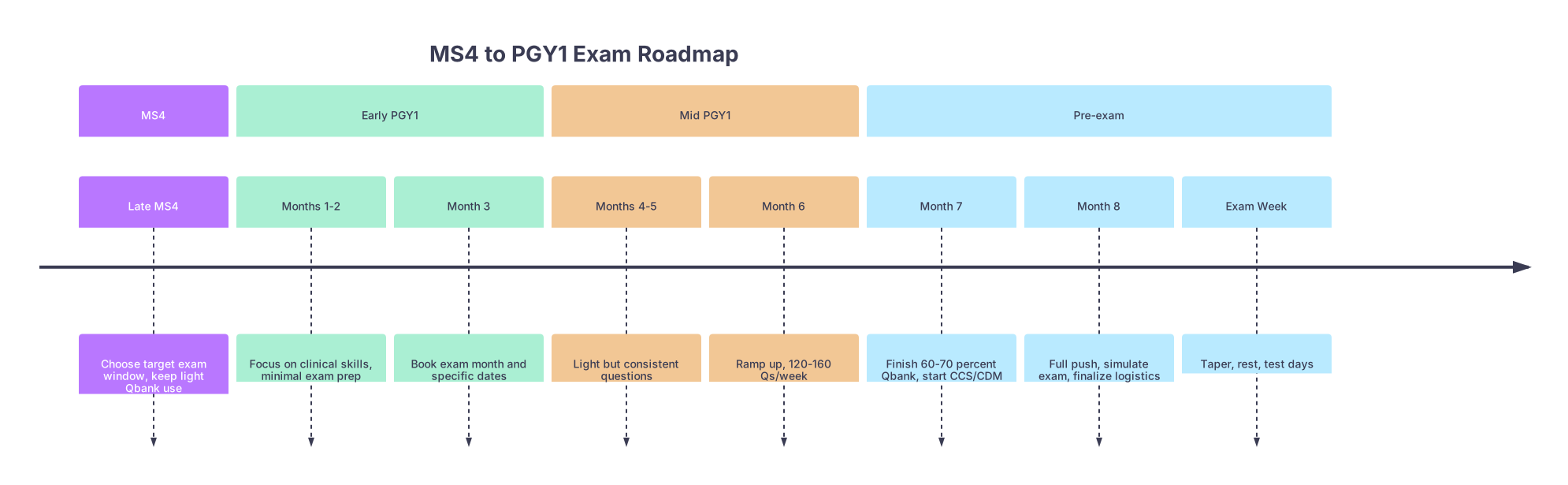
| Period | Event |
|---|---|
| MS4 - Late MS4 | Choose target exam window, keep light Qbank use |
| Early PGY1 - Months 1-2 | Focus on clinical skills, minimal exam prep |
| Early PGY1 - Month 3 | Book exam month and specific dates |
| Mid PGY1 - Months 4-5 | Light but consistent questions |
| Mid PGY1 - Month 6 | Ramp up, 120-160 Qs/week |
| Pre-exam - Month 7 | Finish 60-70 percent Qbank, start CCS/CDM |
| Pre-exam - Month 8 | Full push, simulate exam, finalize logistics |
| Pre-exam - Exam Week | Taper, rest, test days |
Final Month and Final 2 Weeks
Assume exam mid-March.
4 Weeks Out
At this point you should:
- Be finishing your first pass of Qbank.
- Be doing daily questions unless on brutal nights/ICU.
- Have done:
- At least one full-length simulation (multiple blocks).
- Multiple CCS/CDM sessions.
Add:
- Rapid review sessions:
- OB triage algorithms.
- Vaccines.
- Diabetes and HTN outpatient management.
- Antibiotic choices.
2 Weeks Out
Now you shift from building knowledge to sharpening and tapering.
At this point you should:
Cut volume slightly to protect sleep
- Aim: 100–140 questions per week.
- Focus only on:
- Missed questions.
- Weak categories.
- Stop obsessing about finite details like rare vasculitides.
Review CCS/CDM strategy, not just content
- For Step 3:
- Practice opening moves:
- Stabilize ABCs.
- Admit vs outpatient.
- Initial labs/imaging sets.
- Practice opening moves:
- For Level 3:
- How to phrase orders.
- When to choose “observe” vs “admit.”
- For Step 3:
Lock in logistics
- Confirm:
- Start time.
- Route to test center.
- What ID you need.
- Arrange to:
- Not be post-call the day before.
- Have post-exam recovery time (at least the evening).
- Confirm:
Final 3–4 Days
At this point you should:
- Stop new resources entirely.
- Do:
- Light question review (20–40 per day).
- High-yield cards or notes you already made.
- Go through:
- One organized recap of your biggest weaknesses.
Do not:
- Start a brand-new Qbank.
- Try to read an entire textbook.
- Pull a late-night cram session.
COMLEX Level 3 vs Step 3: Specific Tweaks for DOs
If you are dual applying or holding both exams, you need to be slightly more strategic.
If You Are DO Taking Only COMLEX Level 3
At this point (PGY1 planning) you should:
- Use UWorld Step 3 for:
- Clinical reasoning.
- Inpatient medicine strength.
- Use COMLEX-specific bank for:
- OMT.
- COMLEX-style vignettes.
- CDM format.
Issue I see repeatedly: DO residents ignore COMLEX format, then complain about time and CDM structure. Fix that by:
- Doing CDM practice at least weekly starting 8–10 weeks out.
- Specifically reviewing:
- OMT indications/contraindications.
- Classic Osteopathic manipulative treatment questions (I know, they feel ridiculous, but they are free points).
If You Are DO Taking Both Step 3 and Level 3
Brutal but doable. You must sequence intelligently.
At this point you should:
- Take Step 3 first, then Level 3:
- Step 3 content prep heavily overlaps.
- Level 3 then becomes a format and OMT adjustment.
- Recommended spacing:
- 4–8 weeks between exams.
- Example:
- Step 3 in January (Month 7).
- Level 3 in March (Month 9).
Allocation:
- 80–90% of prep: UWorld Step 3, general resources.
- Last 3–4 weeks before Level 3: heavy COMLEX bank + CDM + OMT.

What If You Fall Behind? PGY2 Recovery Plan
Life happens. Maybe PGY1 was all ICU, nights, and chaos. You hit PGY2 and still have no Step 3 / Level 3 date.
At this point (start of PGY2) you should:
Pick the earliest feasible 2–3 month window
- Look for:
- An elective.
- Lighter ambulatory months.
- Do not delay beyond Month 15–18 of residency unless absolutely forced.
- Look for:
Set a 10–12 week compressed plan
- Weeks 1–4:
- 80–120 questions/week.
- Rebuild baseline.
- Weeks 5–8:
- 160–220 questions/week.
- Finish Qbank.
- Weeks 9–10:
- Simulate exam, CCS/CDM heavy.
- Final 1–2 weeks:
- Taper, sharpen.
- Weeks 1–4:
Coordinate with fellowship timeline
- If you plan competitive fellowship:
- You absolutely want Step 3 / Level 3 done before ERAS submission.
- That means:
- Exam completed by August–September of PGY2.
- If you plan competitive fellowship:

Quick Snapshot: Minimal Viable Timeline
If you ignore everything else, this is the bare-bones, realistic sequence.
| Timepoint | Action |
|---|---|
| Late MS4 | Decide PGY1 vs early PGY2 exam window |
| PGY1 Month 3 | Book exam month and tentative dates |
| PGY1 Months 4–5 | 80–120 Qs/week, light prep |
| PGY1 Month 6 | 120–160 Qs/week, start CCS/CDM |
| PGY1 Month 7–8 | 160–220 Qs/week, finish Qbank, full sims |
| Final 2 Weeks pre-exam | Taper Qs, focus on weak spots + CCS/CDM |

Open your residency rotation schedule (or email your coordinator if you do not have it yet) and pick a real exam month today. Write it down, block those days tentatively, and then open your Qbank and do one mixed 40-question block—just to start the clock.