
The idea that you can “just power through night float and still crush Step 3” is fantasy-level delusion.
If you’re staring down a brutal night float block and a Step 3 date that suddenly looks insane… you’re not the problem. The plan was. And you’re not the first person to realize mid‑block that your whole schedule might be falling apart.
Let’s talk through the actual worst‑case scenarios you’re spiraling about—and what’s real, what’s exaggerated, and what’s fixable.
The Fear: Night Float Will Completely Nuke My Step 3 Prep
You’re probably thinking some version of:
- “I’ll be too exhausted to learn anything.”
- “Everyone else is doing 40–80 questions a day and I’m barely touching UWorld.”
- “If I move my exam, it will look bad to my program.”
- “If I don’t move it, I’ll fail or barely pass and screw myself for fellowship.”
And underneath all of that is the uglier thought:
“What if this is the moment I prove I’m not actually cut out for this?”
Let me be blunt: night float + Step 3 is one of those combos that sounds fine in January when you’re building the schedule spreadsheet, and then you hit week 1 and realize your brain feels like wet cardboard at 8 a.m.
You’re not weak. You’re sleep‑deprived.
Here’s what actually tends to break people’s Step 3 study plans on night float:
- Totally unrealistic question goals (like “I’ll just do 60 a day after sign‑out”).
- No honest adjustment for circadian whiplash.
- Guilt‑based studying: you sit in front of UWorld, mentally gone, clicking random answers, calling it “studying.”
- Refusing to move the date because of pride / fear of what people will think.
- Or the opposite: panic‑moving the exam 6 months for no reason.
The truth is somewhere in between. Night float will hurt your efficiency. It does not automatically ruin your Step 3 outcome unless you double down on a bad plan.
Step 3 Reality Check: How Much Prep Do You Actually Need?
You can’t even decide if night float is “ruining” your plan until you’re honest about what you really need to be ready.
Here’s the unsexy reality I’ve seen over and over:
- If you passed Step 1/2 comfortably (not by 1 point, not on your 3rd try),
- You’re in residency, seeing real patients,
- You’re not aiming for a 280, just a solid pass with a decent cushion,
…you do not need some mythical 3‑month, 3000‑question, 4‑hours‑a‑day boot camp.
Most people who feel “ruined” are comparing themselves to some fantasy schedule they found on Reddit from someone who:
- Was on an easy elective,
- Had golden weekends,
- And probably exaggerated how consistent they were anyway.
Let’s put some numbers on this so your brain has something concrete to cling to:
| Prep Style | Total QBank Questions | Time Frame | Daily Avg (realistic) |
|---|---|---|---|
| Light | 800–1200 | 4–6 weeks | 25–40 |
| Moderate | 1500–2000 | 4–8 weeks | 35–60 |
| Heavy (anxious) | 2000–2800+ | 6–10 weeks | 40–70 |
Notice something: the daily numbers aren’t that crazy. The real killer isn’t how many questions you need—it’s consistency and mental bandwidth.
Night float wrecks both. So you can’t pretend you’re on a cushy elective and expect it to work.
How Night Float Actually Breaks Your Brain (And What To Do Instead)
You already know you’re tired. That’s not news. The part that destroys Step 3 prep is the specific kind of tired you get on nights:
- You’re wired at 3 a.m., useless at 3 p.m.
- Your “days off” feel like jet lag recovery, not bonus study time.
- Your attention span is garbage. You re‑read the same explanation 4 times and retain nothing.
- Random: your mood tanks. Which makes you more likely to think “I’m dumb” instead of “I’m tired.”
Trying to cram a full “normal” study day into that state is like trying to run intervals on a broken ankle.
So what actually works on night float?
1. Drop the “big day” fantasy
You know the lie:
“I’ll just do almost nothing tonight, but this weekend I’ll do like 120 questions and really catch up.”
No you won’t. You’ll sleep until 2 p.m., stare at the wall, scroll your phone, maybe do 20 questions, hate yourself, and repeat.
Instead, swap “big days” for small, non‑negotiable chunks:
- 10–20 questions before your shift
- 10–20 questions right after sign‑out (if you’re not unsafe‑level tired)
That’s it. If you’re in survival mode, even 10 per day counts. The point is continuity, not heroics.
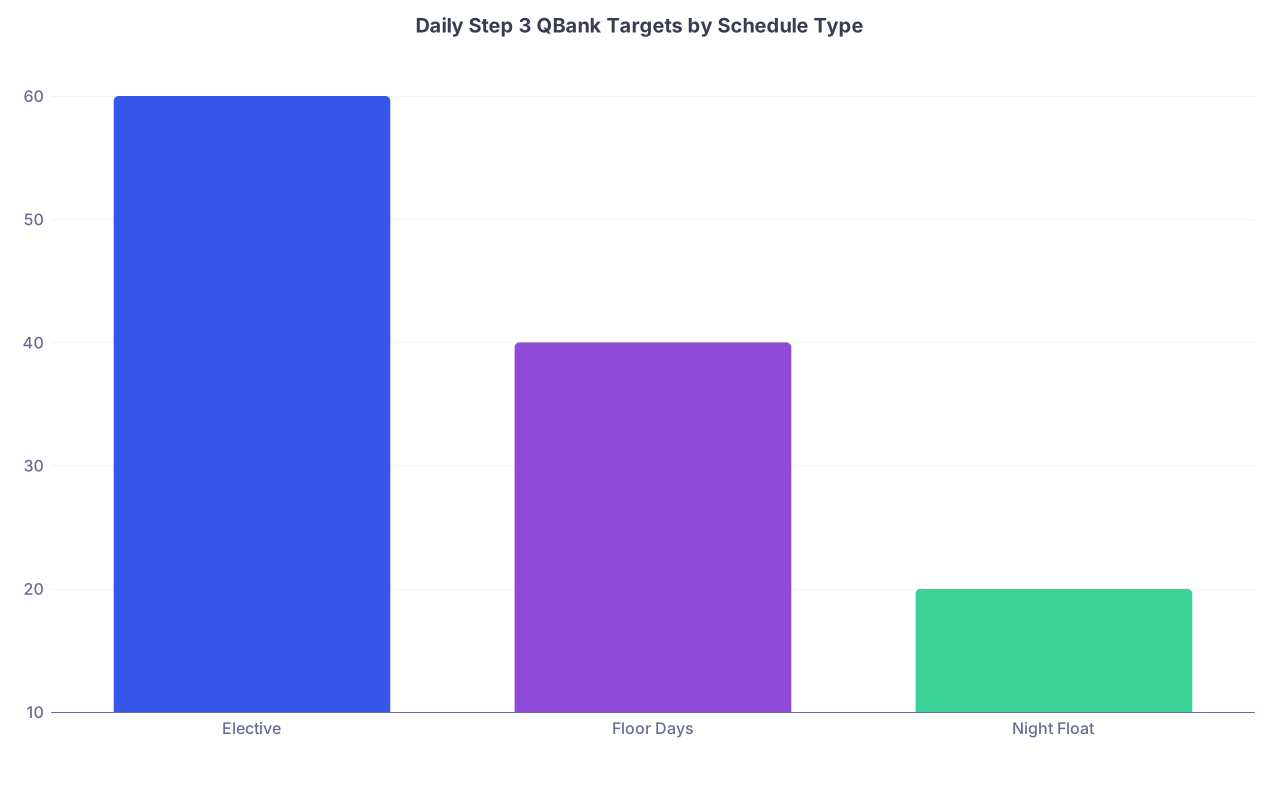
| Category | Value |
|---|---|
| Elective | 60 |
| Floor Days | 40 |
| Night Float | 20 |
2. Switch from “learning mode” to “maintenance mode”
On days or blocks when you’re fried, stop pretending you’re going to:
- Deeply review every explanation
- Make Anki cards for every subtle nuance
- Build comprehensive notes like it’s Step 1 again
Night float is not for building a knowledge empire. It’s for not losing ground.
Night float strategy:
- Do mixed questions in small sets (5–10 at a time).
- Focus on reading the question stem well and recognizing classic patterns.
- For explanations, pick 1–2 key points per question and move on.
- Flag things you keep missing; those become your “real study” topics when you’re back on days.
You’re basically telling your brain: “Don’t forget the big stuff; we’ll refine later.”
The Big Decision: Do I Move My Step 3 Date?
Here’s the thing that’s probably making you most anxious:
You’re mid‑block, your schedule is breaking, and you don’t know if you should reschedule.
You’re scared of both options:
- Keep the date → fail or barely pass
- Move the date → look flaky or irresponsible
Let’s get brutally practical. Ask yourself these questions, honestly:
- Have I completed at least ~40–50% of my main QBank with real effort, not zombie clicking?
- Do I have at least 7–10 relatively sane days left before the exam (including some post‑night‑float recovery)?
- When I do questions at my best time of day, am I scoring anywhere near passing range (usually somewhere in that high‑50s–60s raw % range on mixed sets)?
If:
- You’ve done almost nothing real,
- You’re still neck‑deep in night float the week before your date,
- Your scores are trash even when well rested,
Then yeah. Move it. That’s not “weak.” That’s just not gambling your license on a bad hand.
If instead:
- You’re halfway or more through UWorld or your main QBank,
- You have a week or two of non‑night‑float coming up,
- Your scores when awake are okay-ish,
You’re probably not as doomed as you feel.
Here’s a flow that might calm your brain a bit:

| Step | Description |
|---|---|
| Step 1 | On Night Float, Exam in 2-4 Weeks |
| Step 2 | Strongly Consider Rescheduling |
| Step 3 | Use Post-Nights Week for Heavy Review |
| Step 4 | Keep Date, Shift to Maintenance + Practice CCS |
| Step 5 | QBank >= 50% Done? |
| Step 6 | Still on Nights Right Before Exam? |
| Step 7 | Scores Near Passing When Rested? |
Programs see reschedules all the time. People get sick. Rotations shift. Life happens.
What does look bad is failing Step 3 because you tried to tough‑guy your way through an obviously terrible setup.
How To Salvage a Night Float–Destroyed Study Plan
Let’s assume the worst: you’re mid‑night‑float, your original “do 60 questions daily” dream is dead, and you’re behind.
Here’s how to rebuild without starting from zero.
Step 1: Accept a “patchwork” study schedule
Stop aiming for “perfect.” It’s gone. Instead, think in weeks, not days.
Build a rough map like:
- While still on nights: 10–25 questions/day, max. No guilt if some days are zero.
- First 2 days post‑nights: recovery + light review only (flashcards, reviewing marked questions, watching short vids).
- Remaining pre‑exam days: 40–80 questions/day, depending on how many remain and how wrecked you feel.
You might end up with a jagged pattern:
- Week 1 (nights): 80–120 total questions
- Week 2 (nights): 120–150 total
- Week 3 (post‑nights + days off): 250–350
- Final week: whatever’s left + CCS focus
Patchy. Imperfect. Still enough.
Step 2: Prioritize high‑yield over completeness
If you’re behind, you will not read every explanation in depth. Let it go.
Things to prioritize when time is tight:
- Bread‑and‑butter: diabetes, HTN, CHF, COPD, pneumonia, AFib, ACS, pregnancy basics, psych emergencies.
- Common inpatient questions you actually see every night on cross‑cover.
- Screening, vaccines, cancer workup, basic prevention guidelines (Step 3 loves this stuff).
- CCS practice—don’t skip this. A few focused sessions can move your score more than slogging through 200 extra random questions.
Shift from: “I must get through every single question”
To: “I must be sharp on the 60–70% of things they love to test.”

Step 3: CCS on night float? Do it strategically
You do not need to spend 3 hours a day on CCS while on nights. But a little bit goes a long way.
What actually helps:
- Do 1–2 cases at a time, no more, on a day you feel semi‑functional.
- Focus on “flow”: admit >> orders >> monitoring >> consults, not memorizing every possible test.
- Make a short checklist you glance at:
- Vitals, IV, O2, monitors
- Pain control
- NPO if needed, DVT prophylaxis
- Admit level (floor vs ICU)
- Early key tests/consults
You’re aiming for: “I know what to do next in a case,” not “I know every exotic workup by heart.”
Talking To Your Program If You Need To Move It
This is the part that makes people sick to their stomach:
Actually telling someone you want to move the exam.
You’re picturing your PD thinking: “Wow, this person can’t handle residency.”
Reality: most chiefs / PDs have seen people move Step 3 because:
- They got stuck on a brutal ICU block
- Family emergency
- Illness
- Or yes, night float wrecked them
The key is how you frame it. Something like:
“I had scheduled Step 3 for [date], assuming I’d be on a lighter rotation. I’m on night float this month and my study progress has been much slower than expected. I want to make sure I pass on the first attempt, so I’m planning to move it to [new time frame, preferably a lighter block]. I’m still actively studying, but I think I’ll perform better with a more stable schedule.”
That doesn’t sound flaky. That sounds like someone who understands risk management.
The only thing that tends to annoy programs is:
- Last‑minute chaos that screws up coverage, or
- Failing Step 3 because you insisted on taking it in an obviously bad window.
If you’re going to move it, do it before it becomes a disaster.
How To Not Completely Burn Out While You’re Doing All This
The worst version of this is:
- You’re on nights,
- You’re behind on Step 3,
- You’re sleep‑deprived,
- And then you add self‑loathing on top.
That combo will wreck you faster than the exam ever could.
Bare minimum survival rules:
- Protect core sleep. If you’re falling asleep during sign‑out, that’s dangerous. Step 3 can wait; patient safety can’t. If a study session will drop your sleep to 3–4 hours, skip it.
- Stop doom scrolling other people’s study schedules. They’re not on your rotation. Their context is not your context. You’re just feeding the anxiety monster.
- Redefine “success” on nights:
- Today’s win = 10 focused questions, or reviewing 1 block, or 1 CCS case.
- Not “I did 0, therefore I’m a failure.”
- Have a hard cutoff. If your eyes are burning and your brain is glitching, close the laptop. Zombie study doesn’t help your score; it just makes you hate studying more.
You’re not supposed to feel amazing right now. You’re supposed to feel tired and worried and a little behind. That’s the normal resident experience, not a sign you’re doomed.
FAQ: Night Float + Step 3 Panic Edition
1. What if I can only do like 10–15 questions per night on float—is that even worth it?
Yes. As long as you’re actually trying on those questions and not half‑asleep guessing. Think of it as keeping your brain in “test mode” so it isn’t shocked when you ramp up later. Ten real questions are better than 40 where you don’t read the stem.
2. Is it better to move my Step 3 and be “late” or risk a barely‑passing score?
One fail looks way worse than taking it later in PGY‑1 or early PGY‑2. A barely‑passing score isn’t ideal for super‑competitive fellowships, but a fail is a red flag. If you genuinely feel underprepared and your QBank performance backs that up, moving it is the safer path.
3. What if my co‑residents all did Step 3 during night float and “were fine”?
You don’t know what “fine” actually means. You don’t know their scores, how much they had done beforehand, or how miserable they felt. Comparing yourself to other people’s highlight reels is a fast track to nonsense decisions. Your sleep, your brain, your timeline.
4. I’m terrified that rescheduling will make my PD think I’m not resilient. Should I just push through?
Resilience isn’t “ignore reality and hope it works out.” It’s recognizing when a plan isn’t safe or smart and adjusting before it blows up. Framing it as wanting to ensure a first‑time pass and perform at your best is not a weakness. It’s judgment.
5. What if night float ruins my plan and I still don’t feel ready even after it’s over?
Then you adjust the plan again. Step 3 isn’t a one‑shot or bust. Tons of people re‑space their prep after bad rotations. The question isn’t “Did I stick to my original schedule?” It’s “Am I improving, and does my current performance suggest I can pass?” If the answer is no, you buy more time. That’s not failure; that’s course correction.
Bottom line?
- Night float absolutely wrecks perfect study plans; it does not automatically wreck your Step 3 chances.
- Small, consistent, realistic effort during nights + a smarter post‑nights push beats guilt‑driven fantasy schedules every time.
- Moving the exam when your prep is clearly not there is a sign of judgment, not weakness—and it’s far better than gambling on a fail.