
The fear around CCS is massively out of proportion to its actual power to destroy your Step 3 score.
Let me say that again, because I know your brain is already trying to argue with it: CCS is not the all-or-nothing, score-destroying monster people make it out to be. Important? Yes. Fatal if you’re average at it? Almost never.
You’re probably sitting there thinking some version of: “If I bomb CCS, do I fail Step 3?” or “I’m so slow with orders—what if my first case goes horribly and it tanks my whole exam?” I’ve heard all of that. I’ve thought all of that. And I’ve watched people with mediocre CCS performance still pass Step 3 comfortably.
Let’s actually break this down instead of spiraling.
How Much Does CCS Really Count Toward Your Step 3 Score?
Here’s the blunt truth: CCS matters, but it’s not 80% of your score, it’s not half, and it’s not the only thing they care about. Step 3 has two major components: the multiple-choice questions (MCQs) and the CCS cases.
The exact scoring weights aren’t officially published in a neat table by NBME, but across score reports, analysis, and way too many anxious debriefs, this is a realistic ballpark:
| Component | Approximate Weight |
|---|---|
| MCQ (Day 1 + Day 2) | ~60–70% |
| CCS Cases (Day 2) | ~30–40% |
So yeah, CCS is significant. You can’t ignore it and expect everything to be fine.
But here’s the key: “significant” is not the same as “if I screw one case, I’m done.” Your score is an aggregate. There’s no magical trapdoor that opens if you mismanage one simulated patient and drops you into the “fail” category.
What I keep seeing:
People who are:
- Decent on MCQs (say, equivalent of 215–225-ish Step 2 level)
- Just “okay” at CCS (not slick, not perfect, a bit clumsy)
…still pass Step 3. Repeatedly. With room to spare.
The people who get in real trouble with CCS are usually the ones who are already borderline on MCQs and then also completely neglect CCS or panic so much they freeze.
So the real question isn’t: “Can CCS single-handedly destroy me?”
It’s: “Am I decent enough on both parts that nothing becomes a catastrophe?”
Can You Fail Step 3 Just Because of CCS?
This is the nightmare scenario in everyone’s head: you’re fine on the test questions, then CCS goes badly, and suddenly you fail.
Let me be honest: yes, in theory, if you do very poorly on CCS—like missing key diagnoses, doing nothing for hours of simulated time, not ordering basic labs or imaging, not treating emergencies—you can absolutely drag your score down enough to fail. The system doesn’t care that you’re “actually a good doctor, just bad at computers.” It grades what you do in the case. Period.
But that’s the extreme.
Failing purely because of CCS is usually a combination problem:
- Weak or borderline MCQ performance
and - Very poor CCS performance (not just “non-ideal,” but “dangerous if real life”)
Where you are probably sitting is more like this:
“I’ll probably do okay on MCQs but I feel slow and awkward on CCS, and I’m scared that not being slick will sink me.”
That’s not how it works.
You don’t need to be elegant. You don’t need to perfectly maximize every case. You need to:
- Not miss life-threatening stuff
- Show that you can think through a plan
- Order reasonable tests and treatments in a somewhat logical sequence
- Move the clock when appropriate
If you do that, even imperfectly, CCS becomes a buffer more than a bomb.
I’ve seen people:
- Finish only 6–7 of the 9–12 cases “confidently”
- Completely mismanage one case early on
- Forget random specifics (like giving Rhogam, or some nuanced follow-up)
…and still pass.
Because the exam doesn’t say “you failed Case #3, so you fail Step 3.” It aggregates hundreds of decision points across all cases.
How CCS Performance and MCQs Actually Play Together
Think of Step 3 scoring like this:
You have two big buckets—MCQ and CCS. You don’t need to be amazing in both. You need to not be disastrous in either.
If your MCQ performance is strong, CCS can be just okay, and you’re still fine.
If your MCQ performance is borderline, you want CCS to be at least decent so it doesn’t pull you down.
Here’s a very rough mental model (not official numbers, but useful for sanity):
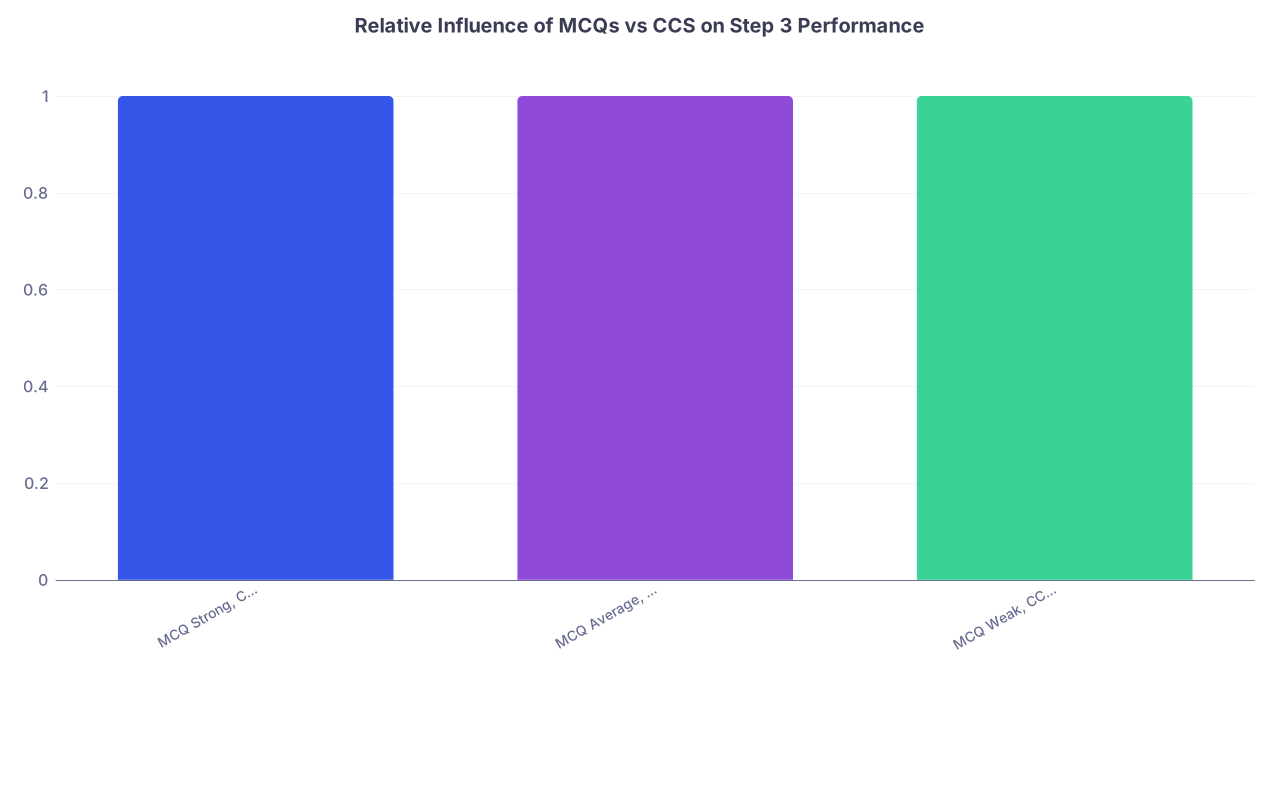
| Category | Value |
|---|---|
| MCQ Strong, CCS Weak | 1 |
| MCQ Average, CCS Average | 1 |
| MCQ Weak, CCS Strong | 1 |
All three of those patterns can pass.
The risky pattern is: MCQ weak + CCS weak.
Most terrified people are not actually in that last category. They’re just catastrophizing one part.
I’ve seen:
- Residents with ~220-ish Step 1/Step 2 equivalent
- Do almost no formal CCS prep, just a quick night of practicing the interface
- Walk out feeling like “I messed up half the cases”
- Still end up with a Step 3 in the low-to-mid 220s
Were they CCS superstars? No. But they did enough of the basics right.
What “Bad CCS” Actually Looks Like vs What You’re Imagining
Your brain is imagining failure like this:
“I didn’t order literally every test and consult in the universe; I stopped the case early; I must’ve failed it.”
That’s not “failure” in CCS terms. That’s normal.
True “bad CCS” looks more like:
- Not recognizing an emergency (e.g., chest pain and you don’t get an EKG or troponins)
- Not starting life-saving treatments (no oxygen, no fluids for shock, no antibiotics for sepsis)
- Ignoring obvious lab abnormalities
- Never moving the clock, so nothing gets followed up
- Ordering wild, irrelevant tests and missing the diagnosis entirely
What you’re probably doing is:
- Ordering stuff but not perfectly optimal
- Forgetting one or two recommended tests
- Being a little slow on moving the clock
- Over-ordering or under-ordering a bit
- Not sending the patient home with perfect counseling and follow-up tied in a bow
That’s… fine. Annoying, maybe. Not catastrophic.
CCS is graded in shades of gray. Partial credit. Weighted for priorities. You don’t get a 0 or 100. You get “you did some important things right, some suboptimal, some wrong” and it averages out.
How Much Practice Do You Actually Need for CCS?
Here’s where the anxiety spirals: “Do I need to run 100 cases? 200? All of them from every resource?”
No. You do not.
There are two separate skills with CCS:
- Clinical reasoning (what should I actually do for this patient?)
- Interface mechanics (how do I click, search, order, and move the clock efficiently?)
Most people reading this have enough baseline clinical reasoning to not be completely lost—even if you’re an intern or late MS4. Your real problem is almost always #2: you don’t know this clunky NBME interface, and that’s what makes you feel incompetent.
You don’t fix that by reading another list of “things to order in every case.”
You fix it by sitting down and actually using the damn software.
I’ve seen plenty of people pass comfortably after:
- Doing the official NBME practice CCS cases (the ones on the Step 3 site)
- Running maybe 10–20 total practice cases in a program like CCSCases, Archer, or UWorld’s interactive cases
Not 80. Not “every case in the bank twice.”
The goal isn’t to become a CCS ninja. It’s to become functional:
- You know where labs live
- You know how to admit vs discharge
- You know how to move time forward
- You know how to add orders as results come back
Once your hands know the interface, your brain can actually think.
What Actually Moves the Needle on CCS Score
If you’re terrified, focus on the few things that disproportionately matter. Don’t drown in minutiae.
The big-ticket items:
- Stabilize emergencies early. Airway, breathing, circulation. Oxygen, IV access, fluids, basic monitoring. Don’t be fancy; be safe.
- Don’t delay obvious tests. Chest pain? EKG and troponins. Abdominal pain? Labs, imaging as appropriate. Suspected pregnancy? Pregnancy test. You know this stuff.
- Move the clock. Constantly forgetting to pass time is a silent killer of your score. Order, then advance, then react.
- Place patients in the correct setting. ICU vs floor vs outpatient. If someone looks sick, don’t leave them in the clinic.
- Finish cases reasonably. If they’re better, discharge with some kind of follow-up and counseling. Don’t just abandon them in the hospital forever.
If you’re doing these basics—even imperfectly—you’re already miles away from the “absolute tank” category.
To visualize how a basic case should flow, something like this:

| Step | Description |
|---|---|
| Step 1 | Patient arrives |
| Step 2 | Assess ABCs |
| Step 3 | Initial orders & vitals |
| Step 4 | Decide setting: ED/ICU/Floor/Clinic |
| Step 5 | Order key labs/imaging |
| Step 6 | Advance time |
| Step 7 | Review results & adjust treatment |
| Step 8 | Advance time / reassess |
| Step 9 | Stable? |
| Step 10 | Discharge or follow-up |
You don’t have to do this perfectly. Just roughly follow this loop.
How Much Can Strong CCS Save a Weak MCQ Score?
Another thing people obsess over: “My MCQ performance is mediocre—can I use CCS to bail myself out?”
To a degree, yes.
If your MCQs are in the “barely passing” range, strong CCS can absolutely be the difference between pass and fail. I’ve seen this work both ways:
- Person A: decent MCQs, absolutely neglected CCS, panicked during the cases, failed by a hair
- Person B: borderline MCQs, took CCS seriously, practiced the interface, passed with a barely-above cutoff score
CCS is not some tiny extra. That ~30–40% chunk is enough to move you from fail to pass or from low pass to okay score.
But it’s not magic. You can’t be disastrously weak in MCQs and expect CCS to carry you. If you’re consistently bombing UWorld blocks at like 40–45%, CCS won’t magically turn a 165 into a passing score.
The realistic mental picture:
- CCS can rescue a borderline MCQ performance
- CCS can’t rescue a truly unprepared exam overall
So if you know you’re average-ish on MCQs, CCS is actually a very high-yield place to invest a few focused hours. The return on investment is big.
Common CCS Myths That Are Making You More Anxious Than You Need to Be
Let me just call out a few lies your brain (and random Reddit threads) might be feeding you.
Myth 1: “If I run out of time on a case, I failed that case.”
No. Many cases end early on purpose because you did what you needed. Other times you run out of the allotted time. That’s not an automatic fail; they look at what you did along the way. Did you manage the essentials? You still get credit.
Myth 2: “If I don’t get the exact final diagnosis, my score is ruined.”
You’re graded on management, not a single line with the exact right wording. If you treat presumed PE like PE, you’re fine even if you didn’t type the perfect phrasing in the diagnosis box.
Myth 3: “I need to know a memorized order set for every possible CCS topic.”
No. That’s a fantastic way to waste time and still feel incompetent. You need good habits (emergency stabilization, logical workup, escalation) more than copy-paste lists.
Myth 4: “Everyone else is great at CCS and I’m the only one struggling with the interface.”
Absolutely not. I’ve literally heard interns say after the exam, “I had no idea what I was doing on half the cases.” And they passed. You don’t see their panic posts afterward because once people pass, they shut up and move on.
A Sane, Minimal CCS Game Plan If You’re Already Spiraling
If you’re close to the exam and panicking, here’s the least you should do that still actually helps.
- Do every official NBME practice CCS case on the Step 3 site. Learn the interface there. Click things. Break things. This alone reduces like 50% of the anxiety.
- Run at least ~10–15 full CCS cases on some platform that mimics the real interface (UWorld’s interactive CCS, CCSCases, Archer — pick one and stop shopping).
- Write down a short, ugly checklist for emergencies:
- ABCs & vitals
- O2, IV, monitor, maybe pulse ox, CXR, EKG if chest or resp issue
- Basic labs (CBC, CMP, etc.)
- Move clock → reassess → adjust
- Skim through how to handle a few high-yield scenarios: chest pain, SOB, abdominal pain, sepsis, pregnancy issues, stroke. Not super deep. Just main workup + stabilization.
That’s it. That already puts you ahead of a scary percentage of people who barely touched CCS and still passed.
To visualize how just a modest amount of prep increases your odds, think of it like this:
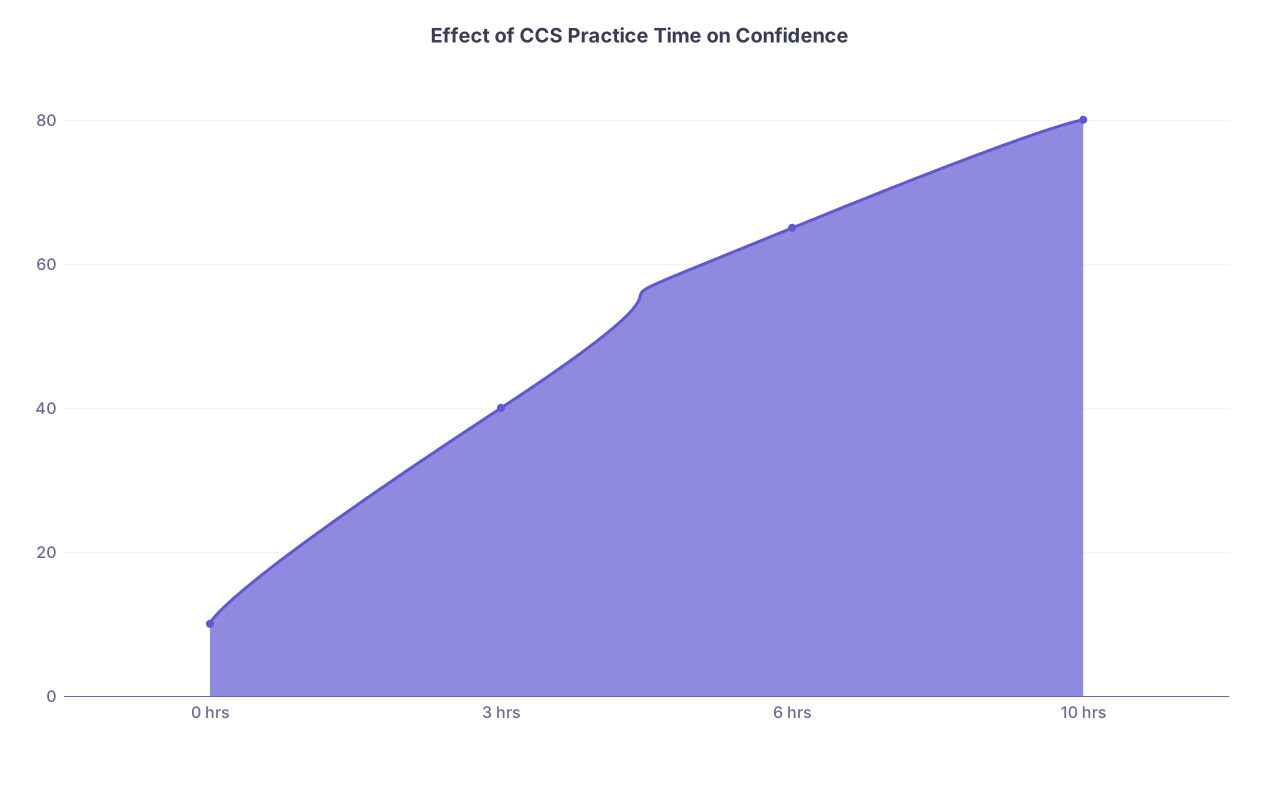
| Category | Value |
|---|---|
| 0 hrs | 10 |
| 3 hrs | 40 |
| 6 hrs | 65 |
| 10 hrs | 80 |
Is this exact? No. But the pattern’s real: a few hours of targeted practice moves you out of panic mode into “functional enough.”
What If You Truly Bomb a Few Cases?
Here’s the part no one tells you: almost everyone walks out believing they bombed at least some of the cases.
You will:
- Forget something obvious in one case
- Overreact and over-order stuff in another
- Miss a nuance like prophylaxis or a specific counseling point
The scoring system expects this. You are not being graded like a subspecialist. You’re being graded like a general physician who mostly knows what they’re doing and doesn’t kill people.
You don’t have to “win” every case. You have to avoid repeatedly making unsafe, negligent-level decisions across many cases.
Think of it like MCQs:
You don’t need 100%. You need comfortably over the bar.
A Quick Reality Check on Step 3 As a Whole
You’re giving CCS a level of terror that probably belongs to the entire exam, not this one segment.
Step 3 is:
- A pass/fail exam for licensing
- Not the primary gatekeeper for competitive fellowships
- Often taken during residency when your brain is already half-fried
Is it important? Yes. Failing is a headache, emotionally and logistically.
Is it the defining metric of your career? No.
Program directors lose sleep over residents who repeatedly fail Step 3. They do not lose sleep over “wow, they only got a 212 instead of a 230 because their CCS was clunky.”
If you’re preparing reasonably:
- UWorld MCQs (even 60–70% done is often enough)
- Some CCS practice
- A couple weeks of focused effort
You’re in the same boat as the majority of residents who pass this thing every single year feeling kind of inadequate.
Final Thoughts (Before Your Brain Starts Spiraling Again)
Let me condense all of this into something you can hold onto when your anxiety kicks back in at 2 a.m.:
- CCS is important but not all-powerful; it’s maybe 30–40% of your Step 3 score, not 100%.
- You don’t need to be perfect at CCS; you need to be safe, functional, and familiar with the interface. Clumsy but reasonable still passes.
- A few focused hours of practice on the real-style software plus solid MCQ prep is usually enough to get you over the line. You’re probably closer to “fine” than your brain will ever let you believe.