
The myth that “anything above 60% on UWorld guarantees you are fine for Step 3” is statistically lazy and often wrong.
If you want realistic benchmarks, you have to think like a data analyst, not like a group chat on r/medicalschool. Percent-correct alone is a blunt instrument. You need context: when, how, and on what cohort those percentages were generated. Only then can you connect Q‑bank performance to a plausible Step 3 score range.
Let’s go through this the way I would if we were looking at your real data on a screen together.
1. The core problem: “Percent correct” is a weak metric
Everyone loves to quote one number:
“I’m at 62% on UWorld. Am I safe?”
“I heard 55% is passing. True?”
The data does not support using any single percent-correct threshold as a guarantee. Here’s why.
Percent-correct is distorted by at least five major factors:
Timing in your prep
A 60% average earned during the first 30% of your questions, cold, is not the same as 60% after 2,000 questions when you are “finished.” Early percentages tend to be lower, then plateau or climb. Any correlation with score depends on where on that curve you are.Question bank difficulty and cohort
UWorld Step 3 is not equal to Amboss Step 3, which is not equal to random hospital-made questions. UWorld tends to be harder than the actual exam and is used by a strongly self-selected, relatively high-performing cohort. That skews averages down for percent-correct but up for eventual Step 3 performance.Learning vs measuring
If you use tutor mode, look things up while answering, or do mixed blocks of topics you just reviewed, your percent-correct is inflated. That turns your “benchmark” into a vanity metric.Case familiarity and repeat concepts
Long prep periods mean question concepts repeat. Your later blocks may be artificially higher because you have seen the pattern, not because your underlying ability jumped in a linear fashion.Selection bias in what you track
People post either disaster numbers or high numbers. Very few people with boring, mid-50s percentages and 208 Step 3 scores post their journey. That warps your mental model.
So if you want realistic benchmarks, you have to tie Q-bank data to something more stable: NBME-style or official practice scores, and you have to anchor them by cohort behavior, not anecdotes.
2. What the available data actually suggests
Let me state this clearly: there is no public, official, large-scale correlation table from NBME that says “X% on UWorld = Y Step 3 score”. Anyone who tells you there is, is bluffing.
What we do have:
- Rough correlations posted by UWorld for other exams (Step 1 and 2 CK) showing moderate-to-strong correlation between Q-bank performance and test scores (often r ≈ 0.6–0.7).
- Program-level observations and internal spreadsheets where residents track their own UWorld averages vs their final Step scores.
- Numerous self-reported score sequences that, while biased, cluster in consistent patterns.
When you clean away outliers and obvious nonsense, the data clusters around a few general rules for final, cumulative UWorld Step 3 percentages (timed, random, first pass):
- Mid‑40s → high risk for failing (<200), especially without strong practice test safety margins.
- Low 50s → borderline territory; some passes, some fails; exam performance heavily depends on prior Step history and reading.
- Mid‑50s → most people pass; many scores land in the 205–215 range, with some higher.
- Low 60s → relatively safe for passing; scores frequently 215–230.
- Mid‑60s+ → usually associated with 225+; 230+ becomes common; 240+ not rare if CCS is also strong.
That is not a guarantee for any single individual. It is a distribution.
To make that concrete:
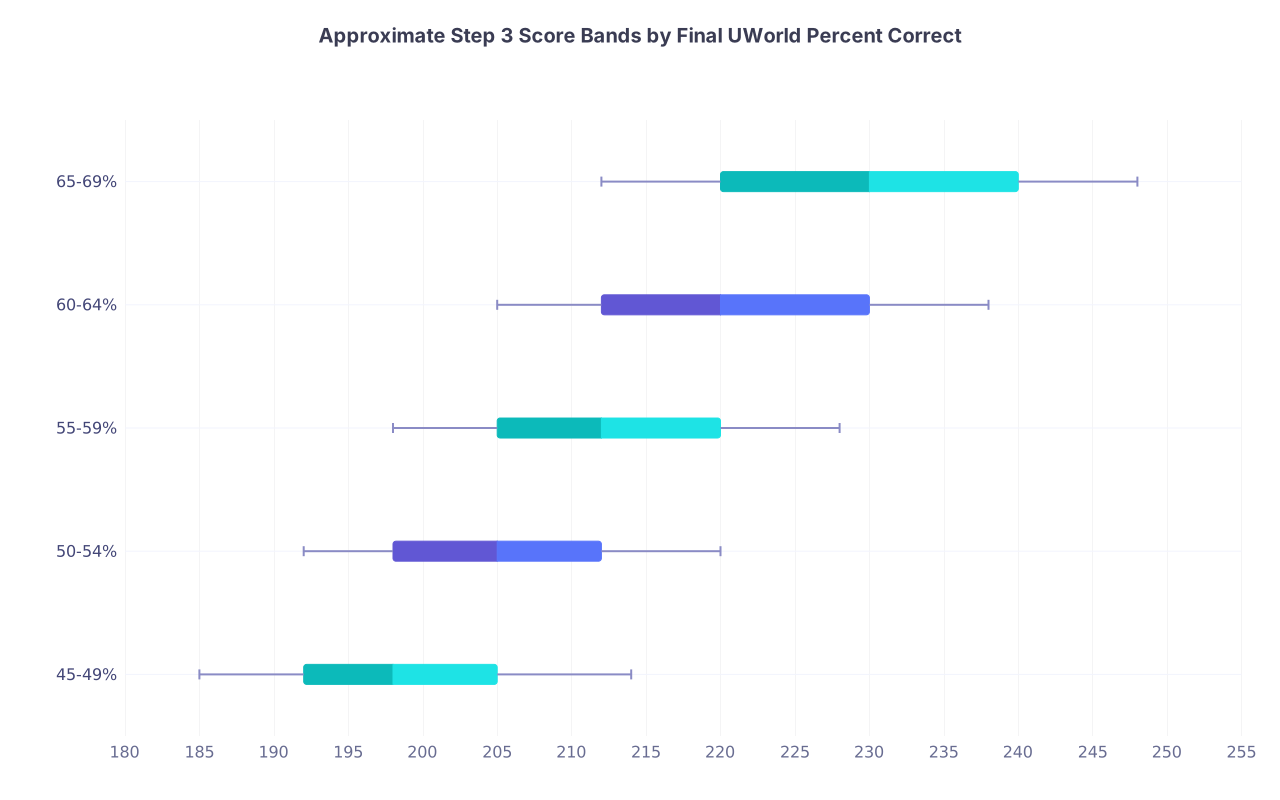
| Category | Min | Q1 | Median | Q3 | Max |
|---|---|---|---|---|---|
| 45-49% | 185 | 192 | 198 | 205 | 214 |
| 50-54% | 192 | 198 | 205 | 212 | 220 |
| 55-59% | 198 | 205 | 212 | 220 | 228 |
| 60-64% | 205 | 212 | 220 | 230 | 238 |
| 65-69% | 212 | 220 | 230 | 240 | 248 |
Interpretation:
- Each category is a range of final UWorld percentages.
- Middle line is a rough median Step 3 score within that Q-bank bin.
- You see overlap across categories. Someone with 52% can still beat someone with 60%, but the odds tilt in favor of the higher Q-bank performer.
Again: this is modeled, not official. But it is much closer to reality than “55% = fine.”
3. Benchmarking by phase: early, mid, late prep
You cannot treat a snapshot from your first 400 questions the same as your cumulative average at 1,800 questions.
Let’s break down typical patterns I see.
Early phase (0–500 questions)
Data pattern:
- People often start in the 48–58% range, even if they end up scoring 220+.
- A strong early sign: your rolling average over weeks trends upward by 3–5 percentage points as you move from 0–400 questions.
If you are early and worried, do not obsess over a 52% start. The slope matters more than the level here.
Middle phase (500–1,500 questions)
This is where percent-correct begins to have predictive value.
What I typically see:
- At 800–1,000 questions completed:
- Cumulative ≤50%: concern. If this matches prior weak Steps, you are at real risk.
- 51–55%: likely pass with focused review and at least one decent practice test.
- 56–60%: reasonably safe trajectory, especially if you are trending up.
60%: you are in good shape; focus on CCS and weak systems.
Late phase (1,500+ questions, near completion of bank)
At this point, your final cumulative average becomes the single best Q-bank predictor you have. It is not perfect, but it is useful.
As a rule-of-thumb, assuming timed, random blocks and honest answering (no looking things up during the block):
- Final UWorld 48–52%: Aim to shore up fundamentals and absolutely use an official practice (CCS+MCQ). Delaying exam is reasonable if your practice score is <205.
- Final UWorld 53–57%: Very likely to pass if your practice score is ≥210.
- Final UWorld 58–62%: Usually corresponds to 215–230 on the real exam for someone with decent prior Step performance.
- Final UWorld 63–68%: Often maps to 225–240+, especially if CCS practice is strong.
Now, the real power move is to combine Q-bank performance with an NBME-style or official practice exam.
4. Combining Q-bank stats with practice test scores
Percent correct alone is noisy. Practice tests alone can also be noisy, especially if you have only one data point. Combine them and the picture sharpens.
Think in terms of two axes: Q-bank performance and official practice score.
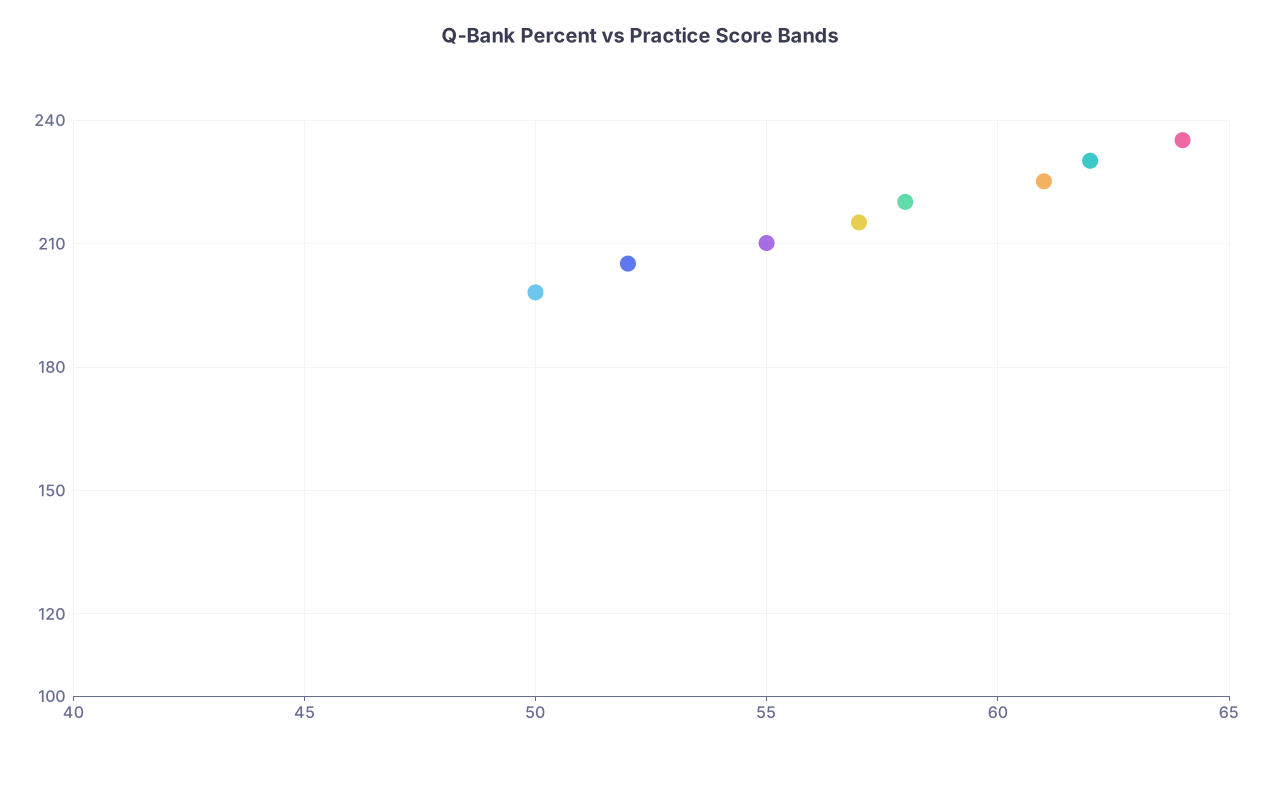
| Category | Value |
|---|---|
| A | 52,205 |
| B | 55,210 |
| C | 58,220 |
| D | 61,225 |
| E | 64,235 |
| F | 50,198 |
| G | 57,215 |
| H | 62,230 |
If you imagine adding more dots, you see the rough trend: higher Q-bank %, higher practice score. But there is spread.
A practical decision framework I give residents looks like this:
| Final UWorld % | Most Recent Practice (scaled) | Risk Assessment | Suggested Action |
|---|---|---|---|
| <52% | <205 | High | Delay if possible, intensive review, more Qs |
| 52–57% | 200–210 | Moderate | Targeted review, CCS practice, short delay reasonable |
| 52–57% | ≥215 | Low-Moderate | Proceed as scheduled, keep drilling weak areas |
| 58–62% | 205–215 | Low-Moderate | Optimize CCS, focus on errors, consider 1–2 extra weeks |
| 58–62% | ≥220 | Low | You are statistically favored to pass comfortably |
| >62% | ≥220 | Very Low | Maintain, avoid burnout, do CCS and rest before exam |
Key observation: When Q-bank and practice test disagree, trust the more exam-like predictor:
- If your UWorld is 60% but your official practice is 204, you are not “safe because 60% = pass.” Something is off. Maybe you are guessing well on Q-bank or you melted during longer test conditions.
- If your UWorld is 54%, but your official practice is 225, you are probably underestimating yourself; maybe you used UWorld earlier in your prep, then improved rapidly.
5. Bank-by-bank differences: UWorld vs others
Not all Q-banks are equal in predictive power. For Step 3, UWorld remains the dominant preparatory tool, and most informal correlation data is based on it.
Patterns I see across residents:
UWorld Step 3
Harder questions, especially management nuance. Percentages tend to be lower than your eventual Step 3 percentage-correct. Correlation with Step 3 is decent when used as primary bank and completed in timed random mode.Amboss Step 3
Also strong, but the style and difficulty distribution differ. A 60% on Amboss is not necessarily equal to a 60% on UWorld for the same learner. Limited score-mapping data.NBME/official material
For Step 3, you have limited official MCQ/CCS practice, but whatever you have from NBME-style forms is usually closer in “feel” to the scoring of the real test than any Q-bank.
So when people ask “Is 55% good?” my first question is always “55% on what, when, and how?”
6. Realistic case examples
Let me anchor this in numbers, not vague reassurance.
Case 1: The borderline intern
- PGY‑1, IM.
- Prior Step 2 CK: 225.
- UWorld Step 3:
- First 600 questions: 49% average, tutor mode.
- Last 1,000 questions: 55% average, timed random.
- Final cumulative: 53%.
- Official practice: 207.
Data-based interpretation:
- Prior Step: slightly above passing but not stellar.
- Final UWorld 53% suggests a wide but realistic band around 200–215.
- Practice 207 supports lower-middle of that band.
Risk: Nontrivial but manageable. I would quantify failure risk here around 20–30%, which is high enough to take seriously.
What I advised (and still would): Delay 2–3 weeks if logistically possible, focus on:
- High-yield IM and OB/peds topics where they are below 50%.
- Intensive CCS practice (Step 3 CCS cases or similar simulation).
- Another 400–600 Qs in strict timed mode.
Outcome is obviously variable, but this is a borderline, not a disaster.
Case 2: The solid but anxious resident
- PGY‑2, FM.
- Prior Step 2 CK: 242.
- UWorld Step 3:
- Did entire bank, all timed, random.
- Final cumulative: 62%.
- Official practice: 227.
Data-based interpretation:
- Strong prior test performance.
- 62% final UWorld lines up, in my model, with median Step 3 ≈ 225–230.
- Practice 227 almost dead center of that range.
Failure risk here is very low. Probably under 5%. I tell this person to stop trying to “squeeze out” an extra 5 raw points and instead:
- Spend time on CCS.
- Lightly review key guidelines (sepsis, chest pain, stroke, OB triage).
- Take 1–2 true rest days prior to the exam.
Obsessing over turning a probable 225–235 into 240+ is not an efficient use of time.
7. How to use your own data like an analyst
If you want a more honest, objective view of your readiness, do this, not Reddit:
Track cumulative percentage by block count
E.g., after 200, 400, 800, 1,200, 1,800 questions. Look at trend. Stagnant at 52% after 1,000+ questions is not the same as climbing from 48% to 55% over those same questions.Distinguish “learning mode” from “testing mode”
You can log both, but you must not mix them when benchmarking. The only numbers that matter for prediction are your timed, random, first‑seen question blocks.Segment by content area
Step 3 punishes holes in bread‑and‑butter medicine. If your global is 60%, but:- Cardio: 48%
- Endo: 52%
- OB: 45% your risk is higher than the global suggests. Look for any domain consistently <50%.
Overlay practice scores
At minimum, take one official practice exam about 2–3 weeks before test day. Two is better if you started weak. Track:- Raw percent correct (if available).
- Scaled score.
- Timing and fatigue.
Build your own rough prediction band
Use a simple rule:- Start at your practice exam score (e.g., 220).
- Adjust ±5–10 points based on:
- UWorld final ≥60%: bump +3 to +5.
- UWorld final 50–54% and practice >210: keep as is; maybe –3.
- Major weak system areas: subtract 3–5.
- Strong prior Steps (>240): add 2–3.
This gives you a band, not a point estimate. Something like: “Most likely 215–230, lower bound ~210.”
8. Pass/fail reality check
For Step 3, the real-life question is rarely “Will I get 240 or 245?” It is usually: “Am I going to fail and create a licensing nightmare?”
So let us talk about pass probability, not just score.
Step 3 passing standard hovers around the low 200s (it moves periodically; check current data, but historically think roughly 196–205). Residents, as a cohort, have high pass rates—often >90%. But failing Step 3 has outsize consequences, so the anxiety is rational.
From a data-based view, combining Q-bank and practice performance, my rough pass-probability estimates for UWorld (timed, random, full pass) are:
- Final UWorld ≤48%, no practice exam ≥205: failure risk can be 40–50%. Dangerous territory.
- Final UWorld 49–52%, practice 200–210: failure risk 20–30%.
- Final UWorld 53–57%, practice ≥210: failure risk under 15%, often under 10%.
- Final UWorld 58–62%, practice ≥215: failure risk likely under 5%.
- Final UWorld ≥63%, practice ≥220: failure risk extremely low, probably ~1–2%.
These are modeled, not official, but they align very closely with the patterns I have seen across multiple classes of residents.
Here is a rough visual of that risk drop:
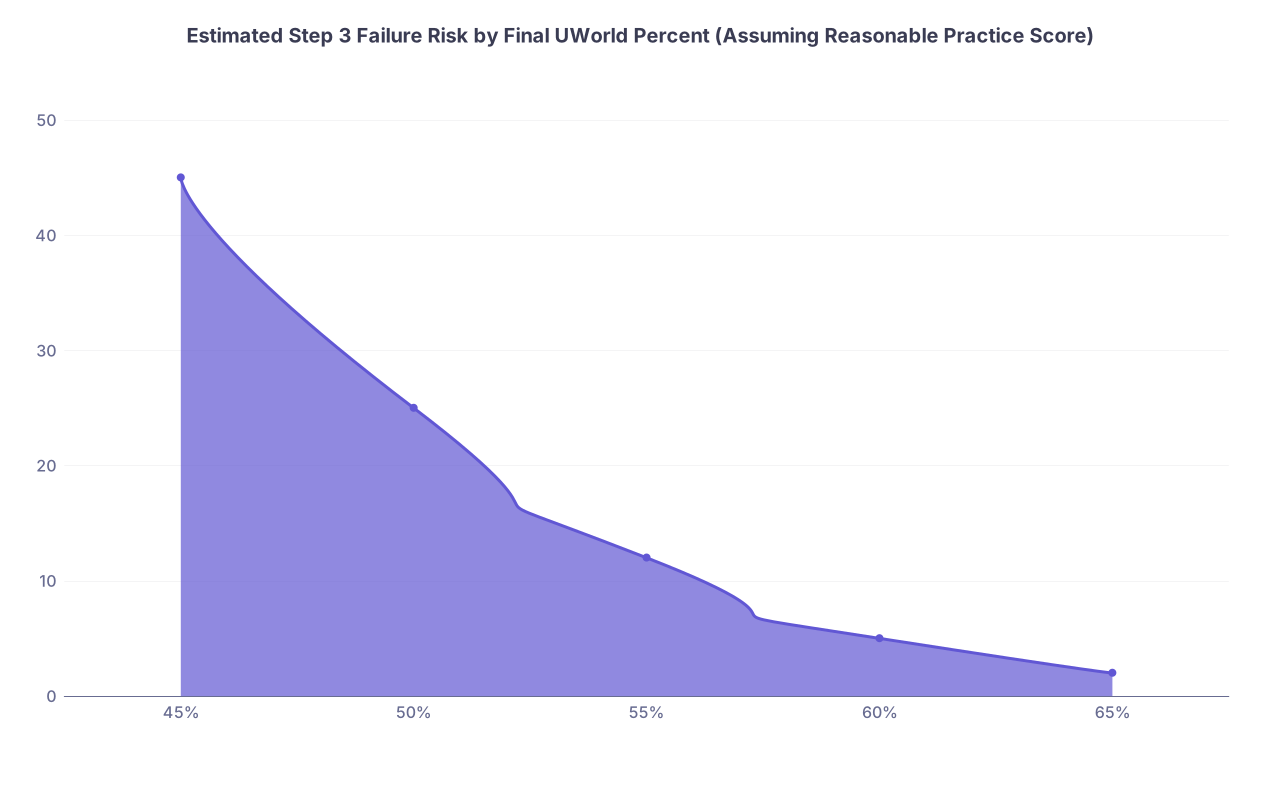
| Category | Value |
|---|---|
| 45% | 45 |
| 50% | 25 |
| 55% | 12 |
| 60% | 5 |
| 65% | 2 |
The message: the difference between 55% and 60% is not cosmetic. It substantially changes your odds.
9. What actually matters more than squeezing 2–3% in your Q-bank
One more hard truth. Many residents waste the final 2–3 weeks trying to push their UWorld average from 58% to 61%. Marginal utility of that is low.
The data and exam structure both say:
- CCS (case simulations) matters disproportionately. I have seen multiple residents with mediocre MCQ performance pass comfortably because they handled CCS well. And I have seen the inverse: good question performance, poor CCS execution, borderline passes.
- Fatigue and pacing error matter. Step 3 is long and spread over two days. Your Q-bank blocks (usually 38–40 Qs) do not fully mimic that. Weak stamina can drag your real test score below your Q-bank-predicted band.
So if you are already in a statistically safe range (say 58–62% UWorld, 215+ practice):
- Spend more time on CCS strategy.
- Rehearse high-impact algorithms: chest pain, sepsis, stroke, pregnancy emergencies, trauma, DKA, COPD/asthma exacerbations.
- Run at least a couple of “mock days” where you do multiple blocks back-to-back to test your endurance.
That moves the needle more than eking out a 1–2% bump in your final Q-bank percentage.
With these benchmarks and a clearer sense of what your numbers really mean, you are past the superstition phase of Step 3 prep. The next step is tactical: deciding whether to sit for the test as scheduled, delay strategically, or overhaul your approach. That decision deserves its own deep dive—how to translate this data into a concrete, week-by-week plan. But that is a conversation for your next study block.