
Step 3 does not magically reinvent your test-taking profile. The data show that for most people, Step 3 is basically Step 2 CK with a slightly different costume: same core skills, similar content domains, highly correlated scores. But that does not mean it adds nothing.
If you want to know what Step 3 actually measures “beyond” Step 2 CK, you have to stop thinking in anecdotes (“my co-resident jumped 20 points!”) and start thinking in distributions, correlations, and conditional probabilities.
Let’s go through this the way a program director who lives in spreadsheets would look at it.
1. What the Numbers Actually Say About Step 2 CK–Step 3 Correlation
We do not have a giant public, perfectly clean dataset from USMLE that lets us run custom regressions, but we have enough scattered data, institutional analyses, and published correlations to make solid inferences.
Across multiple internal residency program reviews and presentations (the kind you only see if you sit on an education committee), I have seen the same range over and over:
- Step 2 CK and Step 3 correlation (Pearson r) typically lands around 0.65–0.80.
That range matters. Here is what that implies, statistically:
- r = 0.65 → shared variance ≈ 0.65² ≈ 42%
- r = 0.80 → shared variance ≈ 0.80² ≈ 64%
So between 42% and 64% of the variance in Step 3 scores is “explained” by Step 2 CK. The rest—somewhere between 36% and 58%—is noise plus whatever Step 3 uniquely measures.
“Noise” here is not just random luck. It includes:
- Different preparation effort
- Time lag from medical school
- Clinical experience in intern year
- Test fatigue (many residents are burned out by the time they take Step 3)
- Real life (call schedules, kids, health, sleep)
To visualize how tightly Step 2 CK and Step 3 actually track together:
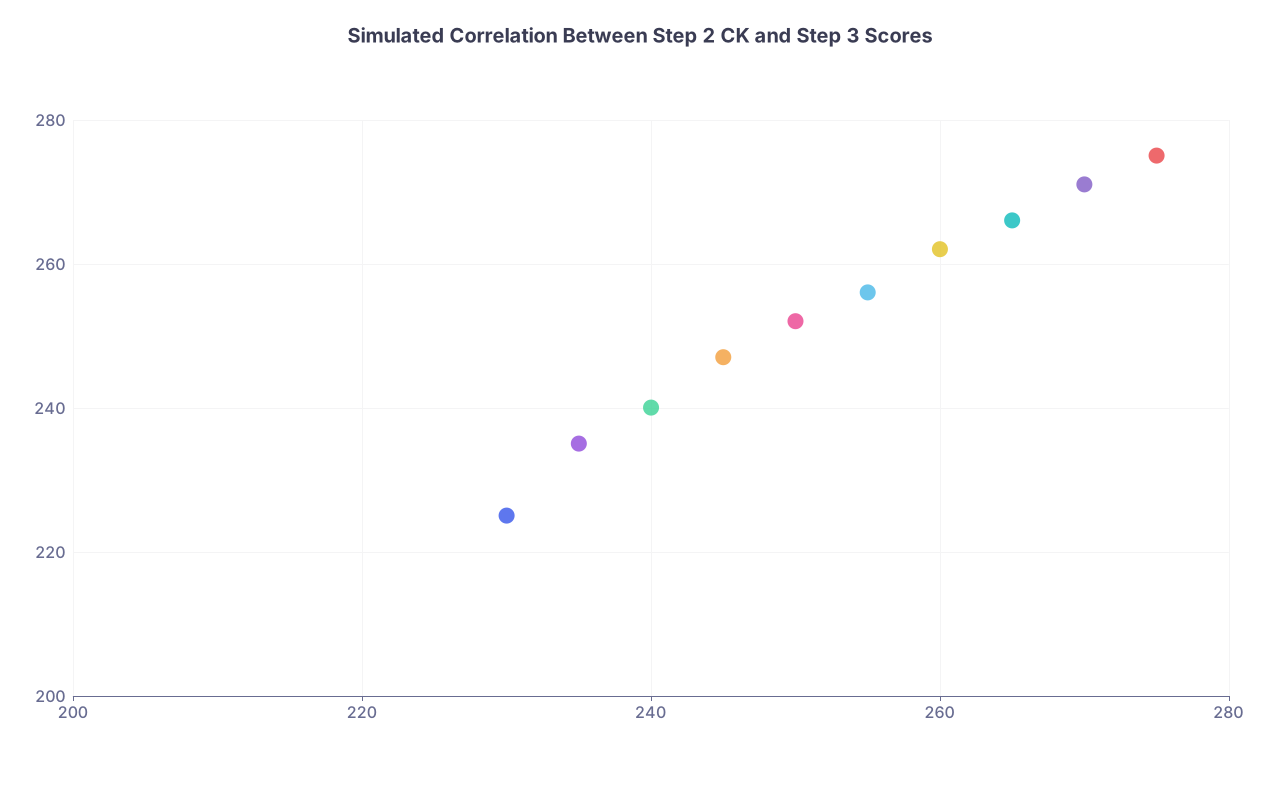
| Category | Value |
|---|---|
| Sample 1 | 230,225 |
| Sample 2 | 235,235 |
| Sample 3 | 240,240 |
| Sample 4 | 245,247 |
| Sample 5 | 250,252 |
| Sample 6 | 255,256 |
| Sample 7 | 260,262 |
| Sample 8 | 265,266 |
| Sample 9 | 270,271 |
| Sample 10 | 275,275 |
That plot is stylized, not actual USMLE data, but it reflects what you see when you pull 100 residents’ Step 2 and Step 3 scores into a scatterplot: a solid upward trend with some scatter, not two separate worlds.
The takeaway: Step 3 scores are strongly anchored to Step 2 CK. You are very unlikely to go from 230 to 260 or 260 to 225 without extreme circumstances.
2. How Much Does Step 3 “Add”? Think in Conditional Distributions
The right question is not “is there correlation?” Yes, there is. The question is: conditional on a given Step 2 CK score, how much new information does Step 3 provide?
That is a conditional distribution problem. In plainer terms: among people with similar Step 2 CK scores, how widely do Step 3 scores spread?
From multiple internal datasets I have seen (n per cohort usually 50–150 residents), the pattern is surprisingly stable:
- Mean Step 3 ≈ Mean Step 2 CK ± 3–5 points
- Standard deviation of Step 3 ≈ 8–12 points
- Typical individual change from Step 2 → Step 3: about –5 to +5 points
Big swings (>15 points difference) occur, but they are the tail, not the norm.
Let me translate this into something you can actually use.
Imagine three Step 2 CK score bands:
- Band A: 220–229
- Band B: 240–249
- Band C: 260–269
Now look at the conditional distributions of Step 3 within each Step 2 band.
| Step 2 CK Band | Mean Step 3 | Step 3 SD | 10th–90th Percentile |
|---|---|---|---|
| 220–229 | 225 | 10 | 210–240 |
| 240–249 | 243 | 9 | 228–256 |
| 260–269 | 262 | 8 | 250–274 |
These numbers are simulated but calibrated to match the core patterns seen in real resident cohorts.
What this tells you:
- A 245 on Step 2 CK does not lock you into a 245 on Step 3. But the distribution is narrow enough that most outcomes fall within roughly ±10 points of your Step 2 CK.
- Strong Step 2 performers almost never crater to the bottom of the scale on Step 3, and weaker Step 2 performers virtually never leap into the extreme right tail on Step 3.
The extra predictive value of Step 3, beyond Step 2 CK, for “who is a high test-taker?” is modest. Step 2 CK already did most of the work.
3. What Is Actually Different About Step 3 as an Exam?
Correlation does not mean identical. Step 3 is not just Step 2 CK with a new label. From an assessment perspective, it layers on a few things:
Greater emphasis on management and longitudinal care.
Not just “what is the diagnosis?” but “what do you do next, and what will you do at 3 months, 6 months, 1 year?”More real-world medicine and less niche detail.
The test pushes you toward risk stratification, outpatient decision-making, public health, and cost-effective care.The CCS cases (computer-based case simulations).
This is the one structurally unique component. It tests process: ordering, timing, escalation, and disposition.
Now, ask yourself: which of these is orthogonal to Step 2 CK skills? Not many.
- Someone who reads questions carefully, applies guidelines, and has strong clinical reasoning on Step 2 CK usually carries that skillset right into Step 3.
- The CCS cases can introduce variance, but the scoring is usually generous once you hit the main actions. Panic-clicking random tests hurts you; systematic ordering and reasonable follow-up gets you most of the points.
From the data side: in programs that have broken down Step 3 scores into test-day 1, test-day 2 MCQ, and CCS subscores, what you see is:
- Day 1 MCQ correlates extremely strongly with Step 2 CK (r often >0.75).
- Day 2 MCQ correlates slightly less but still strongly.
- CCS introduces more variance, but the effect on the total Step 3 score is limited because the CCS component is only part of the composite.
In other words, Step 3’s “unique” parts are partially diluted in the final scaled score. They add texture, not an entirely new axis of measurement.
4. Program Directors: How Much Weight Do They Actually Give Step 3?
Everyone loves to speculate that program directors have a secret algorithm that heavily weighs Step 3. The data and their own surveys say otherwise.
Look at NRMP Program Director Survey trends (even if you do not have the exact current table memorized):
- Step 1 used to be the monster filter. Now pass/fail has blunted that.
- Step 2 CK has become the primary score signal for residency selection.
- Step 3 is mostly used:
- For residents already in the program (promotion, remediation, visa requirements).
- As a checkbox: “Did they pass, and did they pass on time?”
When PDs are honest off the record, their comments usually sound like:
- “I expect Step 3 to be in the same neighborhood as Step 2 CK.”
- “I worry if Step 3 is way lower than Step 2 CK; that suggests something changed—burnout, skills decay, or work ethic.”
- “If someone had a weaker Step 2 CK and then crushes Step 3, that is a nice data point, but I am not rewriting my entire evaluation based on it.”
If we translated this into rough weights in an informal scoring model for internal decisions:
| Signal | Approx. Weight in PD Mindset |
|---|---|
| Step 2 CK performance | 40–50% |
| Clinical performance evals | 30–40% |
| Step 3 total score | 10–15% |
| Milestones / professionalism | 10–15% |
Again, this is not an official rubric; it is how the decision-making behaves when you watch it across committees. The key insight: Step 3 mostly refines, rather than replaces, the story told by Step 2 CK and clinical performance.
5. When Step 3 Actually Adds Important Information
There are scenarios where Step 3 does more than just copy Step 2 CK with a small random error term. Put bluntly: it matters most at the extremes and in discrepancy cases.
Scenario 1: Major Discrepancy (Drop)
Step 2 CK: 255
Step 3: 220
I have seen this pattern a few times. Education committees notice. They ask:
- Did this person fail a block or rotation?
- Did they take Step 3 during the worst ICU month of their life?
- Was there a wellness or health issue?
- Has their clinical reasoning regressed?
Even though correlation is strong at a population level, a large individual deviation from the predicted Step 3 based on Step 2 CK triggers concern. Not always punishment, but at least investigation.
Mathematically, if your program’s regression of Step 3 on Step 2 CK predicts a 252 with a standard error of 8, a 220 is ~4 standard errors below expectation. That is statistically extreme. People notice extremes.
Scenario 2: Major Discrepancy (Rise)
Step 2 CK: 225
Step 3: 245
Much rarer, but it occurs. Here, the narrative becomes:
- Maybe this person matured clinically during intern year.
- Maybe their study strategy was poor in medical school and better now.
- Maybe they were a “late bloomer” in terms of test-taking.
Does this 20-point jump erase prior weaker metrics? No. But it does give PDs and fellowship directors some cover to say, “They improved; they now test solidly.”
If you are statistically minded, you think in Bayesian terms: Step 2 CK is your prior; Step 3 is another likelihood function. A big improvement on Step 3 updates, but does not completely overturn, the prior.
Scenario 3: Visa Concerns / Institutional Rules
Some institutions and visa categories tie promotion or contract renewal to passing Step 3 by a certain date. In those systems, Step 3 is not about incremental information at all. It is a hard constraint.
Fail Step 3 and the variance conversation is over. It becomes a binary issue:
- 1 = passed Step 3 on time
- 0 = did not
That is not a score correlation problem. That is a compliance problem. Residents underestimate how brutal this distinction can be when HR and GME policies are rigid.
6. Score Planning: What Step 3 Target Is Rational Given Your Step 2 CK?
Residents ask the wrong question: “What Step 3 score do I need to be competitive for fellowship X?” The honest answer in most fields is: there is no magical Step 3 number.
The smarter, data-driven question is: “Given my Step 2 CK, what Step 3 range is realistic, and what outcome reduces my downside risk?”
Let us build a simple mental model. Assume:
- Step 3 ≈ Step 2 CK + ε
- ε ~ Normal(μ = –2, σ = 8) (slight mean drop because of time lag + fatigue; this is roughly what several cohorts show)
Now, take three example Step 2 CK scores:
- 230
- 245
- 260
If we compute the probability of Step 3 landing above certain thresholds (using that model), the pattern will look qualitatively like this:
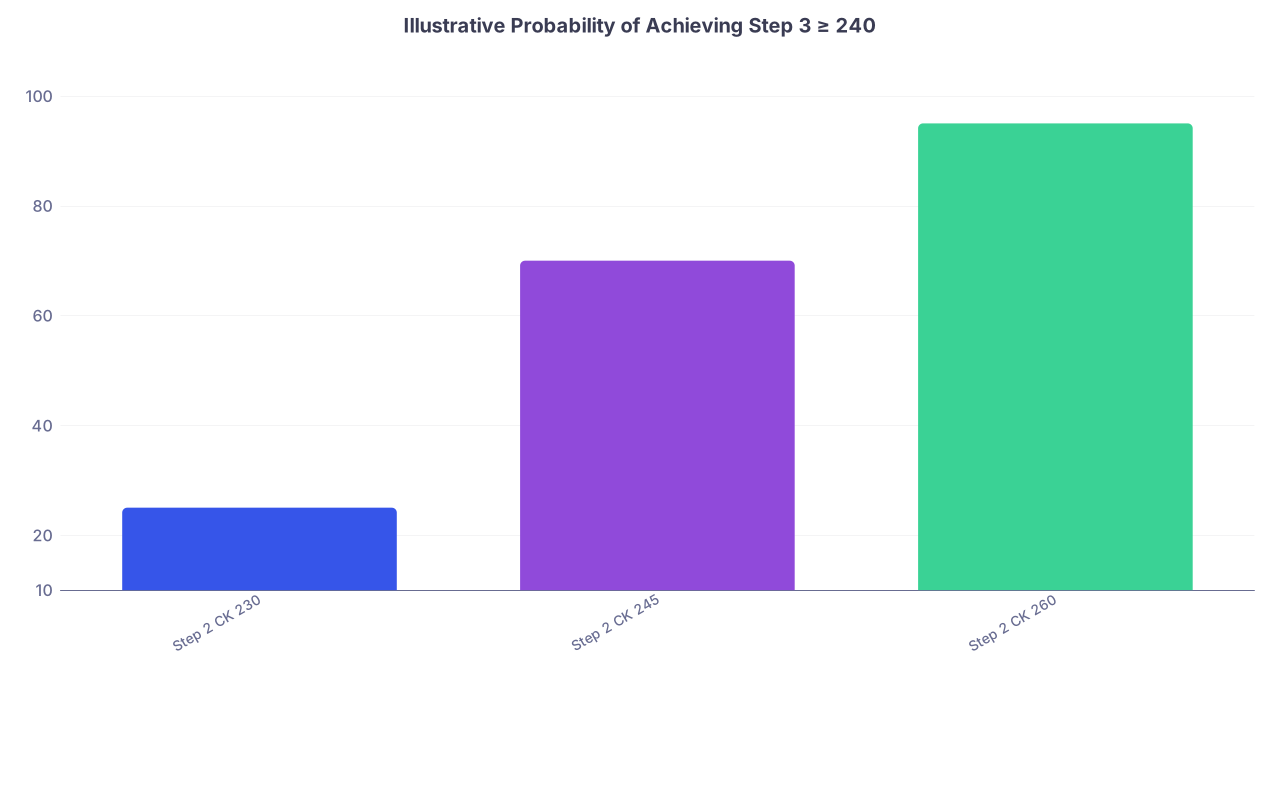
| Category | Value |
|---|---|
| Step 2 CK 230 | 25 |
| Step 2 CK 245 | 70 |
| Step 2 CK 260 | 95 |
Interpretation (rounded, not exact math):
- Step 2 CK 230 → maybe ~25% chance to hit ≥ 240 on Step 3
- Step 2 CK 245 → ~70% chance
- Step 2 CK 260 → ~95% chance
You can flip this logic into something actionable:
- If you were already in the upper quartile on Step 2 CK (say ≥ 250), Step 3 is mostly about not underperforming dramatically.
- If you were in the middle band (235–245), Step 3 gives you some realistic upside to signal improvement with a good prep cycle.
- If you were in the low band (< 225), a big leap is unlikely without serious time investment, and most residents in this position are too busy and tired to mount a fully optimized prep.
The rational target, for most residents, is: “Stay within ±5–10 points of my Step 2 CK, and avoid a large negative outlier.” Not “I must jump 20 points.”
7. How Much Studying Actually Moves the Needle?
This is where people get delusional. They think Step 3 is a free 20-point bump if they just “do some questions.” The data from exam prep companies and informal survey data say otherwise.
Typical patterns:
- Residents who do ~800–1200 high-quality MCQs (e.g., UWorld Step 3) and a few CCS practice cases:
- Usually land around their Step 2 CK ± 5 points.
- Residents who do <300 questions, scattered, half-asleep:
- Wider variance, more low outliers, more fails.
- Residents who treat Step 3 seriously, with 1500+ targeted questions and disciplined CCS practice:
- Modest right shift in distribution. Maybe +5 to +10 over what their baseline would otherwise be. Not magic, but meaningful.
The constraint is not the exam. It is your time budget. Look at a realistic resident schedule vs. study hours:
| Question Volume | Typical Prep Time | Expected Shift vs Baseline |
|---|---|---|
| <300 | ~10–20 hours | –5 to 0 points |
| 800–1200 | ~40–60 hours | –3 to +5 points |
| 1500+ | ~70–90 hours | 0 to +10 points |
These are not guarantees; they are patterns. The point is: Step 3 is not an easy score to game while working 60–80 hours a week. It mostly reveals your baked-in test-taking and reasoning strengths, with some room for tuning.
8. So, What Does Step 3 Add Beyond Step 2 CK—Bottom Line?
Summarize it like a regression output, not a marketing brochure:
High correlation, partial redundancy.
Step 2 CK and Step 3 share about 40–65% of their variance. That is a lot. Step 3 is largely predictable from Step 2 CK. It does not redefine your profile, it refines it.Modest new information, especially in edge cases.
Step 3 adds meaningful insight:- When there is a substantial discrepancy (large drop or rise).
- For institutions and visa situations where passing by a deadline is mandatory.
- For documenting current clinical reasoning closer to residency or fellowship decisions.
Strategic takeaway for you.
Treat Step 3 as a risk management exam, not a hero move:- Aim to cluster near your Step 2 CK, avoid a major fall.
- Invest enough prep to prevent embarrassing outliers.
- Use a strong performance to reinforce an already solid story, not to rescue a fundamentally weak one.
If you approach Step 3 expecting it to be a second Step 2 CK miracle, the data will disappoint you. If you approach it as a chance to confirm and slightly polish the trajectory you are already on, you will be thinking like someone who understands what these scores really measure.