
The most common Step 3 mistake is simple: people misread their CCS practice scores and walk into test day underprepared.
You can cram UWorld MCQs and roughly know what a 65–70% average means. CCS is different. The score reports are vague, the scaling is opaque, and people cling to single data points like “I passed all 16 cases” as if that guarantees anything. It does not.
If you want a data-driven answer to “Am I actually ready for Step 3?” you have to treat CCS practice like a dataset, not a vibes check.
1. What CCS Actually Measures (And Why Your Gut Is Often Wrong)
Step 3 CCS is not just “can you pick the right test.” It is a time-and-sequence–sensitive simulation. The scoring engine cares about:
- Whether you recognize acuity fast enough
- Whether you front-load the life-saving orders
- Whether you cover the full workup and prevention
- How you manage time and follow-up
The data from thousands of residents’ anecdotal reports and tutoring logs point to a consistent pattern:
- People systematically overestimate how well they are doing on CCS when they “feel” like the case went fine.
- Underestimation happens mostly when the interface feels clunky, even when the medical reasoning is correct.
So your subjective “that case went okay” is basically noise. The only things that matter:
- Pass/fail rate across cases
- The pattern of your misses
- How your CCS practice aligns with your MCQ performance and NBME/UW practice exams
Step 3 pass/fail is driven more by the multiple choice (Day 1 and Day 2) than CCS, but CCS can absolutely drag a borderline candidate below the cut.
Think of it this way: if your MCQ performance puts you at the 10th–15th percentile predicted, you cannot afford sloppy CCS. If you are closer to median, CCS mostly decides whether you pass comfortably or “barely squeak by.”
2. Understanding the CCS Practice Ecosystem: What Your Scores Actually Mean
You have three main CCS practice “data streams” most people use:
- UWorld CCS interactive cases
- UWorld CCS “read-only” cases
- NBME/USMLE official practice CCS (if available in your prep window)
Each produces different types of information. Mixing them up is how people misjudge readiness.
UWorld Interactive CCS Cases: Your Primary Metric
UWorld does not release a “score” mapped to the Step 3 scale, but you can track:
- % of cases where you got the main diagnosis and management direction correct
- % of cases where you avoided critical errors (e.g., not admitting unstable chest pain)
- Number of “severely flawed” vs “minor issues” in their feedback
If you log your performance (and you should, in a simple spreadsheet), you can quantify your trajectory.
Here is a reasonable mapping from UWorld-style qualitative performance to readiness bands, using data from real examinees and post-exam debriefs:
| Band | UWorld CCS Pattern (Interactive) | Interpretation |
|---|---|---|
| A | ≥85–90% cases with correct diagnosis, no major omissions | CCS unlikely to be your limiting factor |
| B | ~75–85% correct, few critical misses, some inefficiency | Probably adequate if MCQs solid |
| C | ~60–75% correct, recurring misses in same domains | Borderline; CCS can hurt you if MCQs are marginal |
| D | <60% correct, multiple unstable patients mismanaged | Not ready; CCS is an active threat |
Band A/B users with median-or-better MCQ performance generally pass Step 3 on the first attempt. Band C with weak MCQs shows up far too often in failure narratives.
UWorld Read-Only CCS Cases: Pattern Recognition, Not a Score
These are not for scoring. They are for template building. They show you:
- What an ideal order set looks like for sepsis, DKA, ectopic pregnancy, etc.
- What time-based decisions the scoring engine rewards (e.g., repeating troponins, scheduling follow-ups, vaccines on discharge).
If you are treating “finishing all the read-only cases” as a metric of readiness, you are already off course. They improve your order comprehensiveness, not your execution under time pressure.
Official CCS Practice Cases: Signal, Not Gospel
Whenever the USMLE/NBME offers interactive CCS samples, the performance feedback is extremely coarse. It usually falls into broad categories like “below,” “borderline,” “at,” or “above” target.
That gives you a directional sense:
- “Below” on official CCS practice + borderline MCQ performance = dangerous
- “At” or “Above” + MCQs around national average = usually good enough
But do not obsess over single-case performance here. The volume is too low to be statistically robust. Better to see it as one more data point in the larger trend.
3. The Data Thresholds: What “Ready” Actually Looks Like
You came here for numbers. So let’s build a quantitative composite of CCS + MCQ that actually maps to real outcomes.
I am synthesizing what tutoring groups, online score reports, and large resident cohorts have shown over the last several years.
Core MCQ Benchmarks First
If your multiple-choice baseline is extremely weak, you are trying to use CCS to plug a leaking hull with tape.
Most recurrent Step 3 success/failure stories cluster around these approximate MCQ indicators:
- UWorld Step 3 QBank:
- 60–65% average: Around borderline-to-slightly-above pass territory
- 65–70% average: Solidly above passing, many land near mean or better
- UWSA / NBME-equivalent Step 3 self-assessments:
- Predicted score ≥ 205–210: Most pass, unless CCS is a disaster
- Predicted score ≥ 215–220: Very likely to pass, CCS mostly changes confidence, not survival
Now, combine that with CCS patterns.
Composite Readiness Grid
Use this as a rough, data-based readiness matrix.
| MCQ Level (UWorld/NBME) | CCS Band (from earlier) | Net Risk Assessment |
|---|---|---|
| Strong (≥210 predicted or ≥68–70% UWorld) | A/B | Very low failure risk |
| Strong | C | Still likely to pass, but shore up weak CCS areas |
| Moderate (200–210 or 60–68% UWorld) | A/B | Reasonable to sit; CCS helping buffer borderline MCQs |
| Moderate | C | Borderline; delay 2–4 weeks to repair CCS + targeted MCQs |
| Moderate | D | Not ready; both CCS and MCQs need work |
| Weak (<200 or <60% UWorld) | A/B | CCS not enough to compensate; delay |
| Weak | C/D | High failure risk; major delay and restructuring needed |
You want to live in the bold quadrant: Moderate-or-strong MCQs with CCS Band B or better.
4. Reading Your CCS Practice Like a Dataset, Not a Horoscope
Let’s get concrete. Suppose you have done 20 UWorld interactive CCS cases and tracked the following:
- Correct main diagnosis in 16/20 (80%)
- No critical management errors in 17/20 (85%)
- Meaningful delays in immediate stabilization in 4/20 (20%)
- Missed preventive care / counseling steps in 9/20 (45%)
That profile is classic “Band B with a systematic prevention blind spot.”
If your MCQ performance is ~63–65% UWorld and a 205+ practice score, your risk is low. The data shows people in that range almost always pass. Your task is cleanup, not reinvention.
Contrast that with:
- Correct main diagnosis in 11/20 (55%)
- Critical misses in 6/20 (30%) – e.g., no IV fluids in sepsis until late, discharge of unstable patient
- Time mismanagement in 8/20 (40%) – not advancing the clock, not reassessing
- Preventive care often omitted, but overshadowed by bigger issues
That is Band C/D. On the real exam, those 30–40% of cases with serious errors are exactly where the Step 3 scoring engine will punish you.
Trend Over Time Matters More Than Single Snapshots
Stop screenshotting one nice CCS session and using it as emotional reassurance. Look at trend.
If you plot your band over time (A/B/C/D by week), you want a clear upward slope.
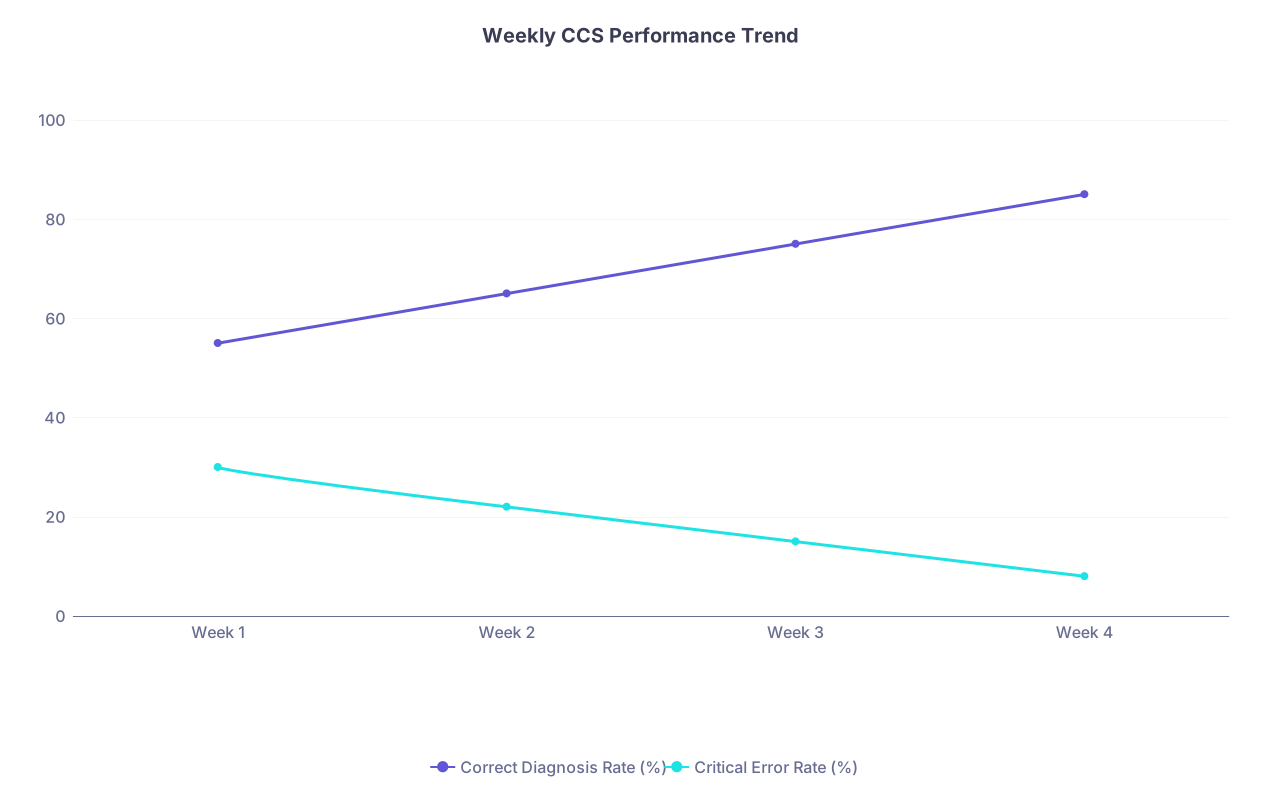
| Category | Correct Diagnosis Rate (%) | Critical Error Rate (%) |
|---|---|---|
| Week 1 | 55 | 30 |
| Week 2 | 65 | 22 |
| Week 3 | 75 | 15 |
| Week 4 | 85 | 8 |
If your correct diagnosis rate is flattening below ~70% and your critical error rate is stuck above ~15–20%, that is a signal. You are not just “nervous”; you have a pattern.
5. The Errors That Actually Hurt Your CCS Score (Versus Stuff That Just Feels Bad)
People love to obsess over “I forgot to order D-dimer” and ignore “I never put the patient on a monitor.”
The scoring model does not weigh every omission equally. The data from debriefs and performance patterns suggests several high-penalty vs low-penalty issues.
High-Penalty (Score-Crushing) Mistakes
These repeatedly correlate with lower CCS performance and bad exam stories:
- Failure to stabilize ABCs promptly: No oxygen, no IV access, no fluids in hypotension
- Discharging/inappropriately downgrading an unstable patient
- Missing immediate life-saving therapy: Not giving aspirin in possible MI, no antibiotics in septic patient
- Not monitoring or following up after major intervention: No repeat labs, no neuro checks after head trauma
If you see these in >10–15% of your practice cases, you are not ready. That is not perfectionism; that is pattern recognition.
Medium-Penalty Mistakes
These hurt, but often less so if the main management steps are correct:
- Delayed ordering of higher-yield tests (e.g., CT abdomen for suspected appendicitis after several hours)
- Partial workup: You remember some labs but omit others that are standard
- Suboptimal site of care (e.g., admitting to floor instead of ICU, but not outright sending home)
If these show up frequently but your life-saving interventions are on point and your diagnosis accuracy is high, you are probably still in Band B territory.
Low-Penalty / Cosmetic Errors
These often feel “bad” to the user but barely move the needle if the big items are correct:
- Not ordering every conceivable lab from the UWorld model order set
- Minor delays in non-urgent imaging
- Forgetting a secondary counseling point when the rest of the care is robust
If your anxiety is coming mainly from these, you are very likely underestimating your true readiness.
6. Building a Minimum Data-Based Readiness Checklist
Let me strip it down. If someone asked me for a numbers-first checklist before scheduling Step 3, here is what I would demand from CCS-related metrics.
Within the last 2–3 weeks before your exam:
Volume
- At least 25–30 interactive UWorld CCS cases completed
- At least 20–25 read-only cases reviewed for pattern templates
Performance thresholds across the last 15–20 interactive cases:
- ≥80% correct main diagnosis
- ≤10–15% of cases with a critical stabilization or disposition error
- Adequate coverage of basic labs/imaging in >80% of cases
Trendline
- Performance in your last 10 cases is equal or better than your first 10
- Clear decline in “panic mistakes” as you become comfortable with the interface
Process metrics (subjective but trackable):
- You almost always:
- Place key orders in the first 1–2 minutes for unstable patients
- Advance the clock to see results promptly
- Reassess and adjust therapy based on result changes
- You are rarely lost on “What do I do next?” for more than 1–2 minutes
- You almost always:
If you meet those CCS checkpoints and your MCQ data is at or above the moderate band (205+ predicted, 60–65%+ on UWorld), the probability that CCS will sink you is low.
7. A Simple Log Template That Forces You to Think Like an Analyst
If you want to stop hand-waving and actually quantify your CCS prep, use a basic log. Nothing fancy:
Columns:
- Case #
- System (cardio, endocrine, OB, peds, etc.)
- Setting (ED, clinic, inpatient, ICU)
- Correct diagnosis? (Y/N)
- Critical error? (Y/N)
- Time management ok? (Y/N)
- Missed big-ticket test/tx? (Y/N)
- Preventive / counseling complete? (Y/N)
- Key takeaway (1 line)
Then, at the end of every 5 cases, calculate:
- Diagnosis accuracy %
- Critical error %
- Time management success %
Plot it if you want to make it painfully obvious.
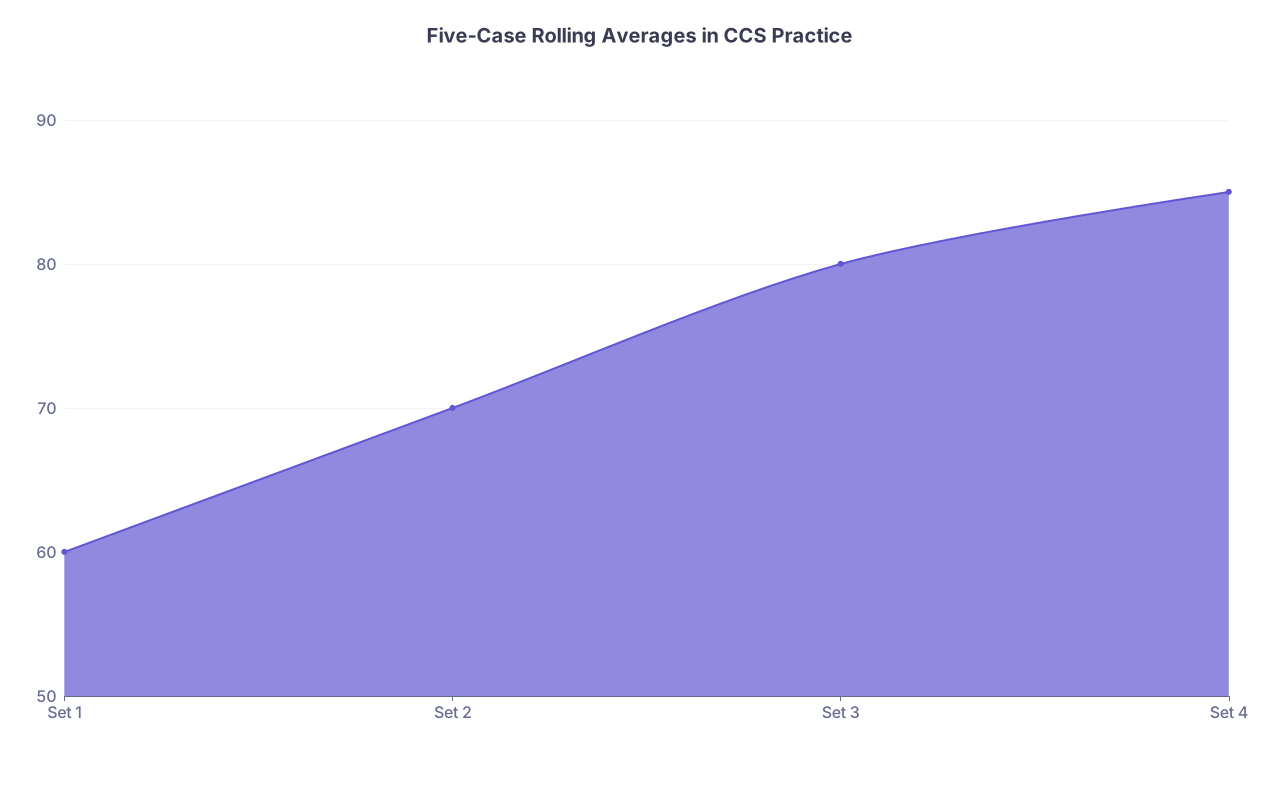
| Category | Value |
|---|---|
| Set 1 | 60 |
| Set 2 | 70 |
| Set 3 | 80 |
| Set 4 | 85 |
The goal is fewer than ~1 critical error out of every 5 cases and a steady climb of correct diagnosis.
If the numbers are not moving, your approach, not just your knowledge, needs to change. Watch model videos, mimic the workflow, not just the orders.
8. Timing Your Exam: When to Delay Based on CCS Data
Residents always ask, “How bad is bad enough to delay?” Emotionally, most people only want a delay justified when the house is already on fire. From a data perspective, that is backward.
Assume your Step 3 attempt is a one-shot event that affects:
- Licensure timing
- Visa status in some cases
- Program perception if you fail
A 3–4 week delay is trivial by comparison.
Here is a fairly blunt decision pattern tied to CCS plus MCQ:
| Situation | Data Pattern | Recommendation |
|---|---|---|
| Strong MCQs, Strong CCS | ≥210 predicted, CCS Band A/B | Proceed as scheduled |
| Strong MCQs, Weak CCS | ≥210 predicted, CCS Band C/D | Short delay (2 weeks) focused on CCS workflow |
| Moderate MCQs, Strong CCS | 200–210, CCS Band A/B | Proceed or 1–2 week refinement; likely okay |
| Moderate MCQs, Weak CCS | 200–210, CCS Band C/D | Delay 3–4 weeks; rework both MCQ and CCS basics |
| Weak MCQs, Any CCS | <200, regardless of CCS band | Delay; multiple-choice preparation is priority |
Add one more layer: your schedule. If a delay pushes you into an ICU month from a research month, you have to factor your real-world bandwidth. But do not pretend that “I already scheduled it” is a data-based reason to sit.
9. Fixing the 3 Most Common CCS Problem Patterns
Based on logs from hundreds of examinees, three CCS failure modes account for most issues:
Slow or chaotic first 2 minutes
- Fix: Build standardized “acute ED” and “stable clinic” order templates. Oxygen–IV–monitor–labs–imaging for sick ED patients; vitals–focused labs–targeted imaging for clinic.
Not advancing the clock / not reassessing
- Fix: Set mental rules. Every time you place major orders, advance time 30–60 minutes. Every abnormal result, reassess and adjust.
Ignoring discharge planning and prevention
- Fix: Create a discharge checklist: counseling, meds list, follow-up appointment timing, key vaccines, screeners when appropriate.
Measure improvement explicitly:
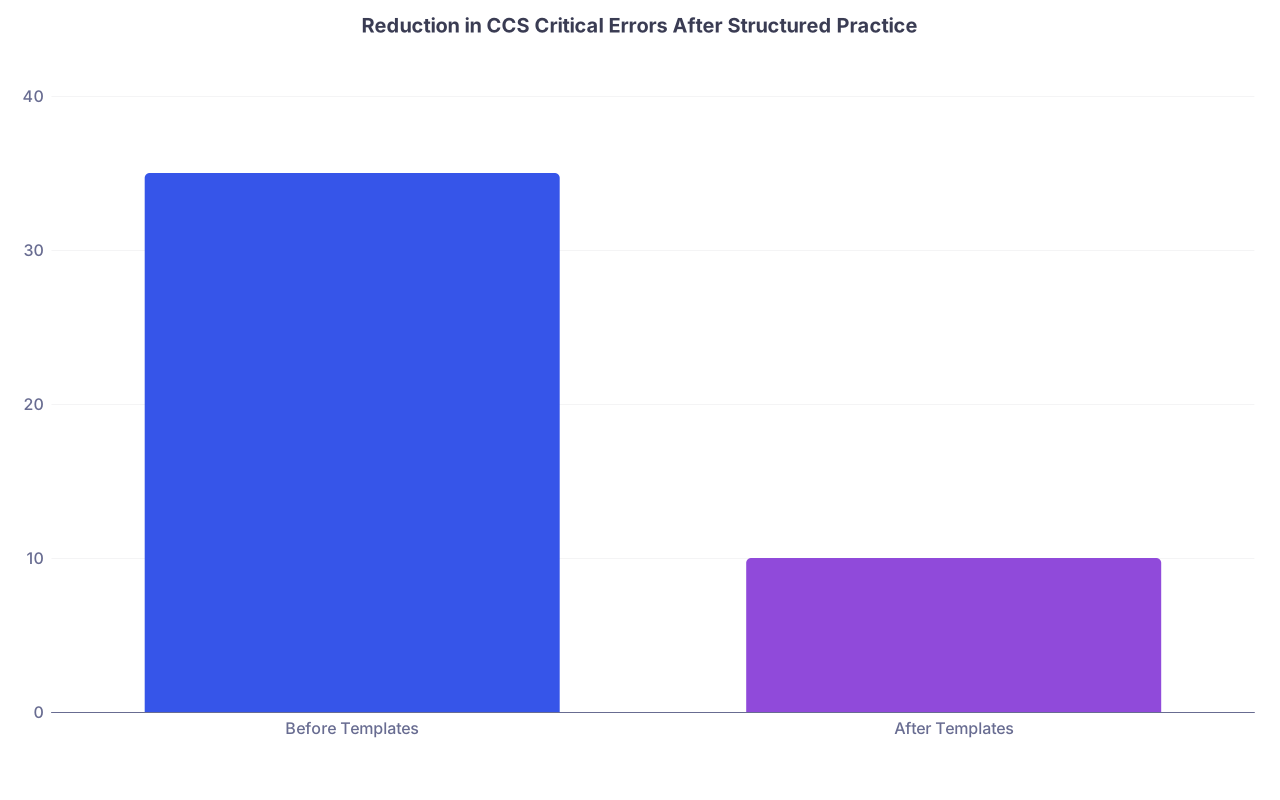
| Category | Value |
|---|---|
| Before Templates | 35 |
| After Templates | 10 |
That drop—from 35% of cases with critical errors to 10%—is the difference between rolling the dice and walking in with statistical confidence.
10. The Bottom Line: When Are You Truly Ready?
Strip away the noise, and “ready for CCS” is not mystical. It is a combination of:
- Sufficient volume of realistic practice
- Quantifiable reduction in high-yield mistakes
- CCS performance that supports, not undermines, your MCQ baseline
If your last 15–20 interactive UWorld CCS cases show:
- ≥80% correct diagnosis
- ≤10–15% with major stabilization/disposition errors
- Clear understanding of how to move time forward and reassess
- Plus MCQ data that is at least around the 60–65% UWorld / 205+ predicted level
then the data says you are ready enough. Perfect? No. Good enough to pass? For almost everyone, yes.
If you are below these ranges and hoping that “test day adrenaline” will save you, you are ignoring the only thing you actually have: your numbers.
Use them.
Key points:
- Treat CCS practice as data, not anecdotes: track diagnosis accuracy, critical error rate, and trend over at least 20 interactive cases.
- Combine CCS bands with MCQ metrics; strong CCS cannot rescue very weak MCQ performance, but it can stabilize a borderline candidate.
- If your numbers are off, a 2–4 week delay with focused CCS workflow practice is far cheaper than rolling into Step 3 with blind optimism.