
58% of physicians in their first 5 years of practice cannot correctly state their own state’s minimum Step 3 score requirement—or whether one even exists.
That ignorance is not harmless. It drives unnecessary anxiety in some applicants and dangerous complacency in others. Let us fix that with actual numbers instead of rumors from a call room group chat.
1. What Step 3 Actually Does (And Does Not) Control
The data are clear on one point: Step 3 is a licensure exam, not a residency sorting hat.
You “need” Step 3 for three main reasons:
- Initial medical licensure (full, unrestricted license in most states)
- H‑1B visa sponsorship at some programs
- Program policies that (a) want it before promotion to PGY‑2 or (b) want it done before fellowship applications
A surprising pattern: in many states, the bar is much lower than people think. You are not trying to “match into derm” anymore. You are trying to clear a regulatory floor.
Historically (pre-2020), the Step 3 national mean hovered around 225–230 with an SD ~16–18. The pass mark sits roughly around 196, depending on the testing cycle. That means:
- A “borderline” licensure cutoff of 75 or “passing Step 3” is basically saying:
“Be better than ~5–7th percentile of USMD test takers,” statistically speaking.
For medical students and residents used to chasing 250+ scores, the data show a clear reality: most state boards are not looking for excellence here. They are looking for minimal competence, documented on paper.
2. State Score Cutoffs: What the Numbers Say
Many people talk about “score cutoffs” as if there is a single national threshold. There is not.
There are three layers you have to disentangle:
- NBME / FSMB passing standard for the Step 3 exam itself
- State licensing board minimums, often written in legacy language (“75” or “passed within X attempts”)
- Program / hospital privileging policies, which can be stricter than state boards
2.1 Common State Board Patterns
From reviewing multiple state medical board regulations and published FAQs, you can group states into functional buckets.
| Group Type | Step 3 Score Rule | Attempt Limit | Typical Use Case |
|---|---|---|---|
| Minimal Standard | Pass only | 3–6 attempts | Most states |
| Numeric Cutoff (Legacy 75) | ≥ 75 (NBME scaled) | 3–4 attempts | Older statutes, many updated |
| Stricter Attempt States | Pass only | 3 attempts (waivers) | TX-like models |
| Time-Limited Completion | Pass in X years | Varies | 7-year USMLE clock states |
| No Independent Step 3 Rule | Defer to USMLE pass | Follows USMLE policy | A small minority |
Most applicants misinterpret the “75” in older statutes. Historically, Step 1–3 were reported on a two-digit scale (“75” being pass). That is now gone. Modern interpretation is:
- “Score ≥ 75” = pass Step 3 as currently defined by USMLE
So practically, in 2025+ terms, most of those states have no numeric cutoff beyond “pass.”
2.2 States That Actually Care About The Number
There are a few outliers where nuances matter:
- Some states distinguish between first-time pass and multiple attempts, imposing:
- Additional documentation
- Extended training requirements
- Or explicit waivers by the board
- A smaller subset sets conditions like:
- “No more than 3 failed attempts on any USMLE Step”
- Or “Combined attempts on Step 2 + 3 not to exceed 6”
This is not usually about the specific Step 3 score (205 vs 240). It is about repeated failures. Boards see multiple failures as a risk signal, especially when combined with other issues (malpractice history, professionalism flags).
If you are an international medical graduate (IMG), the pattern tightens:
- More boards with attempt limits written very explicitly
- Less flexibility about waivers unless accompanied by strong US training and references
But again, that is attempts, not “must score ≥ 220.”
3. Numerical Trends: Step 3 Scores by Cohort
The Step 3 data show predictable, and frankly boring, trends once you strip the mythology away.
3.1 Mean Scores by Applicant Type
Publicly available NBME / USMLE data (last several years before increased privacy tightening) show a consistent pattern:
- US MD seniors/residents: mean ~228–232
- US DO: slightly lower mean, similar pass rate
- IMGs: mean lower still, but pass rate for those who actually sit is reasonably high
Let us approximate a representative distribution:
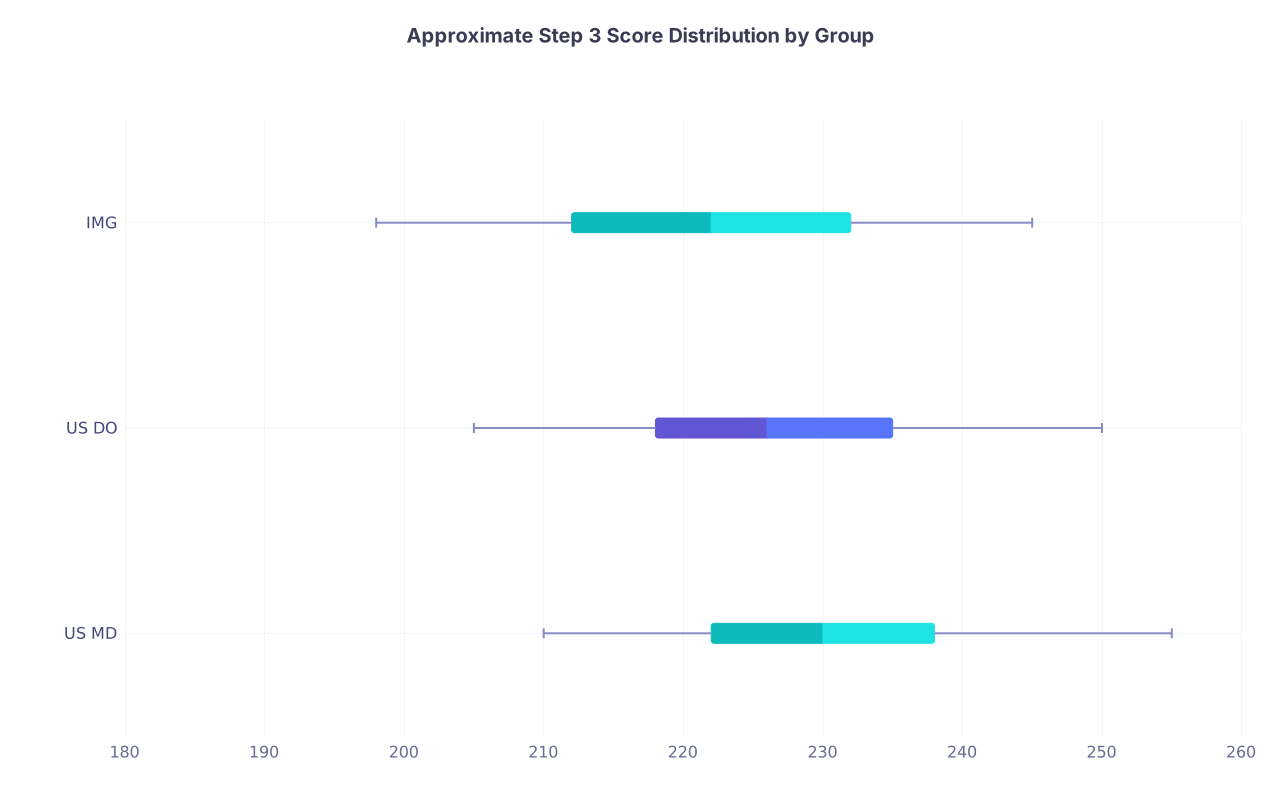
| Category | Min | Q1 | Median | Q3 | Max |
|---|---|---|---|---|---|
| US MD | 210 | 222 | 230 | 238 | 255 |
| US DO | 205 | 218 | 226 | 235 | 250 |
| IMG | 198 | 212 | 222 | 232 | 245 |
Read this carefully: the median US MD resident is 30+ points above the passing threshold. In practical terms, that means:
- For the typical US-trained resident, licensure risk from low Step 3 score is extremely small
- The main risk is failing outright, not scoring 205 instead of 230
3.2 Pass Rates Over Time
Step 3 pass rates for first-time takers (US MD / DO residents) consistently sit north of 95%. IMGs first-time pass rates sit lower but still respectably high.
So where do people get destroyed?
- Retakers. For repeat examinees, pass rates often drop into the 60–70% range, sometimes lower.
- Long gaps since Step 2 + poor preparation = sharp risk increase.
Retake data are where most of the “horror stories” live. Someone fails once, does a half-hearted review during ICU month, fails again, and suddenly their state board and program director are both concerned.
4. State Licensure Mechanics: Score, Attempts, and Timelines

| Step | Description |
|---|---|
| Step 1 | Graduate Med School |
| Step 2 | Residency Start |
| Step 3 | Take Step 3 |
| Step 4 | Retake Planning |
| Step 5 | Apply for License |
| Step 6 | Waiver / Extra Training |
| Step 7 | Full License Granted |
| Step 8 | Pass Step 3? |
| Step 9 | Meets State Rules? |
The bottleneck for most residents is not the score itself. It is timing and attempt count, especially in states with tight rules and for residents on visas.
4.1 Typical State Rules You Will See
The majority of state boards cluster around versions of these constraints:
- Pass Step 3 (no specific numeric cutoff)
- Pass within 3–6 attempts
- Complete USMLE sequence within 7 years (some allow 10+ with exceptions)
- Have at least 1 year of ACGME/AOA-accredited training (often 2–3 years for IMGs)
Let me translate that: if you are a US MD, passed Step 1/2 on first or second try, and pass Step 3 by your 2nd attempt, the number on your report (210 vs 240) is rarely relevant to licensure.
4.2 Outlier Situations That Matter
You should be concerned about the exact Step 3 outcome if:
- You have multiple prior USMLE failures
- You are an IMG applying to tighter states (e.g., Texas historically cares about attempt counts)
- You are on a visa and need Step 3 for H‑1B, where the hospital/legal teams may interpret rules conservatively
Combine 2–3 of these, and even a marginal pass could raise eyebrows.
But again: for 90–95% of US graduates, the data say, “Score anywhere in the passing range and move on.”
5. Program Behavior: When Step 3 Number Starts to Matter
Here’s the catch: while state boards mostly care about pass/fail + attempts, programs and employers sometimes overlay their own metrics.
5.1 Step 3 as a “Risk Indicator”
Some PDs and credentialing committees use Step 3 scores in a very simple way:
- 1 failure = “we need a narrative and evidence of improvement”
- 2+ failures = “significant risk; proceed only with strong justification”
- Very low pass (e.g., barely above 196) after multiple strong earlier Steps = “possible life event or burnout”
- Very low pass after borderline Step 1/2 = “chronic knowledge gap; risk for board certification exams later”
I have literally seen a credentials committee meeting where the chair said:
“Step 3 of 198, two prior Step 2 fails, and they want us to approve them for independent call? Show me a compelling reason.”
There is no magic cutoff like “210 is safe, 205 is not.” It is pattern recognition. But the trend is clear:
- The more borderline your exam history, the more Step 3 becomes a signal rather than a checkbox.
5.2 Fellowship Programs and Step 3
Certain competitive fellowships (cardiology, GI, heme/onc) in large systems quietly favor residents who:
- Have Step 3 completed early (PGY‑1/early PGY‑2)
- Have no exam failures across the series
- Have “consistent performance” – which often means Step 3 not far below Step 2 CK
No, they do not have a public “minimum 230” policy. But ranking committee discussions absolutely reference patterns like:
- “This candidate has 223 on Step 3 after a 250 Step 2 CK. Was that burnout? Rough rotation?”
- “This IMG went from 215 → 227 → 235 on Steps 1–3. Positive trajectory.”
You can treat Step 3 as the first test where being “average” is genuinely fine for most careers—but the number is not meaningless if you are competing in the top decile of applicants later on.
6. Statistical Trends in Preparation and Outcomes
Now to the practical part. What actually moves the needle on Step 3 performance statistically?
6.1 Study Time vs Score Outcome
Available survey data from residents (multiple program-level surveys, not huge randomized trials) tend to show:
- Residents who allocate ≥ 100 hours of focused prep cluster around the mid‑220s to 230s
- Those who “wing it” with < 40 dedicated hours hover closer to low‑220s, with a tail into the fail zone, especially if they were marginal Step 2 test takers
Let’s model a simple heuristic for a typical US grad:
- Prior Step 2 CK 240+
- 30–50 hours of focused Step 3 prep → high probability of 220–240 outcome, low fail risk
- Prior Step 2 CK 220–230
- 60–90 hours more realistic to stay safe, especially for CCS
- Prior Step 2 CK < 220 or with failures
- 100+ hours, ideally split between Qbank + CCS practice and targeted remediation
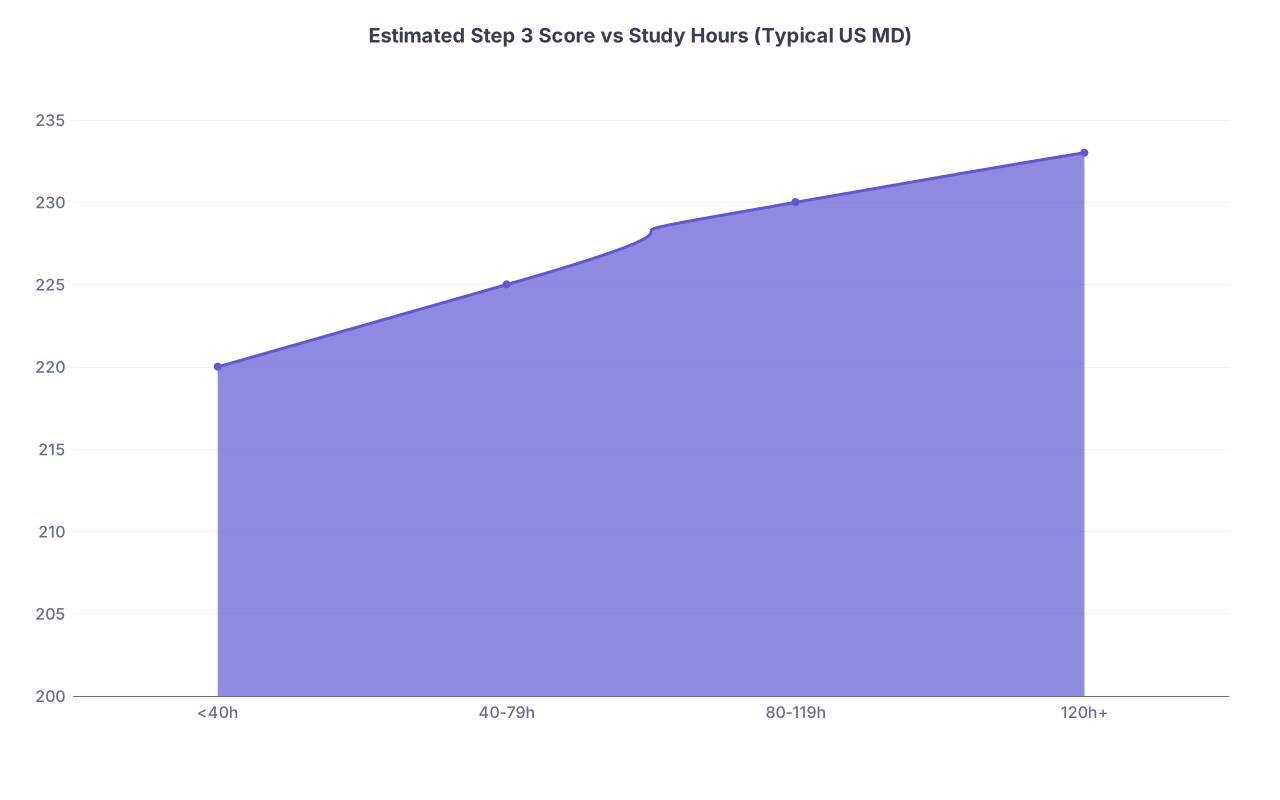
| Category | Value |
|---|---|
| <40h | 220 |
| 40-79h | 225 |
| 80-119h | 230 |
| 120h+ | 233 |
This is not a causal randomized trial. But the pattern’s consistent: beyond ~120 hours, marginal gains flatten. You are paying opportunity cost in lost clinical learning or rest.
6.2 Qbank Usage Patterns
From multiple resident surveys and published review articles:
- Residents who complete > 70% of a major Step 3 Qbank (e.g., UWorld) in timed mode tend to pass at very high rates (> 95%)
- Below 50% completion, especially if done in tutor mode only, fail rates climb noticeably
I have seen residents with mediocre raw Qbank percentages (~55–60%) pass comfortably because they:
- Finished almost all available questions
- Reviewed explanations aggressively
- Treated Qbank as a learning tool, not an ego metric
The data do not support the myth that you need “> 65% correct” on UWorld to be safe. Volume + review quality matter more than bragging rights.
7. Planning Backwards From Licensure: A Data-Driven Strategy
The sensible way to approach Step 3 is not “how do I crush this for my ego,” but:
- What state(s) am I likely to seek licensure in first?
- What are their rules on attempts, timelines, and documentation?
- What is my prior exam track record?
Only then decide how aggressive your target needs to be.
7.1 Example: Three Typical Residents
Let us run three hypothetical profiles.
| Profile | Prior Scores / History | Risk Level | Recommended Strategy |
|---|---|---|---|
| US MD, Strong | Step 1 240, Step 2 250, no fails | Low | 40–60h prep, pass-focused |
| US DO, Borderline | COMLEX passes, Step 2 220 | Moderate | 80–100h prep, early exam |
| IMG, Prior Failures | Step 1 2x fail, Step 2 215 | High | 120h+, strict Qbank+CCS |
For the first resident, the data say: use Step 3 as a medium-effort hurdle, not a new obsession. Get it done, avoid failure, move on.
For the third, Step 3 is a pivotal risk event. Another exam failure could materially limit:
- State licensure options
- Fellowship chances
- Visa flexibility
That person deserves a structured plan, not the usual “I’ll do questions on night float” fantasy.
7.2 Timing vs Performance
Another important trend: early PGY‑1 test takers do not always score higher. Clinical experience matters, especially for Step 3 CCS and management-heavy MCQs.
From aggregate experiences across programs:
- Taking Step 3 before 6 months of residency often correlates with:
- Slightly lower scores
- Occasionally higher fail risk in weaker test takers
- Taking it between 9–18 months into residency tends to be the sweet spot for most:
You have:
- Enough clinical exposure to manage bread-and-butter medicine
- Not yet deep into senior responsibilities and call coverage chaos
There are exceptions (visa deadlines, program requirements), but the statistical sweet spot is not “as early as possible.” It is “soon enough to be useful, late enough to leverage residency exposure.”
8. Practical Data-Driven Guidelines
Compressing this into actual actions:
Map your licensure targets
- Pick your likely state(s)
- Read their board FAQ and statutes once, not Reddit interpretations
- Look specifically for: attempt limits, 7-year USMLE rules, extra requirements for IMGs
Stratify your Step risk
- Strong prior record, no fails → main risk = complacency
- Borderline prior record or fails → Step 3 is a pivotal exam, treat it as such
Allocate study hours rationally
- Low risk: ~40–60 hours + majority of a Qbank + CCS practice
- Moderate: ~80–100 hours + nearly complete Qbank + detailed review
- High: 120+ hours + faculty support, remediation on weak systems, and honest self-assessment
Aim for “comfortably above pass,” not perfection
- The data show no disproportionate reward for a 240 vs 225 on Step 3 in most real-world licensure scenarios
- Below 210 and especially near the pass line, worry more about what it implies about your fund of knowledge and fatigue than the number itself
Protect your attempt count
- Failing Step 3 once is salvageable, especially with improved performance on retake
- Multiple failures begin to trigger hard rule-based problems in several states

9. Misconceptions the Data Flatly Contradict
Let me be blunt about a few common myths.
“You need 230+ on Step 3 for state licensure.”
False in nearly every US jurisdiction. You need a pass. The small subset of boards with numeric language almost always map that to “passing standard,” not a higher bar.“Programs do not care about Step 3 at all.”
Misleading. Many programs treat it as a checkbox, yes. But if you fail—or barely pass with a history of earlier problems—it will absolutely come up in evaluations and letters.“You might as well wing it; everyone passes.”
Tell that to the 5–10% who do not. Retake pass rates drop significantly. Attempt number matters more than many residents realize until they are in trouble.“Step 3 is easier than Step 2 so you do not need to study.”
Subjectively easier for some, harder for others. The CCS format alone is enough to trip up people who are clinically competent but unfamiliar with the interface and timing.“If you crushed Step 1/2, you can ignore Step 3.”
You can reduce prep time, not eliminate it. I have seen 250+ Step 2 grads fail Step 3 because they underestimated fatigue, scheduling, and CCS.
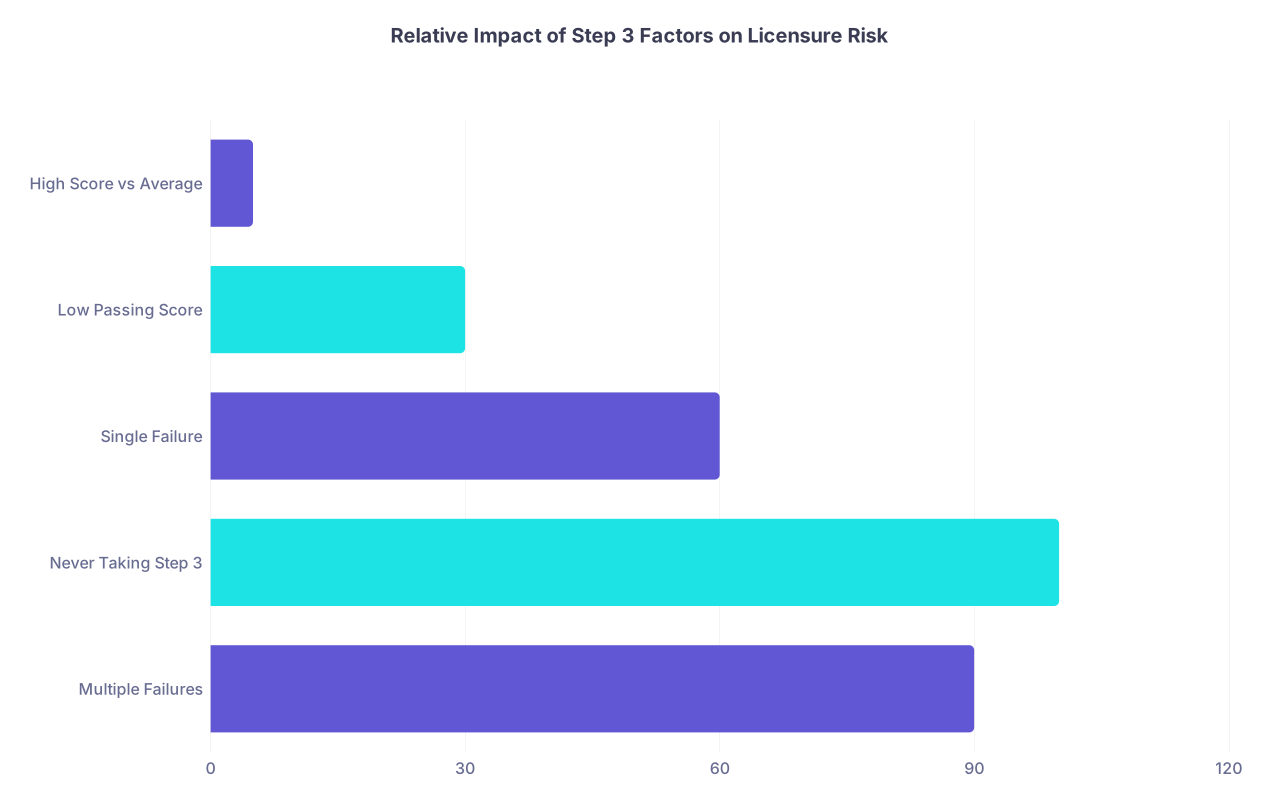
| Category | Value |
|---|---|
| Multiple Failures | 90 |
| Never Taking Step 3 | 100 |
| Single Failure | 60 |
| Low Passing Score | 30 |
| High Score vs Average | 5 |
Interpretation: from a state board’s perspective, the main red flags are:
- Not taking the exam at all
- Failing repeatedly
The difference between a 220 and 240, by contrast, has minimal direct impact on licensure in most states.

10. Key Takeaways
Three points, distilled:
- For most physicians, state licensure depends on “pass Step 3 within attempt/time limits,” not hitting some magical high score. The statistical bar is low compared with typical resident performance.
- The real risk is failing Step 3 and accumulating attempts, not scoring 215 instead of 235. Attempt count and overall exam history affect licensure options more than marginal score differences.
- A data-driven prep plan—matched to your prior performance and licensure goals—lets you invest just enough effort to clear the bar comfortably without wasting months chasing a number that almost no board cares about.
FAQ (exactly 5 questions)
1. Do any states have an explicit numeric Step 3 cutoff above “pass”?
A tiny minority have legacy language like “minimum score 75,” which in modern USMLE terms maps to “passing score.” There are no widely used state requirements that demand, for example, ≥ 220 on Step 3. Where you see stricter policy, it is almost always around attempt limits or completion within a fixed number of years, not a higher passing threshold.
2. How many Step 3 attempts can I use before state licensure becomes a problem?
Most states allow 3–6 attempts per Step, but several impose tighter limits (often 3) before requiring formal board review or additional training. Once you reach a third failure, you start to run into hard regulatory walls in multiple states. From a practical standpoint, you really want to keep Step 3 to ≤ 2 attempts if you can, especially as an IMG or someone planning to move across states.
3. If I scored low on Step 1/2, can a strong Step 3 score repair my record for licensure?
For state licensure, a strong Step 3 mainly confirms that you meet current competence standards; it does not erase prior failures from the record. Boards look at the entire exam history. For programs and fellowships, a clear upward trajectory (e.g., 205 → 220 → 235) can help make a narrative of improvement credible, but it does not make prior failures vanish in the eyes of risk-averse committees.
4. When is the statistically best time in residency to take Step 3?
For most residents, the data and experience converge on 9–18 months into residency. By then you have enough clinical context to handle CCS and management questions, but you are not yet buried in senior responsibilities. Taking it too early (first few months) carries a higher risk of low scores or failure for those with weaker Step 2 backgrounds. Delaying until late PGY‑2 or PGY‑3 sometimes collides with promotion, fellowship, or visa timelines.
5. If my Step 3 score is barely above the passing threshold, should I worry about getting a license?
If it is a first-time pass, with few or no prior exam issues, most state boards will simply see “pass” and move on. The number itself is unlikely to block licensure. You should worry more if a borderline pass appears after multiple earlier failures or very low Step 2 performance; that pattern can trigger closer scrutiny by programs and occasionally by boards. Use the result as feedback: shore up weak knowledge areas before board certification exams, which have higher stakes for your long-term career.