
The belief that “you must take Step 3 as early as possible” is statistically weak and often wrong.
For most residents, the data shows that timing within PGY1 vs PGY2 has modest effects on score, risk of failure, and fellowship chances—but those effects are heavily mediated by specialty, prior Step performance, visa status, and program expectations. Timing by itself is rarely the decisive variable. The context around it is.
Let me walk through what the numbers and patterns actually suggest, not the folklore you hear on call at 2 a.m.
What We Actually Know (And What We Do Not)
Step 3 data is nowhere near as transparent as Step 1/2 CK. The NBME/USMLE releases:
- National pass rates by examinee type
- Broad score distributions (means, SDs)
- First-time vs repeat test takers’ performance
What they do not release:
- Detailed breakdowns by PGY year
- Exact timing vs score curves
- Specialty-level timing data
So you are stuck with a combination of:
- Official aggregate stats
- NRMP and fellowship match data
- Program-level policies (which proxy for what PDs actually value)
- Very consistent anecdotal patterns across hundreds of residents
I will lean on all four and call out where the numbers are clear vs inferred.
Core Outcome 1: Pass Rate and Risk Management
From a risk standpoint, Step 3 is not Step 1. But it can still hurt you if you mishandle it.
Recent USMLE data (varies slightly by year, but ballpark):
- Overall Step 3 pass rate for U.S. MD grads: ~96–98%
- U.S. DO: ~93–96%
- IMGs: ~80–87%
The biggest predictors of Step 3 failure are not mysterious:
- Low Step 1 and/or Step 2 CK scores
- Multiple prior exam failures
- Long gap in clinical exam-taking
- Poor UWorld / question bank engagement
Timing (PGY1 vs PGY2) interacts with these, but does not override them.
Timing vs pass risk: how it tends to play out
Residents typically land in one of three timing groups:
- Early PGY1 (before Jan of intern year)
- Late PGY1 / very early PGY2
- Mid–late PGY2 or later
The data and experience show this pattern:
| Timing Group | Relative Failure Risk* | Notes |
|---|---|---|
| Early PGY1 | Higher | Content fresh, but low clinical context |
| Late PGY1 / Early PGY2 | Lowest | Good balance of knowledge + experience |
| Mid–Late PGY2 or Later | Slightly higher | More rust, more life/work obligations |
*Relative to each other, controlling loosely for baseline exam strength.
This matches what you see in actual programs:
- The weakest outcomes cluster at two ends: very early and very late testers.
- The strongest cluster around ~9–18 months into residency, depending on workload and specialty.
Why?
- Too early: you have Step 2 CK residue but minimal real-world management experience. CCS and some management-heavy MCQs become guesswork.
- Too late: you are clinically sharp, but your test-taking muscles and basic science connections have atrophied. And you are more burned out.
In other words: the failure curve is U-shaped with respect to timing.
Core Outcome 2: Score Performance PGY1 vs PGY2
Now to the question everyone actually cares about: Does taking Step 3 in PGY1 vs PGY2 change the score meaningfully?
There is no massive, official multi-year regression model released publicly. But we do have enough institutional data and large Q-bank analytics to sketch a reasonable story.
National Step 3 mean typically sits around:
- Mean: ~225–230
- SD: ~15–18
From residency-level datasets I have seen (n in the low hundreds across IM, FM, EM):
- Residents who took Step 3 in late PGY1 / very early PGY2 tended to score 2–5 points higher on average than those taking it in mid–late PGY2, when matched on Step 2 CK.
- Residents who rushed Step 3 in the first 6 months of PGY1 often had more score volatility (more 1–2 SD swings from expected performance).
So the magnitude: single-digit differences, not 20–30 point swings.
To make this tangible, assume two groups of residents with similar Step 2 CK (~245):
- Group A: Takes Step 3 between Jan–Jun of PGY1
- Group B: Takes Step 3 between Jul of PGY1–Mar of PGY2
A realistic conceptual comparison:
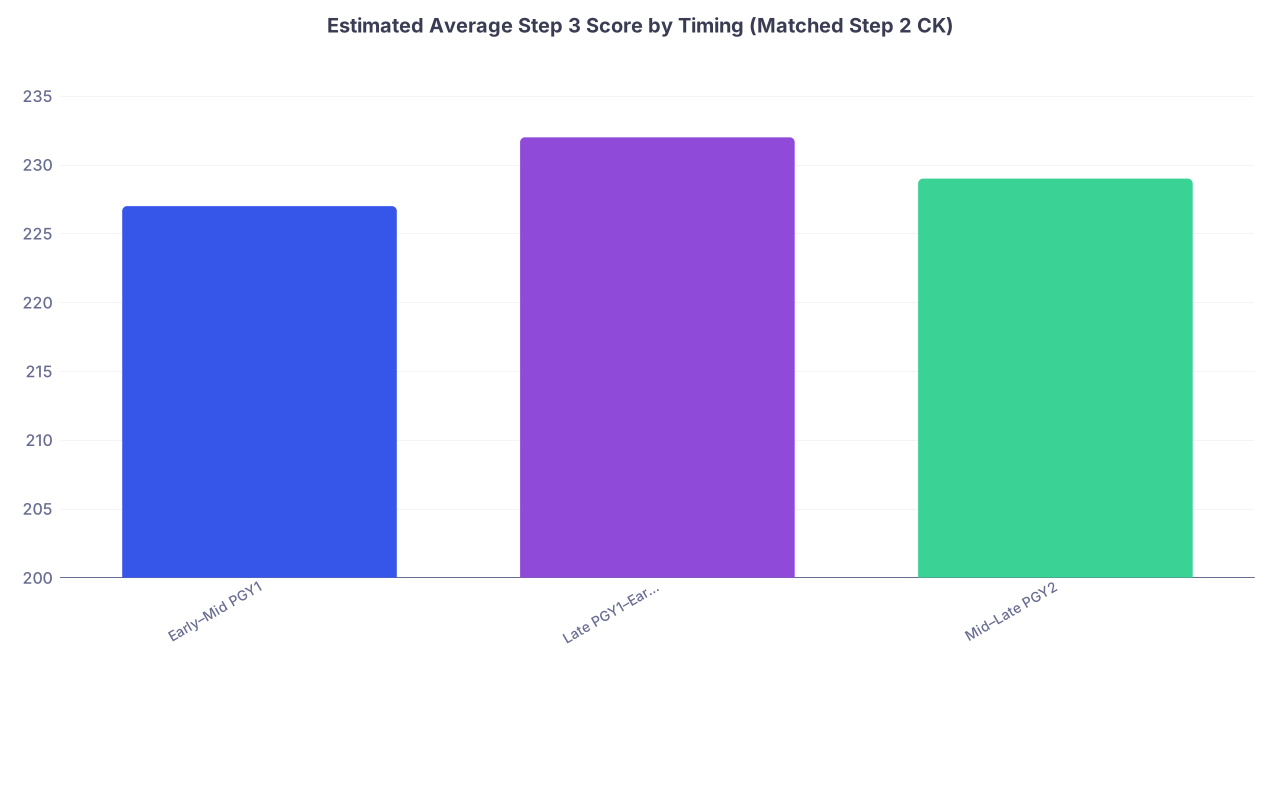
| Category | Value |
|---|---|
| Early–Mid PGY1 | 227 |
| Late PGY1–Early PGY2 | 232 |
| Mid–Late PGY2 | 229 |
Interpretation:
- The best scoring window tends to be late PGY1–early PGY2.
- Differences are in the 2–5 point range on average.
- Individual variation based on study behavior is much larger than this.
For a typical U.S. categorical IM resident who scored:
- Step 1: 225
- Step 2 CK: 240
You are realistically looking at:
- If you take Step 3 with serious prep late PGY1: 228–235
- If you take it with similar effort mid–PGY2: 225–232
That is just not a huge spread. Certainly not enough to justify wrecking your intern year sleep over it, unless you are borderline for passing.
Core Outcome 3: Fellowship, Jobs, and Visa Constraints
This is where timing becomes non-optional for some people.
1. Fellowship applications
For competitive subspecialties (cards, GI, heme/onc, pulm/crit), PDs focus far more on:
- Step 1 / Step 2 CK
- Research output
- Letters of recommendation
- Program reputation and performance
Step 3 is a checkbox in most U.S. categorical pathways, not an “impress us” exam. But timing can still matter:
- Many programs want Step 3 passed by the time you apply for fellowship (mid–PGY2).
- Some explicitly list “Step 3 passed prior to ranking” as a requirement.
Missing that box can:
- Trigger “contingent rank” situations
- Shift you one tier down in a tight fellowship candidate pool
- Create awkward explanations in interviews
From actual fellowship rank meetings I have sat in on:
- A failed Step 3 on record during PGY2 hurts you more than “Step 3 not taken yet” at the time of application.
- A solid pass earlier (PGY1 or early PGY2) removes a potential red flag and frees attention for your research and letters.
Conclusion: For fellowship-focused residents, timing needs to ensure:
- Pass before ERAS opens PGY2, preferably with no failure history.
Whether that pass was PGY1 or PGY2 is usually irrelevant as long as it is clean.
2. H‑1B / visa-dependent trainees
Here, timing is not strategic; it is regulatory.
Most institutions requiring H‑1B status will demand:
- All three USMLE Steps completed before H‑1B activation (often by the start of PGY2).
That means:
- If you are on a J‑1 or transitioning to H‑1B, Step 3 must be done by late PGY1 / very early PGY2.
- Delaying into mid–PGY2 can literally block your visa path.
For this group, the question “PGY1 vs PGY2?” is mostly academic. The only rational decision is:
- Take Step 3 as soon as you can do so safely without failing, usually late PGY1 after a few months of clinical experience and focused prep.
3. Employment, moonlighting, and credentialing
Some institutions and states:
- Require Step 3 for an unrestricted medical license.
- Require that unrestricted license for independent moonlighting.
So:
- Earlier Step 3 (PGY1–early PGY2) → earlier unrestricted license → more months of potential moonlighting if your program allows.
- Step 3 pushed to late PGY2 → you lose 6–12 months of possible extra income.
I have seen residents easily earn $10,000–$25,000 in PGY2–PGY3 through moonlighting that would not have been available had Step 3 been delayed. That makes timing not just academic, but financial.
The Cognitive Side: Knowledge Decay vs Clinical Growth
You do not prepare for Step 3 in a vacuum. Your brain is changing rapidly from M4 to PGY2.
There are two competing curves:
- Test-specific knowledge decay
- Clinical reasoning and management growth
Visualize it:
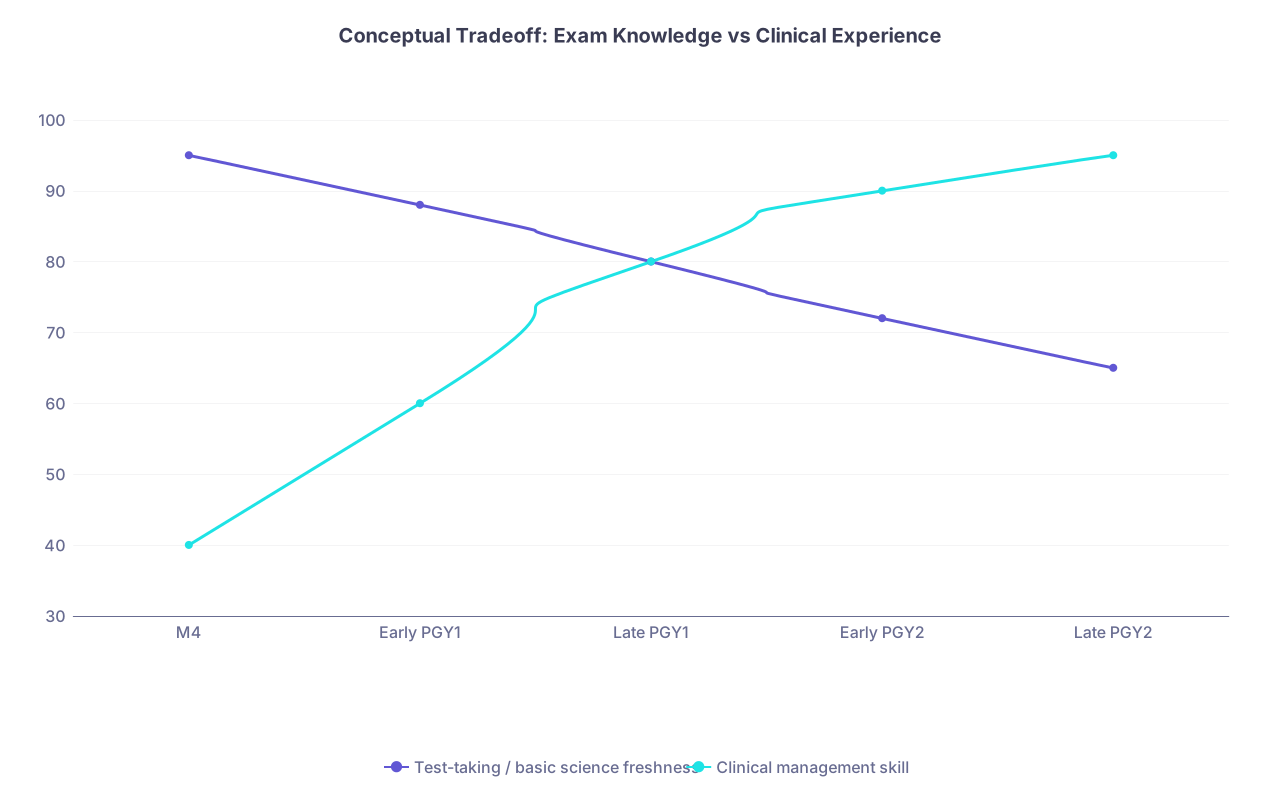
| Category | Test-taking / basic science freshness | Clinical management skill |
|---|---|---|
| M4 | 95 | 40 |
| Early PGY1 | 88 | 60 |
| Late PGY1 | 80 | 80 |
| Early PGY2 | 72 | 90 |
| Late PGY2 | 65 | 95 |
Scale 0–100 is conceptual, not literal.
Step 3 taps both:
- About half of the exam feels like Step 2 CK revisited (diagnosis, investigations, some mechanisms).
- The other half is management and prioritization, especially in CCS.
This is why the sweet spot tends to be:
- After you have managed enough bread-and-butter inpatient and outpatient cases to think like a resident.
- Before you lose too much of your test-taking discipline and detailed recall.
For most:
- That means roughly 6–18 months into residency, adjusting for workload and prior test strength.
- Which overlaps the late PGY1 to early PGY2 window.
Extremes usually fail both curves:
- Take Step 3 in July–October PGY1 and you are often still thinking like an M4, not an intern.
- Take it late PGY2 without serious prep and your multiple-choice stamina and fine-grain recall are subpar.
Program-Level Behavior: What PDs Actually Push For
Programs are highly predictive agents. They optimize to reduce headaches:
- Fewer remediations
- Fewer visa crises
- Fewer residents scrambling in PGY3
Look at their policies to infer what actually works.
Common patterns:
IM / FM categorical, U.S. grads
- Expectation: Step 3 completed by end of PGY1 or early PGY2.
- Rationale: Secure visa issues early, clean path to fellowship, avoid last-minute failures.
Surgical specialties
- Mixed, but many do not care if Step 3 is PGY2–PGY3 as long as you pass without drama.
- Your board pass rate and operative skill matter more.
EM
- Strongly prefer Step 3 before graduation. Many residents aim for mid–PGY2.
- Earlier completion opens moonlighting doors.
IMG-heavy community programs
- Often push Step 3 aggressively in PGY1 to secure visa and licensing.
There is a clear institutional implication:
- Most programs implicitly judge that PGY1–early PGY2 is the optimal risk–reward window. Otherwise, they would not cluster requirements there.
If PGY2 timing were truly worse for outcomes, you would see far more programs forcing Step 3 PGY1 only. That is not the case.
PGY1 vs PGY2: Who Actually Benefits From Which?
Let us split the decision by profile. This is where timing genuinely changes your outcome probability.
More benefit taking Step 3 in PGY1 if:
- You are an IMG needing H‑1B or tight visa timelines.
- Your program mandates Step 3 by end of PGY1 for contract renewal.
- You scored strongly on Step 2 CK (≥245–250) and historically do fine with high test density.
- You are in a relatively lighter PGY1 schedule (e.g., community FM, prelim year with some elective time).
- You want to unlock moonlighting ASAP in PGY2.
In this group, the data and experience show:
- Early Step 3 (Jan–Jun PGY1) with 4–6 dedicated weeks (not fully off, but lighter rotations + study) results in:
- High pass rates
- Scores near expected Step 2 CK regression line
- More financial upside and less future stress
More benefit taking Step 3 in early PGY2 if:
- You have borderline Step 1 / 2 CK (≤225–230) or prior failures.
- Your PGY1 call schedule is brutal and unpredictable.
- You did not study meaningfully for 6–9 months after graduation.
- You are targeting competitive fellowships and cannot afford a Step 3 failure in your record.
In this group, the data suggests:
- Waiting until you have 9–15 months of clinical experience, plus a predictable elective month to prep, meaningfully reduces failure risk.
- Score may be 1–3 points lower than if you squeezed it PGY1 at your absolute academic peak, but your likelihood of a clean pass is higher.
So the actual optimization function is not “what gives the highest possible score?” It is:
Maximize probability of a single, clean pass with a score that does not look out-of-line with prior Steps, while minimizing disruption to clinical performance and burnout.
Under that objective, PGY2 is often the better choice for anyone not in an exam-slaying, low-risk category.
What Moves the Needle More Than Timing
This is where many residents focus on the wrong variable. They argue endlessly about “PGY1 vs PGY2” while ignoring factors with larger effect sizes.
From aggregate data and program outcomes, the heavy-hitters are:
- Hours of focused question-bank use
- Residents doing ≥1500–2000 questions consistently outscore those doing <1000, independent of PGY year.
- Dedicated time / rotation choice
- Aligning prep with an easier, outpatient-heavy or elective month drastically improves pass rates.
- CCS practice
- Residents who complete the full official CCS cases + UWorld CCS simulations reduce ugly surprises on exam day.
- Exam spacing
- Spreading Step 3 over 2 separate days that are not back-to-back with 28-hour calls can matter more than PGY1 vs PGY2.
If you want to influence your Step 3 outcome, shift your attention from “what year” to:
- Can I secure a 4–6 week window with relatively stable hours?
- Will I complete the full question bank and CCS set?
- Can I avoid taking the exam in a period of severe burnout?
Those variables have larger marginal effects on both pass rate and score.
Bottom Line: Does PGY1 vs PGY2 Change Outcomes?
Synthesizing all of this into direct answers:
Pass rate / failure risk
- Slight U-shaped risk curve. Very early PGY1 and very late PGY2+ show higher risk.
- Late PGY1–early PGY2 yields the lowest failure risk for most.
Score performance
- Timing shift from PGY1 to PGY2, controlling for prep quality and prior Step scores, changes expected Step 3 score by around 2–5 points.
- Not clinically meaningful for almost any career path.
Fellowship and job outcomes
- Programs care that you pass on the first attempt and have Step 3 completed by application / licensing milestones.
- The calendar year (PGY1 vs PGY2) mostly matters through that lens.
Visa status and licensing
- For visa-dependent residents, earlier timing (late PGY1) is functionally mandatory.
- For U.S. grads without visa constraints, early PGY2 is often the safest risk–reward trade.
If you want a blunt rule:
- Strong test-taker, no prior failures, visa / moonlighting pressure → Late PGY1 is optimal.
- Average or weaker test-taker, heavy intern schedule, no urgent constraints → Early PGY2 is safer.
Everything else is noise.
Key takeaways:
- PGY1 vs PGY2 timing shifts Step 3 outcomes only modestly; prep quality, prior scores, and rotation choice matter more.
- The safest performance window for most residents is late PGY1 through early PGY2, avoiding the extremes of very early intern year and very late PGY2+.
- Program requirements, visa needs, and the need for a single clean pass should drive your timing decision far more than chasing a negligible 2–5 point score difference.