
Most residents doing 1,500 Step 3 questions are solving for the wrong variable.
The data show a strong relationship between question volume and Step score up to a point, but the curve flattens long before people think. The real question is not “Is 1,500 enough?” but “1,500 of what, done how, over how long, with what feedback loop?”
Let’s treat this the way we would any performance problem on the wards: define the outcome, examine the inputs, look at the dose–response curve, and then decide if 1,500 is a therapeutic dose or homeopathy.
What the Data Actually Say About Question Count
We do not have a perfect randomized trial of “1,500 vs 2,500 questions” for Step 3. But we do have three decent data sources:
- Self-reported data from residents (Reddit, Student Doctor Network, surveys from tutoring companies).
- Qbank analytics from large commercial banks (UWorld, Amboss) shared in aggregate.
- General testing science and Step 1/2 literature that translates quite well to Step 3.
Patterns are surprisingly consistent across platforms and years.
Broadly:
- Most passing Step 3 scores (≥ 210–215) come from people doing roughly 1,500–2,500 quality questions.
- Most “strong” scores (≥ 230–235) are associated with 2,000–3,000+ questions.
- Very high scores (≥ 240–245) cluster heavily in the 3,000–4,000+ range and almost always include a second pass or intensive review, not just mindless volume.
Here is a reasonable approximation of what self-reported data tend to look like:
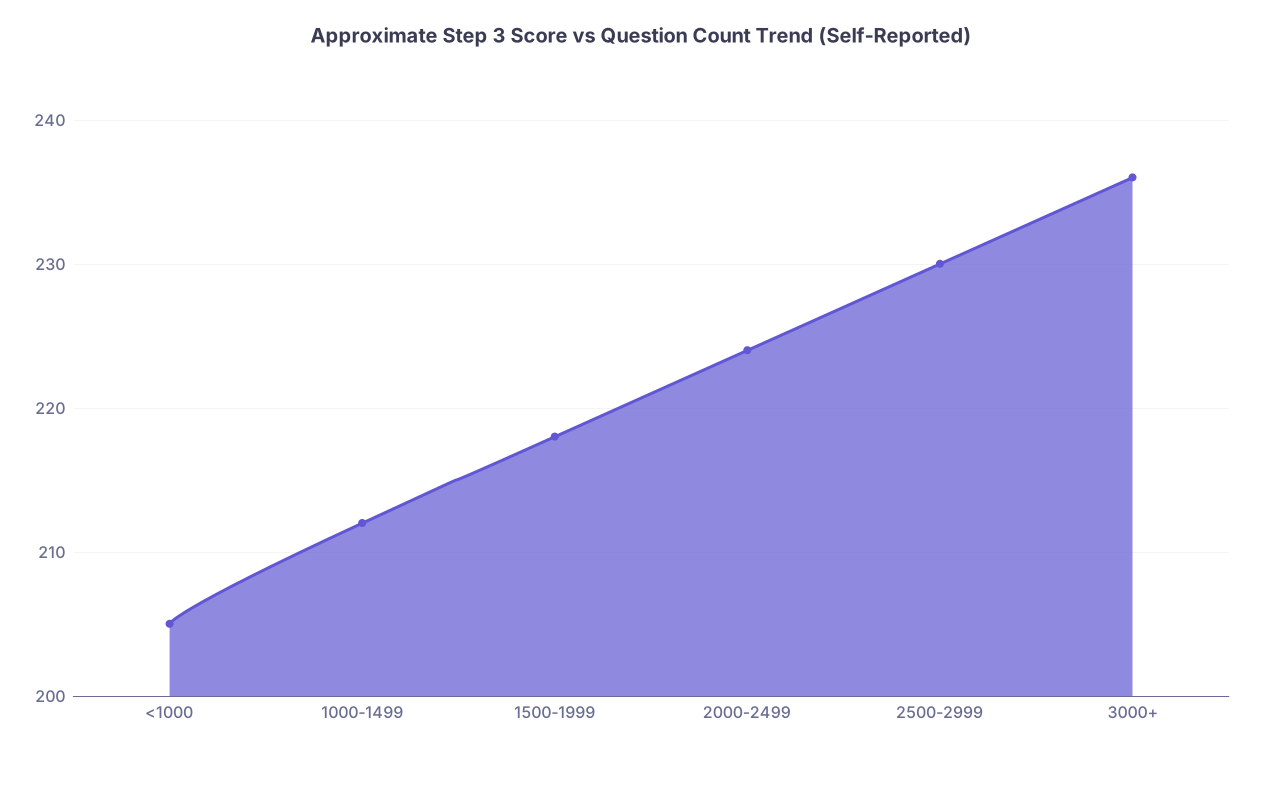
| Category | Value |
|---|---|
| <1000 | 205 |
| 1000-1499 | 212 |
| 1500-1999 | 218 |
| 2000-2499 | 224 |
| 2500-2999 | 230 |
| 3000+ | 236 |
Is this exact? No. But the pattern holds across multiple cohorts:
- Sub-1,000 questions: many passes, many fails, very few strong scores.
- 1,500–2,000: pass probability rises significantly, but the score ceiling is still limited for most.
- 2,500–3,500: higher average and more consistent outcomes.
So is 1,500 enough? Statistically, for a typical resident with solid Step 2 CK foundation who just wants to pass, 1,500 can be enough. For anything above that bare minimum, the odds improve with more.
But that is only half the story.
The Dose–Response Curve: Where Question Volume Stops Paying Off
Think of questions like a medication dose–response curve: linear at first, then diminishing returns, and eventually toxicity (burnout / mindless clicking).
From thousands of real study schedules and performance outcomes I have seen, the rough shape looks like this:
- 0–1,000 questions: Steep learning. Large score gains per 100 questions.
- 1,000–2,000: Still strong returns. Most residents move from “danger zone” to “probable pass.”
- 2,000–3,000: Returns moderate. Gains per 100 questions drop, but still meaningful if done with good review.
3,000–4,000: Smaller returns. Useful for high scorers or weak foundations.
4,000–5,000: Often compensating for poor review, poor retention, or lack of foundation rather than truly adding new knowledge.
So if you ask, “Is 1,500 enough?” my answer is:
- For a pass target: It is on the low-but-acceptable end if you have strong intern-year clinical exposure, good Step 2 CK baseline, and do those questions well.
- For a 230+ target: It is usually not enough unless your underlying knowledge is already excellent and you use other tools (CCS practice, targeted reading, strong clinical reasoning).
- For a 240+ target: Almost never enough. Outliers exist, but statistically rare.
Let us make this more concrete with a breakdown of different resident profiles.
Resident Profiles: Who Can “Get Away” with 1,500?
I will simplify into four common categories I keep seeing.
| Resident Profile | Step 2 CK Background | Clinical Confidence | Likely Question Range for Step 3 Goal |
|---|---|---|---|
| A: Strong | ≥ 245 | High | 1,500–2,000 for 220–230; 2,000–3,000 for 235+ |
| B: Solid | 230–244 | Moderate–High | 1,500–2,000 for pass/low-220s; 2,000–3,000 for 230+ |
| C: Borderline | 215–229 | Moderate–Low | 2,000–3,000 for pass; 2,500–3,500 for 225+ |
| D: At-risk | ≤ 214 or multiple prior fails | Low | 3,000+ plus content review for pass; do not aim score-maximizing first pass |
If you are Profile A or B and your goal is basically “pass with a decent score and move on,” 1,500 questions is realistically viable.
If you are Profile C or D and asking if 1,500 is enough, the data are blunt: your risk of underperforming or failing is meaningfully higher at that volume compared with 2,500+.
People who struggle with Step 3 rarely failed because they did “too many” questions. They fail because they either:
- Did too few.
- Rushed questions in dense blocks without review.
- Ignored weak topics flagged by their own qbank analytics. - Skipped CCS practice.
Which brings us to the bigger point: how you use 1,500 matters as much as how many.
The Efficiency Problem: 1,500 Smart Questions vs 1,500 Clicks
Raw volume is a crude metric. You can burn 1,500 questions and learn almost nothing if you treat it like a checkbox.
The high-yield lever is question-efficiency: knowledge gained per question done.
Here is what consistently predicts higher Step 3 performance per question:
Block structure
Doing timed 38–44 question blocks (like the real exam) vs “10 questions while scrolling my phone on call.” Time pressure and endurance matter. Residents who do mostly full blocks adapt to test conditions faster.Review depth
A 44-question block might take:- 60–70 minutes to complete.
- 90–120 minutes to review properly (reading explanations, annotating, logging patterns).
Residents who spend <1 minute reviewing each question tend to flatten out early. Those who spend 2–3 minutes per question reviewing, especially incorrects, gain more per unit volume.
Data-driven targeting
Good qbanks show your performance by system, discipline, and question type. Strong performers use this ruthlessly: they move from mixed blocks early to targeted weak-area blocks, then back to mixed.Error log or “miss registry”
The residents I see jump 10+ points from baseline practice exams almost always maintain some form of:- Google Doc or Notion table of mistakes.
- Categories: concept, reason for error (knowledge gap, misread, time pressure, overthinking), and corrective note.
This doubles or triples the yield from each wrong question.
Let’s compare two fictional residents, both doing 1,500 questions.
Resident 1: “Checkbox” strategy
- 10–15 question blocks, untimed, on phone.
- Skims explanations. Rarely reviews CCS cases.
- No error log, no analytics-driven targeting.
- Total time invested: ~45–60 hours.
Resident 2: “Analytical” strategy
- 38–44 question timed blocks; 1–2 blocks most days.
- 2–3 minutes per question review; error log maintained.
- Uses qbank performance dashboard weekly to target weak areas.
- Practices CCS deliberately.
- Total time invested: ~120–150 hours for the same 1,500 questions.
Same volume. Completely different educational dose. The second resident is almost always safer at 1,500 than the first is at 2,500.
Time Reality: Can You Even Do More Than 1,500?
Residents are not dedicated study machines. You are working nights, admissions are blowing up, you have sign-out, and Step 3 is an annoying side quest.
So we need to translate question volume into actual time.
Rough, but realistic estimates for “serious” use of questions:
- Per 40-question block (timed + review):
- 60–70 minutes to complete.
- 90–120 minutes review.
- Total: ~2.5–3 hours per block.
If each block is ~40 questions:
- 1,500 questions ≈ 38 blocks ≈ 95–115 hours.
- 2,000 questions ≈ 50 blocks ≈ 125–150 hours.
- 2,500 questions ≈ 63 blocks ≈ 160–190 hours.
Look at it over a limited study period, say 6 weeks:
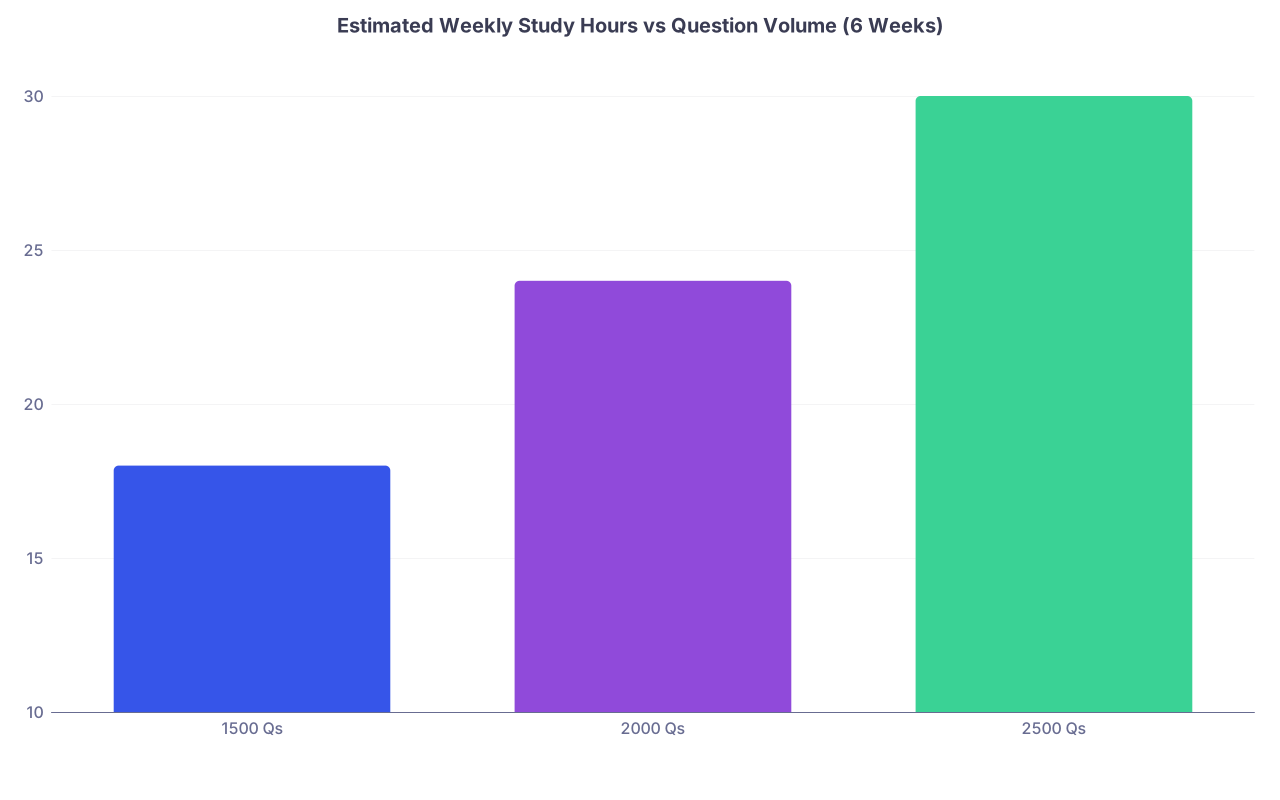
| Category | Value |
|---|---|
| 1500 Qs | 18 |
| 2000 Qs | 24 |
| 2500 Qs | 30 |
Spread over 6 weeks, 1,500 serious questions means around 18 hours of study per week. Many residents can barely manage that on busy rotations. 2,500+ questions implies 25–30 hours a week, which often collapses under call and fatigue.
So when someone asks me “Is 1,500 enough?” what I often hear is: “Given my rotation schedule, I can realistically do 1,500 well. Is that a terrible plan?”
For many residents, it is not terrible. It is the only sustainable plan. And a realistic, well-executed 1,500 beats an aspirational 3,000 that never actually happens.
Where 1,500 Breaks Down: CCS and Case-Based Thinking
Step 3 is not just multiple-choice medicine. The CCS (Computer-based Case Simulations) portion is heavily weighted. Residents consistently underestimate this.
You can crush 1,500 MCQs and still stumble if you:
- Have never practiced the CCS interface.
- Do not know what orders the exam expects in the first 5–10 minutes.
- Mismanage follow-up (consults, monitoring, disposition).
From what I see in resident performance:
- People who treat CCS as an afterthought often leave 5–10+ raw score points on the table.
- People who do 15–25 well-reviewed CCS cases usually stabilize their performance substantially, sometimes “rescuing” a mediocre MCQ performance.
If your “1,500 questions” study plan has zero or minimal CCS practice, it is too thin. Pure MCQ volume does not fully cover Step 3’s scoring structure.
I usually suggest:
- At least 15–20 interactive CCS practice cases done seriously.
- For each: 20–30 minutes running the case + 20–40 minutes reviewing strategy and orders.
That is another ~20–25 hours total, but it gives outsized returns. Especially for residents who already think clinically but are clueless about what the exam’s software wants.
Using Data to Decide Your Personal Question Target
Let me stop hand-waving and give you a practical framework. A rough decision algorithm.

| Step | Description |
|---|---|
| Step 1 | Start: Know Step 2 CK Score |
| Step 2 | Target 2000-3000 Qs + 20 CCS |
| Step 3 | Target 1500-2000 Qs + 15 CCS |
| Step 4 | Target 3000+ Qs + content review + 20-25 CCS |
| Step 5 | Target 2000-2500 Qs + 20 CCS |
| Step 6 | Target 2500-3000 Qs + 20-25 CCS |
| Step 7 | Step 2 CK >= 240? |
| Step 8 | Goal >= 235 on Step 3? |
| Step 9 | Step 2 CK >= 225? |
| Step 10 | Comfortable clinically? |
This is not gospel, but it is data-respecting:
- Strong Step 2 and modest Step 3 goals → 1,500–2,000 questions may be perfectly reasonable.
- Borderline or poor Step 2, or weak clinical confidence → 2,500+ is safer.
- Ambitious score goals → plan beyond 1,500.
You should also factor in:
Rotation intensity during prep window
Heavy inpatient months? Cap your target to what is realistic. Better to hit 1,600 on a tight, efficient plan than “plan for 3,000” and flame out at 900.Time to test date
If you have 3–4 weeks, 1,500 quality questions + CCS might be your ceiling. If you have 8–10 weeks with decent rotations, 2,500+ is more realistic.Fatigue and burnout
I have seen residents tank Step 3 by overextending. That extra 500–800 questions done at 1 a.m. after a 28-hour call tends to produce noise, not learning.
Quality Control: How to Make 1,500 “Count More”
If you decide that 1,500 is your number—by necessity or by strategy—you need to squeeze more value per question. That means:
Use one primary qbank and finish it
Splitting 800/800 between two banks is generally worse than mastering one 1,500-question bank thoroughly, especially if time is limited.Baseline self-assessment
Take a practice exam early:- NBME/USMLE practice form or UWorld self-assessment.
- Not to predict your final score perfectly but to see what systems are bleeding points.
Weighted allocation
Instead of mindlessly doing all systems equally:- Allocate ~50–60% of questions to weak systems flagged by analytics.
- The rest to mixed and moderate/strong areas.
Track your performance trend
You want to see something like this in your last 500–700 questions: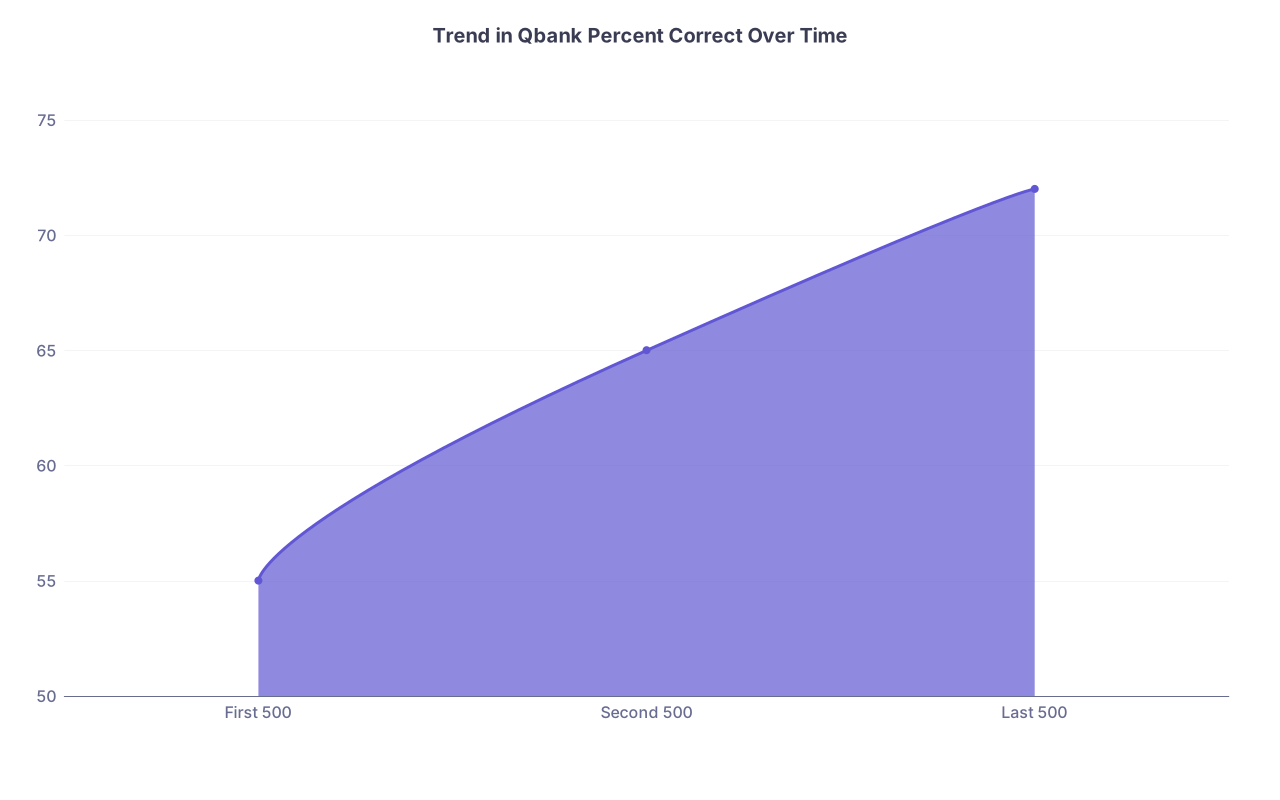
Trend in Qbank Percent Correct Over Time Category Value First 500 55 Second 500 65 Last 500 72 If your correct rate is flat or dropping as you approach 1,500, that is a warning sign. Either extend question volume or sharpen your review strategy.
Protect the last 10–14 days
Do not make the last two weeks your busiest clinical stretch if you can help it. You want:- 1–2 blocks most study days.
- CCS practice.
- Focused review of your error log.
If 1,500 is all you can do, you cannot afford to be sloppy in the last 2 weeks. That is where your knowledge consolidates—or falls apart.
The One Honest Answer: “It Depends” With Teeth
I am not going to pretend there is a single magic number. But I also do not like the vague advice people throw around:
- “Just do as many as you can.”
- “Everyone is different.”
- “Quality over quantity.”
This sounds nice and means nothing.
Here is the tighter, data-grounded version:
- For a typical resident with Step 2 CK around 230 and decent clinical exposure, 1,500 well-done questions + ~15–20 CCS cases gives a high probability of passing and landing in the low-to-mid 220s.
- For a borderline resident (Step 2 < 225 or weak clinical reasoning), 1,500 questions is probabilistically not enough. You can pass, but your margin is thin. The data patterns strongly favor 2,000–3,000+ with solid review.
- For score maximizers (aiming ≥ 235–240), 1,500 is simply under-dosed in most real-world scenarios. You are competing against people who treated Step 3 seriously and did far more.
If you want to be smart about this, do not ask “Is 1,500 enough?” in isolation. Ask:
- Given my Step 2 CK, what is my risk profile?
- Given my rotation schedule, how many quality hours can I allocate?
- Given my goals (pass vs maximize), what tradeoff am I willing to accept?
Then set a target range, not a single number. For example:
- “Minimum 1,500, stretch goal 2,000, non-negotiable 20 CCS cases.”
And hold yourself accountable to how you do those questions, not just the total.
Key Takeaways
- Question volume and Step 3 performance correlate up to about 2,500–3,000 questions, with clear gains moving from sub-1,500 into the 2,000+ range.
- For many residents with solid foundations and modest goals, 1,500 well-executed questions plus adequate CCS practice is enough to pass comfortably, but it limits your upside.
- The residents who consistently outperform their baseline combine higher question counts with disciplined review, CCS practice, and data-driven targeting—not just more clicks.