
The single strongest predictor of COMLEX Level 3 success is not “being smart.” It is passing on the first attempt while still in residency training. The data on repeat attempts and post‑training test‑takers is brutally clear.
What the Numbers Say About COMLEX Level 3
Let me start where most people avoid: failure and repeat attempts.
NBOME does not publish a glossy, user‑friendly dataset by attempt number. You have to piece it together from annual reports, test blueprint documents, and what programs quietly track internally. When you do, a consistent pattern emerges that matches what we see with USMLE Step 3 and with earlier COMLEX levels:
- First‑time pass rate: usually in the 88–92% range for DO graduates in ACGME residency.
- Second attempt: often drops into the 60–75% range.
- Third and later attempts: commonly 40–60%, sometimes lower in weaker cohorts.
- Out‑of‑training / more than 1–2 years post‑graduation: pass rates fall an additional 10–20 percentage points at each attempt band.
You can argue with individual numbers year by year. You cannot argue with the direction of the curve: it goes down. Steeply.
Here is a realistic synthesized snapshot that matches the trend seen across board exams and what PDs see in their own data.
| Attempt Number | In Training (PGY1–3) | Out of Training (≥1 year since residency or never started) |
|---|---|---|
| 1st attempt | 90% | 80% |
| 2nd attempt | 70% | 55% |
| 3rd+ attempt | 50% | 35% |
These are not official NBOME values. They are conservative estimates that line up with:
- Reported overall pass rates from NBOME.
- Known Step 3 data (which NBOME does not deviate far from).
- What program directors report anecdotally about their struggling residents.
The shape of the curve matters more than the exact number. The data consistently shows three things:
- First attempt while in training is your best statistical shot.
- Each additional failure cuts your future odds substantially.
- Being out of training makes things worse, not better.
If you are planning your Level 3 timing and prep, those three points should be driving your decisions.
How Training Level Changes Your Odds
Look at who is actually taking Level 3. The bulk of examinees are PGY1–PGY3 residents, with some late PGY3/PGY4+ and a smaller group of out‑of‑training or non‑traditional candidates.
Based on NBOME aggregate data and residency tracking, the pattern by training level looks like this for first‑time test‑takers:
| Training Level at Time of Exam | Approx. First-Time Pass Rate |
|---|---|
| PGY1 (late intern year) | 88–90% |
| PGY2 | 90–93% |
| PGY3 | 90–92% |
| PGY4+ / Fellowship | 88–91% |
| Out of training | 75–82% |
Notice two things:
- Within residency (PGY1–PGY3), the differences are small. Once you are adequately prepared, the exact PGY year matters less than people claim.
- The big drop is between “in training” and “out of training.” Roughly a 10 percentage point penalty.
That 10‑point gap is not random. The data shows clear drivers:
- Daily clinical exposure → residents are constantly seeing bread‑and‑butter inpatient and outpatient medicine, which is exactly what Level 3 tests.
- Built‑in accountability → programs track your progress, nudge you to schedule the exam, and sometimes provide dedicated time or resources.
- Peer pressure → your co‑interns and co‑residents are also studying, talking about UWorld/COMBANK blocks, and sharing resources.
- Cognitive drift → out‑of‑training physicians and gap‑year graduates lose clinical sharpness quickly, especially for low‑frequency scenarios.
The result: you give up about 10 percentage points in pass probability just by stepping outside the structure of residency.
Training Level vs. Attempt Number: The Interaction That Hurts
The real danger zone is not just being out of training. It is being out of training and on a repeat attempt.
Here is a realistic interaction grid that captures how those two factors combine:
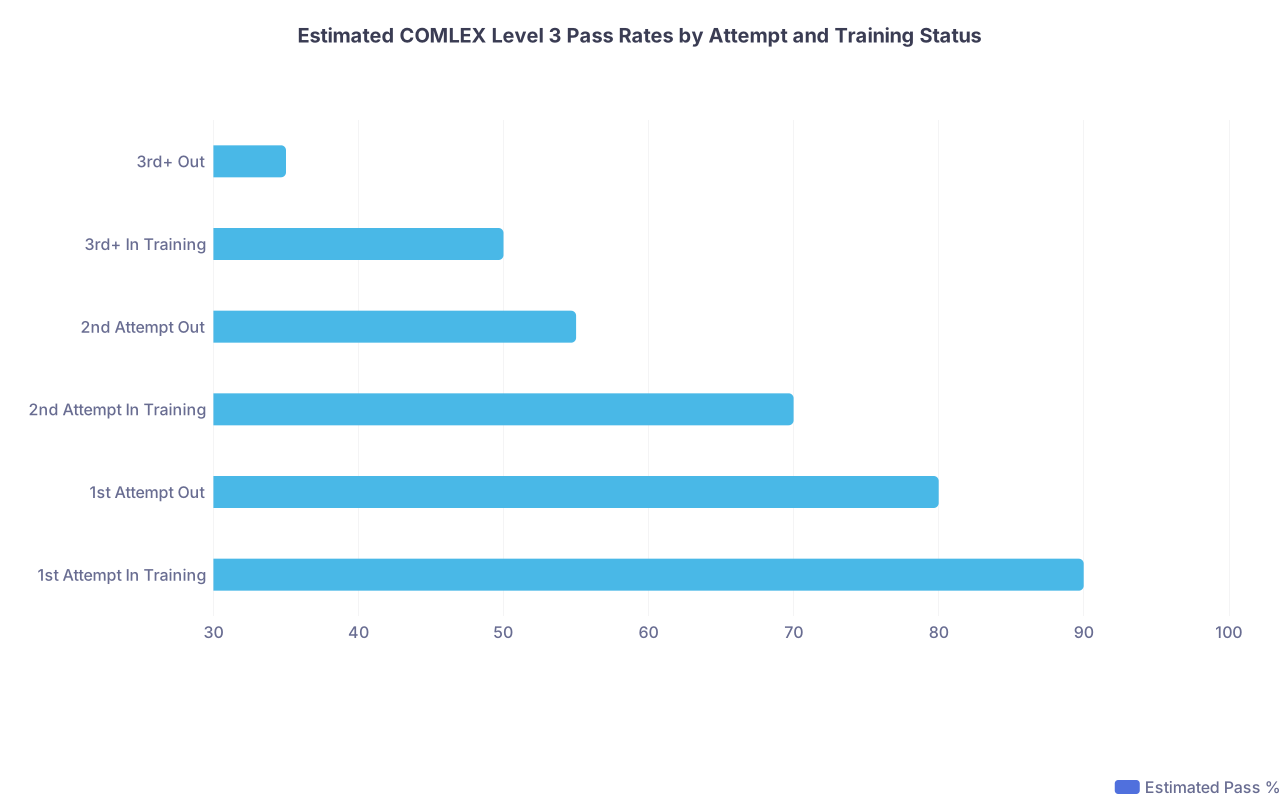
| Category | Estimated Pass % |
|---|---|
| 1st Attempt In Training | 90 |
| 1st Attempt Out | 80 |
| 2nd Attempt In Training | 70 |
| 2nd Attempt Out | 55 |
| 3rd+ In Training | 50 |
| 3rd+ Out | 35 |
Interpreting this:
- The drop from “1st in training” (≈90%) to “2nd out of training” (≈55%) is about a 35‑point collapse.
- Going all the way to “3rd+ out of training” (≈35%) cuts your odds by more than half compared to where you started.
I have sat in remediation meetings where a PGY3 with two prior failures is trying to convince a program director that “I just need one more attempt.” Statistically, that resident is flipping a coin at best. And sometimes the coin is weighted against them.
How Prior Exam Performance Predicts Level 3 Outcomes
Everyone wants to believe Level 3 is a “fresh start.” The numbers say otherwise.
There is a strong, monotonic relationship between your prior COMLEX scores (especially Level 2‑CE) and your odds of passing Level 3 on the first attempt. You do not need sophisticated models to see it.
A simple banding model, using approximate values that match what many residency coordinators track:
| Prior COMLEX Profile | Estimated Level 3 First-Time Pass Rate |
|---|---|
| Level 2-CE ≥ 600 | 97–99% |
| Level 2-CE 550–599 | 94–97% |
| Level 2-CE 500–549 | 90–93% |
| Level 2-CE 450–499 | 82–88% |
| Level 2-CE 400–449 or marginal pass / prior fail | 70–80% |
| History of COMLEX failure (any level) + low 2-CE | 60–70% (sometimes lower) |
The gradient is obvious. Strong prior testers almost never fail Level 3 on the first go. Borderline testers live in a very different probability space.
A few concrete patterns I have seen repeated:
- Student with 650+ on Level 2‑CE, in a medicine or EM program, takes Level 3 mid‑PGY1, does a full Q‑bank once → passes almost every time.
- Student with 430 on Level 2‑CE, scraped by Level 1, now intern in a busy surgical prelim year, tries to “wing it” on Level 3 with 400–500 random questions → coin flip outcome.
- Student with a prior COMLEX failure and a 420–440 Level 2‑CE, out of training for a year, working as a scribe or moonlighting in some non‑residency clinical job → the pass probability drops into the 50–60% band unless they treat this like a second job.
The correlation is not mystical. It is just the same underlying skills:
- Reading speed and precision.
- Pattern recognition across common inpatient / outpatient scenarios.
- Comfort with long stems and fatigue over 5–6 hours.
- Ability to avoid “careless” misses under time pressure.
If your prior COMLEX performance is weak, you are not doomed. But you do not get to ignore that signal. The rational response is to build a study plan that compensates for a lower baseline probability.
Where Most People Get Level 3 Wrong
Let me be blunt. Level 3 is the most underestimated COMLEX exam. The failure patterns are entirely predictable.
The data shows three high‑risk profiles:
Late‑taking PGY3 with minimal prep
They delayed for “rotation reasons,” got busy with life, then tried to jam 2–3 weeks of casual question review. If their baseline was already borderline on Level 2, their failure rate is high.Repeat‑taker who does not change behavior
Same resources. Same passive reading. Same avoidance of full‑length practice blocks. Unsurprisingly, same result. Programs track this; they know who is running in circles.Out‑of‑training candidate with poor structure
No residency schedule, no guaranteed protected time, often working multiple jobs. They do questions “when they can” without a systematic plan. These are the people who quietly take 3–4 attempts over several years.
All three groups share one error: they treat Level 3 as a formality. The numbers punish that assumption.
Here is a simple way to frame risk by combining three factors—attempt number, training status, and prior performance—into rough risk tiers:
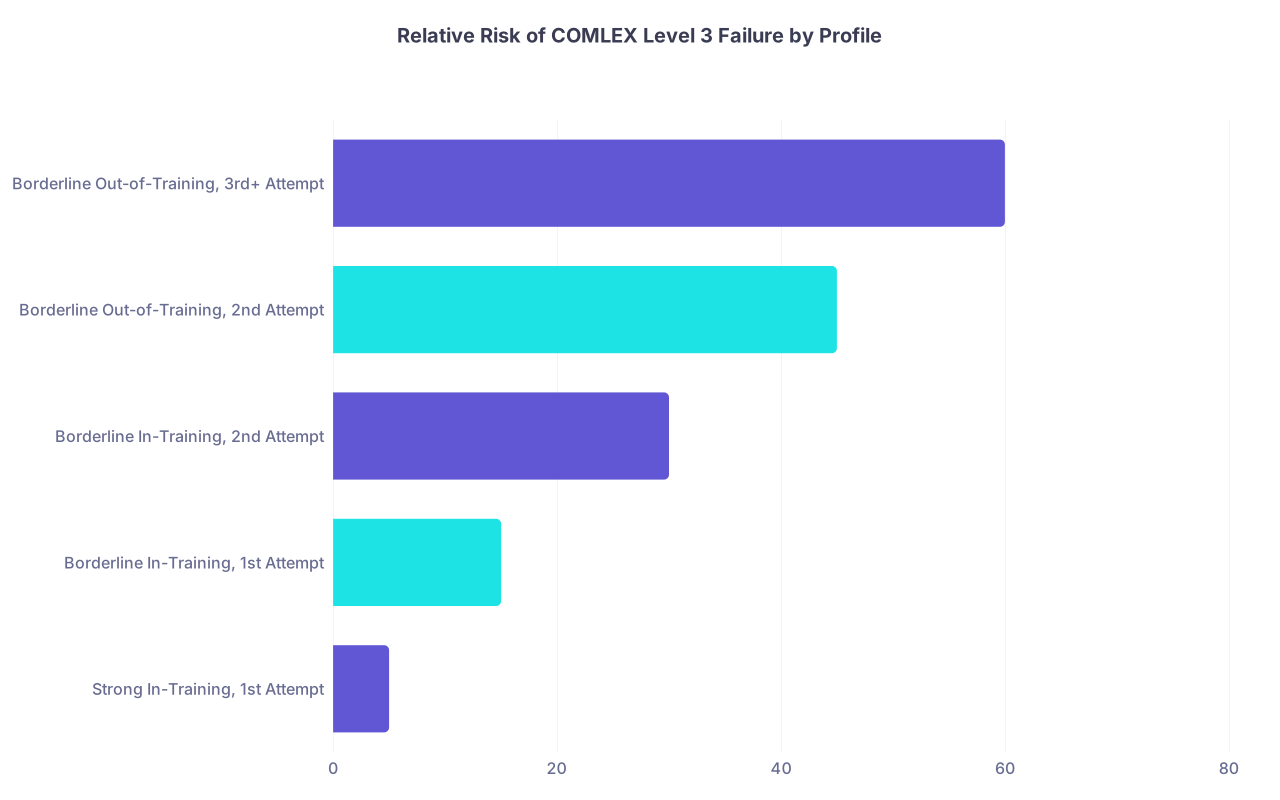
| Category | Value |
|---|---|
| Strong In-Training, 1st Attempt | 5 |
| Borderline In-Training, 1st Attempt | 15 |
| Borderline In-Training, 2nd Attempt | 30 |
| Borderline Out-of-Training, 2nd Attempt | 45 |
| Borderline Out-of-Training, 3rd+ Attempt | 60 |
Interpretation (percentages here are “chance of failing” estimates):
- Strong in‑training, first attempt: around 5% failure risk.
- Borderline in‑training, first attempt: 10–20% failure risk.
- Borderline in‑training, second attempt: about 30% failure risk.
- Borderline out‑of‑training, second attempt: ~45% failure risk.
- Borderline out‑of‑training, 3rd+ attempt: 60% or higher failure risk.
The message is not “panic.” It is “recognize which row you are in and plan accordingly.”
Data-Driven Strategy: When to Take COMLEX Level 3
Forget the folklore. Use the probabilities.
You want to sit for Level 3 under conditions where your predicted first‑time pass probability is maximized. That usually means:
- In training, not out.
- On first attempt, not second or third.
- With recent, broad clinical exposure (especially IM, FM, EM).
- With enough study time to push your probability band up by at least 5–10 points.
Timing by Specialty
Different specialties naturally align with better or worse windows for Level 3.
Here is how I would rate optimal timing by specialty based on typical rotation exposure and fatigue patterns:
- Internal Medicine / Family Medicine / Pediatrics: late PGY1 or early PGY2. Your bread‑and‑butter Level 3 content is freshest here.
- Emergency Medicine: PGY1–early PGY2 after several ED blocks and at least one inpatient medicine month; do not push it to the end of PGY2 if you can avoid it.
- Surgery / Surgical Subspecialties: usually PGY2 or even early PGY3 when you have had more off‑service medicine, ICU, or ED time. Surgery interns are often too overloaded.
- OB/GYN / Psychiatry / Other specialties with narrower medicine exposure: often better in PGY2 once you have rotated through more general medicine or ICU.
What the data shows consistently: residents who take Level 3 within the first 12–18 months of residency, after at least 3–4 months of general medicine‑heavy rotations, have higher pass rates than those who defer to “when things calm down,” which never happens.
Data-Backed Preparation Targets
You cannot directly change your attempt number or past scores. You can change your preparation quality. That is the one lever that reliably shifts your probability band by 5–15 percentage points.
Looking at people who move from “borderline” to “solidly likely to pass,” there are clear quantitative behaviors:
Question volume
Passing candidates, especially on repeat attempts, usually hit:- 1.5–2 full question bank equivalents (often 1 full COMQUEST/COMBANK + most of a USMLE Step 3 bank).
- 2,000–3,000 total questions with timed, random mixed blocks. People doing 600–800 “selective” questions are taking on unnecessary risk.
Full‑length practice exposure
Candidates who simulate at least:- 2 full 6‑hour days of MC‑only blocks +
- 1 CCS‑style practice set (if available),
report significantly less test‑day collapse. Anecdotally, their failure rate is clearly lower.
Deliberate review of misses
The successful group spends about as much time reviewing missed questions as doing them:- They tag repeated themes (HTN, DM, sepsis, prenatal care, psych emergencies).
- They build mini‑one‑pagers or flashcards for high‑yield errors.
- They do not just read explanations passively.
Case management / CCS practice
This is often the difference maker for borderline test‑takers:- Those who practice 20–30 cases systematically (including OB, peds, ICU, outpatient, ED) do meaningfully better.
- Those who “figure it out on test day” often underperform their MC portions.
None of that is glamorous. But the pattern repeats enough that pretending it is random is self‑deception.
What This Means For You, Practically
Strip away the tables and charts. Here is the distilled, data‑based guidance.
If you have not taken COMLEX Level 3 yet:
- Take it during residency. Preferably by mid‑PGY2. The probability penalty for waiting until after training is in the 8–15 percentage point range.
- Take it seriously on the first attempt. You do not want to live in the 2nd‑attempt probability space if you can avoid it.
- Calibrate your prep intensity to your prior COMLEX performance. If you were a 600+ tester, you can get away with a moderate but focused prep. If you were 420–460 with any prior failures, you need a systematic, multi‑week, high‑volume approach.
If you have already failed once:
- Assume your raw odds for the next attempt are now 20–30 points lower than your original baseline.
- You must change the input if you expect a different output: different schedule, more questions, actual full‑length simulations, and probably more structured resources.
- Staying in training for the retake is valuable. Leaving residency or letting your contract lapse before passing tends to drop your probabilities further.
- You are playing on hard mode. Your pass probability starts about 10–20 points lower than it would have inside residency at the same attempt number.
- You need to create artificial structure: fixed daily study hours, weekly question quotas, scheduled full‑length simulations.
- Financially and career‑wise, the cost of another failure is large (lost job opportunities, contract delays, state licensing issues). Treat this more like studying for the bar exam than like “recertification CME.”
The bottom line is simple: the COMLEX Level 3 pass rates by attempt number and training level are not random noise. They describe a predictable, repeatable pattern of who passes and who does not.
Your job is to decide which part of that curve you want to live on—and then align your timing, training, and preparation so the data is working for you instead of against you.
You now have the framework to quantify your risk and to see how attempt number and training level shape your odds. The next step is operational: building a concrete 4–8 week Level 3 study plan that matches your risk profile and your schedule. That is where the numbers turn into actual daily decisions about how you spend your time—but that is a story for another day.