There are two bad applicants I see over and over.
The first one has done what feels responsible. She wrote out answers to every likely question, rehearsed them until they sounded smooth in her bedroom, and arrived on Zoom ready to “perform.” Then the interview starts, and suddenly every answer has the same polished cadence. Same opening. Same tidy three-part structure. Same suspiciously perfect phrasing. She doesn’t sound confident. She sounds preloaded.
The second applicant goes the opposite direction. He tells himself he wants to be authentic, so he avoids preparation because he doesn’t want to sound scripted. Then he gets asked, “Tell me about yourself,” and somehow burns three minutes wandering through undergraduate biochemistry, a volunteer trip, and a half-finished point about resilience before landing nowhere. Authentic? Maybe. Effective? Not even close.
That’s the real problem. Most applicants either over-script or under-prepare. And both versions make interviewers work too hard.
Let me tell you what really happens on the program side. Faculty are not scandalized that you have notes in a virtual interview. Nobody imagines you’re sitting there with an empty desk and a monk-like memory. They know this is Zoom. They know people keep bullet points nearby. What alerts them is not the existence of notes. It’s dependency. It’s when your eyes keep darting away, your answer arrives half a beat too late like you’re retrieving it from a file cabinet, or your emotional tone stays weirdly flat during a personal question because you’re reading language that was written yesterday.
Virtual residency interviews are not memory contests. They’re communication tests under mild pressure. Can you stay organized? Can you answer the actual question? Can you sound like a person while thinking on your feet? That’s what’s being scored, even when nobody says it that bluntly.
So here’s the promise of this article: you can use cheat notes well. In fact, smart applicants should. But the notes have to function as invisible scaffolding, not a script. They should steady you, not speak for you.
And the stakes are real. Programs have limited time and too many applicants. Faculty want authenticity, efficiency, and self-awareness fast. If you can give them clear answers without looking staged, you make their job easier. That matters more than most applicants realize.
(See also: non-verbal communication tips for more.)
What Program Directors Really Notice on Zoom
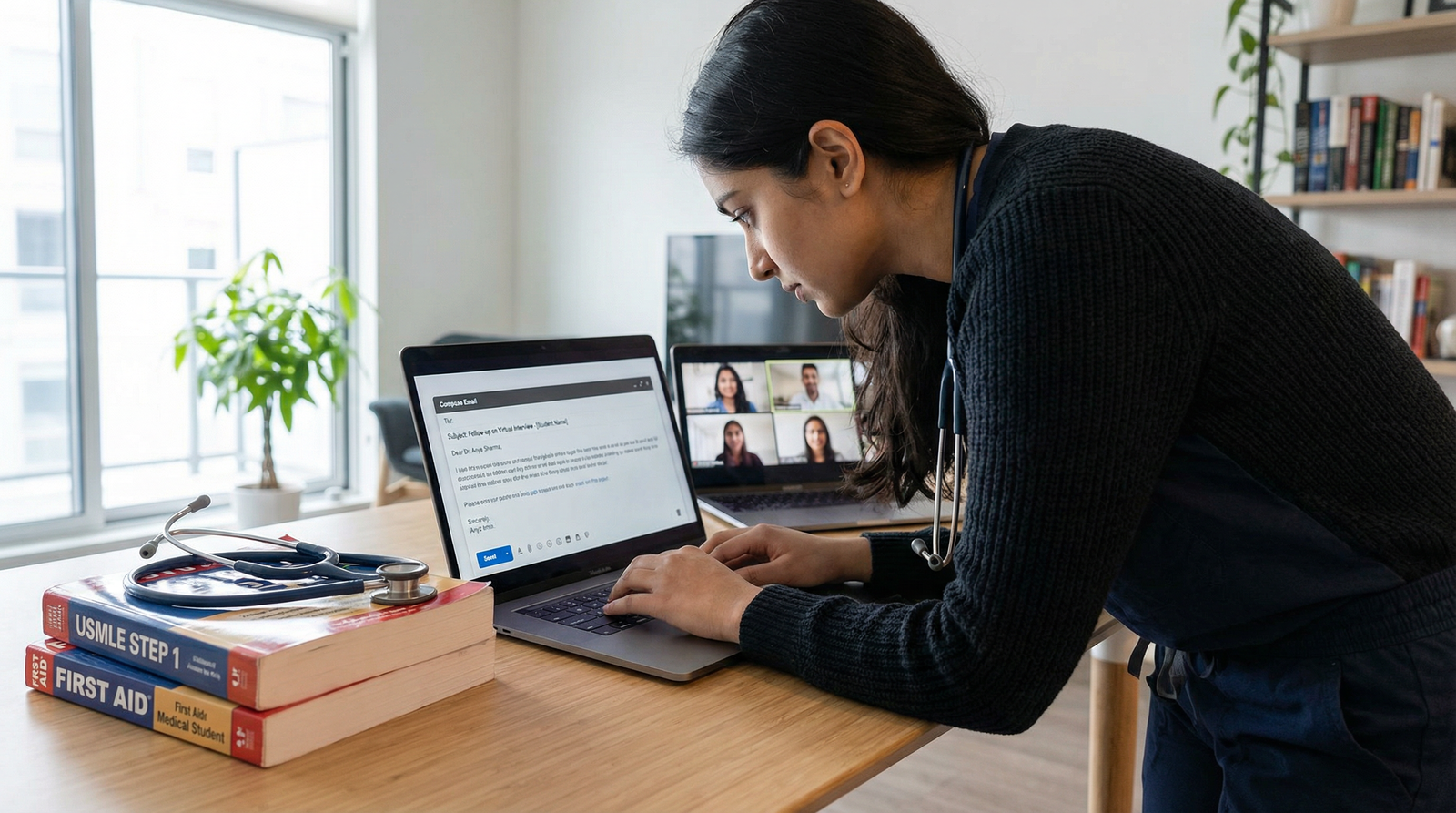
Here’s what faculty notice, even when they’re too polite to say it out loud in the debrief.
First: eye movement. Not all eye movement. Human eye movement. Brief downward glances? Normal. Everybody does it. You look down for a second, gather a thought, come back. No problem. Repeated lateral reading, though—that’s the giveaway. Especially if your eyes move in the same direction every time a question gets remotely challenging. Interviewers may not consciously think, they’re reading, but they absolutely register that something feels off.
Second: delayed answers that sound retrieved rather than considered. There’s a very particular pause that happens when someone is searching notes instead of thinking. I’ve seen faculty describe it as “canned,” “stiff,” or “not fully present.” What they mean is this: the answer doesn’t emerge like a thought. It arrives like a document.
Third: canned transitions. “That’s a great question.” “I’m so glad you asked that.” “I think there are three main reasons.” Once or twice, fine. Every single time? Brutal. It starts sounding like media training for a local school board race.
Program directors, associate program directors, core faculty, and residents don’t all interpret this the same way. PDs usually focus on judgment and fit. If you seem over-rehearsed, they wonder whether this is the real you or a carefully managed version. Residents often notice vibe first. They’re asking themselves a simpler question: would this be easy to talk to at 2 a.m.? Faculty, especially the ones who do lots of interviews, often detect stiffness fastest. They’ve watched enough applicants on Zoom to spot the difference between reflective and rehearsed in under five minutes.
And yes, long pauses matter. Not because you’re forbidden to think, but because the interview is short and virtual fatigue is real. By the fourth or sixth applicant of the day, attention drops. The person who gives concise, human answers becomes far more memorable than the person who delivers technically flawless monologues.
The red flags are usually obvious. Reading full sentences. Answering every question in identical rhythm. Giving a “personal” story with no emotional texture because the wording has been frozen in place. Missing the actual question because you forced in the speech you prepared. That last one is common and disastrous. An interviewer asks about conflict with a team member, and the applicant launches into a leadership story because that’s what they had ready. That’s not preparation. That’s refusal to listen.
The acceptable version of note use looks very different. A fast glance. A recovered keyword. A more organized answer. Maybe a better example than you would’ve remembered under stress. That’s fine. Good, even. The point is not to be note-free. The point is to stay relational. Responsive. Alive.
Build Cheat Notes the Way Strong Applicants Do: Keywords, Not Speeches
This is where strong applicants separate themselves from anxious ones.
Weak applicants build notes like term papers. Paragraphs. Full sentences. Carefully crafted wording. Maybe even highlighted transitions. It feels safer because it looks complete. It is also exactly what gets people caught reading.
Strong applicants build notes as triggers.
That means bullet prompts, story cues, values anchors, and short reminders tied to examples you already know well. The note is not the answer. The note is the spark that lets you answer naturally.
Here’s the structure I recommend because it works in real interviews.
For your personal intro or “tell me about yourself,” don’t write a polished bio. Write 3 to 5 anchors:
- med school setting
- patient populations
- key turning point
- specialty pull
- what you value in training
That’s enough. You don’t need a paragraph that begins, “I’m currently a fourth-year medical student at…” Of course you are. They have your application.
For a hardship or challenge story, your note might be:
- ICU month / overwhelmed early
- asked senior for feedback
- built task list system
- better ownership, less silent struggle
See the difference? Those cues pull up the real story. They don’t imprison you inside one exact wording pattern.
For teamwork or conflict:
- discharge delay disagreement
- nurse concern valid
- clarified priorities
- updated family together
- learned to slow down + align
For specialty motivation:
- continuity + acuity
- love decision-making under uncertainty
- long-term patient relationships
- team culture matters
For “why our program”:
- county + tertiary mix
- strong resident autonomy
- mentorship in med ed
- felt grounded resident culture
- X track / clinic / fellowship exposure
That last one matters more than applicants realize. Program-specific notes should not be generic praise with the name swapped in. Faculty can smell recycled flattery instantly. “Strong training, supportive culture, diverse pathology” describes half the country. You need anchors that prove you paid attention.
Here’s the insider rule I give people bluntly: if a note cannot be scanned in under two seconds, it is too long.
Two seconds. That’s the threshold.
If your eyes need to travel across a full sentence, it’s too long. If you need to find where one thought ends and another begins, it’s too cluttered. If you have six stories listed under one heading and need to choose among them live, it’s too messy.
Formatting matters because it changes behavior. Use large font. Aggressive white space. Bold cue words. Color-coded sections if that helps you orient fast. Keep one screen maximum per topic, and ideally one master sheet with compact sections rather than fifteen open documents. The hidden trap isn’t just reading. It’s searching. Applicants build so many “helpful” notes that during the interview they’re basically doing document management.
A simple format works best:
Tell me about yourself
Roots: urban underserved med school
Pull: continuity + complexity
Turning point: clinic patient with repeated admissions
Goal: rigorous training, grounded team culture
That is usable.
What’s not usable is this:
“I am currently a fourth-year student who has developed a strong interest in internal medicine through a variety of clinical experiences, particularly those involving medically complex and underserved populations…”
That’s dead on arrival. Nobody talks like that unless they’re reading.
Same idea for behavioral questions. Don’t script the whole STAR answer. Just store the bones.
Instead of: “I was working with an interprofessional team during my medicine rotation when a disagreement emerged regarding…”
Use:
- setting
- tension
- your action
- result
- what changed in you
Three to five triggers. That’s it.
And yes, keep smart questions to ask at the end. But again, not a page. Just prompts:
- resident support after hard rotations?
- feedback culture?
- elective flexibility?
- what differentiates graduates here?
- change program made from resident feedback?
Those are real conversation starters. Better than the lifeless “What are you looking for in an ideal applicant?” that faculty have answered a thousand times.
Your notes should look almost underprepared to an anxious person. That’s how you know they’re probably right.
(See also: tech fixes that backfire for more.)
Where to Place Notes So You Don’t Look Like You’re Reading
Now the physical setup. This is where people get weirdly careless.
Camera geometry is simple: the farther your notes are from the webcam, the more obvious your eye travel becomes. That’s it. You do not need a complicated productivity rig. You need your cue source as close to the camera as possible.
If you’re using a laptop only, the best move is usually a brief note strip directly under the webcam or at the top center of the screen in a narrow window. Not half the screen. Not a giant document. A tight reference zone.
If you have an external monitor, be careful. This is where applicants betray themselves constantly. They put the Zoom window on one screen and notes on another, then spend the interview looking like they’re watching a tennis match. If you use a second monitor, put notes on the monitor closest to the camera and keep glances minimal.
Printed notes can work beautifully, especially a single clean cue sheet taped behind or beside the laptop at near-camera level. Old-school. Effective. No pop-up risk. No accidental tab chaos.
Sticky notes under a ring light or around the webcam can work too if they’re sparse. One or two-word prompts. Not wallpaper. Once your camera starts living inside a halo of neon reminders, you’ve overbuilt the system.
And don’t get seduced by teleprompter-style gadgets unless you know exactly what you’re doing. Most applicants do not. They think it will make them look smooth. More often it makes them look eerie—too fixed, too glassy, too aware of their own image.
Control the rest of the visual environment. Close every unnecessary window. Turn off notifications. Hide message previews. Silence your phone. Test your framing and do a recording before interview day. Not because lighting perfection wins interviews, but because technical sloppiness drains cognitive bandwidth you should be using to think and connect.
One more trap. A big one. Applicants often create too many notes and then spend the interview trying to find the right section. That searching behavior is worse than having no notes at all. You look distracted, delayed, and oddly disconnected. Better to have one lean sheet you know cold than five beautiful documents you can’t navigate under pressure.
How to Rehearse So Notes Support You Instead of Exposing You
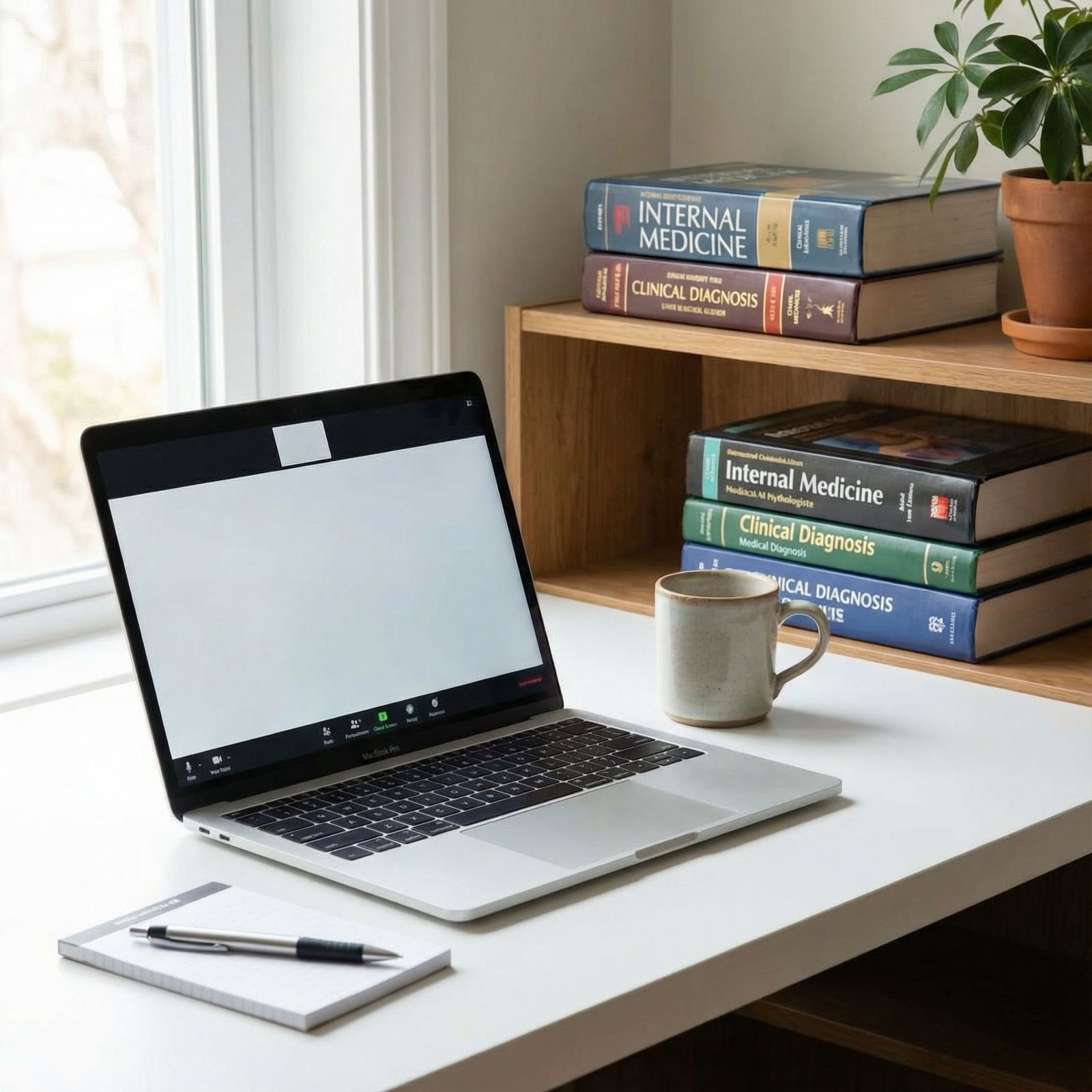
This is the part people skip, and then they wonder why the notes still look awkward.
You do not rehearse by memorizing better. You rehearse by making retrieval cleaner.
Here’s the progression I use.
First, answer common questions freely with no notes. Out loud. Not in your head. You need to hear where you ramble, where your story order breaks down, and where you default to vague filler.
Second, rebuild those answers using cue words only. Force yourself to answer from prompts, not from a script. This teaches flexible recall. That matters because interviewers do not ask your beautifully anticipated question in the exact way you practiced. They rephrase. They interrupt. They follow up. They ask for a different example. If you memorized language, you become brittle fast.
Third, practice on camera. This is non-negotiable. What feels subtle in your body often looks ridiculous on Zoom. I’ve watched applicants swear they only glance briefly at notes, then on recording it looks like they’re checking stock prices. The camera tells the truth.
Fourth, do a mock interview with someone who changes question order and interrupts you. This is where real readiness shows up. Can you still sound natural when your “why this specialty” answer gets followed immediately by “tell me about a conflict with a senior resident”? Can you pivot without scrambling through your note system like a courtroom clerk?
You also need glance discipline. The sequence is simple: look, retrieve, return, speak. Not speak while reading. That last part is the giveaway. If words start coming out while your eyes are still on the note source, the interviewer feels the script even if they can’t prove it.
Work on pacing too. Over-rehearsed applicants often answer too quickly, as if they’re trying to stay on the rails before memory slips. Slow down. Let there be signs of actual thinking. Tiny pauses are human. Variation in tone is human. A sentence you restart because you want to say it better? Human. That’s not a flaw. It’s evidence you’re present.
Ask yourself after each practice round:
Did I answer the actual question?
Did I overuse notes?
Did my eyes drift too far?
Did I sound like I was thinking in real time?
Did I leave room for conversation?
That last one matters. Good interviews do not feel like oral board exams. They feel like efficient, thoughtful conversations. If every answer is a sealed speech with no openness, the interaction dies.
And if you get caught using notes? Relax. The recovery is easy unless you panic. Pause, smile, and say something like, “I just wanted to make sure I answered that accurately.” Then continue naturally. No drama. No overexplaining. Most interviewers will not care unless your whole interview has felt artificial.
The applicants who do best are not the ones with the prettiest prep materials. They’re the ones who have rehearsed enough that the notes become almost irrelevant. Present if needed. Invisible if not.
The Insider Bottom Line: Use Notes to Sound More Like Yourself, Not Less
The best applicants don’t hide preparation. They make it disappear.
That’s the trick. Not being note-free. Not pretending you’re effortlessly brilliant on command. Just building support that protects your clarity under pressure without replacing your personality.
Programs are not sitting there hoping you deliver perfect prose. They want warmth, coherence, insight, and self-awareness. They want to feel like they met you, not your document. They want to hear that you can think, connect, and recover in real time.
So use the notes. Just don’t worship them.
Keep them short. Keep them close to the camera. Rehearse with them until they stop being a crutch and start being a quiet backup system. If you do that, you won’t sound less polished. You’ll sound more real. And in virtual interviews, real beats polished far more often than applicants think.
You can’t control every question. You can control your setup, your structure, and your rehearsal. That’s enough. More than enough, actually.