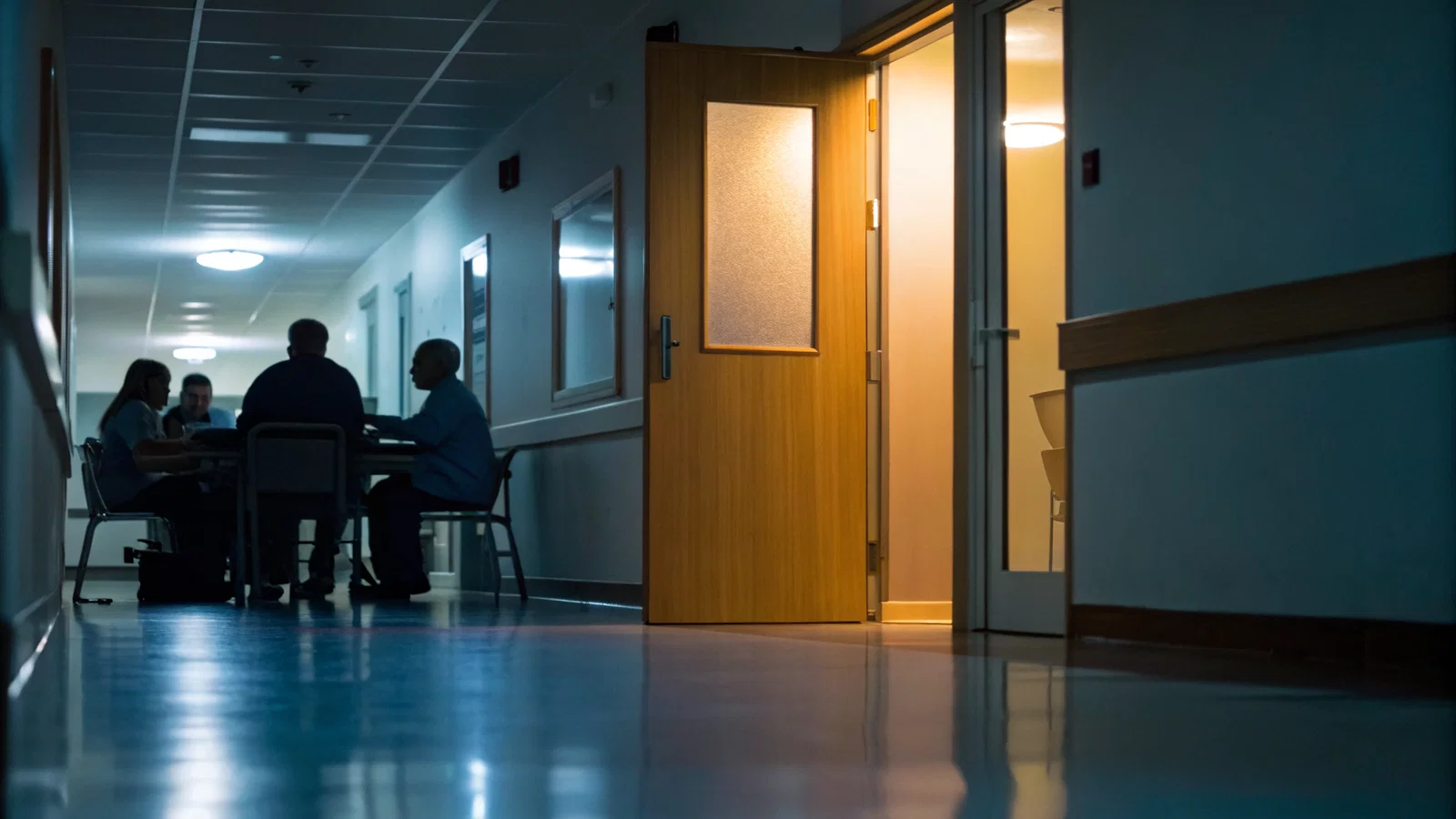
It's 4:45 on a Tuesday. You're walking to the workroom and you pass Conference Room B. Door shut. Through the frosted glass you can make out your program director, both associate PDs, and one of the chiefs. On the projector: a spreadsheet with your class list. Your name is in row fourteen.
Your stomach drops. What are they saying about me?
Navigating these high-stress moments often requires understanding how program directors quietly track your wellness and resilience.
Fair question. Here's the honest answer, from someone who has sat in that room many times: they're asking three things about you. Is this person safe? Is this person struggling? And if they're struggling, what do we actually do about it?
That's it. That's the whole meeting.
Understanding what residents confide about burnout in closed-door meetings can help clarify why peer transparency matters so much.
These sessions usually ride along with the semi-annual Clinical Competency Committee reviews, Novemberish and Aprilish in most programs, because the ACGME requires programs to track both competency and wellbeing, and it's efficient to do them in the same sitting. What's said in that room shapes your Milestones ratings, whether you get a supportive check-in or a remediation letter, and eventually what goes into your fellowship letters.
Here's what surprises most residents: the dominant emotion in that room isn't judgment. It's concern, tangled up with logistics. "Has anyone actually asked her how she's doing?" gets said far more often than "What do we do about him?" I've watched a room full of faculty spend twenty minutes problem-solving childcare options for a PGY-2 whose mother got sick. That happens. Regularly.
Trainees frequently struggle with what program directors think when you talk about burnout during these evaluations.
But, and this is the part that should get your attention, the room can only act on what it knows. And that's where residents get themselves into trouble.
The Core Challenge
The biggest problem with wellness reviews is that wellness and performance blur together, and the room has to untangle them in real time.
Burnout looks like laziness until someone names it. Depression looks like unprofessionalism. I watched a PGY-2 get flagged as a "professionalism concern" because her note completion dropped from the 90s to the 60s and two nursing evals used the word "abrasive." The discussion started down the documentation-and-remediation road until one faculty member, bless her, asked, "Didn't her mom just get diagnosed with something?" She'd been driving two hours each way for chemo appointments and telling no one. Same data. Completely different response once the room understood it.
So what actually puts your name on the agenda? Here's my honest tally from the meetings I've attended. This isn't published data, it's what I've seen trigger flags, ranked by how often they come up:
Notice what's at the bottom of that list. Self-disclosure almost never starts the conversation, because by the time the room is talking, the data has usually already spoken. Duty hour violations, chart completion stats, ITE trajectories, eval language. The room trusts your numbers more than your brave face. You cannot out-perform your own Epic data, and pretending you're fine while your metrics crater is the single worst strategy available to you.
Now the pitfalls. I've watched residents make the same five mistakes over and over:
- Assuming silence means safety. It doesn't. It often means nobody's told you yet. "Soft" concerns get discussed verbally long before anything reaches you, deliberately, because nobody wants to alarm a resident over a blip.
- Assuming the meeting is punitive. Also wrong, usually. But this fear keeps residents from asking what was said, which means they can't correct a wrong impression.
- Hiding the struggle until it becomes a performance issue. Once the chart completion numbers flag you, the room is reacting to a problem. If you'd raised your hand six weeks earlier, the room would've been responding to a person.
- Disclosing badly. Either not at all, or as an unstructured venting session. What lands well is specific: what's happening, what you're already doing about it, what you need.
- Treating the PD's office like a confessional. It isn't one. Your program director is not your therapist, and the conversation is not privileged. If the concern crosses certain thresholds, patient safety, impairment, it moves to the GME office whether anyone likes it or not. Choose what you share, and where, with open eyes.
One more thing residents miss: the room runs on coded language. "We're keeping an eye on him" means informal monitoring. "She's going through some things" means the room knows and has decided to give space. "Let's not put this in writing yet", that phrase is doing enormous work, means you have a window to turn things around before anything becomes a formal record. Green flags matter too: self-awareness, help-seeking, and honest self-assessment buy you enormous goodwill. Denial and blame burn it fast.

Actionable Next Steps
First, understand the pipeline a concern travels through, because your move depends on where you are in it:
Now the plan, step by step:
1. Audit yourself quarterly. Pull your own evals, duty hour reports, note completion stats, and ITE trajectory. Know your data before the room does. If your numbers are slipping, assume they're being discussed, because they are.
2. Build the relationship before you need it. Go to your semi-annual advisor meetings prepared. A resident who's a stranger gets discussed in the abstract. A resident the room actually knows gets the benefit of the doubt. This is unfair and completely predictable.
3. Disclose early, with the three-part formula. "Here's what's going on. Here's what I'm already doing. Here's what I need." That structure signals self-awareness, which is the single most persuasive thing you can project.
4. Follow up every check-in with a two-line email. "Thanks for meeting today, my understanding is I'll do X by Y, and we'll reconnect in a month." Responsiveness creates a paper trail that works for you.
5. Know your outside lanes. The employee assistance program, your state's physician health program, and your own therapist are conversations that don't route through your program. Use them. And check your state's licensing application language, most states have reformed their mental health questions, thanks largely to the Dr. Lorna Breen Heroes' Foundation's push, so treatment is far less dangerous to your license than rumors suggest.
6. If a review felt wrong, say so. Ask your advisor directly: "Were there concerns about me this cycle? Can I have specifics in writing?" If that fails, the GME office and your hospital's ombuds exist for exactly this. Almost nobody uses the ombuds. You should.
Bottom line: that closed door is a triage room, not a courtroom. The room's default setting is help. But it can only help with what it can see, and the residents who come out best are the ones who show the room the right things before the data shows the wrong ones.
Key Takeaways
- Be prepared. Know your own numbers, evals, notes, duty hours, before the room reviews them.
- The default in that room is support, not punishment. But it acts on visible evidence, not invisible effort.
- Early, structured disclosure beats late discovery. Every single time.
- Focus on high-yield areas: note timeliness, eval language, and exam trajectory, that's what actually gets read.
- After any wellness conversation, follow up in writing. Responsiveness is your best evidence.