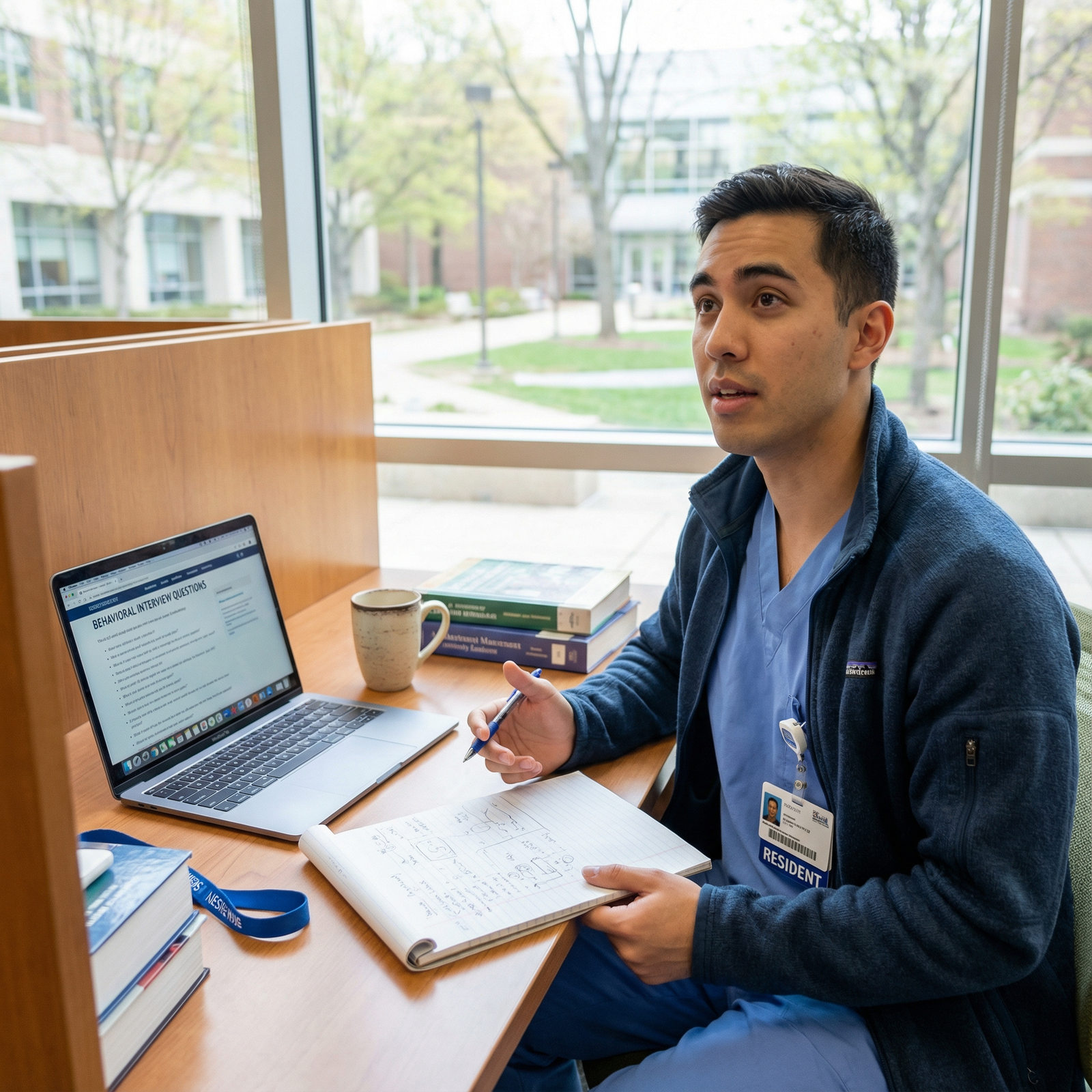
Understanding the Pathology Residency Interview Landscape as an IMG
The pathology residency interview is more than a conversation about your CV. For an international medical graduate (IMG), it is a structured evaluation of your medical foundation, your understanding of U.S. pathology practice, your communication skills, and your potential as a colleague.
Programs use a mix of:
- Traditional questions (“Why pathology?” “Tell me about yourself”)
- Behavioral questions (“Tell me about a time you made a mistake”)
- Situational/ethical questions (handling disagreements, errors, or cultural issues)
- Application-specific questions (about research, gaps, observerships, and USMLE attempts)
This IMG residency guide focuses on common interview questions for pathology, why they are asked, and how you can answer them effectively. Many of these are behavioral interview medical style questions designed to predict how you will perform in residency.
Throughout, remember three goals:
- Show you understand modern U.S. pathology practice (clinical relevance, team-based care, patient safety).
- Demonstrate professionalism and maturity through concrete examples.
- Communicate clearly, concisely, and confidently, despite being trained outside the U.S.
Core “Get to Know You” Questions
These questions set the tone and often appear at the beginning of the interview. They are your chance to control the narrative of who you are as a candidate.
1. “Tell me about yourself.”
This is the most predictable of all residency interview questions, and programs judge you heavily on it. They are looking for:
- A structured and concise answer (2–3 minutes)
- A clear, logical story linking your background to pathology
- Evidence of maturity, insight, and good communication
Suggested structure for IMGs in pathology:
- Brief origin and training
- Country, medical school, graduation year
- Key clinical/academic highlights
- Rotations, research, specific pathology exposure
- Why pathology (transition to your interest in the field)
- Current status and goals
- Observerships, research, exams, and why this specialty in the U.S.
Example outline answer:
- Origin & medical school: “I completed my medical degree at [University] in [Country] in 2020.”
- Early interests: “During my clinical years, I was consistently drawn to understanding disease mechanisms and correlating clinical findings with underlying pathology.”
- Exposure to pathology: “I spent an elective in surgical pathology where I observed sign-out, tumor boards, and the impact of pathology on treatment decisions.”
- U.S. transition: “After graduation, I completed USMLE exams and undertook observerships at [Institutions], where I saw how pathologists directly influence patient management.”
- Current: “Now, I’m seeking a pathology residency where I can build strong diagnostic skills, contribute to multidisciplinary care, and continue research in [specific area].”
Tips:
- Avoid reciting your CV line by line.
- Highlight key turning points that led you to pathology.
- Tailor the final sentences to that specific program (community vs academic, strengths, location).
2. “Why pathology?” / “Why did you choose pathology over clinical specialties?”
This question is central to a strong pathology match. Programs worry about applicants who see pathology as a “backup” or who have limited understanding of the field.
What interviewers want to hear:
- A genuine, specific interest in pathology
- Evidence you understand what pathologists actually do in the U.S.
- Clear thinking about your career path (surgical pathology, hematopathology, academic vs community)
Elements of a strong answer:
- Intellectual attraction: pattern recognition, problem-solving, integrating clinical, histologic, and molecular data.
- Impact on patient care: emphasize that pathologists are central to diagnosis and treatment decisions.
- Experiences that shaped your decision: electives, research, tumor boards, case presentations.
- Why you are a good fit: attention to detail, love of microscopy, analytic mindset, comfortable with indirect patient care.
Weak answers to avoid:
- “I don’t like dealing with patients.”
- “I didn’t match in internal medicine, so I chose pathology.”
- Overly vague: “I like diseases and slides.”
Example phrases to use:
- “I enjoy working through complex diagnostic puzzles.”
- “I like the combination of morphology and emerging molecular techniques.”
- “I’m motivated by the fact that our report directly guides oncologic treatment.”
3. “Why the United States?” & “Why our program specifically?”
As an international medical graduate, you must explain both your choice of country and program.
Why the United States?
- Emphasize: exposure to cutting-edge diagnostics, structured training, research infrastructure, multidisciplinary teams.
- Mention: desire to train in a system with standardized pathology residency curricula and strong quality assurance.
Why our program?
Use specific, researched reasons:
- Unique strengths: subspecialty sign-out, strong hematopathology or cytopathology, molecular pathology lab, community exposure, or diverse case mix.
- Educational features: structured didactics, mock boards, CP rotations, early frozen section responsibility.
- Fit with your goals: academic career, research focus, community practice preparation, visa sponsorship.
Example structure:
“I want to train in the U.S. because of the strong emphasis on multidisciplinary care, advanced molecular diagnostics, and structured, competency-based training. I am particularly drawn to your program because of the early exposure to independent sign-out under supervision, the strength in hematopathology, and the high volume of oncologic cases. Additionally, your track record in fellowships and your openness to IMGs align closely with my long-term goal of pursuing [subspecialty] and contributing to academic practice.”

Behavioral and Situational Questions: Proving You Can Function as a Resident
Behavioral interview medical questions are central to most U.S. programs. They typically begin with “Tell me about a time when…” and assess how you behave in real-world situations.
Use the STAR method:
- Situation – brief context
- Task – your responsibility
- Action – what you did
- Result – outcome and what you learned
4. “Tell me about a time you made a mistake.”
This is nearly universal. Interviewers are evaluating:
- Your honesty and insight
- Your approach to patient safety
- How you handle feedback and prevent recurrence
Good strategies:
- Choose a real, non-trivial mistake, but not something catastrophic or unethical.
- Show how you:
- Recognized it
- Reported or communicated it appropriately
- Took steps to correct it
- Changed your behavior afterward
Example (adapted to pathology interest):
- Situation: Mislabeling samples in med school lab or nearly missing a diagnosis in a clinical rotation.
- Action: You double-checked, informed your supervising physician, and implemented a personal checklist to avoid similar errors.
- Result: Error avoided or minimized, and you adopted a systematic approach that you still use.
Avoid:
- Blaming others exclusively.
- Saying you have never made a mistake.
5. “Tell me about a time you had a conflict with a colleague or supervisor.”
Pathology is team-based: pathologists interact with surgeons, oncologists, radiologists, residents, and lab staff. Programs want residents who can handle conflict professionally.
Key points:
- Choose a work-related, professional conflict.
- Show you:
- Sought to understand the other person’s perspective
- Communicated calmly and respectfully
- Focused on the patient or task, not ego
- Reached a resolution or at least improved communication
Strong approach:
“We had different opinions on how to prioritize cases. I requested a short meeting, listened to their concerns, explained the workflow from my perspective, and we agreed on a compromise prioritization method.”
Avoid:
- Describing dramatic, unresolved conflicts.
- Criticizing an entire team or supervisor harshly.
- Making yourself appear passive or helpless.
6. “Describe a situation where you had to work under pressure or heavy workload.”
Even in pathology, workload stress is real: high-volume sign-out, multiple frozen sections, STAT labs, call, and urgent intraoperative consultations.
What programs look for:
- Time management skills
- Ability to prioritize
- Maintaining quality under stress
- Knowing when to ask for help
Example scenario (for an IMG):
- Covering emergency department patients overnight, numerous consults, or managing overlapping responsibilities during medical school or observership.
- Emphasize:
- Organizing tasks by urgency and impact
- Communicating with the team
- Recognizing limitations and seeking input
7. “Tell me about a time you adapted to a new environment or culture.”
For an international medical graduate, this is particularly important. It predicts how you’ll adapt to:
- U.S. hospital culture
- Electronic medical records
- Different patient expectations and legal frameworks
Strong elements:
- Moving from your home country to another school or hospital
- Adjusting to a new language or educational system
- Integrating into a diverse team
Emphasize:
- Flexibility
- Openness to feedback
- Proactive efforts to learn local norms (documentation, patient interaction, hierarchy)
Clinical, Ethical, and Pathology-Specific Questions
Even though pathology is less “at the bedside,” programs must ensure you can reason clinically and ethically.
8. “What do you think the day-to-day work of a pathologist involves?”
This question tests your understanding of the specialty. A superficial answer suggests limited exposure and jeopardizes your pathology match.
Include:
- Anatomic pathology: review of histology slides, frozen sections, grossing, sign-out, tumor boards, correlation with imaging and clinical information.
- Clinical pathology: lab management, quality control, transfusion medicine, microbiology, hematology.
- Consultation: communicating results to clinicians, discussing borderline diagnoses, participating in multidisciplinary meetings.
- Education/research: teaching residents, medical students; involvement in research or quality improvement projects.
Show you know pathology is more than “just looking at slides.”
9. “How do you handle uncertainty or difficult cases?”
This is essential in pathology where borderline or rare diseases are common.
Strong points:
- Use of systematic approaches (differential diagnoses, checklists).
- Recognizing when to seek second opinions.
- Correlating with clinical and radiologic data.
- Understanding limitations of tests and need for additional immunostains or molecular studies.
You can say:
“In complex cases, I value a structured approach: reviewing the clinical history, radiology, morphology, and relevant immunostains. If I remain uncertain, I do not hesitate to seek a second opinion from a more experienced colleague, and I clearly communicate the degree of diagnostic certainty in the report.”
10. “How would you handle a situation where a surgeon pressures you for a quick answer during a frozen section, but you are uncertain?”
This situational question evaluates:
- Patient safety priorities
- Professional communication
- Ability to manage pressure
Strong approach:
- Emphasize that patient safety and diagnostic accuracy come first.
- You would:
- Clearly state your level of certainty.
- Consider giving a descriptive or deferred diagnosis if appropriate.
- Communicate calmly: “I cannot provide a definitive diagnosis on frozen; we need permanent sections.”
You might say:
“I would acknowledge the urgency but explain that giving a wrong diagnosis carries serious risk for the patient. If I am not confident, I would provide the most accurate preliminary impression I can and recommend waiting for permanent sections. I would document this clearly and discuss it promptly with my attending.”
11. “Discuss a challenging clinical or pathology-related case you encountered.”
Even if your direct pathology experience is limited, choose:
- A case where pathology findings were central
- A situation showing your analytical thinking and collaboration
Describe:
- The clinical scenario
- Key pathology findings (e.g., distinct histology, immunostain panel)
- Your role (observing, presenting, researching the case)
- What you learned about pathology’s role in patient management

IMG-Specific Questions: Gaps, Exams, Visas, and Training Background
As an international medical graduate, you should be prepared for questions that specifically relate to your training path and the realities of being an IMG in the U.S.
12. “Tell me about your clinical experience in the U.S.”
Programs want to know:
- What you have already seen in the U.S. healthcare system
- How prepared you are for American clinical and lab culture
Discuss:
- Observerships, externships, or research with clinical exposure
- Any time spent in pathology departments: gross room, sign-out, tumor boards
- What you learned about communication styles, documentation, or workflow
If you do not have direct U.S. pathology experience:
- Emphasize related experiences (other specialties, lab exposure, conferences).
- Show you understand the differences compared to your home country.
13. “How have you kept your clinical knowledge current, especially if you have a gap since graduation?”
Many IMGs face time gaps—between graduation and USMLEs, research, or moving countries. Programs will ask about:
- Any years since graduation
- What you did in that time: research, teaching, clinical work, family responsibilities
Prepare a clear, honest explanation:
- If research: describe projects, publications, and relevance to pathology.
- If personal/family reasons: be brief but straightforward, then focus on how you returned to medicine and stayed updated.
- Emphasize ongoing learning: CME, online courses, pathology texts, case-based discussions.
Avoid:
- Appearing defensive or apologetic.
- Minimizing the gap; instead, frame it constructively.
14. “You had multiple attempts on USMLE Step __ / You took a long time to complete exams. Can you comment on that?”
Be honest and non-defensive:
- Briefly explain contributing factors (language adjustment, work obligations, test-taking strategy).
- Do not over-explain or blame the exam.
- Focus on what changed:
- Improved study methods
- Better time management
- Subsequent stronger performance on other steps, OET, or research output
End with:
“Although my score does not reflect my true potential, I have since demonstrated my abilities through [research, clinical evaluations, Step 2 performance, etc.], and I am confident I can handle the academic rigor of residency.”
15. “Do you need visa sponsorship? What are your long-term plans?”
Programs want to know:
- If they can support your visa (J-1, H-1B)
- Whether you understand the implications of visas for training and employment
Answer:
- Clearly state your current status and visa needs.
- Show awareness without going into legal details.
- Describe realistic, long-term plans that may include:
- Completing pathology residency and at least one fellowship
- Potentially staying in academic or community practice in the U.S.
- Remaining open to global collaboration or eventual return to your home country
Avoid sounding:
- Uncertain or unrealistic (e.g., “I will definitely get a green card quickly”).
- Completely uninterested in educational or service contributions to your home country, if that has been part of your story.
Frequently Asked (and Often Underprepared) Questions
These questions commonly appear and can catch IMGs off-guard if not prepared.
16. “What are your strengths and weaknesses?”
For strengths:
- Choose 2–3 traits relevant to pathology:
- Attention to detail
- Logical, analytical thinking
- Reliability
- Professionalism
- Curiosity and love of learning
- Support each with brief examples.
For weaknesses:
- Pick something real but improvable, not core to pathology:
- Initial shyness in large groups
- Tendency to be overly self-critical
- Taking on too many responsibilities at once
- Show:
- Insight
- Concrete steps you have taken to improve
- Evidence of progress
Avoid:
- “I’m a perfectionist” without context.
- Weaknesses that raise safety concerns (chronic lateness, disorganization, poor teamwork) unless you can prove major change.
17. “Where do you see yourself in 5–10 years?”
Programs want to see direction, but not rigid inflexibility. Examples:
- Academic pathologist with interest in [subspecialty].
- Community pathologist who enjoys broad sign-out.
- Pathologist involved in medical education, quality improvement, or global health.
For IMGs:
- You can mention:
- Desire to contribute to pathology education in your home country (lectures, collaborations, telepathology).
- Working at the interface of clinical care and lab management.
Keep it realistic:
- Fellowship after residency is typical in pathology (e.g., hematopathology, cytopathology, GI, derm, molecular).
18. “What do you like to do outside of medicine?”
This is not a trick question. Programs look for:
- Well-rounded individuals
- Healthy stress management
- Potential for positive social fit within the residency
Mention:
- Real hobbies or interests (music, sports, reading, travel, cooking, volunteering).
- Briefly connect to qualities valued in residency (discipline, teamwork, perseverance, creativity).
Avoid:
- Saying you “just study” in all your free time.
- Sharing controversial or polarizing hobbies in great detail.
19. “Do you have any questions for us?”
Never say “No, I don’t have any questions.” This is a key part of the pathology residency interview where you show engagement.
Prepare 2–4 thoughtful questions, such as:
- “How is feedback provided to residents in your program?”
- “How do residents get involved in quality improvement or patient safety projects in the laboratory?”
- “What subspecialty sign-out model do you use, and how does resident autonomy evolve over the four years?”
- “What kind of support do IMGs typically need and receive in your program?”
Avoid:
- Questions easily answered on the website.
- Starting with salary or vacation time (those are better later or via administration).
Putting It All Together: Practical Tips for IMGs in Pathology
To maximize your success in the pathology match as an international medical graduate:
Know your story clearly
- Practice your “tell me about yourself” and “why pathology” answers aloud.
- Be ready to explain your path from your home country to U.S. pathology training in a compelling, concise way.
Use behavioral frameworks
- Prepare 6–8 strong STAR stories that can answer multiple questions:
- A time you made a mistake
- A conflict with a colleague
- A leadership experience
- Handling high workload
- Adapting to a new environment
- A case where pathology played a key role
- Prepare 6–8 strong STAR stories that can answer multiple questions:
Demonstrate understanding of U.S. pathology practice
- Review basics of anatomic and clinical pathology workflows.
- Understand frozen sections, tumor boards, lab quality systems, and CP topics like transfusion medicine and microbiology.
Address IMG concerns proactively
- Gaps in training: explain them honestly and constructively.
- Multiple attempts: acknowledge, explain briefly, and focus on growth.
- Visa: know what you need and understand the basic terminology (J-1 vs H-1B) without making this the center of your interview.
Practice residency interview questions with feedback
- Use mock interviews with mentors, faculty, or peers.
- Record yourself answering “tell me about yourself” and “why pathology” to refine content and delivery.
- Get feedback on your clarity, pacing, and body language.
Be professional but authentic
- Maintain eye contact (or camera focus for virtual interviews).
- Speak at a moderate pace; accent is not a problem if you are clear.
- Show genuine enthusiasm for pathology and for learning.
After the interview
- Send a brief, professional thank-you email highlighting one specific aspect of the conversation or program that resonated with you.
- Reflect on which questions challenged you and refine your answers for future interviews.
FAQ: Common Questions from IMGs About Pathology Residency Interviews
1. Are interviewers concerned that IMGs have less direct pathology experience?
Not necessarily. Many IMGs come from systems where formal pathology exposure is limited. Interviewers mainly care that you:
- Understand the core responsibilities of a pathologist
- Have made an informed decision about the specialty
- Show clear motivation and potential to grow U.S. observerships or electives in pathology help, but motivated self-study, research, and clear explanations of your interest can also be persuasive.
2. How technical should my answers be? Should I discuss immunostains and molecular tests?
Use a balanced approach. You should:
- Demonstrate awareness of modern tools (immunohistochemistry, molecular diagnostics, flow cytometry).
- Show that you know how they support clinical decisions. Avoid turning every answer into a technical lecture. Focus primarily on how you think, communicate, and work in a team. Technical depth is a bonus, not the main assessment at the interview stage.
3. If I previously applied to another specialty (like internal medicine) before shifting to pathology, how do I explain that?
Be honest but strategic:
- Explain what attracted you initially to the other specialty.
- Describe experiences that made you reassess and discover that pathology aligns better with your strengths and interests.
- Emphasize that you made a deliberate, informed switch, not a decision out of desperation.
- Show how your prior clinical exposure enriches your understanding of pathology and patient care.
4. What if I get a question I do not understand or cannot answer immediately?
It is acceptable to:
- Ask for clarification: “Could you please rephrase the question?”
- Take a brief pause to think: “That’s an important question; let me think for a moment.” If you truly do not know, especially on a factual or technical topic:
- Acknowledge your limits: “I’m not entirely sure, but I would approach it by…”
- Emphasize your willingness to learn: “This is something I would look up and discuss with a senior or attending.”
Interviewers are not expecting perfection—they are assessing your honesty, reasoning, and teachability.
By anticipating these common interview questions and preparing thoughtful, structured responses, you greatly improve your chances in the pathology match as an international medical graduate. Focus on telling a clear story, demonstrating insight and professionalism, and showing genuine enthusiasm for a career in pathology.