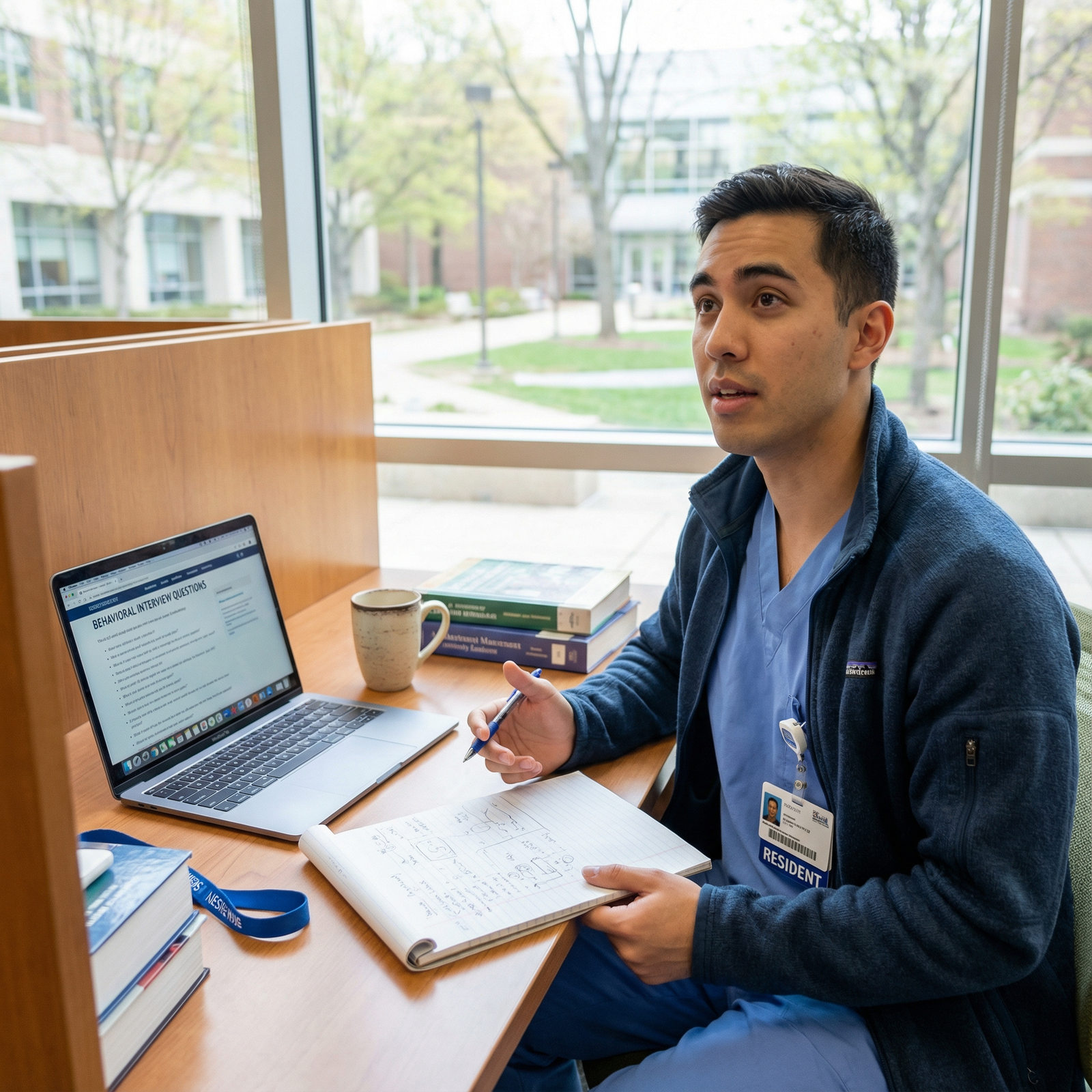
Understanding the Global Health Residency Interview Landscape as an IMG
Applying to a global health–focused residency track as an international medical graduate is both an opportunity and a challenge. You bring unique perspectives from international medicine, but you must also demonstrate that you can adapt to the U.S. healthcare system, meet ACGME competencies, and thrive in a global health residency track.
Programs use behavioral interview medical questions to assess not only clinical competence but also cultural humility, resilience, ethical judgment, and commitment to underserved populations. Common residency interview questions are often similar across programs, but global health positions add layers related to international work, health equity, and cross-cultural communication.
This IMG residency guide will:
- Break down common interview questions you’re likely to face
- Explain why programs ask them
- Give strong answer frameworks and sample responses tailored to global health
- Highlight IMG-specific strategies and pitfalls to avoid
- Provide a practice checklist and FAQs to help you prepare
Core “Traditional” Questions You Must Master
Even in a global health residency track, you’ll encounter classic questions that appear in almost every interview. As an international medical graduate, you need your answers to simultaneously address fit, global health interest, and U.S. readiness.
1. “Tell Me About Yourself”
This is often the very first question. It sets the tone and is your best opportunity to build a coherent narrative connecting:
- Your background and identity as an international medical graduate
- Your clinical experience (locally and internationally)
- Your motivation for international medicine and global health
- Your specific reasons for choosing this specialty and this program
What programs are assessing
- Communication skills and organization
- Self-awareness and professionalism
- Whether your story clearly leads to a global health career path
- How you present yourself under low-pressure conditions
Answer structure (3-part story)
- Brief background (15–20 seconds)
- Key experiences and strengths aligned with global health (1–1.5 minutes)
- Why this specialty + why global health + why U.S. training (30–45 seconds)
Sample answer (adapt and personalize)
“I was born and trained in [country], where I completed my medical degree and a year of internship in a large public hospital that primarily serves low-income, rural patients. Early in my training, I was struck by how preventable many of the conditions we saw were—complications from uncontrolled hypertension, late-stage TB, and maternal mortality due to limited access to basic obstetric care.
These experiences drew me toward global health. During medical school, I worked on a community-based hypertension screening project in rural clinics, where I helped organize mobile outreach days and developed simple patient education materials in local languages. I became interested not only in individual patient care, but also in health systems, task-shifting, and how to deliver care sustainably in resource-limited settings.
After graduation, I moved to the U.S. and completed observerships in [institution], where I learned to navigate the electronic medical record, multidisciplinary rounds, and guideline-based care. These experiences confirmed that I want to train in a residency that combines strong clinical training with a global health residency track that emphasizes health equity, implementation science, and service to underserved communities.
I’m particularly excited about your program’s partnerships in [specific country or domestic underserved setting] and the opportunity to gain both rigorous clinical training and structured mentorship in global health research and field work.”
Key tips for IMGs
- Avoid repeating your entire CV; focus on the narrative arc.
- Briefly acknowledge your path to the U.S. (visa, exams, observerships) without dwelling on logistics.
- Make your global health interest specific (particular populations, diseases, or themes like health systems, refugee health, or maternal-child health).
2. “Why This Specialty?” (e.g., Internal Medicine, Family Medicine, Pediatrics)
Programs want to know you’re genuinely committed and not just using global health as a “buzzword.”
What programs are assessing
- Alignment between your experiences and the specialty’s scope
- Realistic understanding of day-to-day work
- Long-term career vision (how global health fits into it)
Answer framework
- Early clinical exposure → first spark
- Specific experiences with underserved/global populations → validation
- Skills and interests that match the specialty
- Long-term goal clearly connected to global health
Example (Internal Medicine with global health focus)
“I chose Internal Medicine because I enjoy complex problem-solving, longitudinal relationships with patients, and the opportunity to manage chronic diseases that drive global morbidity and mortality, such as HIV, TB, and cardiovascular disease.
In my internship, I cared for many patients with multi-drug resistant TB and advanced HIV, which required coordinating care across limited resources, considering social determinants like housing and nutrition, and working closely with community health workers. These cases showed me the importance of strong internists who can integrate evidence-based care with an understanding of local context.
Long-term, I see myself practicing as a clinician-educator who splits time between academic medicine in the U.S. and health systems–strengthening work in low-resource settings. Internal Medicine provides the broad clinical foundation I need, and a global health residency track like yours—where I can gain training in implementation science, quality improvement, and global health ethics—will help me prepare for that path.”
3. “Why Our Program?” (Including “Why Our Global Health Track?”)
This is where many IMGs give generic answers. To stand out, you must show you’ve researched the program deeply, especially its international medicine and global health components.
What programs are assessing
- Genuine interest vs. mass applications
- Fit with their unique global health opportunities
- How you’ll use resources they actually offer
Preparation checklist
Before interviews, research:
- Global health curriculum (didactics, certificates, MPH options)
- Field sites and partnerships (countries, NGOs, domestic underserved clinics)
- Faculty interests (global health, migration health, refugee health, maternal-child health, etc.)
- Past resident projects (posters, publications, QI initiatives)
Answer framework
- One or two clinical training strengths that matter to you
- One or two global health–specific features
- How these align with your career goals
- Brief note on culture/mentorship that appeals to you
Example
“I’m particularly interested in your program because it combines strong clinical training in a safety-net hospital with a structured global health track. I appreciate that all residents, not only those in the track, care for a diverse immigrant and refugee population, which will allow me to apply global health principles in a local context.
I was especially drawn to your partnership with the district hospital in [country/region], where residents participate in bidirectional exchanges rather than short-term missions. My experience working with community health workers back home has made me value sustainable, capacity-building approaches like this.
Finally, when I spoke with Dr. [Name] and reviewed recent resident projects on [topic], I could see a clear path to developing my interests in [e.g., non-communicable diseases in low-resource settings]. The program’s mentorship structure and emphasis on global health ethics strongly match my long-term goal of practicing as an academic clinician with a focus on health equity.”

Global Health–Specific Interview Questions You Should Expect
Programs with a global health residency track often use targeted questions to evaluate your understanding of global health principles and your readiness for fieldwork.
4. “What Does Global Health Mean to You?”
Avoid vague answers about “helping poor countries.” Programs want evidence of thoughtful, current understanding.
What they’re assessing
- Conceptual clarity about global health vs. international medicine
- Awareness of equity, partnerships, and decolonizing global health
- Maturity and humility
Strong answer elements
- Emphasize equity and shared learning
- Recognize bidirectional benefit
- Mention systems, policies, and social determinants
Example
“To me, global health is about advancing health equity across borders—geographic, economic, and social. It includes not only international work, but also caring for underserved and marginalized populations here in the U.S.
I see global health as a collaborative field that focuses on strengthening health systems, addressing social determinants, and developing sustainable solutions in partnership with local communities and providers. It’s not about ‘delivering care from the outside,’ but about mutual learning, capacity-building, and respecting local expertise.
As an international medical graduate, I’ve seen how well-intentioned projects can fail if they don’t align with local priorities. That’s why I value programs like yours that emphasize long-term partnerships, ethics, and bidirectional exchanges.”
5. “Tell Me About a Global Health or International Medicine Experience You’ve Had”
Even if you haven’t done formal global health electives abroad, your home-country training as an IMG often qualifies as relevant experience.
What they’re assessing
- Practical understanding of working in resource-limited settings
- Ability to reflect on challenges and lessons learned
- Awareness of ethical issues and power dynamics
Answer framework (STAR with reflexivity)
- Situation – context of your international medicine experience
- Task – your role
- Action – what you did
- Result – what changed
- Reflection – ethical/cultural insights and how it shapes you now
Example (for an IMG from a low-resource setting)
“During my internship in [country], our hospital frequently ran out of certain medications and laboratory reagents, including CD4 counts and viral load testing for HIV patients. As a junior doctor, I worked with a small team to develop a simplified clinical algorithm for monitoring stable HIV patients when lab tests were delayed, based on WHO guidelines and local expert consensus.
My role included reviewing the literature, discussing feasibility with nurses and community health workers, and piloting the algorithm in our clinic. We also created simple counseling sheets to explain to patients why we were relying on clinical signs and adherence rather than lab tests alone.
Over six months, we observed improved adherence and fewer missed follow-up visits, though the data were observational. More importantly, this experience taught me that global health work often requires balancing ideal guidelines with local realities. It also reinforced the importance of involving frontline staff and patients in designing practical solutions. I hope to build on this kind of health-systems thinking in a structured way during residency.”
6. “How Do You Think About Ethics in Global Health Work?”
Ethical awareness is non-negotiable. Programs want to avoid residents who might engage in unsafe or inappropriate practice abroad.
Potential follow-up prompts
- “What concerns you about short-term medical trips?”
- “How would you respond if you’re asked to perform beyond your level of training during an international rotation?”
Key points to include
- Respect for scope of practice
- Importance of supervision and local standards
- Avoidance of “voluntourism”
- Commitment to sustainability and capacity-building
Example
“I think ethics in global health requires constant self-reflection about power, privilege, and impact. Short-term trips can unintentionally cause harm if they undermine local providers, create dependency, or encourage trainees to work beyond their level of competence.
As an IMG, I’ve seen situations where external teams introduced new practices that were not sustainable once they left, which sometimes frustrated local staff. For this reason, I value programs that work through established partnerships, prioritize education and capacity-building, and ensure that trainees operate under appropriate supervision and within their usual scope of practice.
If I were asked to perform a procedure beyond my training level during an international rotation, I would respectfully decline, explain my limitations, and seek supervision or alternative solutions that prioritize patient safety.”
7. “What Global Health Issues Are You Most Interested In?”
This question evaluates your direction, not your final career plan.
How to respond
- Name 1–2 specific themes or populations (e.g., NCDs in low-resource settings, refugee health, maternal mortality, migration health, climate change and health).
- Tie to past exposure and future plans.
- Connect clearly to what their global health residency track offers.
Example
“I’m particularly interested in non-communicable diseases in low-resource settings and among migrant populations. During medical school, I saw many young patients with uncontrolled diabetes and hypertension who presented late with complications because of limited access to regular care and medications.
I’m also interested in how migration affects continuity of care—for example, refugees or immigrants who move between countries and health systems. Your program’s work with local refugee clinics and its partnership in [country] addressing hypertension management align very closely with these interests. I hope to develop skills in implementation science and quality improvement to design and evaluate interventions that improve long-term outcomes for these populations.”

Behavioral Interview Medical Questions: Communication, Culture, and Resilience
Most residency interview questions in the U.S. now include behavioral components: “Tell me about a time when…” As an IMG, your international medicine experiences are rich sources of examples, but you must translate them into the U.S. competency framework.
8. Communication & Cultural Humility
Common questions
- “Tell me about a time you cared for a patient from a different cultural background.”
- “Describe a challenging communication with a patient or family and how you handled it.”
- “How do you manage language barriers in clinical practice?”
What they’re assessing
- Respect for diversity
- Adaptability and nonjudgmental attitude
- Awareness of your own cultural lens
Answer tips
Use the STAR method and be explicit about:
- How you adapted your communication
- How you sought to understand the patient’s perspective
- What you learned and how you’d apply it in a U.S. context
9. Working in Resource-Limited Settings
Potential questions
- “Tell me about a time you had to make a clinical decision with limited resources.”
- “How do you balance standard-of-care guidelines with what is realistically available?”
What they’re assessing
- Clinical reasoning under constraints
- Ethical decision-making
- Insight into transferring these skills appropriately to U.S. practice
Example
“In my internship, we often managed patients with severe sepsis without access to an ICU. I remember a case of a middle-aged man with presumed septic shock from pneumonia. We had limited vasopressors and only one functional monitor.
Together with my senior, we prioritized early antibiotics, fluid resuscitation, and frequent bedside assessments, while arranging transfer to a higher-level facility. We used our single monitor for the most unstable patient and manually checked vitals every 15 minutes for others, documenting closely.
This experience taught me to be deliberate in triage decisions and to communicate transparently with families about limitations. It also reinforced the value of basic clinical skills—physical exam, frequent reassessment, and teamwork. In the U.S., where resources are greater, I still carry that mindset of using resources wisely and focusing on fundamentals, but always adhering to local standards and guidelines.”
10. Teamwork and Conflict
Common prompts
- “Tell me about a time you had a conflict with a colleague and how you resolved it.”
- “Describe a time when you had to work in a multidisciplinary team.”
IMG-specific considerations
- You may have worked in more hierarchical systems; programs want to know you can function in a more collaborative, interprofessional environment.
- Emphasize respect for nurses, social workers, pharmacists, and other team members.
Answer guidance
- Avoid blaming language; show empathy for the other person’s perspective.
- Highlight listening, compromise, and patient-centered focus.
11. Resilience and Coping
Global health and residency can both be emotionally demanding.
Sample questions
- “Tell me about a time you faced a major setback or failure.”
- “How do you handle stress or emotional challenges from patient care?”
How to respond
- Choose an example that shows growth, not perfection.
- Discuss specific coping strategies (supervision, debriefing with peers, healthy routines).
- As an IMG, you might also mention adapting to a new country, exams, or visa challenges, but relate these back to your resilience and support systems, not just hardship.
IMG-Specific Challenges and How to Address Them in Interviews
12. Explaining Gaps, Transitions, and Exam Timing
Programs will often ask:
- “Can you walk me through what you’ve been doing since graduation?”
- “I see there was a gap between your graduation and now. Can you tell me more about that?”
Principles
- Be honest, concise, and non-defensive.
- Emphasize productive activities: clinical work, research, language learning, USMLE preparation, observerships, teaching, family responsibilities.
- End with: “And now I’m fully ready and focused on residency training.”
13. Adapting to the U.S. Healthcare System
Common questions:
- “What challenges do you anticipate as an IMG in U.S. residency?”
- “How have you prepared yourself to work in the U.S. clinical environment?”
Strong response elements
- Acknowledge differences: EMR, documentation, patient autonomy, malpractice environment, interprofessional practice.
- Mention concrete steps you’ve taken: observerships, online courses, U.S.-style case presentations, improving spoken and medical English.
- Show openness to feedback and eagerness to learn.
14. Questions You Should Ask Interviewers
Your questions reveal your priorities and your understanding of global health.
Consider asking:
- “How does your global health residency track ensure sustainable partnerships with sites abroad?”
- “What kind of mentorship and protected time are available for residents interested in global health research or implementation projects?”
- “How do you support IMGs in adjusting to the U.S. system, particularly around communication, documentation, and feedback?”
Avoid only logistical questions (salary, days off) early in the conversation; keep those for later or for residents.
Practical Preparation Strategy for IMGs in Global Health
Use this checklist as your IMG residency guide for interview prep:
Draft your core stories
- “Tell me about yourself”
- One global health/international medicine experience
- One communication challenge
- One teamwork/conflict example
- One resilience/setback example
Align your stories with competencies
- Patient care and clinical reasoning
- Interpersonal and communication skills
- Systems-based practice
- Professionalism and ethics
- Practice-based learning and improvement
Research each program
- Global health track website, faculty bios, recent publications
- Types of field sites and underserved local populations
- Required vs. elective global health rotations
Practice out loud
- Simulate interviews with mentors/peers
- Work on pace, clarity, and concision
- Especially refine “tell me about yourself” and “why this program?”
Prepare for video interviews
- Professional background and attire
- Camera at eye level, test audio connection
- Notes allowed, but answers should not sound read
Reflect on your unique value as an IMG
- Multilingual abilities
- Lived experience in resource-limited settings
- Cross-cultural adaptability and resilience
Frequently Asked Questions (FAQ)
1. I don’t have formal global health electives abroad. Can I still be competitive for a global health residency track?
Yes. As an international medical graduate, your home-country clinical experience often counts as global health–relevant, especially if you worked with underserved populations or in resource-limited settings. Highlight:
- Public or rural hospitals with limited resources
- Work with NGOs, outreach clinics, or community health workers
- Research or quality improvement projects focused on access, equity, or specific diseases prevalent in your region
Frame these experiences using global health principles: health systems, sustainability, social determinants, and equity.
2. How do I avoid sounding like I’m using “global health” just to improve my application?
Programs easily recognize superficial interest. To show authenticity:
- Be specific about issues (e.g., TB/HIV co-infection, maternal mortality, refugee health, NCDs).
- Connect interests to concrete past experiences, not just ideals.
- Know some of the program’s partnerships and initiatives and explain how you’d engage with them.
- Acknowledge long-term commitment, including willingness to work with underserved populations in the U.S., not only abroad.
3. What are some strong questions I can ask to show genuine interest in global health during my interview?
Examples include:
- “How do residents in the global health track balance field experiences with core clinical training?”
- “Can you share an example of a resident-led global health project that the program is particularly proud of?”
- “How does your program approach ethical issues and sustainability in its international partnerships?”
- “What opportunities exist for IMGs like me to contribute to domestic global health initiatives, such as immigrant or refugee health clinics?”
These questions demonstrate that you understand both the opportunities and responsibilities involved in global health work.
4. How should I answer if I’m asked about my long-term visa or career plans in the U.S.?
Be honest but focused on your professional goals:
- Emphasize your commitment to completing residency and providing high-quality care.
- If you plan to pursue a career that includes both U.S. practice and international work, describe this clearly and realistically.
- If visa sponsorship is relevant, you can mention that you’re open to the visa types the program supports, but avoid turning the discussion into a purely logistical conversation. Bring the focus back to your clinical and global health aspirations.
By preparing thoughtfully for these common interview questions for international medical graduates in global health, you can present yourself as a reflective, capable, and committed future resident. Your unique perspective as an IMG is not just an obstacle to overcome—it is a powerful asset to any program committed to global health and health equity.