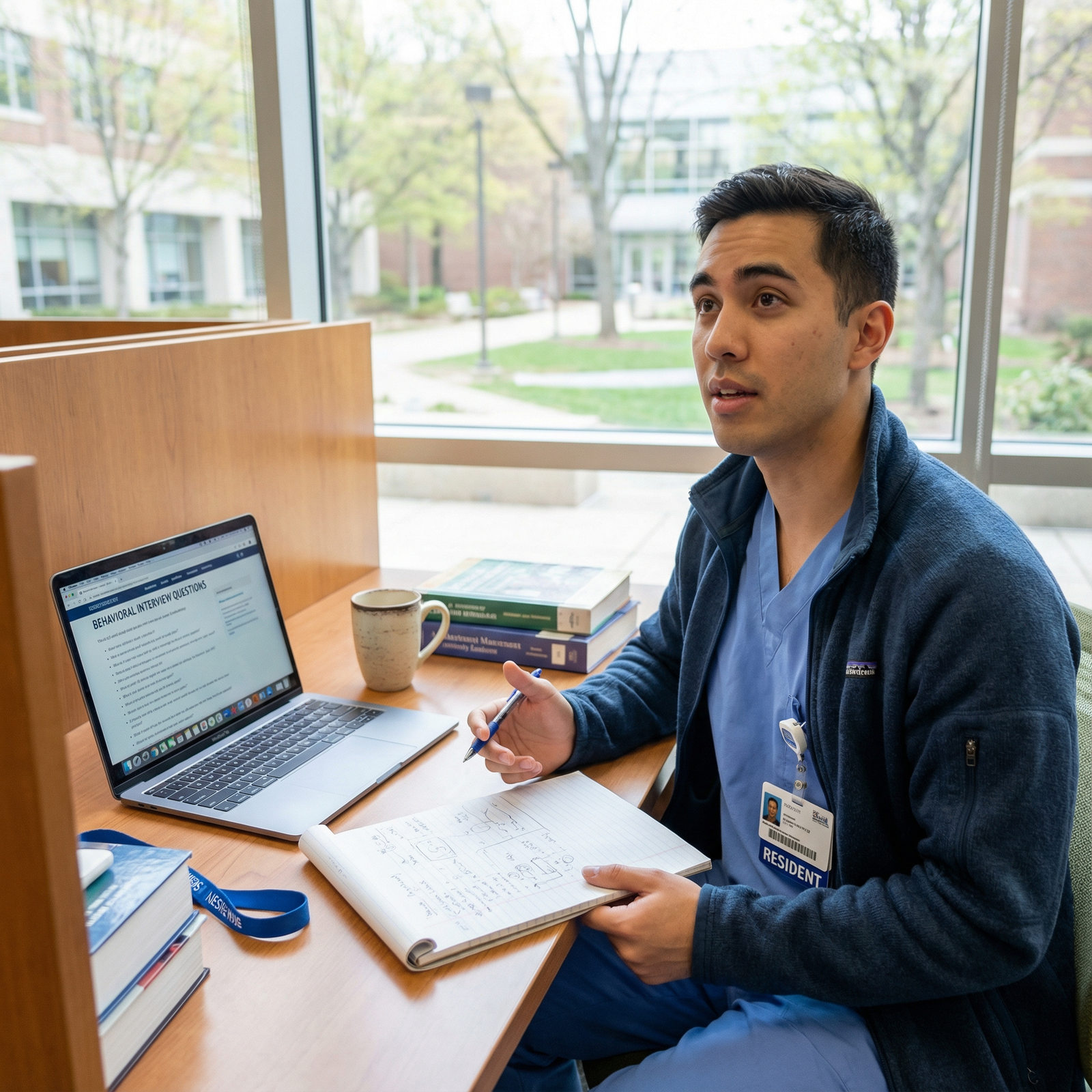
Understanding the General Surgery Residency Interview as an IMG
For an international medical graduate, the general surgery residency interview is often the most decisive step in the surgery residency match. Your application earned you an invitation; your performance in behavioral interview medical questions, clinical scenarios, and communication-based questions will determine whether you rank highly.
This IMG residency guide focuses specifically on common interview questions you’re likely to encounter—and how to answer them strategically. While the examples are tailored to general surgery, the principles apply widely to other surgical specialties as well.
You’ll see recurring themes:
- Communication and teamwork in high-stakes environments
- Technical interest and understanding of general surgery
- Handling stress, conflict, and failure
- Adapting as an international medical graduate to a U.S. health system
- Professionalism, resilience, and teachability
Your goal is not to recite memorized answers, but to understand the categories of questions and have clear, structured, honest stories ready.
Core Personal and Background Questions
These questions typically come early in the conversation and set the tone. As an IMG, how you introduce yourself and frame your background can strongly influence first impressions.
“Tell me about yourself.”
This is almost guaranteed. Treat it as your 1–2 minute professional summary, not your life story. For a general surgery residency interview, emphasize:
- Who you are as a physician (training, medical school, recent experience)
- Why you’re drawn to general surgery
- What you’ve been doing recently (USCE, research, clinical work)
- One or two key strengths aligned with surgical training
Structure (simple 4-part):
- Background: Where you trained and core identity as a physician
- Transition: How you developed interest in general surgery
- Current: What you’re doing now that is relevant
- Future: What you are looking for in a surgery residency
Example (IMG-focused):
“I’m a physician from [Country], where I completed my medical degree at [Institution] and developed a strong foundation in clinical medicine and procedural skills. During my surgical rotations, I was particularly drawn to general surgery because of the combination of decisive interventions, immediate impact on patients, and the need for disciplined teamwork in the OR.
After graduating, I completed a surgical internship at [Hospital] and then moved to the U.S., where I’ve been involved in [observerships/externships/research] in general surgery at [Institution]. These experiences have helped me adapt to the U.S. healthcare system, strengthen my communication skills, and confirm that I want a career in academic general surgery with a strong focus on patient-centered care and quality improvement.
I’m now looking for a residency program that emphasizes early operative exposure, structured teaching, and a culture of mentorship, where I can grow into a safe, reliable, and technically skilled general surgeon.”
Make sure your “tell me about yourself” aligns with your application and naturally leads to your interest in their program.
“Walk me through your CV.”
This is similar but more chronological. Select 4–5 key experiences that relate to:
- Surgery exposure
- Leadership or teaching
- Research or quality improvement
- Adaptation to the U.S. system
- Anything that addresses potential “red flags” (gaps, attempts, transitions)
Do not simply read your CV. Instead, highlight patterns: continuous improvement, commitment to surgery, and resilience.
“Why did you choose general surgery?”
Programs want to see that you understand what general surgery really involves: demanding hours, stress, responsibility, and lifelong learning.
Address three elements:
- Clinical reasoning: The appeal of surgical decision-making
- Technical aspect: You enjoy working with your hands and procedures
- Lifestyle realities: You understand the demands and accept them
Example:
“I chose general surgery because I enjoy taking care of acutely ill patients where decisions and interventions have immediate, often life-saving impact. In my surgical rotations, I found that I preferred managing complex abdominal pathologies and trauma over more longitudinal, clinic-based specialties.
I also genuinely enjoy procedural work—thinking three-dimensionally, planning an operation, and executing it with precision as part of a coordinated team.
Through my internship and time in U.S. ORs, I’ve seen the long hours and intensity of call, but I still feel energized by this environment. I’m comfortable with the lifestyle because I value the responsibility and the privilege of being trusted when patients are at their most vulnerable.”
Avoid vague comments like “I like to help people” or “I like to work with my hands” without concrete examples.
“Why do you want to train in the United States?” (IMG-specific)
For an international medical graduate, interviewers want to understand both your motivation and your commitment to practicing in the U.S.
Include:
- Exposure to U.S. medicine (USCE, observerships, research)
- Appreciation for systems-based practice, resources, training structure
- Long-term plan to stay and contribute to the U.S. health system
Example:
“My experiences in [Country] gave me a strong clinical base, but working and observing in U.S. hospitals showed me the benefits of structured surgical training: graded responsibility, strong emphasis on evidence-based practice, and team-based perioperative care.
I appreciate how general surgery training here integrates research, quality improvement, and multidisciplinary collaboration. I plan to build my career in the U.S. as a general surgeon, ideally in an academic or high-volume community setting, where I can combine operative practice with teaching and system improvement. Training here will give me the skills and exposure to complex pathology that I need to reach that goal.”
Motivation, Fit, and Program-Specific Questions
Program directors want to know if you understand their program, and if you’re likely to thrive and stay for the full five years.
“Why our program?”
This is one of the most critical residency interview questions. Generic answers are a major red flag.
Before interviews, research:
- Case volume and types of surgery
- Trauma level, subspecialty exposure
- Resident autonomy and early operative experience
- Academic vs community orientation
- Resident outcomes and fellowships
- Unique features (simulation lab, global surgery track, research years, strong IMG history)
Then answer with 3–4 specific reasons that align with your goals.
Example:
“I’m very interested in your program because of its high operative volume in bread-and-butter general surgery and the early engagement of junior residents in the OR. When I spoke with your residents, they emphasized that by the end of PGY-2 they feel comfortable managing common emergencies independently with faculty backup, which is exactly the type of autonomy I’m seeking.
I’m also drawn to your trauma and acute care surgery experience, as I’d like to maintain a strong emergency surgery skill set. As an IMG, I value that your program has a history of successfully training international graduates who have gone on to strong fellowships and practice positions.
Finally, I appreciate your structured didactics and simulation curriculum, which I believe will help me refine both my technical and communication skills early in training.”
Avoid listing things that obviously appear on every program website (e.g., “You have a strong reputation”).
“What are you looking for in a general surgery residency?”
Answer in terms of environment, training style, and culture:
- High operative exposure with supervision and safe autonomy
- Strong teaching, feedback, and mentorship
- A supportive but high-expectation culture
- Research or QI opportunities if important to you
Example:
“I’m looking for a residency that offers high-volume operative training with graduated autonomy, strong mentorship, and a culture where residents help each other succeed. I value clear expectations, regular feedback, and attendings who are invested in teaching in the OR and on rounds. In addition, I’d like some flexibility to engage in clinical research or quality improvement projects, especially in perioperative care and outcomes.”
“Where do you see yourself in 5–10 years?”
This helps them assess your long-term commitment to surgery and potential alignment with their program’s strengths.
Answer honestly but realistically:
- General surgery practice (community or academic)
- Possible fellowship interests (e.g., MIS, surgical oncology, trauma/critical care, colorectal)
- Interest in teaching, research, or leadership
Avoid sounding noncommittal or “using” surgery just to get into a different field.
Example:
“In 5–10 years, I see myself as a board-certified general surgeon practicing in the United States, ideally in a high-volume community or academic-affiliated hospital. I’m particularly interested in minimally invasive and acute care surgery and may pursue fellowship training in those areas, depending on my exposure during residency.
I enjoy teaching and would like to remain involved in resident and medical student education, as well as quality improvement projects aimed at optimizing perioperative outcomes.”

Behavioral and Situational Questions (High-Yield for Surgery)
Behavioral questions are central in a behavioral interview medical context. Interviewers use them to predict how you will behave under pressure, with teams, and in ethical dilemmas.
Use the STAR framework:
- Situation – Brief context
- Task – What you needed to do
- Action – What you did (focus here)
- Result – Outcome and what you learned
Aim for concise, structured answers with specific detail.
Common Behavioral Themes in General Surgery
- Dealing with conflict (team, nurse, co-resident, attending)
- Handling stress, long hours, or heavy workload
- Responding to mistakes or near-misses
- Managing difficult patients or families
- Working with limited resources or in challenging environments
“Tell me about a time you had a conflict with a colleague or team member.”
Programs know that surgical training is intense. They want to know that you handle conflict constructively and respectfully.
Example structure:
- Situation: Where you were (e.g., ward, OR, ED)
- Conflict: Disagreement on management, communication style, workload
- Action: How you listened, clarified, and resolved the issue
- Result: Improved understanding, patient safety, team function
Example answer (IMG in U.S. rotation):
“During my observership in general surgery, I was assisting with pre-op preparation. A nurse felt that I was interfering with their workflow because I was asking multiple questions about the EMR and documentation.
I realized she was under time pressure, so I apologized for interrupting and asked when would be a better time to go over my questions. I then made a list and later approached her during a quieter period, explaining that as an international graduate I wanted to learn the U.S. documentation process correctly to support the team and avoid errors.
She appreciated the explanation and we agreed on a more efficient way for me to help, such as checking consent forms and ensuring the patient was marked and ready. Our collaboration improved, and I learned to be more aware of workflow and to communicate my learning needs without overwhelming colleagues.”
Avoid blaming others; focus on your communication, flexibility, and respect.
“Tell me about a time you made a mistake or missed something.”
This is very common and critical for surgery, where patient safety is paramount. The key is to show:
- Honesty and accountability
- Reflection and learning
- Systems thinking (not just personal shame)
Example (non-catastrophic but real):
“As an intern in [Country], I was on call for surgical admissions. We evaluated a patient with abdominal pain, and although the labs were concerning for early sepsis, I initially underestimated the urgency and did not escalate immediately to my senior.
A few hours later, the patient’s condition worsened and required emergent surgery. Fortunately, the patient recovered well, but in reviewing the case with my senior, I realized that I had anchored on a less severe diagnosis and had not fully appreciated the vital sign trends.
Since then, I’ve changed my approach. I now pay closer attention to early warning signs, discuss uncertain cases sooner with seniors, and use checklists for sepsis criteria. This experience reinforced for me the importance of speaking up early and not delaying when I have concerns, especially in surgery where time can significantly affect outcomes.”
Programs prefer this level of self-awareness over claims of never making mistakes.
“Describe a stressful situation and how you handled it.”
General surgery residency is high-stress by nature. Show that you have coping strategies and maintain professionalism.
Example:
“During my surgical internship, I was on a 24-hour call with multiple admissions and post-op patients. At one point, two unstable patients arrived almost simultaneously—one with suspected perforation and another with GI bleeding.
I quickly triaged with my senior, clarified roles, and prioritized initial stabilization. I communicated clearly with the nurses about vital sign monitoring, labs, and fluid resuscitation. When I felt overwhelmed, I paused briefly to organize a written list of tasks by urgency.
By staying structured and communicating frequently with the team, we were able to stabilize both patients and arrange appropriate interventions. This experience taught me the importance of prioritization, clear communication, and asking for help early when needed. I’ve since continued to use task lists and short mental check-ins during busy shifts to stay effective under pressure.”
“Tell me about a time you worked with a difficult patient or family.”
This tests your empathy, cultural sensitivity, and communication skills.
Example (as IMG with cultural differences):
“On my surgery rotation, I cared for a patient who was very distrustful of the medical team and frequently refused recommended tests. The family had concerns based on prior negative experiences with hospitals in their home country.
I asked for permission to sit with them and listen to their concerns without interrupting. I then summarized what I had heard and acknowledged that their fears were understandable. I explained our recommendations in simple language, using diagrams to show the problem and the proposed intervention.
I also involved a translator to ensure understanding, and I invited them to ask questions repeatedly. Over the next day, their trust increased and they agreed to the necessary imaging and treatment.
This experience reinforced how listening, cultural sensitivity, and clear explanations can transform a challenging interaction into a collaborative one.”

Clinical, Ethical, and Specialty-Specific Questions
Even in a behavioral-style interview, you may encounter scenario-based or semi-clinical questions—especially in general surgery.
“Describe a challenging case you were involved in.”
Choose a case where:
- Your role was clear
- There were diagnostic or management challenges
- You demonstrated teamwork, communication, or early recognition of deterioration
Emphasize your thinking process, not just the diagnosis.
Example outline:
- Situation: Patient presentation and your role
- Challenge: Diagnostic uncertainty, limited resources, severity
- Actions: How you gathered data, communicated, escalated, and collaborated
- Outcome and lessons: Clinical and professional growth
“How would you handle it if you strongly disagreed with your attending about a patient’s management?”
They want to know that you are respectful, safety-focused, and appropriately assertive.
Key principles:
- Respect hierarchy but prioritize patient safety
- Ask questions with humility: “Can you help me understand…”
- Use evidence or guidelines gently
- Document and escalate through proper channels only if necessary
Example answer:
“As a resident, I recognize that the attending is ultimately responsible for patient care. If I had a strong concern about a management plan, I would first clarify that I fully understand their reasoning by asking, ‘Can you help me understand why we’re choosing this approach over…?’
If I still felt that an important risk or alternative was being overlooked, I would respectfully share my perspective using data or guidelines, while acknowledging my more junior position. For example, ‘I was wondering whether we should also consider… given [specific concern].’
If, after discussion, the plan remained the same but I believed there was a serious patient safety issue, I would follow institutional policies—discussing with a senior resident or another attending as appropriate—making sure that my focus stayed on patient safety rather than on being ‘right.’ In all cases, I would remain respectful, avoid confrontation in front of the patient, and be open to learning from the attending’s experience.”
Ethical questions you might encounter
- “What would you do if you saw a resident or attending behaving unprofessionally?”
- “How do you approach informed consent with patients who have limited understanding?”
- “Tell me about a time you advocated for a patient.”
The thread: you should prioritize patient safety, respect, honesty, and appropriate use of institutional resources (ethics consults, supervisors).
IMG-Specific and Red-Flag-Type Questions
As an international medical graduate, you are more likely to be asked about:
- Gaps in training
- Multiple attempts on exams
- Visa status
- Long path to the match
Prepare honest, non-defensive explanations that show growth.
“Can you explain this gap in your CV?”
Common reasons: exam preparation, research, family responsibilities, health issues, immigration processes.
Guidelines:
- Be honest but concise
- Explain what you did to stay clinically connected or professionally active
- Emphasize that the issue is resolved and you’re fully ready for residency
Example:
“After completing my internship in [Year], I had a two-year period where I was primarily focused on preparing for the USMLE exams and relocating to the United States. During that time, I remained connected to medicine by volunteering in a surgical outpatient clinic, attending hospital conferences, and participating in a research project on postoperative outcomes.
This period also allowed me to improve my English communication and adjust to life in the U.S. Now, my exams are complete, my immigration status is stable, and I’m fully committed and ready to begin residency without further interruptions.”
“You graduated in [Year]. How have you maintained your clinical skills?”
Programs worry about older graduates being out of practice. Address this directly:
- Clinical roles (house officer, GP with procedural work, surgical assistant)
- CME, conferences, ATLS/ACLS, simulation, skills labs
- Observerships/externships, hands-on experiences where allowed
Example:
“Since graduating in 2016, I have remained clinically active. I worked as a surgical resident/house officer at [Hospital] for three years, managing pre- and post-operative patients and assisting regularly in the OR. After moving to the U.S., I completed observerships in general surgery and trauma at [Institutions], attended weekly M&M and teaching conferences, and participated in simulation-based training where available.
I have maintained certifications in ACLS and ATLS and regularly review current guidelines and literature in general surgery. These activities have helped me keep my knowledge and clinical reasoning up to date, even while transitioning between health systems.”
“Do you have any concerns about starting residency in the U.S. as an IMG?”
This is an opportunity to show insight and preparation, not to claim perfection.
You might mention:
- Adjusting to EMR systems and documentation
- Communication styles and closed-loop communication
- Different hierarchy and expectations
Then show what you’ve already done to adapt.
Example:
“The main challenge I anticipate is adapting fully to the documentation and communication expectations in the U.S. system, especially with EMRs and interprofessional communication.
During my U.S. observerships, I paid close attention to how residents present cases, write notes, and coordinate with nurses and consultants. I practice presenting cases in the U.S. style and have received feedback from mentors.
I’m confident that with initial guidance and feedback, I’ll adapt quickly. I’m very open to learning, and as an IMG I know I must be proactive in seeking feedback and clarifying expectations.”
Practical Strategies to Prepare for General Surgery Interview Questions
1. Build a “Story Bank”
Before interview season, write brief bullet-point notes for:
- 3–4 teamwork or conflict stories
- 2–3 stress or high-workload stories
- 2–3 mistakes/near-miss stories
- 2–3 leadership/teaching stories
- 2–3 difficult patient/family stories
Practice telling each story using STAR in 1–2 minutes.
2. Anticipate Common Questions and Practice Out Loud
Common general surgery–focused questions include:
- “Why general surgery?”
- “Why this program?”
- “Tell me about yourself.”
- “What are your strengths and weaknesses?”
- “Tell me about a time you worked in a team under pressure.”
- “How do you deal with long hours and fatigue?”
- “What will be your biggest challenge as an intern?”
Record yourself answering. Pay attention to:
- Clarity and organization
- Filler words (“um,” “like”)
- Eye contact and body language (if doing video interviews)
- Speaking pace, especially if English is not your first language
3. Prepare Thoughtful Questions to Ask Programs
At the end, you’ll be asked, “Do you have any questions for us?” Have 2–3 meaningful questions ready:
- About operative experience for juniors
- About culture and support for residents
- About how the program has supported past international medical graduate residents
- About evaluation and feedback systems
Avoid questions easily answered on the website.
4. Addressing Classic “Weakness” Questions
You may be asked:
- “What are your weaknesses?”
- “What would your colleagues say you need to work on?”
Choose a real but modifiable trait that won’t compromise safety (e.g., not “poor time management” or “I get angry with nurses”), and show how you are actively improving it.
Example:
“In the past, I tended to be overly self-critical when I made small mistakes, which sometimes increased my stress level. Over time, and with feedback from mentors, I’ve been working on focusing more on constructive reflection rather than self-criticism.
I now systematically review challenging cases, identify specific lessons, and apply them to future situations. This has helped me maintain resilience while still holding myself to a high standard, which I believe is essential in surgery.”
FAQs: General Surgery Residency Interview Questions for IMGs
1. Are the residency interview questions different for international medical graduates compared to U.S. graduates?
The core general surgery residency questions are similar for everyone: “Tell me about yourself,” “Why general surgery?”, “Why our program?”, along with standard behavioral scenarios. However, IMGs are more likely to be asked about visa status, gaps in training, older graduation dates, exam attempts, and adaptation to the U.S. system. Programs also often explore your long-term plans in the U.S. Be prepared with clear, confident, and honest answers to these IMG-specific areas.
2. How can I practice behavioral interview medical questions effectively?
Use the STAR method and create a story bank. Write short bullet points for situations involving teamwork, conflict, mistakes, stress, and leadership. Practice out loud with a friend, mentor, or fellow applicant. Consider recording mock interviews and focusing on clarity, structure, and time (aim for 60–120 seconds per answer). Practicing “tell me about yourself” and a few high-yield scenarios repeatedly will significantly improve your performance.
3. What if I don’t have much direct general surgery experience in the U.S.?
You can still succeed by emphasizing transferable experiences: surgical internship or residency in your home country, assisting in the OR, emergency room work, and relevant research. For questions about adapting to the U.S., highlight observerships, shadowing, conferences, and any exposure you’ve had to U.S. hospitals. Show that you understand the expectations of a surgery residency and that you are proactive, teachable, and motivated to learn the system.
4. How should I answer if I’m asked about other specialties I considered?
Be honest but keep the focus on why you ultimately chose general surgery. For example, you can say you considered internal medicine or anesthesiology but realized you preferred the hands-on procedural work, acute care, and team environment of surgery. Make sure your final answer reinforces a strong commitment to general surgery and does not suggest ambivalence about the specialty.
By preparing systematically for these common general surgery residency interview questions, and tailoring your answers to your experience as an international medical graduate, you’ll be able to present yourself as a thoughtful, resilient, and committed future surgeon—exactly the kind of colleague programs want in their operating rooms and on their wards.