Understanding the Radiation Oncology Interview Landscape as an IMG
Radiation oncology is a small, competitive specialty that places a strong emphasis on communication skills, professionalism, and long-term patient relationships. As an international medical graduate (IMG), you face an additional layer of scrutiny: programs want to know not only whether you can be a good radiation oncologist, but also whether you can adapt successfully to the U.S. clinical environment.
This IMG residency guide focuses on common radiation oncology residency interview questions, especially behavioral interview medical questions, and how to answer them strategically. You’ll see how to integrate your international background, research exposure, and clinical experiences into compelling answers that help you stand out in the rad onc match.
Throughout this guide, keep three big goals in mind:
- Show you understand modern U.S. radiation oncology practice
- Demonstrate excellent communication and teamwork skills
- Frame your IMG journey as a strength, not a liability
Core Behavioral Questions You’ll Almost Certainly Be Asked
Behavioral questions in medical residency interviews are designed to predict your future behavior by examining your past actions. For radiation oncology, programs are especially interested in how you handle complex decision-making, communication with vulnerable patients, and collaboration in multidisciplinary teams.
Use the STAR framework (Situation, Task, Action, Result) to structure answers clearly.
1. “Tell me about yourself.”
This is almost always the opening question. It sets the tone and often shapes the rest of your conversation.
What they’re really asking
- Can you summarize your story concisely and logically?
- Do you have a coherent path to radiation oncology?
- How does being an international medical graduate fit into your narrative?
How to structure your answer
Think of a 2–3 minute, high-yield narrative:
- Brief background – Where you trained, a concise mention of your home country/medical school.
- Key experiences – A few defining experiences (clinical, research, personal) that drew you to radiation oncology.
- Current status – What you’re doing now (observerships, research, clinical work).
- Future direction – Why you’re interested in this specialty and this healthcare system.
Example outline
- “I completed medical school at [Institution] in [Country], where early on I became interested in oncology after [meaningful patient or family story].”
- “During my clinical years, I pursued experiences in both medical and radiation oncology, including [X research project/rotation]. I was fascinated by the blend of technology, physics, and long-term patient relationships in radiation oncology.”
- “Since graduation, I’ve focused on strengthening my exposure to U.S. oncology through [observerships, research fellowships, clinical electives], where I gained hands-on experience with treatment planning, multidisciplinary tumor boards, and patient counseling.”
- “I’m now looking for a radiation oncology residency where I can continue to grow as a clinician-investigator and contribute to a team that values evidence-based care, mentorship, and innovation.”
Avoid listing your CV chronologically. Instead, tell a focused story that makes your choice of rad onc and your IMG background feel inevitable and purposeful.
2. “Why radiation oncology?”
In a competitive field like radiation oncology residency, this is critical. Programs want to see depth, maturity, and realistic understanding beyond “I like physics” or “I enjoy oncology.”
Key elements to include
- Patient-centered motivation – A specific experience (or two) that sparked your interest.
- Intellectual appeal – Planning, imaging, radiobiology, problem-solving.
- Team-based care – Coordination with medical oncology, surgery, radiology, pathology, physics, and nursing.
- Long-term relationships – On-treatment visits, survivorship care, palliative support.
Example components IMGs can highlight
- Exposure to limited radiation resources in your home country and how that made you appreciate access to advanced technology in the U.S.
- A case where you saw radiation used for palliation and realized its power to relieve suffering.
- Involvement in oncology research, such as outcomes, imaging, or clinical trials.
Red flags to avoid
- Overemphasizing technology without talking about patients.
- Sounding like you are switching from another specialty at the last minute without a clear rationale.
- Giving generic answers that could apply to any oncology field.
3. “Why are you interested in our program?”
Program-specific interest is especially important for IMG applicants. They want to know you’re not just mass‑applying.
Before the interview
- Review the program’s website, research themes, faculty interests, and recent publications.
- Note distinctive features: proton therapy, brachytherapy volume, global health initiatives, resident-led research, community outreach, AI in planning, etc.
In your answer, connect three levels
- Program strengths – Specific features, not generic praise.
- Your background – How your experiences align with those strengths.
- Future goals – How this program helps you grow in research, clinical care, or leadership.
Example approach
“I’m particularly drawn to your program’s strong focus on [e.g., CNS malignancies and stereotactic radiosurgery]. During my research at [institution], I worked on [related project], which introduced me to the challenges of treatment planning and neurotoxicity. I’m also impressed by your residents’ involvement in [e.g., implementation research or quality improvement]. As an IMG with experience in [global oncology/underserved care], I see excellent opportunities here to contribute to ongoing projects and develop as a clinician-researcher in this area.”
4. “Walk me through your CV” or “Tell me about your research.”
Radiation oncology is research-intensive. Programs expect you to talk clearly and confidently about your projects.
What they’re listening for
- Do you actually understand what you worked on?
- Can you communicate complex ideas to non-experts?
- Are you honest about your role?
How to present your research
- Summarize the big picture – “We studied whether…”
- Explain your role – Data collection, analysis, chart review, contouring, writing.
- Highlight skills gained – Statistics, coding, literature review, IRB navigation.
- Mention outcomes – Abstracts, posters, publications, or lessons learned.
Tip for IMGs
If your research setting is unfamiliar to U.S. faculty, briefly contextualize:
“At [Hospital in Country], we see many patients presenting with advanced-stage cervical cancer due to limited screening. Our study aimed to evaluate outcomes after chemoradiation in this population…”
This shows you bring unique insight into global oncology and health systems, a major asset in academic rad onc.
Clinical and Scenario-Based Questions Specific to Radiation Oncology
Radiation oncology interviews often probe your clinical reasoning and your understanding of how radiation integrates into multidisciplinary cancer care. You are not expected to know advanced dose constraints as an applicant, but you are expected to think logically and communicate clearly.
5. “Describe a memorable oncology patient and what you learned.”
They are looking for empathy, reflection, and insight into your clinical values.
Choose a case where:
- You had direct involvement (not just observing).
- There was some emotional or ethical complexity – end-of-life decisions, limited resources, communication barriers.
- You can articulate what you learned about patient care.
Structure your answer
- Brief case summary – Age, diagnosis, context.
- Your role – Student, extern, observer, research assistant.
- Challenge – Communication, decision-making, cultural issues, system limitations.
- Reflection – How it changed your perspective and behavior.
Example angle for IMGs
- A patient who delayed care due to stigma, cost, or travel distance.
- How this influenced your commitment to patient education, early detection, or quality of life.
6. “How would you explain radiation therapy to a patient with newly diagnosed cancer?”
Radiation oncologists spend a lot of time educating patients. Programs want to see if you can communicate clearly and compassionately.
Key points to cover in simple language
- What radiation is: “high‑energy rays to damage cancer cells.”
- How it’s delivered: “similar to getting an X-ray, painless, no sensation during treatment.”
- Basic logistics: simulation, daily treatments, typical duration.
- Common side effects: short-term vs. long-term, dependent on area treated.
- Safety and reassurance: It’s targeted, and you are not radioactive after external beam radiation.
Sample structure
“I would start by asking what the patient already knows, then say something like: ‘Radiation therapy uses high‑energy X-rays to treat cancer cells in a very focused way. We first do a planning scan to map out exactly where we want the radiation to go, then you come in for short daily visits, usually Monday through Friday, over a few weeks. Each treatment is painless and only takes a few minutes, though you’ll be on the table longer for setup. Side effects depend on the area we’re treating—for example, radiation to the head and neck can cause sore throat and difficulty swallowing—but our goal is always to treat the cancer while protecting the healthy tissues as much as possible.’”
You can mention that as an IMG, you are particularly attentive to language and cultural barriers and would check understanding frequently.
7. “What do you think are the biggest challenges in radiation oncology today?”
This tests your awareness of the field and whether you read beyond textbooks.
Potential topics to touch on
- Access and equity – Global disparities in radiation therapy availability.
- Cost and technology – Balancing advanced modalities (protons, SBRT) with cost-effectiveness.
- Personalized medicine – Integrating genomics and imaging biomarkers into treatment decisions.
- Survivorship and toxicity – Managing late effects and quality of life.
- Artificial intelligence – Automating contouring, planning; ethical use.
For IMGs, you can powerfully link global health perspectives:
“In my home country, many regions have no access to linear accelerators, so radiation is delayed or unavailable. This experience makes me particularly interested in research on cost-effective techniques and implementation science—how we can deliver high-quality radiation in resource-limited settings.”
Avoid diving into technical jargon you can’t explain. Depth in one or two areas is better than superficial lists.
8. “How do you handle uncertainty or complex decisions when evidence is limited?”
Radiation oncology often involves gray areas—borderline indications, competing risks, comorbidities.
Demonstrate that you:
- Recognize uncertainty.
- Seek guidance and multi-disciplinary input.
- Communicate options and risks transparently with patients.
- Use evidence and guidelines when available.
You might say:
“In situations where evidence is limited or conflicting, I start by reviewing available guidelines and key studies, then discuss the case with attending physicians and, if appropriate, in a tumor board setting. I think it’s important to frame the decision for the patient honestly: explaining what we know, what we don’t know, and the potential benefits and risks. My experience in [country] taught me that patients value transparency, even when we can’t guarantee outcomes.”
Behavioral and “Fit” Questions Especially Important for IMGs
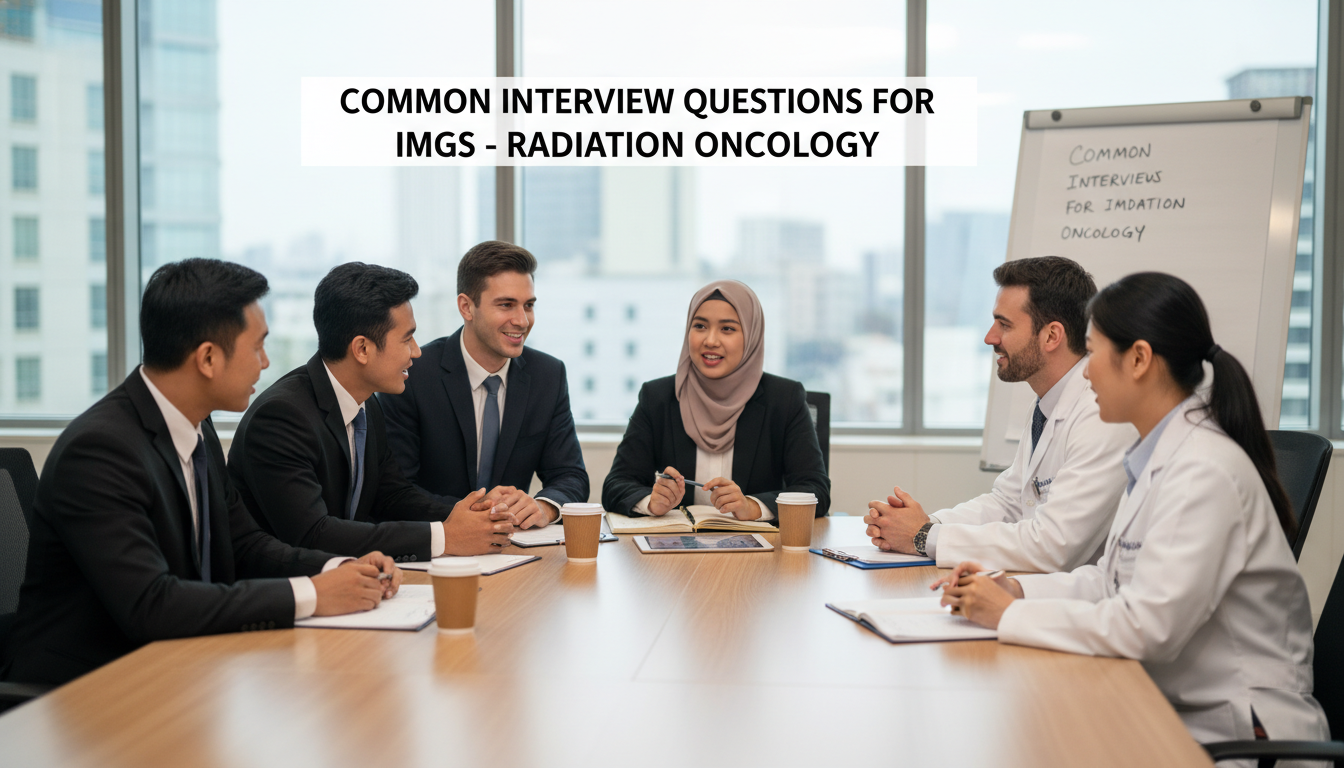
Behavioral interview medical questions probe communication, resilience, teamwork, and professionalism. As an IMG, you should be prepared for questions that indirectly explore your adaptability to U.S. training.
9. “Tell me about a time you had a conflict with a colleague and how you resolved it.”
Use the STAR framework and keep it professional, not personal.
Example scenarios
- Disagreement over division of tasks on a research project.
- Miscommunication during a busy rotation.
- Cultural misunderstanding in a multicultural team.
What to emphasize
- You recognized the conflict early.
- You addressed it directly but respectfully.
- You sought to understand the other person’s perspective.
- You focused on the shared goal (patient care, project outcomes).
- The positive outcome and what you learned.
Avoid blaming language. Demonstrate maturity and emotional intelligence.
10. “Describe a time you made a mistake in clinical care or training.”
They are assessing honesty, accountability, and safety.
How to handle this
- Choose a real but non-catastrophic example.
- Explain briefly what happened, without violating confidentiality.
- Emphasize:
- How you recognized the error.
- How you escalated appropriately or asked for help.
- Steps taken to mitigate harm.
- System or personal changes implemented afterward.
For IMGs, you can mention differences in protocols between your home system and U.S. standards, but you must still own your part:
“In my home institution, we typically did X, but in this setting the protocol was Y. I initially followed my usual habit, then realized the discrepancy. I immediately informed my senior, corrected the order, and afterward I created a checklist to align my practice with local guidelines.”
This shows you are coachable and committed to patient safety.
11. “How have you adapted to the U.S. healthcare system?” (IMG-focused)
This is common for international medical graduate candidates.
Key areas to address
- Communication style – Learning to use plain English, avoiding medical jargon, checking understanding.
- Team hierarchy and expectations – Understanding roles of nurses, APPs, residents, attendings; using SBAR or structured communication.
- Documentation and EMR use – Getting comfortable with electronic records and billing documentation.
- Cultural sensitivity – Navigating diverse patient beliefs and expectations.
Example answer elements
“During my observerships and research experiences in the U.S., I made a conscious effort to adapt to the team-based culture. I learned to present patient cases succinctly, tailor explanations to different levels of health literacy, and use structured communication. I also spent time learning the documentation and EMR systems, and I actively sought feedback from faculty and residents to refine my communication style.”
Programs want reassurance that you will not need a long adjustment period once residency starts.
12. “How do you handle stress and prevent burnout?”
Radiation oncology can involve emotionally heavy conversations, high-stakes decisions, and long working hours, especially in training.
Good elements to mention
- Healthy coping mechanisms – Exercise, hobbies, time with family/friends, religious/spiritual practice.
- Time management – Planning, prioritization, limiting procrastination.
- Seeking support – Mentors, peers, wellness resources.
Avoid sounding like you “never feel stress.” Instead, show insight and sustainable strategies.
13. “Where do you see yourself in 5–10 years?”
They’re looking for alignment with what their program offers and realism about the field.
Consider:
- Academic vs. community practice.
- Interest in subspecialty focus (e.g., CNS, pediatrics, GI, GU, breast, thoracic).
- Research, education, global health, or leadership roles.
- Openness to evolving interests.
Example:
“In 5–10 years, I see myself as a practicing radiation oncologist in an academic or academic-affiliated center, with a particular focus on [e.g., GI malignancies and clinical outcomes research]. I hope to contribute to clinical trials that improve access and quality of radiation therapy, especially for patients from underserved or international backgrounds. I’m also interested in medical education and would like to be involved in resident teaching.”
Frequently Asked Radiation Oncology–Specific Questions (and How to Prepare)
Below is a concise list of common residency interview questions you should rehearse, especially tailored to an IMG radiation oncology residency applicant.
High-Yield Personal and Motivation Questions
- “Tell me about yourself.”
- “Why radiation oncology?”
- “Why did you choose to pursue training in the U.S.?”
- “As an international medical graduate, what unique strengths do you bring to our residency program?”
- “What are your biggest concerns about training in the U.S., and how do you plan to address them?”
Clinical & Oncology-Related Questions
- “Tell me about your oncology or radiation oncology clinical experiences.”
- “Describe a challenging cancer case you were involved in.”
- “How would you explain the risks and benefits of radiation therapy to a hesitant patient?”
- “What do you think is the role of radiation therapy in palliative care?”
Behavioral Interview Medical Questions
- “Tell me about a time you worked on a team that didn’t function well. What did you do?”
- “Describe a time you had to give or receive difficult feedback.”
- “Tell me about a time you had to adjust your communication style for a patient or colleague.”
- “Describe a situation where you went above and beyond for a patient or project.”
Ethics and Professionalism
- “Have you ever observed something you felt was unethical in a clinical setting? What did you do?”
- “How would you handle a situation where a patient refuses a recommended cancer treatment?”
- “What would you do if you strongly disagreed with your attending’s treatment plan?”
Practical Preparation Strategies for IMGs Targeting the Rad Onc Match
To make the most of this IMG residency guide, pair knowledge of common questions with deliberate practice.
1. Build a Personal “Answer Bank”
- List out 20–30 common questions (many are above).
- For each, write bullet-point answers, not scripts.
- Identify 3–4 core stories (patients, research, conflicts, mistakes) you can adapt to multiple questions.
This keeps your responses flexible but consistent.
2. Practice Out Loud with Feedback
- Record yourself on video answering: “Tell me about yourself,” “Why radiation oncology?”, and “Why this program?”
- Practice with:
- A mentor or attending who knows rad onc.
- Peers, especially other IMGs in the application cycle.
- Career or international student advisors.
Ask for feedback on clarity, organization, speed, and non-verbal communication.
3. Translate Your IMG Experience into U.S.-Relevant Skills
Whenever you mention differences between systems, link them to valuable skills:
- Working with limited resources → creativity in problem-solving, appreciation for guideline-based care, advocacy.
- Treating advanced-stage presentations → experience with palliative care, communication around prognosis.
- Multilingual abilities → enhanced communication with diverse patients, interpretation of cultural contexts.
4. Prepare Program-Specific Talking Points
For each interview:
- Identify 2–3 faculty or resident interests you can mention.
- Note 1–2 program features you want to ask questions about (e.g., brachytherapy volume, proton therapy access, global health rotations, resident clinic structure).
- Tailor your “Why our program?” and “Any questions for us?” sections.
5. Anticipate “Soft Spots” in Your Application
As an IMG, you may be asked about:
- Gaps in training or time since graduation.
- Step scores, exam failures, or visa issues.
- Limited U.S. clinical experience.
Prepare honest, concise, and forward-looking answers:
- Acknowledge the issue without defensiveness.
- Briefly explain contributing factors if appropriate.
- Emphasize what you’ve done since then to improve (research, observerships, further exams, publications, language training).
- Reaffirm your current readiness for residency.
FAQ: Common Questions from IMGs About Radiation Oncology Interviews
1. What types of interview formats should I expect for radiation oncology residency?
You may encounter:
- Traditional one-on-one interviews with faculty or program leadership.
- Panel interviews with multiple interviewers.
- Resident-only sessions (informal but still evaluative).
- Virtual interviews via Zoom or similar platforms, which are now standard in many cycles.
Regardless of format, the same core behavioral and specialty-specific questions tend to appear. Practice maintaining eye contact, using clear audio, and avoiding distractions, especially for virtual interviews.
2. Are there any “technical” questions in radiation oncology interviews?
Some programs may ask basic concept questions, but they are usually conceptual, not detailed:
- “What interests you most about radiobiology or treatment planning?”
- “How would you explain fractionation to a patient?”
- “What do you know about IMRT vs. 3D-CRT?” (only if you have had exposure)
If you have done physics or planning research, they may probe specific aspects. You are not expected to function as a resident already, but basic familiarity with modern radiation oncology terminology is an advantage.
3. How should I answer if I have limited direct radiation oncology experience as an IMG?
Be transparent, but highlight related strengths:
- Emphasize your exposure to oncology patients in other settings (internal medicine, surgery, palliative care).
- Link your research in oncology, imaging, or outcomes to rad onc questions.
- Show that you’ve compensated with observerships, rotations, tumor boards, and self-study.
- Articulate clearly why you chose radiation oncology despite limited exposure, and how your experiences confirm this choice rather than make it tentative.
4. How do I respond if asked about visa status or long-term plans as an IMG?
Visa questions usually revolve around logistics and commitment:
- Answer factually: “I am eligible for [J-1/H-1B] and understand the requirements.”
- Reassure them of your long-term commitment to practicing radiation oncology and completing the full residency.
- If you have flexibility due to citizenship or permanent residency, briefly mention it.
Avoid lengthy immigration discussions; keep it professional and concise, then return to demonstrating how you would be a strong resident.
By preparing thoughtfully for these common interview questions and framing your international background as a unique asset, you can present yourself as a mature, adaptable, and highly motivated candidate for radiation oncology residency. Your journey as an international medical graduate is not a disadvantage to hide—it is a rich source of stories and skills that, when articulated well, can significantly strengthen your position in the rad onc match.