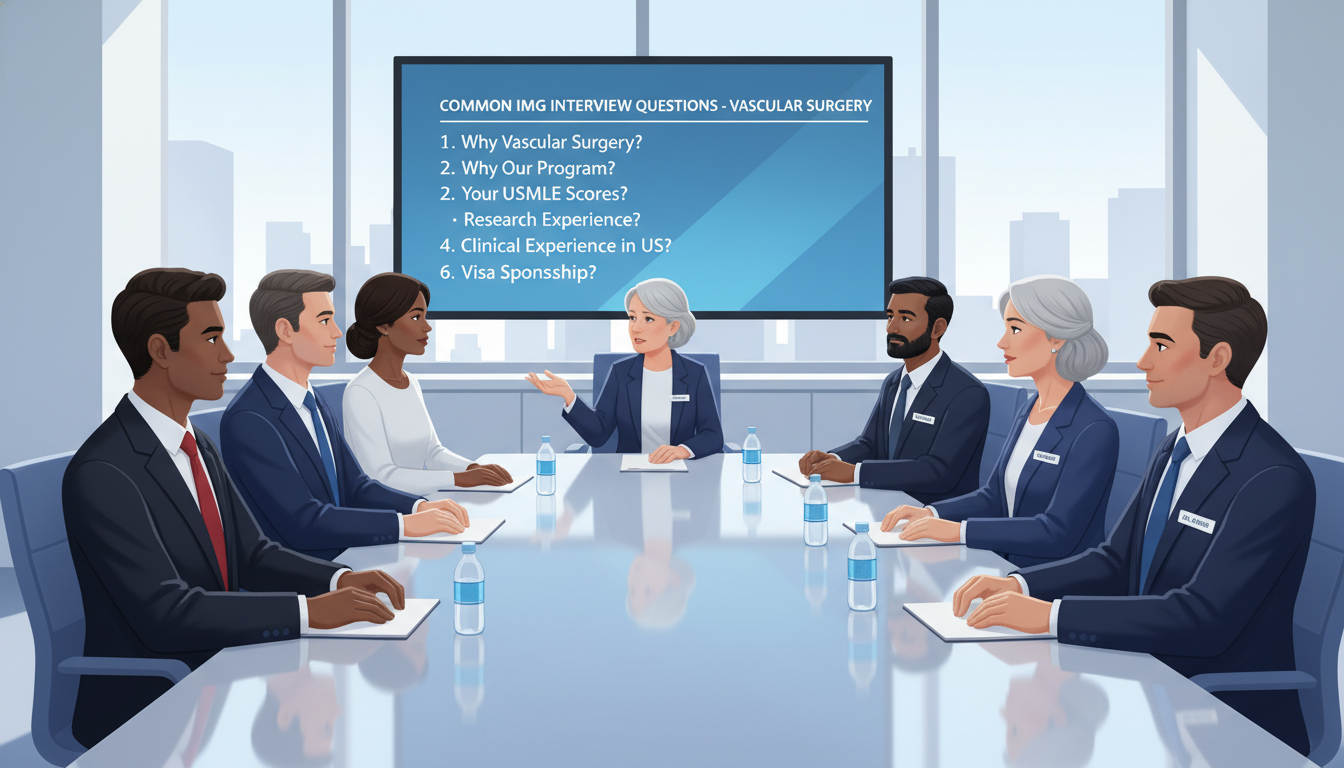
Preparing for a vascular surgery residency interview as an international medical graduate (IMG) requires more than strong clinical knowledge. Programs will also evaluate your professionalism, communication, cultural adaptability, and your understanding of the U.S. training environment—often through behavioral interview questions and scenario-based conversations.
This IMG residency guide focuses on common interview questions for vascular surgery, with sample answers, strategy tips, and specific advice for the integrated vascular program applicant.
Understanding What Vascular Surgery Programs Look For
Before memorizing answers, you need to understand the core qualities vascular surgery residency programs want to see—especially in an IMG:
- Technical potential and work ethic – Can you learn complex open and endovascular procedures and handle long, intense cases?
- Clinical judgment – Do you recognize vascular emergencies, prioritize well, and call for help appropriately?
- Teamwork and communication – Can you work effectively with nurses, anesthesiologists, interventional radiology, and other residents?
- Resilience and maturity – How do you handle complications, death, high-stress call nights, and long work hours?
- Ethical standards and professionalism – Do you respect patients, colleagues, and professional boundaries?
- Adaptability as an international medical graduate – Can you integrate into a new healthcare system, culture, and training structure?
- Commitment to vascular surgery – Are you choosing vascular specifically, not just “any surgical program”?
Programs use common interview questions and targeted behavioral interview medical scenarios to evaluate those attributes. The most frequently asked question—“Tell me about yourself”—is often where your performance is silently scored the highest or lowest, depending on how well you frame your story.
High-Yield “Tell Me About Yourself” & Background Questions
1. “Tell me about yourself.”
This is almost guaranteed. It sets the tone for the entire interview.
Purpose:
- Assess communication skills (clarity, structure, conciseness)
- Understand your journey as an international medical graduate
- Identify your core motivations and professional identity
- See how well you connect your story to vascular surgery residency
Strategy for IMGs:
Use a 3-part structure:
- Brief background – who you are and where you trained
- Key experiences – what shaped you clinically and personally (especially vascular-related)
- Connection to vascular and this program – why you are here
Stay within 1.5–2 minutes. Avoid a long life story; keep it professional and focused.
Sample answer structure:
- 2–3 sentences about where you’re from and your medical school
- 2–3 sentences about clinical experiences and vascular exposure
- 2–3 sentences about research/quality improvement or leadership
- 1–2 sentences linking your background to what you seek in a vascular surgery residency
Example tailored to an IMG:
I completed my medical degree at [University] in [Country], where I first became interested in complex surgical care. During my final year, I rotated on vascular surgery and was struck by the impact of restoring blood flow in patients with critical limb ischemia and aortic aneurysms.
After graduating, I worked as a junior doctor in general surgery and emergency medicine, where I gained experience caring for patients with trauma-related vascular injuries and peripheral artery disease. When I moved to the U.S., I completed observerships in vascular surgery at [Institution] and engaged in clinical research on outcomes after endovascular aneurysm repair, which led to [X] abstracts and [Y] publications.
Those experiences confirmed that I want a career in academic vascular surgery, with a focus on limb salvage and quality improvement. I’m now looking for an integrated vascular program that offers strong open and endovascular training, early operative exposure, and a supportive environment for IMGs.
Avoid:
- Family details unless directly relevant (e.g., major caregiving responsibilities)
- Oversharing personal hardships without clear professional reflection
- Reading a memorized script in a robotic tone
2. “Walk me through your CV.”
Purpose:
To see your ability to summarize and highlight what matters most.
Strategy:
- Organize chronologically but focus on transitions: medical school → key electives → research → U.S. experience.
- Emphasize elements that demonstrate your path to vascular surgery: vascular electives, imaging experience, research in vascular / endovascular topics, or case reports.
- Address any apparent gaps or changes (e.g., USMLE prep period, visa delays) succinctly and confidently.
Example approach:
After medical school at [X], I spent one year as a surgical intern in [Country], where I gained strong exposure to emergency procedures and postoperative care. I then moved to the U.S. to focus on USMLE preparation and secured a research position in vascular surgery at [Institution], working on projects involving [brief description].
In parallel, I completed observerships in vascular and general surgery at [Hospitals], which gave me insight into the U.S. healthcare system and multidisciplinary vascular care. Over the last two years, I have presented at [conferences] and co-authored [papers/posters], and I currently volunteer at a free clinic, where I help manage patients with peripheral vascular disease and diabetes.

Core Motivation & Specialty Choice Questions
3. “Why vascular surgery?”
Purpose:
Programs want to know your choice is intentional, informed, and durable, not a backup to general surgery or another field.
Key elements for a strong answer:
- A specific clinical moment or case that drew you to vascular
- Demonstrated understanding of the field’s realities: long cases, complications, longitudinal follow-up, emergent situations
- Evidence of consistent exposure (rotations, research, mentorship)
- A view of your future self as a vascular surgeon
Example answer:
My interest in vascular surgery started during my final year of medical school, when I followed a patient with critical limb ischemia. I saw him present with severe rest pain and non-healing ulcers, and I observed his angioplasty and subsequent bypass surgery. What struck me most was seeing him walk into clinic two months later with healed wounds and dramatically less pain.
Since then, I have sought every opportunity to deepen my exposure: I joined vascular rounds during my general surgery internship, completed observerships in U.S. vascular programs, and conducted research on outcomes after endovascular interventions. I enjoy the combination of complex decision-making, imaging interpretation, and technically demanding procedures, as well as the long-term relationships with patients managing chronic vascular disease.
I also appreciate that vascular surgeons often care for high-risk patients, where thoughtful judgment and teamwork are critical. I see myself building a career that combines clinical practice with quality improvement to optimize limb salvage and perioperative outcomes.
Avoid vague statements like “I like surgery” or “I enjoy helping people.” Be concrete.
4. “Why an integrated vascular program instead of general surgery first?”
This is uniquely important for applicants to an integrated vascular program (0+5 path).
Goals of your answer:
- Show you understand that integrated training is intense and specialized.
- Demonstrate you’ve explored this path carefully.
- Express commitment to vascular as your long-term career.
Example answer:
I considered both the traditional general surgery–then–vascular fellowship pathway and the integrated vascular program. After speaking with mentors who trained in both models, I realized that the integrated pathway aligns best with my long-term goal of becoming a technically strong vascular surgeon with deep expertise in both open and endovascular techniques.
I like that integrated programs build vascular identity early, with longitudinal experience in imaging, endovascular skills, and complex perioperative care. At the same time, I understand that I will still receive broad surgical training, particularly in my early years. As an IMG, I value the clear, focused structure of the integrated pathway and the opportunity to build long-term mentorship within a single vascular division. I am committed to a career in vascular surgery specifically, so I believe this route will allow me to develop the most cohesive skill set.
5. “Why this program specifically?”
Purpose:
To assess your preparation, sincerity, and fit.
Elements of a strong answer:
- Program-specific details: case volume, early exposure to endovascular, regional referral center, strong limb salvage or aortic program, simulation lab, research focus.
- Alignment with your career goals: academic vs community, research interest, leadership in global surgery or underserved care.
- Mention any IMG-friendly aspects if known (prior IMG residents, mentorship, support for visas), but do this tactfully.
Template:
I am particularly interested in your program because of [2–3 specific program features], and I think my background in [X] fits well with your focus on [Y]. I’m also impressed by [your outcomes, your limb salvage program, your resident-faculty relationships, etc.], which matches what I’m seeking in my vascular surgery training.
Avoid:
Generic statements you could say about any program (“great reputation,” “strong faculty”) without details.
Behavioral & Situational Questions: How You Think and React
Behavioral questions are a central part of residency interview questions, especially in the U.S. They often start with:
- “Tell me about a time when…”
- “Describe a situation where…”
- “Give me an example of…”
Use the STAR method:
Situation → Task → Action → Result (and what you learned).
6. “Tell me about a time you made a mistake.”
This is a classic behavioral interview medical question.
Purpose:
To evaluate honesty, accountability, insight, and growth.
Guidelines:
- Choose a real but not catastrophic mistake.
- Show you understand your role and take responsibility.
- Emphasize what you changed afterward to improve.
Example answer outline:
Situation: During my surgical internship in [Country], I was covering a post-op patient after a cholecystectomy.
Task: I needed to evaluate her complaints of increased abdominal pain and tachycardia.
Action: Initially, I attributed her symptoms to inadequate pain control and delayed calling my senior. When her tachycardia persisted, I re-evaluated, ordered labs and imaging, and then called the senior, who immediately came to assess. The CT showed a significant fluid collection.
Result: The patient returned to the OR for washout and recovered. I realized I had delayed escalation by focusing too narrowly on pain rather than considering complications.
Reflection: Since then, I’ve changed my approach: I use structured post-op checklists, actively look for red flags like persistent tachycardia, and I no longer hesitate to call for help when something doesn’t fit the expected course. That experience reinforced the importance of early senior involvement, which I will carry into residency.
Avoid:
- Claiming “I never make mistakes.”
- Blaming nurses, colleagues, or “the system” without personal reflection.
7. “Describe a conflict with a colleague or supervisor and how you handled it.”
Programs want residents who can function in complex teams.
Example IMG-focused scenario:
Situation: During my observership in the U.S., I noticed that my communication style—more direct and formal—was sometimes perceived as abrupt by nursing staff.
Task: I wanted to maintain good collaboration while respecting cultural norms.
Action: After one nurse seemed upset when I made a suggestion about wound care, I approached her privately, apologized if my tone sounded disrespectful, and explained that in my home country we often communicate more directly in medical settings. I asked for her feedback on how to phrase suggestions more collaboratively.
Result: She appreciated the conversation, and I started using phrases like “What do you think about trying…” or “Would it be possible to…” which improved our teamwork.
Reflection: As an international medical graduate, I’ve learned to be proactive about understanding communication expectations and adjusting my style to build strong relationships with the team.
8. “Tell me about a time you dealt with a very sick or dying patient.”
Vascular surgery involves high-risk patients and frequent end-of-life discussions.
Key points to include:
- Empathy and respect for patient/family values
- Clear communication without giving false hope
- Collaboration with the team (attendings, palliative care, ICU)
Example outline:
I once cared for a patient with a ruptured abdominal aortic aneurysm (or similar critical vascular scenario in your context) who had multiple comorbidities and a poor prognosis. I helped gather the family, listened to their concerns, and clearly explained what the attending had outlined regarding the risks, possible outcomes, and comfort-focused options. I made sure they had time to ask questions and understood that we would support them regardless of their decision.
That experience taught me that in vascular surgery, technical skills must be matched by honest communication and respect for patient autonomy, especially in life-or-limb situations.
9. “How do you handle stress or long hours?”
Vascular call can be intense: ruptured aneurysms, acute limb ischemia, bleeding, and complex postoperative patients.
Strong answer elements:
- Practical coping strategies: exercise, sleep hygiene, time management
- Seeking help early rather than silently burning out
- Maintaining patient safety even when tired
Example:
I handle stress through structure and proactive planning. During busy call periods, I prioritize tasks by urgency, use checklists for patient follow-up, and communicate clearly with the team about critical issues. Outside of work, I manage stress by running and maintaining a consistent sleep schedule when possible.
I’ve also learned to recognize when I’m reaching my limits—fatigue, irritability, difficulty concentrating—and in those situations I’m not afraid to ask for help or clarification from seniors to ensure patient safety. In vascular surgery, the stakes are high, so it’s crucial to acknowledge stress and manage it constructively rather than ignore it.
Clinical & Scenario-Based Questions in Vascular Surgery
While not a full oral exam, many programs will gauge your clinical reasoning with simple case-based questions. As an IMG, be ready to show you understand how care is delivered in the U.S.
10. “How would you work up a patient with acute limb ischemia in the ED?”
They don’t expect fellowship-level answers, but they do expect:
- Recognition of urgency
- ABCs and hemodynamic stability
- Focused vascular exam (pulses, Doppler, motor/sensory function, 6 Ps)
- Early vascular surgery involvement
- Use of imaging and anticoagulation
Example answer approach:
First, I would assess airway, breathing, and circulation, obtain vital signs, and give analgesia. I would perform a focused vascular exam of both limbs, checking pulses, capillary refill, motor and sensory function, and looking for the classic signs of acute ischemia. I would promptly notify the vascular surgery team.
I would start IV access, draw labs including CBC, coagulation profile, basic metabolic panel, and type and screen. If there are no contraindications, I would start systemic anticoagulation with IV heparin while coordinating with vascular surgery and radiology for appropriate imaging, often a CT angiogram, depending on institutional protocol. From there, I’d follow the vascular team’s guidance regarding revascularization options and preoperative optimization.
11. “How would you explain an endovascular procedure to a patient with limited medical knowledge?”
This tests your ability to translate complex concepts into patient-friendly language.
Example:
I would say something like, “You have a blockage in one of the blood vessels supplying your leg. This is limiting blood flow and causing your pain and wounds. One treatment option is an endovascular procedure. This means we make a small puncture, usually in the artery in your groin, and use thin tubes and wires to reach the blockage from the inside. We can then use a balloon to open it and sometimes place a small metal tube called a stent to keep it open.
Compared with open surgery, this usually involves smaller incisions and a faster recovery, but not every patient or blockage is suitable for this approach. We’ll review your imaging and medical conditions to decide whether this is the safest and most effective option for you.”
Being able to speak clearly without jargon is crucial for vascular surgeons.

IMG-Specific Questions & Challenges
As an international medical graduate, you’ll often face additional questions about your background, training, and transition to the U.S.
12. “Why did you choose to come to the U.S. for training?”
Example answer:
I chose the U.S. because of the high volume and complexity of vascular cases, the strong emphasis on evidence-based practice, and the opportunity to train in programs that integrate both open and advanced endovascular techniques. I’m particularly drawn to the structured nature of the integrated vascular program and the culture of multidisciplinary collaboration I observed during my observerships here.
My goal is to become a vascular surgeon who can manage complex limb salvage and aortic pathology, and I believe U.S. training will provide the breadth and depth of experience needed to achieve that.
13. “How do you plan to handle cultural and system differences as an IMG?”
Key points:
- Acknowledge differences (hierarchy, documentation, patient expectations)
- Highlight previous adaptation experiences
- Emphasize openness to feedback
Example:
I’m very aware that the U.S. healthcare system differs from my home country in terms of documentation, patient autonomy, and interdisciplinary communication. During my observerships, I focused on understanding these differences—how teams use the EMR, sign-out systems, and handoffs, and how physicians discuss risks and options with patients.
I adapt by observing carefully, asking questions when I’m unsure, and welcoming feedback, especially early on. I see my background as an asset—it has taught me flexibility and resourcefulness—but I’m committed to aligning fully with U.S. standards of care and communication.
14. “What are your visa needs?” / “Do you require sponsorship?”
Be honest and concise. Programs are used to this.
Example response:
Yes, I will require visa sponsorship. I am eligible for [J-1/H-1B, if applicable], and I’ve researched what that entails. I understand that some programs have specific policies, and I’m happy to provide any documentation or information your office needs.
Avoid turning this into a long, anxious explanation. Confidence and clarity matter.
Practical Preparation Tips for IMG Vascular Surgery Applicants
To make this IMG residency guide actionable, here are concrete steps to prepare for common residency interview questions:
Create bullet-point frameworks, not scripts, for key questions:
- Tell me about yourself
- Why vascular surgery?
- Why an integrated vascular program?
- Why this program?
- Mistake / conflict / stress-handling stories
Practice out loud:
- Use video recordings to check eye contact, pacing, and clarity.
- Ask a mentor or fellow IMG who matched to do a mock interview focusing on behavioral interview medical scenarios.
Prepare 3–5 strong clinical stories:
- One about a critical patient or complication
- One about teamwork or conflict
- One about a time you demonstrated leadership
- One about a time you adapted to a new system
- One about an ethical or communication challenge
Know your CV cold:
- Be prepared to discuss every research project: your role, methods, findings, and what you learned.
- Have a simple, confident explanation for any gaps, exam failures, or changes of direction.
Research each program deeply:
- Review faculty interests, major clinical programs (aortic center, limb salvage program, dialysis access), and typical case mix.
- Note anything particularly relevant to an international medical graduate (prior IMG residents, global surgery initiatives).
Prepare questions to ask them: Examples:
- “How do residents get involved in research, particularly in limb salvage or aortic pathology?”
- “How have IMGs historically integrated into your program?”
- “What qualities distinguish residents who thrive here?”
Simulate the interview day:
- Wear the clothes you’ll use.
- Practice logging into virtual platforms (Zoom, Thalamus, etc.) if interviews are online.
- Prepare a quiet, well-lit background if virtual.
Frequently Asked Questions (FAQ)
1. As an IMG, how can I stand out in a vascular surgery residency interview?
Focus on three strengths:
- Clear commitment to vascular surgery through rotations, research, and mentorship;
- Mature, reflective answers to behavioral questions that show insight and growth; and
- Evidence of adaptability to the U.S. system. Programs know IMGs often had to overcome more obstacles—use that to highlight resilience, but always stay professional and forward-looking.
2. Should I mention weaknesses or failures during the interview?
Yes, when asked about weaknesses, mistakes, or failures, be honest and specific—but always pair them with insight and concrete improvement. For example, “I initially struggled with time management in complex rotations; I addressed this by [specific strategy], which has improved my ability to prioritize under pressure.”
3. How often will I be asked technical or clinical questions?
It varies by program. Some will focus mainly on behavioral and fit questions; others may incorporate basic clinical scenarios relevant to vascular surgery (acute limb ischemia, AAA, DVT/PE, diabetic foot). As an IMG, review core vascular surgery topics and common ED presentations. They’re assessing your reasoning, not subspecialty-level detail.
4. How should I handle the question, “Do you have any questions for us?”
Always have 2–3 thoughtful questions ready that show you understand the program and the specialty. Avoid questions easily answered on the website. Instead, ask about resident education, operative experience, mentorship, research opportunities, and support for IMGs. This part of the conversation often leaves a lasting impression and can distinguish you as well-prepared and genuinely interested.
Preparing for a vascular surgery residency interview as an international medical graduate is challenging, but with focused practice on common interview questions, clear storytelling, and strong understanding of the specialty, you can present yourself as a capable, committed future vascular surgeon ready for the intensity and rewards of an integrated vascular program.