
Understanding the Interventional Radiology Interview Landscape
Interventional radiology residency is one of the most competitive and fast-evolving specialties in medicine. Programs know they are selecting future proceduralists, clinical consultants, and innovators, not just technicians. That’s why IR residency interviews are designed to probe far beyond your board scores and CV.
You can expect:
- Traditional residency interview questions
- Scenario-based and behavioral interview medical questions
- Targeted questions on your understanding of IR as a field
- Assessments of your communication, teamwork, and clinical reasoning
This guide focuses on common interview questions in interventional radiology, how to structure your answers, and how to avoid the most frequent pitfalls. We will also weave in how programs think about the IR match, so you can tailor your responses to what matters most to selection committees.
Core Behavioral & “Fit” Questions
These questions are used across specialties, but in IR they hold special weight because the field is highly collaborative, procedural, and longitudinally patient-facing.
1. “Tell me about yourself”
This is almost guaranteed to appear and anchors many IR residency interviews. Many applicants ramble or recount their entire CV. Instead, use a concise, structured approach.
Goal: Deliver a 1–2 minute professional story that explains who you are, what shaped you, and why you’re a strong fit for interventional radiology.
Suggested structure (Past → Present → Future):
- Past: Academic background, key formative experiences
- Present: Where you are now, clinical and research interests, strengths
- Future: Why IR, what you hope to develop in residency and beyond
Example (paraphrase, don’t memorize):
“I grew up in a small town where access to specialty care was limited, which first sparked my interest in innovative ways to deliver procedures without major surgery. In medical school at X, I gravitated toward anatomy-heavy and procedure-oriented rotations, and joined an IR research group focusing on minimally invasive oncologic interventions.
Currently I’m a fourth-year student completing an IR sub-internship, where I’ve particularly enjoyed managing patients longitudinally—from clinic consultation through procedure and follow-up. I’ve found that I thrive in team-based environments that require both technical skills and nuanced communication with patients.
Looking ahead, I hope to build a career as an academic interventional radiologist with a focus on interventional oncology and medical education. I’m looking for a program where I can develop strong procedural skills, robust clinical training, and opportunities for research mentorship.”
Key tips:
- Tailor your “tell me about yourself” answer to IR. Mention clinical care, procedural interest, and teamwork.
- Avoid autobiographical detail that doesn’t serve your professional narrative.
- Practice, but keep it conversational—not memorized or robotic.
2. “Why Interventional Radiology?”
For the interventional radiology residency specifically, this is a core question. Programs are screening for applicants who understand IR beyond “cool procedures.”
Elements of a strong answer:
- Exposure: How you discovered IR (rotations, mentors, research, patient care).
- What you value: Tie IR features to your own strengths and motivations:
- Image-guided procedures
- Longitudinal patient care
- Innovation and device development
- Acute and elective mix
- Understanding of the field: Acknowledge:
- Call demands
- Clinical responsibilities (consults, clinic, inpatient management)
- Evolving training pathways and scope of practice
- Personal fit: Why you are a good match for IR’s culture and workflow.
Example elements to include:
- “I enjoy thinking anatomically and spatially, and IR lets me combine that with hands-on technical work.”
- “I’m drawn to the balance of acute life-saving interventions and planned elective procedures.”
- “The ability to offer minimally invasive alternatives to high-risk surgery really resonates with my values around patient-centered care.”
Avoid generic statements like “I like procedures and radiology.” Show depth.
3. “Why our program?”
Nearly every IR program will ask this. Vague or generic answers are a red flag.
Do this before the interview:
- Review the program’s:
- Case mix (oncology, PAD, neuro, trauma, women’s health, pediatrics)
- Research strengths and faculty interests
- Call structure and independent vs. integrated IR pathways
- Clinic setup and longitudinal patient care model
- Note specific names, projects, or features that genuinely interest you.
Framework for answering:
- Fit with your goals:
- “I’m interested in interventional oncology, and your program’s strong IR/oncology tumor board and Y90 volume align with that.”
- Training environment:
- “Your early procedural exposure and dedicated IR clinic time will help me become a well-rounded clinical IR.”
- Culture and support:
- “When I spoke with your residents, they emphasized approachability of faculty and strong mentorship for research and fellowship/job placement.”
Avoid:
- Copy-paste answers between programs.
- Focusing only on geography or prestige; those can be components but not the core.
4. Classic Behavioral Questions (With IR-Specific Angles)
Behavioral interview medical questions are designed to see how you’ve actually behaved in past situations, as a predictor of future performance. Use the STAR method (Situation, Task, Action, Result) with IR-relevant examples when possible.
Common questions:
- “Tell me about a time you had a conflict with a team member. How did you handle it?”
- “Describe a time you made a mistake in patient care.”
- “Tell me about a time you had to deliver bad news or handle a difficult conversation.”
- “Give an example of when you had to adapt quickly in a stressful situation.”
- “Describe a time you led a team under pressure.”
Example (conflict with a team member):
- Situation: “On my surgery sub-I, I worked with a senior resident who frequently dismissed nursing concerns about post-op pain control.”
- Task: “As the intern-level sub-I, I needed to advocate for patients while maintaining team cohesion.”
- Action: “I privately approached the resident, framed the issue around patient outcomes and nursing collaboration, and offered to help by triaging calls and documenting pain assessments more systematically.”
- Result: “The resident agreed to adjust the plan, nursing felt heard, and patient satisfaction scores improved. I learned how to respectfully address hierarchy while prioritizing patient care.”
IR angle: Emphasize teamwork with nurses, technologists, and other specialists—this is central to IR practice.
IR-Specific Clinical and Procedural Questions
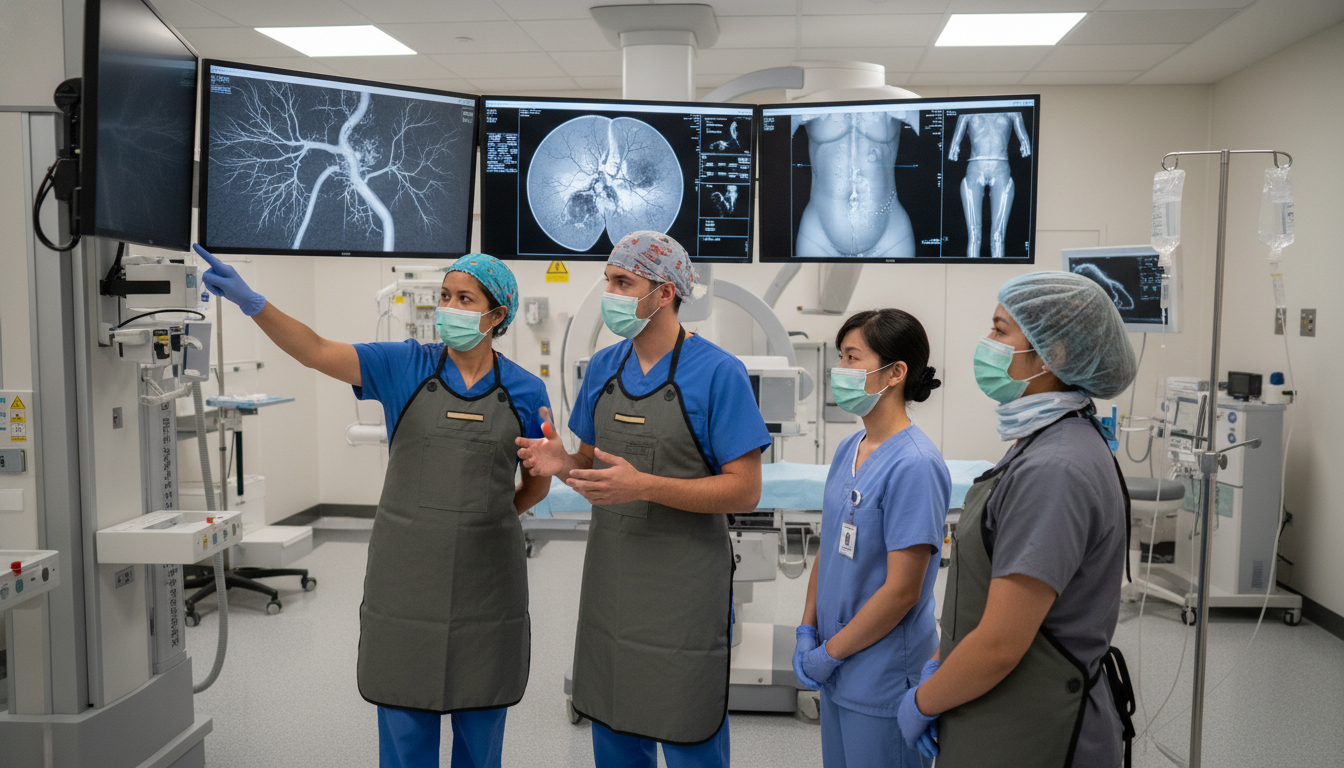
Programs want to know that you grasp what IR actually does and that you think like a clinician, not just a proceduralist.
5. “What does an interventional radiologist do?”
This question checks your understanding of scope and identity. Go beyond “they do procedures under imaging guidance.”
Touch on:
- Pre-procedure:
- Outpatient clinic: evaluating indications, alternatives, risks, patient goals
- Inpatient consults: triaging urgent procedures, risk stratification
- Intra-procedure:
- Image-guided access and navigation
- Collaboration with anesthesia, nursing, technologists
- Real-time decision-making and complication management
- Post-procedure:
- Follow-up in clinic or inpatient setting
- Managing complications, re-interventions, longitudinal disease care
- Systems role:
- Multidisciplinary tumor boards
- Quality improvement and device evaluation
- Call for emergent interventions (bleeding, stroke, PE, trauma)
Explicitly framing IR as a clinical specialty strengthens your answer.
6. “Tell me about a memorable patient you saw in IR (or another rotation).”
Here, interviewers want to see how you think about patients and your role. Choose a case that highlights:
- Clinical reasoning
- Communication and empathy
- Procedural awareness (if IR-specific)
Example structure:
- Briefly describe the patient’s presentation.
- Explain your role and what you contributed.
- Describe the intervention and outcome.
- Reflect on what you learned about IR, communication, or professionalism.
IR-themed example:
“During my IR elective, we saw a patient with advanced HCC referred for Y90. I helped gather the history and imaging, and sat with the patient as the attending explained the risks and realistic benefits. The patient was anxious, and I noticed he didn’t fully understand the term ‘palliative.’ I asked permission to explain it in simpler terms and checked his understanding.
Seeing how the IR team balanced technical planning with honest communication about expectations reinforced for me that IR is not just about procedures but about longitudinal, value-aligned care.”
Avoid sharing excessive identifiable details and avoid overly graphic descriptions.
7. “How would you explain [common IR procedure] to a patient?”
This tests your ability to communicate across knowledge levels. You might be asked about:
- Angiography and embolization
- TIPS
- UFE (uterine fibroid embolization)
- Y90 or other interventional oncology therapies
- Image-guided biopsy or drain placement
Approach:
- Plain language: Avoid jargon.
- Purpose: Why are we doing this? What is the goal?
- Process: High-level description of what happens.
- Risks/benefits: Balanced, comprehensible explanation.
- Alternatives: At least mention there may be other options.
Example (explaining a TIPS):
“A TIPS is a procedure where we create a small tunnel inside the liver to connect two blood vessels. In people with severe liver disease, the blood can’t flow through the liver easily and backs up, causing problems like bleeding or fluid buildup.
Using X-ray guidance, we thread a small tube through a vein in your neck down to your liver and place a tiny metal tunnel to help the blood flow more easily. This can reduce your risk of bleeding and help with fluid, but it can also have side effects, like confusion if more toxins bypass the liver. It’s not a cure for liver disease, but it can improve symptoms and reduce certain risks. We will talk with your liver doctor and you about whether this trade-off makes sense for you.”
Interviewers are listening for clarity, empathy, and realism.
8. “How do you handle complications or bad outcomes?”
Even if you haven’t personally managed a major IR complication, you can draw from other rotations while thinking like a future IR.
Key elements:
- Immediate patient safety: recognize, stabilize, escalate.
- Transparency: honest communication with patient/family and team.
- Systems and learning:
- Debrief with attending/colleagues.
- Participate in M&M or quality review.
- Emotional resilience:
- Acknowledge emotional toll, use healthy coping, seek feedback.
You might say:
“As a trainee, my first responsibility is to recognize when something is wrong and call for help. I believe in transparent communication with patients and families, and also in debriefing with the team to understand what happened and how to prevent it. In IR, where procedures can change a patient’s trajectory quickly, I think it’s essential to pair technical preparation with a culture that supports honest discussion of complications and continuous improvement.”

Academic, Research, and Professionalism Questions
9. “Tell me about your research” (or “favorite project”)
Especially in a competitive IR match, programs want to see curiosity and follow-through. You don’t need a PhD, but you should be able to discuss your work clearly.
When answering:
- Provide a brief background and research question.
- Describe your role specifically (design, data collection, analysis, writing).
- Highlight what you learned that’s applicable to IR:
- Understanding evidence
- Dealing with imperfect data
- Collaborating across disciplines
- Be honest about the project’s status (submitted, in prep, poster).
Pitfalls:
- Overstating your contribution.
- Getting lost in technical details you can’t explain when probed deeper.
- Not knowing key limitations of your study.
10. “What are your strengths and weaknesses?”
Programs know you’re not perfect; they want self-awareness and coachability.
Strengths: Choose qualities that are meaningful in IR, and back them up with brief examples.
- Calm under pressure and procedural environments
- Team-oriented and good at communicating with nurses/techs
- Strong visual–spatial reasoning
- Organized and reliable with follow-through
Weaknesses: Use a real, non-fatal weakness and demonstrate an active improvement plan.
- “I used to avoid asking for help early because I didn’t want to seem unprepared. I’ve worked on recognizing when early escalation can prevent patient harm and have sought feedback from residents and attendings on when to involve them.”
- Avoid “fake” weaknesses like “I work too hard” or “I care too much.”
11. “How do you manage stress and long hours?”
IR involves night call, emergent procedures, and sometimes emotionally loaded cases.
Discuss:
- Time management strategies (task prioritization, checklists, pre-procedure planning).
- Healthy coping mechanisms (exercise, social supports, hobbies).
- Boundaries and professionalism (showing up prepared even when tired).
- Past experiences demonstrating resilience (e.g., intense ICU month, research crunch).
Programs want evidence you can sustain performance without burning out or compromising patient care.
12. Ethical and Professional Scenarios
You might encounter questions like:
- “What would you do if you saw a senior resident cutting corners on informed consent?”
- “How would you handle a situation where a patient refuses a life-saving procedure you’re recommending?”
- “What if an attending asks you to perform a task you don’t feel trained to do?”
General approach:
- Patient safety and autonomy first.
- Respect for hierarchy but not at the expense of ethics.
- Seek guidance and support from appropriate channels.
Example response framework:
“I would first ensure the patient’s immediate safety and understanding, then seek clarification from the attending or discuss privately with the senior. If I still felt there was a significant patient safety or ethical issue, I would escalate appropriately—recognizing my responsibility as a physician to advocate for the patient.”
Logistics, Communication, and “Closing” Questions
13. “What questions do you have for us?”
This is not just politeness; interviewers are assessing your engagement and insight. Prepare 2–4 genuinely thoughtful questions per program.
Examples:
- “How do residents transition from diagnostic to IR rotations, and how is early procedural responsibility structured?”
- “Can you describe the IR clinic model here and how residents participate in longitudinal patient care?”
- “What systems are in place to support resident wellness and mitigate burnout, especially around IR call?”
- “How have graduates from your IR program integrated into different practice settings—academic vs. private—and how do you support that career planning?”
Avoid questions that are easily answered on the website or that focus only on salary, vacation, or moonlighting early in the conversation.
14. “Is there anything else you’d like us to know about you?”
Use this to:
- Re-emphasize a core theme (e.g., dedication to clinical IR, interest in teaching, resilience).
- Briefly highlight something not yet discussed (unique background, project, life experience).
- Avoid repeating your entire application.
You might say:
“We’ve covered most aspects of my application, but I’d like to emphasize how much I value team-based care. Across my IR and surgery rotations, I’ve consistently gravitated toward roles that support communication between nursing, techs, and physicians. I think that collaborative mindset is one of the biggest strengths I’d bring to your IR team.”
15. Questions About the IR Match Strategy and Your Rank List
Some programs may ask:
- “Where else are you interviewing?”
- “How are you thinking about your rank list?”
- “If we matched here, would you be happy training with us?”
Remember: under NRMP rules, you cannot be required to disclose your rank list. However, you can answer honestly while maintaining flexibility.
Examples:
- “I’m interviewing at a mix of academic IR programs with strong clinical training and interventional oncology exposure. I’m still learning about each program, but I can say that your clinical volume and faculty mentorship make you one of the programs I’m very excited about.”
- “I will create my rank list based on fit, particularly clinical IR training, program culture, and mentorship. From what I’ve seen and heard today, your program aligns very well with what I’m looking for.”
Avoid making promises you can’t keep, but don’t be afraid to express genuine enthusiasm.
Practical Preparation Tips for IR Residency Interviews
To make these residency interview questions feel natural, not rehearsed:
Create a story bank:
- 8–10 experiences you can adapt to many behavioral questions:
- A difficult patient
- A team conflict
- A time you led a project
- A mistake you learned from
- A high-pressure clinical situation
- 8–10 experiences you can adapt to many behavioral questions:
Practice aloud:
- Especially “tell me about yourself,” “why IR,” and “why this program.”
- Record yourself or practice with friends/mentors.
Know your application cold:
- Every publication, poster, leadership role, and activity.
- Be ready to explain gaps or changes in direction.
Understand IR basics:
- Common procedures and indications.
- High-yield pathophysiology for liver disease, PAD, oncology, trauma, PE/DVT.
- Enough that you can comfortably discuss cases you’ve seen.
Prepare technology and environment (for virtual interviews):
- Stable internet, neutral background, professional attire.
- Camera at eye level, good lighting, no distractions.
Post-interview reflections:
- After each interview, jot down:
- Program strengths & weaknesses
- Culture vibe
- How your goals align
- This will help when creating your IR match rank list.
- After each interview, jot down:
FAQs: Interventional Radiology Residency Interview Questions
1. How much should I know clinically for an IR residency interview?
You’re not expected to be a mini-IR fellow, but you should:
- Recognize common indications for key IR procedures (biopsies, drains, embolizations, TIPS, UFE, interventional oncology).
- Demonstrate basic understanding of relevant pathophysiology (e.g., portal hypertension, PAD, malignancy staging).
- Be able to discuss cases you’ve observed with clinical reasoning, not just procedural steps.
Programs are looking more for your ability to think clinically and learn, not for advanced technical expertise.
2. How can I stand out when answering behavioral interview medical questions?
You stand out by being:
- Specific: Use concrete details, not vague statements.
- Reflective: Explain what you learned and how you changed your behavior.
- IR-aware: When possible, connect your examples to skills IR values—teamwork, communication, handling uncertainty, staying calm in procedural environments.
- Concise: Stay within 1–2 minutes per answer while covering the full STAR structure.
3. What if I have limited IR exposure compared to other applicants?
Be honest, and focus on:
- Quality and depth of the exposure you do have (even if only an elective or a short rotation).
- Transferable skills from other rotations: surgery, ICU, cardiology, oncology, emergency medicine.
- Demonstrated initiative: reading about IR, attending virtual IR events, connecting with IR mentors, small projects like case reports or QI.
- Clarity of motivation for IR and realistic understanding of the field.
Lack of extensive exposure is less problematic than lack of insight or unrealistic expectations.
4. How long should my “tell me about yourself” answer be?
Aim for 60–120 seconds. Long enough to convey your story and motivations, but short enough to keep attention. Hit:
- Concise background
- Key formative experiences
- Why you’re drawn to interventional radiology
- What you’re looking for in residency
If you’re unsure, record yourself and adjust until it feels natural and flows without rushing.
Preparing thoughtfully for these common interventional radiology residency interview questions will not only help you perform better in interviews, but also clarify what you want from your IR training and career. Use the questions in this guide as a framework to build authentic, specific, and IR-focused answers that reflect who you are—and the interventional radiologist you aim to become.