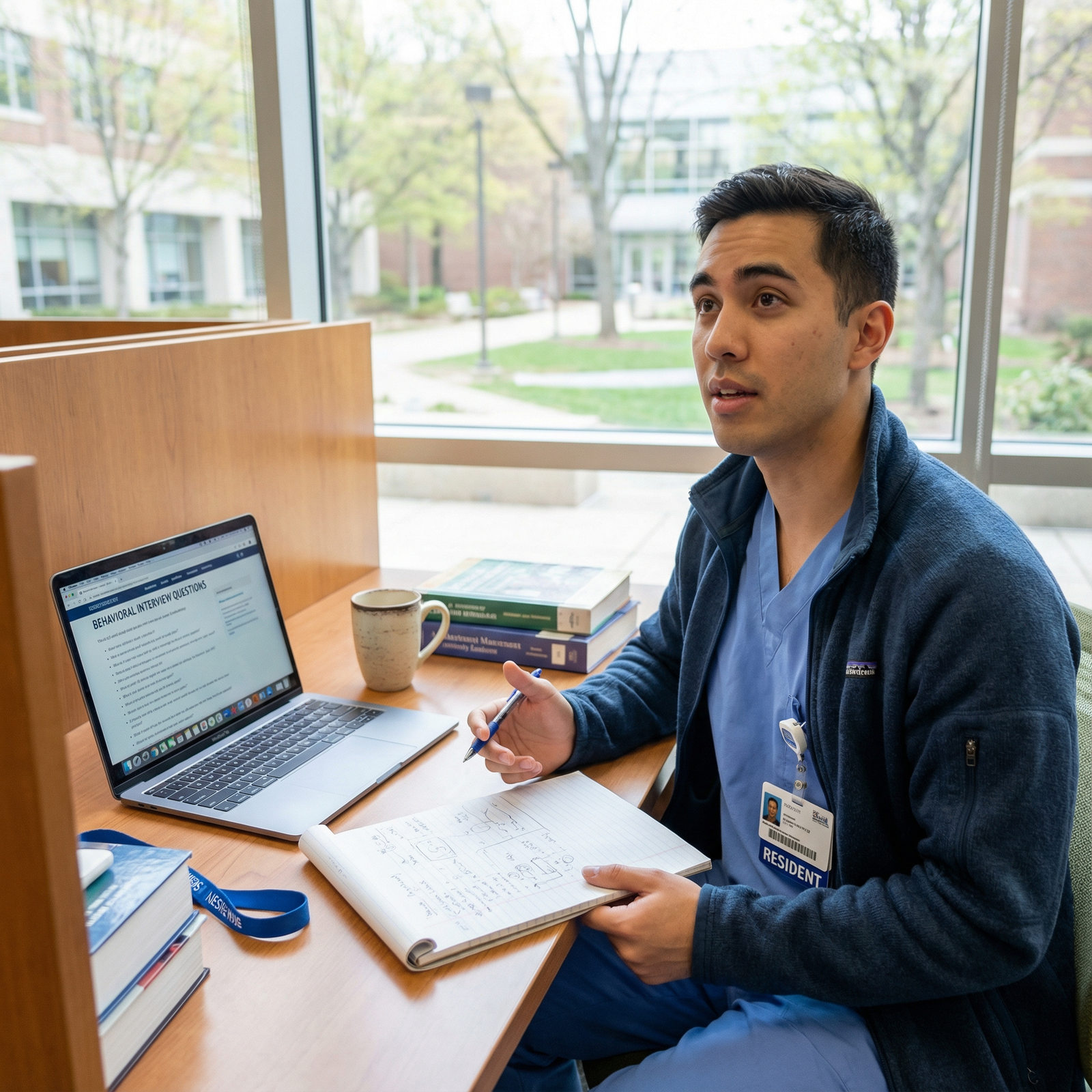
Understanding the Internal Medicine Interview as a Caribbean IMG
As a Caribbean international medical graduate (IMG), you already know that the residency application process is more than scores and transcripts. Program directors often say the interview is the single most important factor once you’ve passed their initial filters. For an internal medicine (IM) residency—especially coming from a Caribbean medical school—how you handle common residency interview questions can strongly influence your IM match outcome.
This article focuses on the behavioral and classic interview questions you are most likely to encounter, with specific guidance tailored to Caribbean IMGs. Whether you’re aiming to highlight your SGU residency match–level preparation, or you’re coming from another Caribbean medical school residency pipeline, these strategies will help you present yourself as a polished, ready-for-training internist.
We’ll cover:
- How interviewers evaluate Caribbean IMGs
- High-yield “tell me about yourself” frameworks
- Common behavioral interview questions in medicine
- Internal medicine–specific clinical and ethical questions
- Red-flag topics specific to Caribbean graduates
- Sample answers and structured approaches
- Practical preparation tips and a short FAQ
How Programs View Caribbean IMGs in Internal Medicine
Before you can answer interview questions well, you need to understand what’s behind them—especially as a Caribbean IMG.
What Programs Are Really Assessing
For an internal medicine residency, interviewers typically evaluate:
- Clinical readiness – Can you function safely as an intern on day one?
- Communication skills – Will you communicate clearly with patients, nurses, and attendings?
- Professionalism and reliability – Are you someone they can trust on nights and weekends?
- Team fit – Will you collaborate well with residents and staff?
- Resilience and maturity – Can you handle stress, feedback, and high workload?
- Motivation for IM – Do you genuinely understand and want this specialty?
For Caribbean IMGs specifically, they may have additional, often unspoken questions:
- How did you end up at a Caribbean medical school?
- Are you prepared for the intensity of a U.S. internal medicine residency?
- Have you closed any knowledge or skills gaps from basic sciences or earlier rotations?
- Are your motivations for IM clear and authentic, not just “easier to match”?
Your job in the interview is not to guess the “right” answers, but to demonstrate—through concrete, structured responses—that you are reflective, teachable, clinically grounded, and fully committed to internal medicine.
The “Tell Me About Yourself” Question: Crafting a Strong First Impression
“Tell me about yourself” is almost guaranteed, and for many programs it sets the tone for the entire conversation. As a Caribbean IMG, this is your best opportunity early on to control your narrative and proactively address concerns.
Goals of a Strong “Tell Me About Yourself” Answer
Your answer should:
- Provide a clear, chronological story (no rambling)
- Explain your path to medicine and then to internal medicine
- Smoothly and confidently incorporate the fact that you attended a Caribbean medical school
- Highlight 1–3 strengths or themes that you want the interviewer to remember
- Be 2–3 minutes long, spoken clearly and naturally
A Simple 4-Part Framework
Think of your answer in four parts:
Background snapshot (15–20 seconds)
- Where you grew up / undergraduate background
- One sentence about what drew you to science or service
Path to medicine (30–45 seconds)
- Briefly how you decided on medicine
- Any formative experiences (clinical, personal, family)
Caribbean medical school + evolution to IM (60–90 seconds)
- One composed sentence on why Caribbean route (no defensiveness)
- Key clinical experiences that led you to internal medicine
- A concrete example showing your fit for IM (e.g., continuity, complex cases)
Where you are now + what you’re looking for (30–45 seconds)
- What you’ve been doing in the last year (rotations, research, work)
- What you want in an internal medicine residency
- One sentence that ties your strengths to the program type
Example Answer (Caribbean IMG, Internal Medicine)
You should customize this, but use it as a model:
“I grew up in [home country/city] and completed my undergraduate degree in [major] at [university], where I developed a strong foundation in the sciences and really enjoyed working closely with people through [teaching/tutoring/volunteering].
I became interested in medicine during [brief story—family illness, shadowing, volunteer experience], where I saw how physicians not only treated disease but also guided patients and families through difficult decisions. That combination of science, problem-solving, and long-term relationships is what drew me in.
I chose to attend [Caribbean school, e.g., SGU / AUC / Ross] because it provided a clear pathway to U.S. clinical training and allowed me to start medical school without delay. During my clinical rotations, particularly in internal medicine at [hospital], I realized how much I enjoy the diagnostic reasoning, managing multi-comorbidity patients, and working as part of a multidisciplinary team. One patient who stands out was [brief 2–3 sentence story showing follow-up, complex care, or communication], and that experience reinforced that internal medicine is where I see myself long-term.
Over the past year I’ve focused on strengthening my clinical skills through [sub-internships, additional IM electives, research, QI], with particular interest in [e.g., hospital medicine/cardiology/endocrinology]. I’m now looking for a residency that emphasizes strong clinical training, supportive mentorship, and a diverse patient population, and I believe my background as a Caribbean IMG, my adaptability, and my commitment to continuous improvement would allow me to contribute effectively to your program.”
Practice until you can deliver something similar smoothly and conversationally—not memorized word-for-word.

Core Behavioral Interview Questions in Internal Medicine
Behavioral interview questions (“Tell me about a time when…”) are central to residency interviews. They are used to predict how you’ll behave as a resident based on your past behavior.
For a Caribbean IMG, these questions are an excellent chance to:
- Demonstrate maturity and professionalism
- Show you can work in U.S. systems and with diverse teams
- Highlight resilience and adaptability (often one of your biggest strengths)
Use the STAR Framework
Answer behavioral questions with STAR:
- S – Situation (brief context)
- T – Task (your responsibility or goal)
- A – Action (what YOU did—focus on your contribution)
- R – Result (what happened + what you learned or changed)
Keep each answer around 1.5–3 minutes.
Common Behavioral Interview Questions for Caribbean IMGs
Below are high-yield behavioral questions with guidance specific to Caribbean medical school residency applicants.
1. “Tell me about a time you had a conflict with a team member.”
What they’re testing:
Professionalism, communication, ability to handle disagreement, emotional maturity.
Tips:
- Avoid blaming or badmouthing the other person.
- Show you sought understanding and resolution, not “winning.”
- End with what you learned and how you’ve applied it since.
Example Outline (STAR):
- S: During my internal medicine rotation at [hospital], a senior resident and I disagreed about the timing of a workup for a patient with suspected PE.
- T: As the primary student on the case, I was responsible for presenting and advocating for the patient while maintaining team cohesion.
- A: I clarified my concerns, requested a brief one-on-one discussion, acknowledged the resident’s experience, and proposed reviewing current guidelines together. We then discussed with the attending, focusing on safety and evidence-based care.
- R: The attending appreciated the collaborative approach, we agreed on a plan, and I learned how to respectfully voice concerns while maintaining hierarchy and teamwork.
2. “Tell me about a time you made a mistake.”
What they’re testing:
Accountability, honesty, insight, ability to learn from error.
Tips:
- Choose a real but non-catastrophic mistake (e.g., documentation, communication).
- Never describe unprofessional or unethical behavior as your “mistake.”
- Emphasize how you fixed it and changed your behavior afterward.
3. “Describe a stressful situation and how you handled it.”
What they’re testing:
Resilience, coping, prioritization, emotional regulation.
As a Caribbean IMG, this is an opportunity to show how you handled:
- High patient loads on busy services
- Adapting to a new health system or culture
- Time pressure during exams or during your IM match cycle
Focus on specific strategies you used (checklists, time management, asking for help appropriately, self-care) rather than just saying you “worked harder.”
4. “Tell me about a time you worked with a difficult or non-compliant patient.”
What they’re testing:
Empathy, communication, cultural sensitivity, patient-centered care.
Show that you:
- Tried to understand the patient’s perspective and barriers
- Used plain language and checked for understanding
- Collaborated with the team (nurses, social work, case management)
- Respected patient autonomy while emphasizing safety
5. “Give an example of a time you received critical feedback.”
What they’re testing:
Teachability, openness, professionalism, growth mindset.
As a Caribbean IMG, program directors want to see that you:
- Can handle direct feedback without becoming defensive
- Actively seek feedback to improve
- Implement changes based on feedback
Internal Medicine–Specific Clinical and Ethical Questions
Internal medicine interviews often include questions tailored to the specialty. These help programs evaluate your curiosity, reasoning, and judgment.
1. “Why Internal Medicine?”
You will almost certainly be asked this. Your answer should be:
- Specific to internal medicine, not just “I like everything.”
- Connected to concrete experiences, not vague statements.
- Aligned with what IM actually is: longitudinal care, complex multi-system disease, diagnostic reasoning, team-based care.
Include:
- A brief initial exposure to IM
- 1–2 specific patient or rotation experiences
- What aspects of IM you find most satisfying (e.g., complex problem-solving, inpatient care, continuity clinic)
- Your long-term goals (hospitalist, fellowship, primary care, academic medicine)
2. “Tell me about a challenging internal medicine case you were involved in.”
What they’re testing:
Clinical reasoning, communication, level of responsibility, self-awareness.
Use a case that:
- Was primarily managed on an IM rotation in the U.S.
- Shows complexity (multi-morbidity, social factors, diagnostic uncertainty)
- Allowed you to play a clear role (orders, notes, family communication)
Briefly outline:
- Chief complaint and key comorbidities
- Your assessment and plan (don’t use excessive jargon)
- How you interacted with the team
- What you learned clinically and professionally
3. “How do you handle uncertainty in medicine?”
Internal medicine is full of gray areas. Program directors know that as an intern you won’t know everything—but they need to see you can recognize when you’re uncertain and act safely.
Include in your answer:
- Recognizing your limits
- Using resources (guidelines, seniors, attendings)
- Communicating clearly with patients about uncertainty
- Safety-netting and close follow-up
4. Ethical and Professional Scenarios
You may get scenario-based questions like:
- “What would you do if you saw a resident behaving unprofessionally with staff?”
- “How would you handle a family requesting you not tell the patient about a serious diagnosis?”
- “What would you do if you felt your attending made a decision you strongly disagreed with?”
In all of these, emphasize:
- Patient safety first
- Respectful communication and chain-of-command
- Seeking guidance and clarity
- Documentation when appropriate
- Cultural sensitivity and shared decision-making

Addressing Caribbean IMG–Specific Topics and Red Flags
As a Caribbean IMG, you should anticipate certain questions or concerns—sometimes asked directly, sometimes indirectly. Preparing thoughtful, confident responses will set you apart.
1. “Why Did You Choose a Caribbean Medical School?”
This may be asked explicitly, or they may hint at it when reviewing your timeline.
Key principles:
- Be honest but concise.
- Avoid appearing defensive or apologetic.
- Show that regardless of the path, you maximized your opportunities and grew from the experience.
Possible elements of an answer:
- Timing (not wanting to delay medical school start)
- Limited spots in local or U.S. schools despite readiness and commitment
- Desire for a clear, structured path to U.S. clinical training
- Emphasis on what you did with that opportunity: strong basic sciences, early adaptation, solid US clinical rotations, strong letters, etc.
End by connecting your Caribbean medical school experience to your preparedness and resilience.
2. Gaps, Repeats, or Exam Struggles
Common questions:
- “Can you explain this gap in your training?”
- “I noticed you retook Step [1/2]. What happened and what did you learn?”
Approach:
- State clearly what happened, without blaming others.
- Describe what you changed (study methods, time management, mental health support).
- Show evidence of improvement (higher scores, better clinical evaluations, increased responsibilities).
Programs are often less concerned about the event itself than about your honesty, insight, and concrete improvements.
3. Limited U.S. Clinical Experience or Observerships
If you have fewer U.S. clinical rotations:
- Emphasize the quality and intensity of the experiences you had.
- Highlight:
- Direct patient care responsibilities
- EHR use
- Exposure to U.S. health systems and interdisciplinary teams
- Mention ongoing efforts to stay clinical (locum scribe, clinical assistant, telemedicine support, research with clinical exposure).
4. Visa and Long-Term Plans
Some interviewers may ask variants of:
- “What are your long-term career goals?”
- “Where do you see yourself practicing in 5–10 years?”
Respond in a way that:
- Reassures them you are likely to complete residency and stay in practice.
- Aligns with the program’s setting (e.g., community, academic, underserved).
- Is realistic—fellowship interest is fine, but avoid sounding like IM is just a stepping-stone you don’t value.
Practical Preparation Strategies for Caribbean IMGs
1. Build a Personalized “Question Bank”
Create your own set of 30–40 common residency interview questions, including:
- Classic questions:
- Tell me about yourself
- Why internal medicine?
- Why this program / this location?
- What are your strengths and weaknesses?
- Behavioral interview medical questions:
- Conflict with team member
- Difficult patient or family
- Time you failed / made a mistake
- Received critical feedback
- Led a team
- Caribbean-specific:
- Why Caribbean school?
- Gaps in education
- Exam attempts
- Visa plans / long-term goals
Write out bullet-pointed STAR outlines for each—not full essays—to keep your answers natural.
2. Rehearse Out Loud and On Video
Especially for Caribbean medical school graduates whose first language may not be English, practicing out loud helps you:
- Smooth transitional phrases
- Fix filler words (“um,” “like,” “you know”)
- Adjust speed and clarity
Record mock interviews (alone or with a friend/mentor) and review:
- Body language
- Eye contact
- Tone and pace
- Clarity of answers
3. Prepare Questions You Will Ask
You will usually be asked, “Do you have any questions for us?” Having thoughtful, specific questions shows genuine interest and maturity.
Examples:
- “How does your program support interns as they transition into managing their own patient panels in continuity clinic?”
- “Can you describe how feedback is given to residents and how often?”
- “What traits do the most successful residents in your internal medicine program share?”
Avoid questions that are easily answered on the website or that make it sound like you’re only interested in visas or vacation policies.
4. Align Your Story Across Application, Interview, and References
Interviewers will often have your:
- ERAS application and personal statement
- MSPE (Dean’s letter)
- Letters of recommendation
Ensure that:
- Key themes (e.g., interest in hospital medicine, research focus, specific IM subfield) are consistent.
- Experiences you highlight in interviews match those emphasized by your letter writers when possible.
- Your story around any red flags is consistent in wording and tone.
5. Practice Answering Concisely
As a Caribbean IMG, you may feel pressure to “explain everything,” leading to long, unfocused answers. Practice:
- Sticking to the STAR structure
- Limiting stories to key details
- Pausing briefly before answering to organize your thoughts
A strong answer is clear, structured, and complete yet concise.
Frequently Asked Questions (FAQ)
1. As a Caribbean IMG, will I get different residency interview questions than U.S. grads?
Most questions are similar, especially for internal medicine: “Tell me about yourself,” “Why IM?,” behavioral scenarios, and clinical/ethical questions. However, Caribbean IMGs are more likely to be asked about:
- Why they chose a Caribbean medical school
- Any educational gaps or exam attempts
- Visa needs and long-term practice plans
Prepare for these explicitly, but otherwise focus on the same high-yield behavioral and clinical questions as any other IM applicant.
2. How should I discuss my Caribbean medical school without sounding defensive?
Address it briefly and confidently:
- One sentence on why that route (timing, opportunity, pathway to U.S. training)
- Emphasize what you gained (adaptability, diverse patient exposure, resilience)
- Shift quickly to your U.S. clinical performance, letters, and readiness for internal medicine.
Avoid apologizing for your path. Present it as one component of a larger story of persistence and growth.
3. What are some red-flag answers for internal medicine interviews?
Avoid:
- Speaking negatively about previous programs, attendings, or countries.
- Blaming others for exam failures or academic issues.
- Saying you chose IM only because you “couldn’t match into something else.”
- Overly long, unstructured stories that don’t answer the question.
- Ethical answers that ignore patient safety, chain of command, or honesty.
Focus instead on ownership, reflection, and concrete improvement.
4. How can I stand out positively as a Caribbean IMG in my IM match interviews?
You stand out not by trying to be “perfect,” but by being:
- Structured: Using STAR for behavioral questions and clear frameworks for “tell me about yourself” and “why IM.”
- Reflective: Showing insight into your experiences, including challenges.
- Authentic: Speaking honestly about your path and goals, including interest in hospital medicine or fellowship, without dismissing the value of general IM.
- Prepared: Demonstrating knowledge of each program and asking thoughtful, program-specific questions.
With focused preparation on these common interview questions and thoughtful reflection on your Caribbean IMG journey, you can present yourself as exactly what internal medicine programs are looking for: a resilient, team-oriented, clinically ready future internist.