
Introduction: Why Role-Play Matters for Behavioral Interviews in Medicine
Behavioral interviews are now a core component of residency selection, fellowship interviews, and many staff physician hiring processes. Program directors increasingly rely on these questions to assess not just what you know, but how you work: your professionalism, resilience, communication skills, teamwork, and ethical decision-making.
Estimates suggest that close to 80% of interviewers regularly use behavioral questions to evaluate candidates’ fit and future performance. For competitive residency and fellowship spots, strong clinical knowledge alone is no longer enough—you must be able to articulate your experiences clearly and convincingly.
That’s where interview role-play comes in. Structured practice using realistic scenarios and behavioral questions can transform you from a nervous, rambling candidate into a focused, confident storyteller. Role-play helps you:
- Organize your experiences using the STAR method
- Practice high-yield communication skills under pressure
- Identify gaps in your examples before the real interview
- Receive targeted feedback in a low-risk environment
This guide will walk you through how to use role-play techniques to prepare for behavioral questions, especially in the context of residency match and applications. You’ll learn:
- The structure and purpose of behavioral questions
- A detailed, step-by-step role-play framework
- Advanced strategies to make practice realistic and effective
- How to give and receive feedback that actually leads to improvement
By the end, you’ll have a clear blueprint for interview preparation that you can start using this week.
Understanding Behavioral Interview Questions in Residency and Job Interviews
What Are Behavioral Interview Questions?
Behavioral interview questions focus on how you’ve handled real situations in the past. The underlying assumption: past behavior is one of the best predictors of future behavior.
These questions usually start with prompts like:
- “Tell me about a time when…”
- “Give me an example of…”
- “Describe a situation where…”
They are typically answered using the STAR method:
- S – Situation: What was the context?
- T – Task: What was your role or responsibility?
- A – Action: What specific steps did you take?
- R – Result: What happened? What did you learn?
For medical students and residents, common behavioral question themes include:
- Conflict with a colleague or team member
- Managing a high-stress call or night shift
- Addressing a medical error or near-miss
- Communicating with a difficult patient or family
- Advocating for patient safety or quality improvement
- Handling feedback or remediation
- Leading a project or QI initiative
Example general questions:
- “Tell me about a time you had a disagreement with a colleague. How did you handle it?”
- “Describe a situation where you had competing priorities. How did you manage your time?”
- “Give an example of a time you made a mistake. What did you do next?”
Example residency-specific questions:
- “Tell me about a challenging interaction with a patient or family and how you handled it.”
- “Describe a time you were overwhelmed on a rotation. How did you cope?”
- “Can you give an example of when you advocated for a patient’s needs?”
Strong candidates don’t just answer the question; they demonstrate insight, maturity, and alignment with the program’s values.
Why Role-Play Is Especially Powerful for Behavioral Questions
You cannot “cram” for behavioral interviews the night before. You need deliberate practice, and role-play techniques are one of the most efficient ways to build skill.
Role-play simulates the real interview environment, giving you a safe space to:
- Practice answering out loud (very different from thinking answers in your head)
- Refine your body language, eye contact, and tone
- Manage anxiety and develop composure
- Test and refine your STAR stories
- Practice handling unexpected follow-up questions
Research in education and psychology consistently shows that simulated practice—including role-play—improves performance in high-stakes, interpersonal situations. It’s the same principle behind standardized patient encounters in medical school.
For residency and job interviews, structured role-play can be the difference between vague, unfocused answers and clear, compelling narratives that program directors remember.
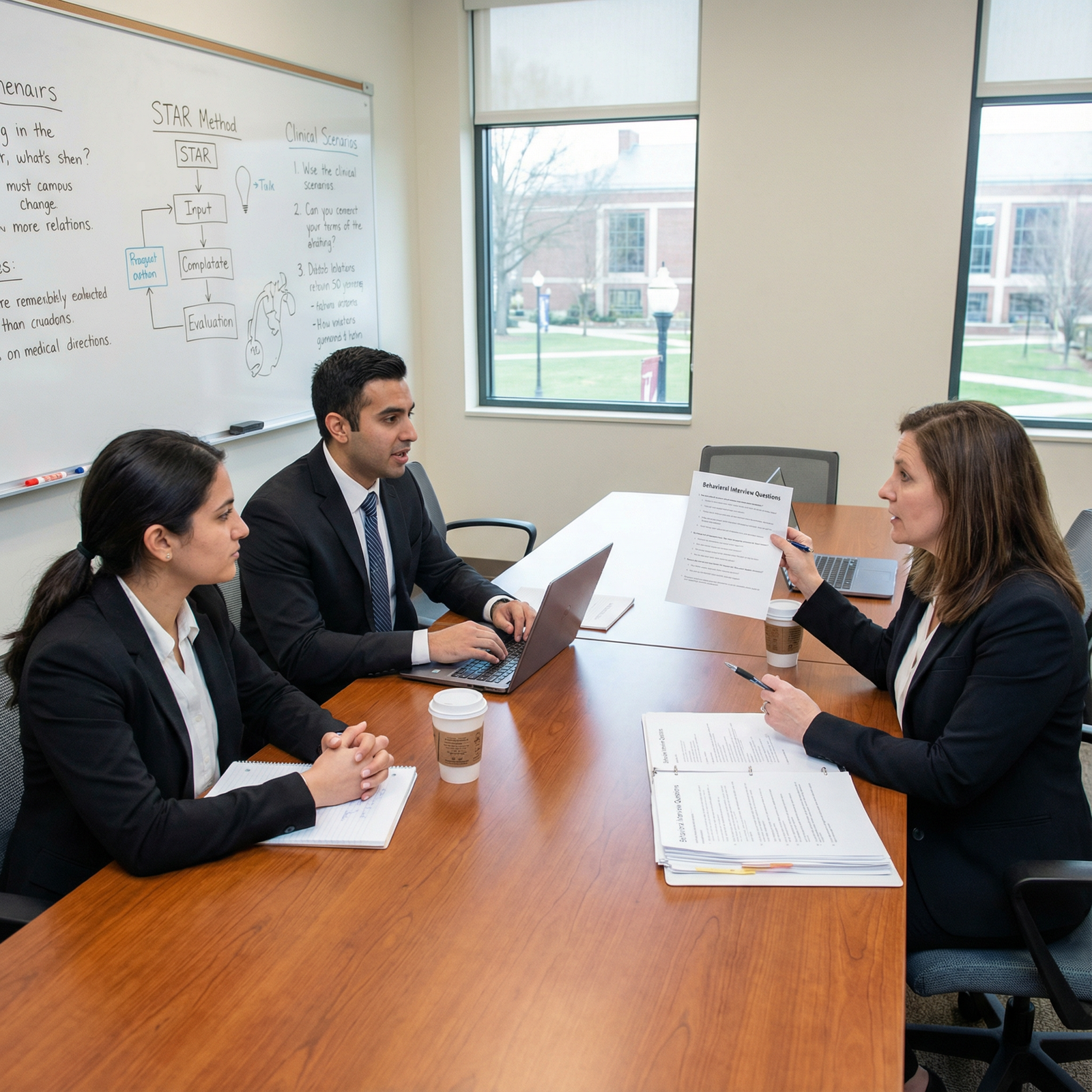
Step-by-Step Guide: Implementing Role-Play for Behavioral Interview Preparation
Step 1: Identify High-Yield Behavioral Questions
Start by creating a targeted question bank tailored to your goals.
A. Research program-specific and specialty-specific questions
Use resources like:
- Glassdoor, Indeed, and specialty forums for previous interview questions
- Your school’s career office or residency advising office
- Residents or recent graduates from your target programs
Focus on categories you know will come up:
- Teamwork and collaboration
- Conflict resolution
- Ethics and professionalism
- Communication challenges
- Leadership and initiative
- Dealing with stress, burnout, or failure
B. Organize your questions by theme
Example categories:
- Conflict: “Tell me about a time you disagreed with a supervisor.”
- Stress: “Describe a time you had to manage multiple urgent tasks at once.”
- Leadership: “Give an example of when you led a team or project.”
- Adaptability: “Tell me about a time a plan changed suddenly. What did you do?”
- Ethics/Professionalism: “Describe a time you saw something that concerned you. How did you respond?”
Aim for 20–30 well-chosen behavioral questions to start. This will give you enough variety without being overwhelming.
Step 2: Choose the Right Role-Play Partner
Your choice of partner strongly affects how realistic and useful your practice will be.
Good options include:
- A resident or fellow in your target specialty
- A faculty mentor or advisor
- A career counselor or dean’s office staff
- A classmate who is also preparing for interviews
- A trusted non-medical friend with strong communication skills
If possible, practice with more than one partner over time to expose yourself to different interviewing styles.
What to look for in a partner:
- Willingness to give honest, specific feedback
- Reliability and consistency
- A basic understanding of medical training and residency culture
- Comfort with a bit of “performance” (staying in interviewer role)
If you can’t find a partner consistently, you can still use solo role-play techniques (described later), but a live partner is ideal.
Step 3: Create a Realistic Interview Environment
Treat your role-play like a dress rehearsal for the real thing.
- Dress in interview attire at least for a few practice sessions
- Choose a quiet, professional-looking space (desk, neutral background)
- If your real interview is virtual, practice over Zoom, Teams, or similar platforms
- Use the same equipment you’ll use on interview day:
- Same laptop/webcam
- Same microphone or headphones
- Similar lighting (test lighting angles and background)
This not only makes the practice more authentic but also reduces technical surprises on the actual day.
Step 4: Conduct the Role-Play Session
Structure each role-play session like a real interview:
Opening
- Your partner greets you and introduces themselves as the interviewer.
- You respond with a professional greeting and brief small talk.
Warm-up question
- Start with “Tell me about yourself” to rehearse your narrative.
Behavioral questions segment
- Your partner asks 5–10 behavioral questions from your question bank.
- You answer each using the STAR framework, aiming for 2–3 minutes per answer.
- Your partner may ask follow-up questions to mimic a real interviewer’s curiosity (e.g., “How did your team react?” or “What would you do differently now?”).
Closing
- Practice asking thoughtful questions at the end (about the program, culture, teaching, etc.).
- End with a professional thank-you.
Treat this as a performance: stay in character, avoid breaking to discuss how you’re doing until after the mock interview ends.
Step 5: Record and Review Your Performance
Whenever possible, record your session (video preferred; audio is acceptable if video isn’t available).
When reviewing:
Watch once with no notes, just to get a general impression.
Then review a second time and assess:
Content
- Did you clearly state the Situation, Task, Action, and Result?
- Did you answer the question asked?
- Did you highlight your role specifically, or say “we” too often?
- Did you show insight and reflection?
Communication skills
- Eye contact with the camera (for virtual) or interviewer (in-person)
- Voice volume and pace—too fast, too soft, monotone?
- Use of filler words (“um,” “like,” “you know”)
- Clarity and conciseness
Nonverbal behavior
- Posture (open vs. closed off)
- Facial expressions (engaged, attentive, warm)
- Nervous habits (pen clicking, hair twirling, fidgeting)
Pick 1–2 specific areas to improve for the next session rather than trying to fix everything at once.
Step 6: Invite Structured Feedback From Your Partner
After the mock interview, debrief with your partner using a clear structure.
You can use a simple rubric (1–5 scale) for:
- Clarity and organization of answers
- Relevance of examples to the question
- Demonstration of key competencies (teamwork, professionalism, resilience)
- Communication skills (verbal and nonverbal)
- Overall impression: Would they rank you highly?
Encourage them to give:
- Specific examples:
- “In the question about conflict, your example was strong, but your Result section was vague.”
- Actionable suggestions:
- “Try naming one concrete outcome—what changed because of your actions?”
Ask targeted questions such as:
- “Did any of my answers feel too long or too short?”
- “Did I come across as defensive or blaming anyone in my conflict examples?”
- “Which answer stood out as my strongest, and why?”
Write down key feedback right away while it’s fresh.
Advanced Role-Play Techniques to Maximize Your Interview Preparation
Technique 1: Create High-Realism Scenarios
Increase the realism of your practice to mirror the pressure of a real interview.
- Timed answers: Use a timer and aim for 2 minutes per answer.
- Mixed question types: Blend behavioral questions with classic residency questions (e.g., “Why our program?” “What are your weaknesses?”).
- On-the-spot scenario prompts:
- “You are on call and two patients decompensate at the same time—how do you prioritize?”
- “You realize an attending made an error in a note. What do you do?”
You can also simulate different interviewer styles:
- Very friendly and conversational
- Neutral and reserved
- Rapid-fire questioning with limited positive feedback
This helps you learn to adapt your tone and communication style without losing composure.
Technique 2: Embrace Variety in Partners and Perspectives
Don’t limit your practice to a single partner.
- Partner swapping: Practice with different classmates, residents, or mentors. Each will have unique questions and expectations.
- Peer practice groups: Create a small group (3–5 people) and rotate roles: interviewer, candidate, and observer. The observer focuses entirely on feedback.
- Role reversal: Occasionally, you become the interviewer. This helps you understand what strong vs. weak answers sound like from the other side, sharpening your own responses.
Technique 3: Use Mock Scoring and Self-Assessment
Develop a simple scoring system for each behavioral question, such as:
- 1–5 for STAR structure
- 1–5 for clarity and conciseness
- 1–5 for impact and insight
- 1–5 for nonverbal delivery
Track your scores across sessions. This helps you:
- Identify patterns (e.g., consistently weak Results section)
- See objective improvement over time
- Prioritize which stories to refine or replace
After each session, ask yourself:
- Which answer felt the strongest? Why?
- Which answer felt awkward or incomplete? What was missing?
- Did I show growth mindset and reflection when discussing mistakes?
Technique 4: Refine and Rotate Your STAR Stories
You don’t need dozens of completely different stories. A core set of 8–12 well-developed STAR examples can cover most behavioral questions if you adapt them thoughtfully.
Common categories for your story bank:
- A time you managed a conflict
- A time you dealt with a difficult patient/family
- A leadership or project example
- A failure or mistake and what you learned
- A time you advocated for patient safety or ethics
- A time you worked in a diverse or interprofessional team
- A time you handled heavy workload or stress
- A time you improved a process or system (QI, research, etc.)
For each story, practice emphasizing different aspects depending on the question (e.g., teamwork vs. time management vs. communication).

Feedback and Self-Reflection: Turning Practice Into Growth
Giving and Receiving Constructive Critique
Effective feedback is specific, balanced, and actionable.
Encourage partners to:
- Start with what worked well:
- “Your story about advocating for a patient was compelling and clearly structured.”
- Then share specific opportunities for improvement:
- “In your error example, spend less time on background and more on what you did to fix the situation.”
- End with encouragement or a concrete next step:
- “If you tighten your Results section, that answer will be excellent.”
When receiving feedback:
- Resist the urge to explain or defend during the first pass. Just listen.
- Ask clarifying questions after they finish:
- “Can you give me an example of where I sounded defensive?”
- Summarize what you heard to ensure understanding:
- “So my main areas to improve are being more concise and highlighting outcomes more clearly. Did I get that right?”
Building a Habit of Self-Reflection
After each role-play session, take 5–10 minutes to reflect:
Emotionally
- When did I feel most confident? Least confident?
- Did I feel flustered or stuck at any point?
Technically
- Which questions consistently trip me up?
- Are there themes where I lack strong examples (e.g., leadership, conflict)?
Strategically
- Which stories best demonstrate the qualities programs seek (professionalism, teamwork, resilience)?
- Do my answers reflect the values of my target specialty and programs?
Use these insights to adjust your next practice session. Over time, this cycle of role-play → feedback → reflection → refinement leads to substantial improvement.
Putting It All Together: A Sample One-Week Role-Play Plan
Here’s how you might structure one week of targeted interview preparation:
Day 1:
- Build or refine your behavioral question bank.
- Draft 8–12 STAR stories with bullet points.
Day 2:
- Solo practice: Answer 5 questions out loud, record yourself.
- Identify 2–3 areas to improve (e.g., Results clarity, timing).
Day 3:
- 45-minute role-play with a partner (virtual or in-person).
- Focus on conflict and stress-management questions.
- Get structured feedback and take notes.
Day 4:
- Edit and strengthen your weaker stories.
- Practice delivering them in under 2 minutes.
Day 5:
- Second role-play with a different partner or same partner with different question set.
- Include general questions (why this specialty, why our program).
Day 6:
- Review recordings from both sessions.
- Note improvements and remaining weak spots.
Day 7:
- Light review and practice selected questions.
- Rest and mental preparation.
Repeating a cycle like this over several weeks before interview season can dramatically increase your comfort, consistency, and confidence.
FAQs: Behavioral Interview Role-Play for Residency and Job Interviews
1. What are some of the most common behavioral questions asked in residency and job interviews?
Common examples include:
- “Tell me about a time you had a conflict with a colleague or team member. How did you resolve it?”
- “Describe a situation where you made a mistake. What happened, and what did you learn?”
- “Give an example of a time you had to manage multiple competing priorities.”
- “Tell me about a time you dealt with a difficult patient or family member.”
- “Describe a situation where you showed leadership or took initiative.”
Preparing STAR stories for these themes will cover a large percentage of behavioral questions you’re likely to encounter.
2. How often should I practice role-play before my residency or job interviews?
Aim for 2–3 focused role-play sessions per week in the month leading up to interviews. Each session can be 30–60 minutes. Quality is more important than quantity:
- Early on, focus on building strong stories and structure.
- Later, emphasize timing, polish, and adaptability to different question wordings.
Even short daily practice (10–15 minutes) answering 1–2 behavioral questions aloud can be very beneficial.
3. Can I still benefit from role-play if I don’t have a partner? How can I practice solo effectively?
Yes. While a partner improves realism and feedback, you can still gain a lot from solo role-play:
- Use a list of behavioral questions and answer out loud in front of a mirror or camera.
- Record yourself on your phone or laptop and review for clarity and nonverbal cues.
- Use video-conferencing software alone (Zoom, Teams) to mimic the interview interface.
- Time your answers to 2–3 minutes to practice concise delivery.
Whenever possible, supplement solo practice with at least a few sessions with a real person—faculty, resident, or peer.
4. How can I avoid sounding rehearsed or robotic when I practice so much?
Focus on rehearsing key points, not memorized scripts:
- Learn the outline of each story (Situation, Task, Action, Result), not exact sentences.
- Vary your wording each time you practice to keep it natural.
- Practice active listening—answer the exact question asked, even if you use a familiar story.
- Keep your tone conversational and engaged, as if talking to a colleague, not reading a speech.
Extensive practice actually makes you more flexible; you can adapt on the spot because you deeply understand your own stories.
5. What if I don’t have many dramatic experiences or “big” stories to use for behavioral questions?
You don’t need dramatic or heroic stories. Interviewers care more about:
- Your judgment and professionalism
- How you communicate and reflect
- Your ability to learn from experience
Everyday clinical experiences can be excellent material:
- A small communication misunderstanding that you resolved
- A busy call night that forced you to prioritize tasks
- A minor error that led you to change your checklist or habit
- A teamwork example from a QI project, teaching role, or student organization
Focus on what you did, what you learned, and how it changed your practice—that’s what leaves a strong impression.
By integrating role-play techniques, thoughtful interview preparation, and targeted practice with behavioral questions, you’ll walk into your residency or job interviews with far more confidence, clarity, and control. Use these strategies to turn your real experiences into compelling stories that show programs exactly why you’ll be an excellent colleague and physician.