Understanding the Pathology Interview Landscape for Non-US Citizen IMGs
Residency interviews in pathology are generally collegial and conversational, but as a non-US citizen IMG (international medical graduate), you will face additional layers of scrutiny—both clinically and non-clinically. Programs want to know not only whether you can interpret slides, but also whether you can adapt to a new system, communicate effectively, and commit to a long-term career in pathology in the US.
This article focuses on common interview questions you can expect as a foreign national medical graduate applying to pathology residency in the United States. It emphasizes behavioral interview medical questions and offers structured ways to answer them, specifically tailored for non-US citizen IMGs.
We will cover:
- Core general questions (e.g., “tell me about yourself”)
- Pathology-specific questions
- Behavioral and situational questions
- Visa, immigration, and IMG-specific questions
- How to practice and refine your responses
1. The Classic Opener: “Tell Me About Yourself” and Other Broad Questions
The first few minutes of the interview heavily influence the rest of the conversation. Programs often start with:
1.1 “Tell me about yourself.”
This is almost guaranteed. It’s also the most misused question. Many applicants recite their CV chronologically; interviewers already have that. Instead, give a short, structured narrative that connects who you are to why you are sitting in that chair.
Goals of this question for a non-US citizen IMG:
- Assess English fluency and clarity of communication
- Understand your personal/professional journey to pathology
- Gauge maturity, self-awareness, and ability to summarize complex paths
Simple structure (2–3 minutes):
- Present: Who you are right now
- “I am a non-US citizen IMG from [country], currently doing [US clinical/research experience or what you’ve done recently].”
- Past: Key background milestones
- Medical school, major experiences, why pathology caught your interest, major research or leadership roles.
- Future: Why pathology in the US, and your career goals
- Long-term goals that align with training at their institution.
Example tailored to a non-US citizen IMG in pathology:
“I am a non-US citizen IMG from India, currently completing a year of research in gastrointestinal pathology at [Institution], where I work on clinicopathologic correlation projects and contribute to diagnostic sign-out. I completed medical school at [University], where I initially considered internal medicine but became drawn to pathology during my third-year rotations when I realized how central tissue diagnosis is to every patient’s care plan.
After graduation, I spent a year working as a junior doctor in internal medicine, which gave me an appreciation for how clinicians rely on accurate pathology reports. That experience, along with a 3‑month elective in an academic pathology department, convinced me that I wanted to train in the US, where the diagnostic, molecular, and translational aspects of pathology are highly integrated.
Looking ahead, I see myself as an academic surgical pathologist with a focus on GI and liver, involved in resident education and translational research. I’m particularly interested in your program because of its strong GI pathology service and emphasis on multidisciplinary tumor boards.”
Common mistakes to avoid:
- Excessive personal details (childhood stories that don’t connect to medicine or pathology)
- Reading from a memorized script (sounds robotic)
- Overemphasis on test scores or visa status at this stage
1.2 “Walk me through your CV.”
This is similar, but the interviewer wants you to explain transitions and gaps from your perspective.
What they’re really asking:
- Why did you make certain choices?
- How did you use your time after graduation?
- Are there any red flags (gaps, low scores) and how do you frame them?
How to respond:
- Start at graduation or late medical school (not childhood).
- Briefly highlight each phase: internship, research, USCE (US clinical experience), observerships.
- For gaps or detours (e.g., preparation for USMLE, family responsibilities), explain concisely and emphasize productive use of that time.
1.3 “Why pathology?”
For a pathology residency interview, this is central. For a non-US citizen IMG, programs also want to know: Why pathology in the US, rather than in your home country or another specialty?
Key elements:
- Your initial exposure (clinical rotations, autopsies, tumor boards, research)
- What you enjoy in daily pathology work (diagnostic reasoning, pattern recognition, correlation with clinical data)
- How your strengths align with pathology (analytical thinking, attention to detail, comfort with non-patient-facing specialty but still patient-centered)
Example response:
“During my internal medicine rotations, I noticed that every major diagnostic and therapeutic decision eventually traced back to pathology. I found myself reading pathology reports closely and wanting to see the slides behind them. My elective in surgical pathology confirmed that I really enjoy pattern recognition, synthesizing clinical and pathologic data, and arriving at a precise diagnosis.
I am detail-oriented and enjoy structured, logical problem-solving, which fits well with pathology. At the same time, I value teamwork and contributing to patient care behind the scenes, through accurate, timely reports and participation in tumor boards. Training in the US offers robust exposure to subspecialty sign-out, molecular diagnostics, and mentorship in academic research, which are not as readily available in my home country. That combination is why I’m committed to pathology residency in the US.”
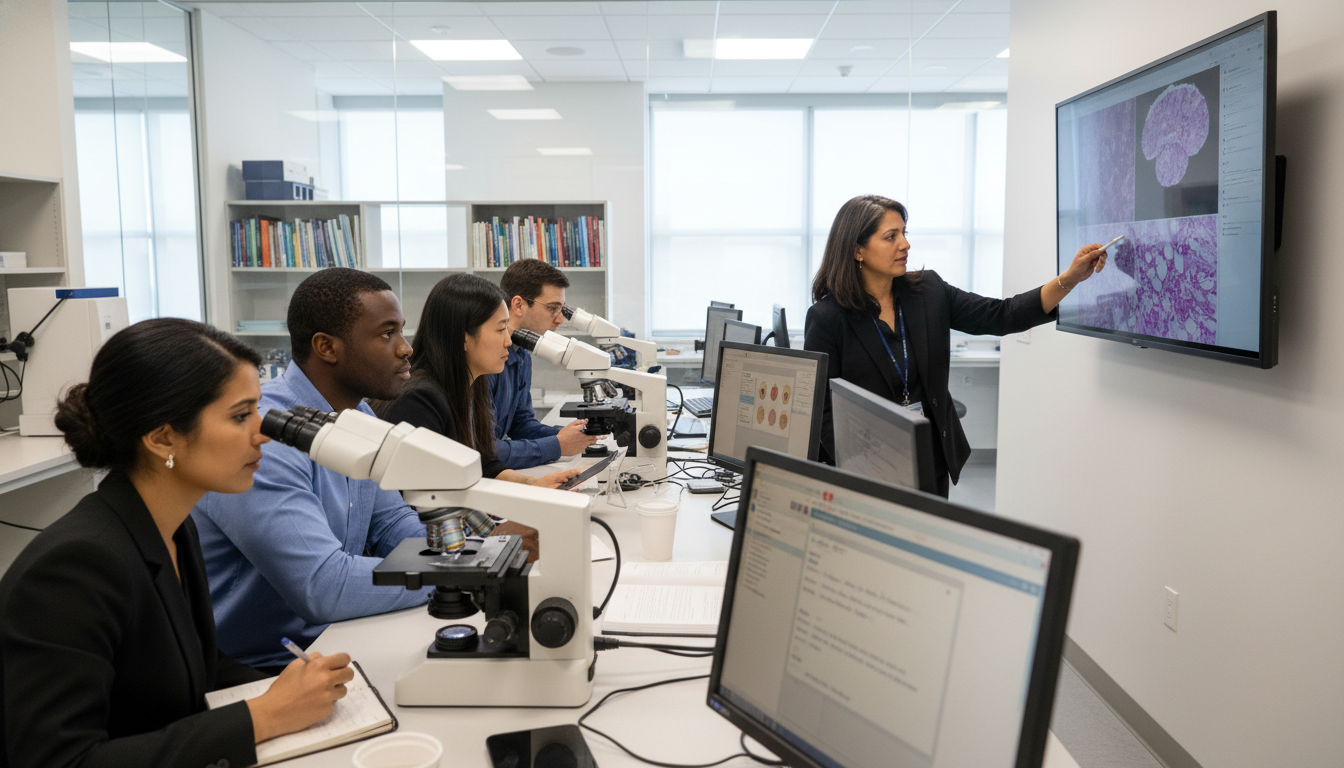
2. Pathology-Specific Questions You Should Expect
2.1 “What do you think a pathologist does day-to-day?”
Some foreign national medical graduates underestimate how different US pathology is from their image of the specialty. Interviewers want to ensure you understand the reality of the job.
Include:
- Surgical pathology sign-out (grossing, previewing, attending sign-out)
- Cytopathology, frozen sections
- Autopsies (depending on program)
- Multidisciplinary tumor boards
- Maintaining quality and safety in the lab, lab management aspects
- Teaching (students, residents)
- Potential research activities
Example:
“On a typical day in surgical pathology, a resident might start by reviewing overnight cases and grossed specimens, preparing for sign-out with the attending. They preview slides, correlate with clinical data and imaging, and formulate differential diagnoses. There may be intraoperative consultations like frozen sections, and participation in multidisciplinary tumor boards. Depending on the rotation, they might also be involved in autopsies, cytology sign-out, or clinical pathology tasks such as reviewing critical lab values. Teaching students and collaborating with clinicians are also daily components.”
2.2 “What areas of pathology interest you the most?”
As an applicant, you are not expected to have a fixed subspecialty, but you should show genuine exposure and curiosity.
You might mention:
- Surgical pathology subspecialties (GI, GU, breast, heme, derm, neuropathology)
- Cytopathology
- Molecular pathology
- Hematopathology and flow cytometry
- Transfusion medicine and coagulation
Connect your interest to your experiences: mentoring, research projects, tumor boards.
2.3 “Have you had any hands-on pathology experience in the US?”
This often appears in the context of a non-US citizen IMG with limited US pathology exposure.
If you have US pathology experience:
- Describe the setting (academic vs community)
- Highlight tasks: grossing, slide preview, tumor boards, research, QA projects
- Emphasize what you learned and how it confirmed your interest
If you do NOT have US pathology experience:
- Be honest. Emphasize any home-country pathology rotations, research, or observerships.
- Highlight your proactive efforts: online pathology courses, virtual electives, slide review clubs, digital pathology projects.
2.4 “How comfortable are you with grossing?”
Many programs are concerned that IMGs may have limited grossing experience, especially in well-developed US-style labs.
Address:
- Any direct grossing experience (type of specimens, level of supervision)
- Understanding of safety, proper fixation, orientation, margin assessment
- Willingness to learn and improve quickly
If you have limited exposure, emphasize transferable skills (attention to detail, manual dexterity, comfort with learning protocols) and readiness to follow structured training.
2.5 “What do you understand about clinical pathology (CP) and its role?”
Some applicants think pathology = only anatomic pathology. As a foreign national medical graduate, show that you understand the importance of CP:
- Laboratory medicine (chemistry, hematology, microbiology, transfusion, coagulation)
- Ensuring accurate results, troubleshooting instrument or specimen problems
- Consulting with clinicians about test selection and interpretation
- Quality control and quality assurance
- Role in transfusion reactions, antimicrobial stewardship, blood bank
This shows you are aware of the full scope of pathology residency.
3. Behavioral & Situational Interview Questions (and How to Answer Them)
Residency programs increasingly use behavioral interview medical questions to predict how you’ll function on a team. They usually start with phrases like:
- “Tell me about a time when…”
- “Describe a situation where…”
- “Give me an example of…”
Use the STAR method (Situation, Task, Action, Result) to structure your answers.
3.1 Common behavioral questions for pathology applicants
A. “Tell me about a time you made a mistake in a clinical setting.”
What they’re testing:
- Honesty and accountability
- Reflection and learning
- Emotional maturity
Example (adapted for an IMG):
Situation: “During my internship in internal medicine in [country], I was responsible for reviewing lab results for a set of patients.”
Task: “One evening, I missed a significantly low hemoglobin result in the electronic record, and the patient’s anemia was only noticed the next morning.”
Action: “When I realized the oversight, I immediately notified my senior resident, documented the finding, and ensured the appropriate transfusion and further workup were arranged. I also apologized to the team and discussed with my senior how to improve my system.”
Result: “The patient was stabilized and did well, but this made a strong impact on me. Since then, I have developed a consistent checklist for reviewing all critical values and verifying them verbally with nursing staff during handoff. This experience reinforced my commitment to meticulous data review, which is essential in pathology where small details can change a diagnosis completely.”
Avoid blaming others; own your part and focus on learning.
B. “Describe a conflict with a colleague and how you handled it.”
As a non-US citizen IMG, programs also want to know if you can navigate cultural and communication differences.
Example:
“During my research year in the US, I worked closely with another fellow on a retrospective pathology project. We had different working styles—he preferred last-minute work, while I liked to plan and keep regular deadlines. This led to tension when we missed an internal deadline for abstract submission.
I requested a short meeting and calmly explained my concerns, focusing on the impact on our shared goal rather than on personal criticism. I asked how we could divide tasks in a way that matched our strengths. We agreed that I would handle early data collection and initial drafts, while he would focus on final revisions and presentations. We also set explicit deadlines in writing.
After that, our collaboration improved, and we successfully presented a poster at a national meeting. The experience taught me the importance of open communication, understanding different work styles, and framing feedback constructively.”
C. “Tell me about a time you worked under significant pressure or workload.”
Pathology residency can be intense, especially on busy surgical pathology or transfusion medicine rotations.
Tips for answering:
- Choose a specific situation: exam time, large call load, many cases in a short time.
- Emphasize time management, prioritization, and seeking help appropriately.
- Avoid portraying yourself as disorganized or chronically overwhelmed.
D. “How do you handle feedback or criticism?”
Programs want residents who accept feedback without defensiveness and translate it into improvement.
Example:
“During my pathology observership, an attending told me that my case presentations lacked a clear structure and that I jumped between clinical history and pathologic findings. Initially, I felt a bit discouraged, but I asked her for specific suggestions on how to improve. She recommended a standardized format: clinical summary, gross description, microscopic features, differential, and final diagnosis.
I adopted this structure for all my subsequent presentations and requested ongoing feedback from her and other faculty. Over time, my presentations became more organized and concise, and I felt more confident. This experience reinforced that honest feedback is an opportunity to grow, and I try to actively seek it.”

4. Questions Specific to Non-US Citizen IMGs and Foreign National Medical Graduates
As a non-US citizen IMG and foreign national medical graduate, you should be prepared for questions that directly or indirectly relate to your status, background, and adaptation to the US system.
4.1 “Why did you choose to pursue residency in the US?”
Possible angles:
- Exposure to technology, subspecialty training, and research
- Structured pathology residency curriculum
- Career goals that align with US training
- Personal experiences (mentors, electives)
Be careful not to criticize your home country excessively; frame it more as seeking specific opportunities than “escaping” a poor system.
4.2 “What challenges do you anticipate as an IMG in our program?”
Interviewers want to know if you have realistic expectations.
Common challenges:
- Adapting to US medical culture and communication style
- Understanding the healthcare system and documentation (EMR, billing, compliance)
- Language nuances, idioms, and phone communication with clinicians
- Distance from family/support system, visa stress
Example response:
“As a non-US citizen IMG, I anticipate that adapting to the nuances of US medical communication and culture will be an early challenge—particularly telephone consultations with clinicians and understanding institutional protocols. To prepare, I have completed observerships and a research year in the US, where I regularly interacted with clinicians, attended tumor boards, and became more comfortable presenting in English. I plan to continue asking for feedback, observing how senior residents communicate, and using hospital resources for cultural and language support. I’m confident these strategies will help me adjust quickly.”
4.3 Visa and immigration–related questions
Programs may ask indirectly about your visa needs or your long-term plans in the US. Typical questions:
- “What are your long-term plans after residency?”
- “Where do you see yourself in 5–10 years?”
- “Do you have any concerns about visa sponsorship or immigration?”
They cannot legally discriminate, but they do care about the feasibility of your path.
Tips:
- Be clear about the visa types you’re eligible for (J-1 vs H-1B), but don’t lead with visa discussion unless asked.
- Emphasize your commitment to completing residency and possibly fellowship in the US.
- If your goal is long-term practice in the US, you can state that honestly.
4.4 “You have been out of medical school for X years. Can you tell us about that time?”
Many non-US citizen IMGs have a gap between graduation and match. Programs will ask about it.
Strong response elements:
- Describe the period chronologically.
- Emphasize productivity: USMLE exams, observerships, research, clinical practice, teaching, personal responsibilities.
- Address any non-clinical time (family care, relocations) honestly but briefly, and show how you stayed connected to medicine (reading, courses).
4.5 “How do you plan to handle being far from your family/support system?”
Residency can be emotionally demanding; programs want to ensure you have coping strategies.
Mention:
- Existing support networks (friends, mentors, religious/community groups)
- Healthy coping strategies (exercise, hobbies, calls with family)
- Past experience living away from home successfully
5. How to Prepare: Turning Common Questions into Strong Answers
5.1 Build a personal “answer bank”
Make a written list of 15–20 core questions, including:
- Tell me about yourself.
- Why pathology?
- Why this program?
- Strengths and weaknesses.
- Conflict, mistake, working under pressure stories.
- Questions specific to being a non-US citizen IMG.
Draft bullet-point answers, not memorized essays. This keeps your response natural.
5.2 Prepare pathology-specific talking points
For a strong pathology match, you should be able to speak comfortably about:
- Your favorite pathology topics or cases.
- Any pathology-related research (clear explanation of your role and findings).
- Tumor boards you have attended and what you learned.
- Any digital pathology or molecular experiences.
5.3 Practice behavioral questions out loud
Practice answering behavioral interview medical questions using the STAR format until it feels natural. Record yourself or practice with:
- Mentors
- Fellow IMGs
- Friends or family who can give honest feedback on clarity and pacing
Focus on:
- Clear structure
- Concise answers (2–3 minutes)
- Professional but conversational tone
5.4 Anticipate and rehearse difficult topics
If you have:
- Low USMLE step score(s)
- Failed attempts
- Long gaps
- Limited pathology experience
Prepare non-defensive, honest answers that show:
- Insight into what happened
- Concrete steps you took to improve
- Evidence of current readiness
5.5 Prepare your own questions for the interviewers
Asking thoughtful questions shows engagement and helps you evaluate the program. For pathology:
- “How is the balance between AP and CP training structured here?”
- “How does the program support non-US citizen IMGs in adapting to the system?”
- “What opportunities are available for research and case reports?”
- “How are residents involved in teaching medical students?”
6. Example Pathology Interview Q&A Set for Non-US Citizen IMGs
Below is a compact list of common interview questions with sample angles you can adapt:
Tell me about yourself.
– 2–3 minute narrative linking your background, medical education, and path to pathology.Why pathology, and why in the US?
– Highlight clinical experiences, electives, and opportunities unique to US training.What do you know about our program, and why are you interested?
– Mention specific faculty, case mix, subspecialty services, research focus, mentorship, or IMG support.Describe a challenging case or situation you encountered related to pathology.
– For example, ambiguous histology, limited clinical information, or communication with clinicians.Tell me about a time you dealt with a heavy workload.
– Internship, rotations, or research deadlines; emphasize prioritization and teamwork.What are your strengths and weaknesses as a future pathologist?
– Strengths: analytical thinking, attention to detail, perseverance.
– Weaknesses: something real but improvable (e.g., public speaking anxiety), plus steps you’re taking to improve.How do you handle uncertainty in diagnosis or decision-making?
– Emphasize literature review, seeking supervision, using multi-disciplinary input, and clear documentation.What are your career goals after pathology residency?
– Fellowship(s) of interest, academic vs community practice, teaching and research plans.How will you contribute to our program as a non-US citizen IMG?
– Diverse perspectives, strong work ethic, adaptability, international experience, language skills.Do you have any questions for us?
– Always say yes, and ask 2–3 thoughtful questions.
FAQs: Pathology Interview Questions for Non-US Citizen IMGs
1. Are interview questions different for non-US citizen IMGs compared to US graduates?
The core clinical and behavioral questions are similar, but as a non-US citizen IMG you are more likely to be asked about:
- Your path to the US system
- Gaps after graduation
- Visa and long-term plans
- Adaptation to US medical culture and communication
Prepare explicitly for these topics and integrate them into your narrative.
2. How important are behavioral interview questions in the pathology match?
Behavioral interview medical questions are increasingly central. In pathology, programs care deeply about:
- Reliability and attention to detail
- Teamwork and communication with clinicians
- How you manage mistakes and feedback
Strong behavioral answers can significantly boost your overall impression, even if your scores are not perfect.
3. How should I answer if asked directly about visa sponsorship?
Answer clearly and briefly:
- State what visa(s) you are eligible for (e.g., J-1 via ECFMG; H-1B if you have all exam requirements).
- Acknowledge that you understand the process and appreciate programs that support IMGs.
- Re-focus on your commitment to training and contributing to their program.
Avoid going into technical immigration details unless the interviewer specifically asks.
4. Can I mention weaknesses like “I am too detail-oriented” in a pathology interview?
Pathology values detail orientation, so framing it as a weakness can sound insincere. A better approach is to choose a genuine but manageable weakness, such as:
- Initial discomfort with public speaking
- Taking longer to complete tasks early on due to double-checking
- Being overly self-critical
Then explain specific steps you’ve taken to improve (courses, practice, time management strategies). This shows insight and growth, which programs value.
By anticipating these common interview questions and practicing focused, honest answers, you can present yourself as a prepared, thoughtful, and resilient non-US citizen IMG who is ready to thrive in a US pathology residency program.