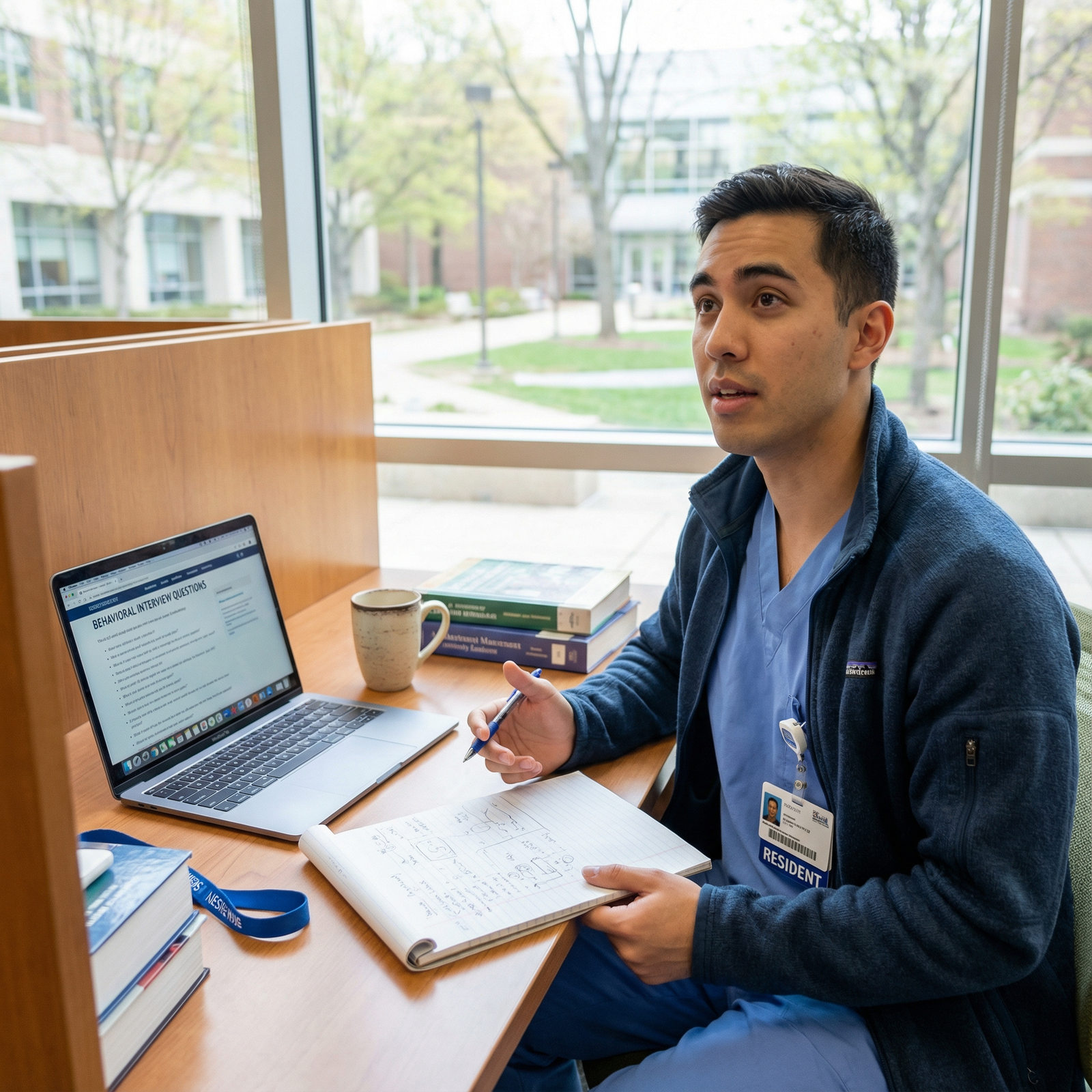
Understanding the Preliminary Medicine Interview Landscape
Preliminary medicine (prelim IM) positions are unique: they are one-year internal medicine internships that often serve as the clinical foundation for advanced specialties such as neurology, anesthesiology, radiology, PM&R, dermatology, and ophthalmology. Because of this structure, your interviews will often emphasize:
- Your reliability and work ethic in a demanding inpatient environment
- Your ability to be a good teammate for a single, intense year
- Your clinical reasoning and communication skills
- How you handle uncertainty, conflict, and fatigue
- Your long-term plans and how a preliminary medicine year fits into them
Most programs use some combination of:
- Traditional open-ended questions (“Tell me about yourself”)
- Behavioral interview medical questions (“Tell me about a time when…”)
- Scenario-based questions (“What would you do if…”)
- Application-specific questions (e.g., about gaps, scores, research)
This guide walks through common residency interview questions for prelim IM, explains what programs are really assessing, and offers frameworks and examples so you can build strong, authentic answers.
Core Personal and Motivational Questions
“Tell me about yourself.”
This is almost guaranteed. It sets the tone, and interviewers use it to gauge your communication skills, insight, and priorities.
What they’re assessing
- How clearly and concisely you organize your story
- Whether your path into medicine and toward your advanced specialty makes sense
- How the preliminary medicine year fits into your trajectory
- Your professionalism and emotional maturity
How to structure your answer (3-part structure)
Aim for 1.5–2 minutes:
- Brief background (15–20 seconds)
- Where you grew up or trained, major educational milestones
- Medical journey + interests (60–90 seconds)
- Why medicine, why your advanced specialty, and key experiences that shaped you
- Why prelim IM at their type of program / what you’re looking for (30–40 seconds)
- Emphasize intern year goals and what you bring to a team
Example (for an anesthesiology-bound applicant)
“I was born in Chicago and completed medical school at X University, where I developed a strong interest in physiology-heavy specialties and acute care. Early in third year, my internal medicine rotation gave me a solid foundation in clinical reasoning and managing complex inpatients, and during my anesthesia elective I really enjoyed working at the intersection of physiology, procedures, and teamwork in the OR.
Over the last two years, I’ve sought out experiences that prepared me for a rigorous prelim IM year: I worked as a sub-I on a busy hospitalist service, participated in a quality improvement project on reducing delirium in hospitalized patients, and served as a peer tutor in our clinical reasoning course.
For my preliminary medicine year, I’m looking for a program with strong inpatient exposure, a culture that values teaching, and a collegial resident group. In return, I bring reliability, clear communication, and enthusiasm for taking ownership of patient care—skills I know will serve me well both as an intern and later in anesthesiology.”
Key tips
- Answer the implicit question: “Why should we want to work with you for a year?”
- Avoid reciting your CV chronologically; choose 2–3 high-yield points.
- Tailor the ending to prelim IM: emphasize learning general medicine, building a patient-care foundation, and being a strong team player.
“Why medicine?” and “Why your advanced specialty?”
Even in a preliminary medicine interview, advanced-program-driven questions are common, because programs want to ensure you’re purposeful and will stay engaged.
What they’re assessing
- Authentic motivation, not just résumé padding
- Self-awareness and alignment between your strengths and your chosen path
- That you won’t disengage from the medicine year because you “just need to get through it”
Approach
- Start with a specific moment or pattern (not a vague childhood story).
- Connect that moment to your strengths and values.
- Show how internal medicine training is essential to your goals.
Example (radiology-bound applicant, shortened)
“My decision to pursue radiology grew out of repeatedly finding myself drawn to pattern recognition and diagnostic problem-solving on rotations. During my medicine clerkship, I noticed how much I gravitated toward reviewing imaging, correlating it with the clinical picture, and then explaining the findings to patients and families. That blend of analytical thinking, technology, and behind-the-scenes impact fits me well.
At the same time, I recognize that to be an effective radiologist I need a strong foundation in internal medicine. I want my preliminary medicine year to solidify my understanding of inpatient workflows, management decisions, and the questions clinicians are trying to answer with imaging. That’s why I’m excited about a prelim IM program that emphasizes both high clinical volume and thoughtful teaching.”
“Why preliminary medicine instead of a transitional year?”
Some programs will probe this directly, especially if your rank list mixes prelim IM and transitional or categorical programs.
What they’re assessing
- Whether you understand the demands and benefits of a prelim IM year
- That you’re unlikely to become resentful or disengaged when the year is hard
- Whether your goals align with their program’s structure (e.g., heavy inpatient exposure vs more elective time)
Response strategy
- Acknowledge that both tracks have pros and cons.
- Emphasize your desire for a rigorous clinical foundation, not just an easier year.
- Link internal medicine training directly to your advanced field.
Example points to include
- Desire to manage complex, multi-morbid patients
- Interest in improving your clinical reasoning, medication management, and communication
- Appreciation that a demanding prelim IM year will make you more confident entering PGY-2

Behavioral Interview Questions: How to Tell Strong Stories
Behavioral questions are central to behavioral interview medical formats and are extremely common during residency interview questions for all specialties, including preliminary medicine.
Using the STAR Framework
Structure your answers using STAR:
- S – Situation: Brief context
- T – Task: Your role or responsibility
- A – Action: What you actually did (focus here)
- R – Result/Reflection: Outcome, and what you learned or changed
Keep each story to about 1.5–3 minutes, with most of the time on Actions and Reflection.
Common Behavioral Questions and Sample Approaches
1. “Tell me about a time you made a mistake.”
What they’re assessing
- Honesty and accountability
- How you respond to errors: do you get defensive or take ownership?
- Your commitment to patient safety and systems improvement
Pitfalls to avoid
- Saying you’ve never made a mistake
- Choosing a trivial “mistake” that shows no growth
- Focusing on blame rather than learning
Sample outline
- S/T: “On my sub-internship, I miscommunicated the timing of a diuretic dose for a patient with heart failure, which led to a delay in treatment.”
- A: Describe how you recognized the error, informed your senior, communicated with nursing and the patient, and filed an incident report if appropriate.
- R: Discuss the clinical outcome and, importantly, what you changed afterward (e.g., adopting a read-back method for verbal orders, using a checklist when calling in orders).
Programs don’t expect perfection, but they need interns who can safely acknowledge and correct mistakes.
2. “Tell me about a conflict with a colleague or team member.”
What they’re assessing
- Emotional regulation under stress
- How you give and receive feedback
- Ability to collaborate in a high-pressure setting
Effective approach
- Choose a mild-to-moderate conflict; avoid highly dramatic or unprofessional stories.
- Show that you considered the other person’s perspective.
- Emphasize resolution and learning.
Example skeleton
- S: Night float with a co-student who frequently left sign-out incomplete.
- T: You needed safe, efficient patient care handoffs.
- A: You requested to talk one-on-one, used “I” statements, focused on specific behaviors and patient safety, offered to create a shared sign-out template, and looped in your senior only if needed.
- R: Handoffs improved; the relationship remained professional; you learned to address issues early and respectfully.
3. “Describe a time you had to work with a difficult patient or family.”
What they’re assessing
- Empathy and communication skills
- Respect for diverse backgrounds and values
- Ability to de-escalate tension and maintain professionalism
Key strategies
- Demonstrate you tried to understand the underlying concern (fear, mistrust, previous bad experiences).
- Show specific communication tools: open-ended questions, reflection, checking understanding, avoiding jargon.
- Conclude with how you’d apply these skills as an intern.
4. “Tell me about a time you were under significant stress. How did you handle it?”
A core question for intern year.
What they’re assessing
- Coping strategies and resilience
- Recognition of your own limits
- Willingness to seek help appropriately
Elements of a strong answer
- Use a story from a demanding rotation, personal challenge, or combination of responsibilities.
- Discuss concrete strategies: prioritization, breaking tasks into steps, using checklists, reaching out to seniors, personal wellness basics (sleep, exercise, social support).
- Avoid glorifying burnout or “toughing it out” without any self-care or help-seeking.
5. “Give me an example of a time you showed leadership.”
Even as a prelim, you will lead in small ways: managing cross-coverage, organizing a team, teaching students.
Possible examples
- Leading a small research or QI project
- Organizing a student-run clinic schedule
- Being the primary organizer for a code review session or teaching conference
- Serving as class representative or orientation leader
Focus on how you influenced others, made decisions, and improved outcomes, not just titles.
Building Your Story Bank
Before interview season, create a document with 8–10 stories that can flexibly cover multiple questions:
- A clinical success
- A mistake or near miss
- A conflict or difficult interaction
- A story that shows empathy and advocacy
- A leadership example
- A time you received critical feedback and grew
- A stressful period you managed effectively
- A teamwork story where you supported a colleague
Label each story with possible themes so you can quickly adapt them during interviews.

Clinical and Scenario-Based Questions in Prelim IM
Because prelim IM is heavily inpatient-focused, many programs include clinical or scenario questions to gauge how you think.
Common Scenario Types
1. Prioritization/triage
Example:
“You’re on night float cross-covering several floors. You receive three pages at once: chest pain in a 72-year-old with known CAD, a fever in a neutropenic patient, and a nurse asking for pain meds renewal. What do you do?”
What they’re assessing
- Safety-first mindset
- Ability to recognize emergencies and prioritize
- Communication and delegation skills
Approach
- State what is most urgent and why (e.g., chest pain vs neutropenic fever—both emergencies; describe rapid triage plan).
- Explain that you would quickly assess the most life-threatening situation while simultaneously giving orders or guidance for the others (e.g., ask nurse to get vitals, EKG, troponins; for neutropenic fever, order stat cultures and broad-spectrum antibiotics; renew pain meds once emergent issues are addressed).
- Emphasize that you would call for help early (senior, attending, rapid response) if needed.
2. Dealing with uncertainty
Example:
“You’re not sure how to manage a patient issue you’re paged about. What do you do?”
Strong answer components
- Acknowledge your limits and avoid guessing.
- Use available resources: patient chart, prior notes, hospital protocols, UpToDate, etc.
- Call your senior resident or attending when beyond your scope.
- Document clearly and communicate with the nurse and patient.
Programs want interns who are safe, not those who pretend to know everything.
3. Ethical dilemmas
Example:
“A patient with decision-making capacity refuses a treatment you strongly believe they need. How do you proceed?”
Key concepts to mention
- Respect for autonomy while ensuring informed decision-making
- Checking understanding, exploring values and concerns
- Involving consultants (ethics, palliative care) when appropriate
- Clear documentation and communication with the team and family
4. Teaching and teamwork scenarios
Example:
“As a prelim, you’ll work with medical students. How do you see your role in teaching them?”
Good answer
- Acknowledge that interns are often the most accessible teachers.
- Emphasize bedside teaching of practical skills: note-writing, presentations, order entry, basic clinical reasoning.
- Offer an example of a time you informally taught or mentored peers or juniors.
Program Fit, Goals, and “Red Flag” Questions
“Why this program?”
This question appears in almost every interview and is crucial for both prelim and categorical positions.
What they’re assessing
- Whether you did your homework
- Genuine interest vs. mass-application mentality
- How your goals align with the program’s strengths
Preparation steps
- Review the program’s website thoroughly.
- Note 3–4 specific features:
- Type of hospital (safety-net, academic, community)
- Inpatient volume and case mix
- Teaching reputation, simulation center, procedure opportunities
- Support for prelims (curriculum, advising, schedule flexibility)
- Connect these features to your personal goals.
Example
“I’m excited about your program because of its strong emphasis on inpatient medicine at a busy safety-net hospital, the clear track record of teaching excellence, and the way prelims are integrated into the residency rather than feeling like a separate group. I’m specifically drawn to your dedicated simulation curriculum for interns and the fact that graduates in anesthesia and radiology have commented on how well-prepared they felt clinically. That aligns well with my goal of finishing my preliminary medicine year with confidence managing acutely ill patients.”
“Where do you see yourself in 5–10 years?”
What they’re assessing
- Clarity about your advanced specialty path
- Whether your goals are realistic and compatible with a prelim IM year
Tips
- Be honest about uncertainty, but show direction.
- Briefly mention interest in academic vs community practice, research, teaching, or leadership if applicable.
- Reiterate that a preliminary medicine year is a key step in that journey.
Addressing Potential Concerns (“Red Flag” Questions)
You may be asked direct or indirect questions about:
- USMLE/COMLEX failures or low scores
- Gaps in training
- Extension leaves or career changes
- Limited clinical exposure in the U.S. (for IMGs)
Principles for answering
- Be honest and concise; don’t overshare irrelevant personal details.
- Take ownership without self-flagellation.
- Focus on what changed: new study strategies, support systems, time management, counseling, etc.
- Demonstrate evidence of improvement (later clerkship grades, Step 2 score, strong sub-I evaluations).
Example:
“I had a Step 1 failure during a period when I was juggling family responsibilities and did not yet have effective study strategies. I took that very seriously. I met with our learning specialist, adjusted my schedule, and completely changed how I studied by doing more active retrieval and timed questions. Since then, I passed Step 1 on my second attempt, scored significantly higher on Step 2, and have done well clinically on my core clerkships and sub-internships. The experience taught me to recognize when I need help early and to put sustainable systems in place, which I believe will serve me well during a demanding intern year.”
Practical Preparation Strategies for Prelim IM Interviews
1. Build and Practice Your Answer Frameworks
- Draft bullet-point outlines (not scripts) for common questions:
- Tell me about yourself
- Why medicine? Why your specialty?
- Why preliminary medicine? Why our program?
- Strengths and weaknesses
- 8–10 STAR stories for behavioral questions
Practice aloud with:
- Peers or mentors
- Recording yourself on video to spot filler words and body language
- Mock interviews through your school or professional organizations
2. Prepare Thoughtful Questions to Ask Programs
You will almost always be asked: “Do you have any questions for us?” Prepare 5–7 questions you genuinely care about. For preliminary medicine year positions, consider:
- “How are preliminary residents integrated into the categorical IM program socially and educationally?”
- “What support is available for prelims matching into or transitioning to their PGY-2 specialty?”
- “Can you describe a typical week for a prelim intern on your busiest inpatient rotation?”
- “How does the program support resident well-being, especially during ICU and night rotations?”
- “Do prelims have opportunities to participate in QI or teaching activities, if they’re interested?”
3. Virtual Interview Logistics
Many programs continue to use virtual formats. Pay attention to:
- Technology: Stable internet, backup device if possible, updated Zoom/Teams client.
- Environment: Neutral background, good lighting, minimal noise, professional framing.
- Professional appearance: Conservative attire, test your camera positioning.
- Eye contact: Look at the camera when speaking; glance at screen to read expressions.
4. Day-of Performance Tips
- Review each program’s notes 10–15 minutes before the interview; know their unique points.
- Have your ERAS application and personal statement accessible for reference.
- Manage time in answers; if you tend to talk long, aim for ~2 minutes per answer unless prompted for more detail.
- Use names when appropriate (“From what Dr. Smith mentioned earlier about your ICU rotations…”).
- Show interest in people, not just schedules: ask residents about their experience, culture, and support.
FAQ: Preliminary Medicine Interview Questions
1. Are prelim IM interviews different from categorical internal medicine interviews?
They overlap heavily, but there are nuances. Prelim IM interviews often focus more on:
- How the one-year experience fits into your advanced specialty plans
- Reliability, work ethic, and team dynamics (since you’ll do primarily inpatient work)
- Your understanding of the rigors of a preliminary medicine year compared with a transitional year
You may get more questions about your long-term specialty goals and how you’ll stay engaged in general internal medicine for that year.
2. How should I answer if I’m not 100% sure of my advanced specialty yet?
Honesty with direction is key. You can say you’re strongly considering one or two fields and explain what you’re doing to clarify your choice (electives, mentorship, research). Emphasize that regardless of the final destination, you value a solid internal medicine foundation and will fully commit to the prelim IM experience.
3. What if I’m asked a behavioral question and can’t think of an example?
Pause and think rather than panicking. It’s appropriate to say, “Let me think for a second,” and then draw from any of the following: clinical rotations, medical school leadership, research, volunteering, even pre-med jobs if relevant. If you truly haven’t experienced that exact scenario, you can say, “I haven’t encountered that specific situation, but in a similar context I…” and describe a related story plus how you would hypothetically respond.
4. How important are interviews compared to my scores and application for prelim IM?
Interviews are critical. Once you’ve received an invitation, you’ve often passed the initial academic and credential screening. The interview then strongly influences where you land on a program’s rank list. Programs want interns who are safe, teachable, hardworking, and pleasant to work with for a year. Strong performance in behavioral interview medical questions, clear communication, and evidence of professionalism can significantly boost your standing, even if some application components are less competitive.
Preparing for common interview questions in preliminary medicine with structured stories, clear motivation, and a solid understanding of what programs value will help you present yourself as the kind of intern colleagues want on their team: reliable, thoughtful, and ready to learn.