Preparing for a preliminary surgery year interview is about far more than memorizing answers. Programs are assessing your judgment, resilience, professionalism, and fit for a demanding clinical environment. This guide walks you through common interview questions in preliminary surgery, how to structure strong answers, and how to avoid common pitfalls—so you can enter interview season confident and prepared.
Understanding the Preliminary Surgery Interview Landscape
A prelim surgery residency interview is different from a categorical general surgery interview in important ways. The program knows you may not be staying there for the full five years, but they still need:
- Residents who are safe and reliable in the OR and on the wards
- Colleagues who can handle high workload and stress
- Team players who will not destabilize the program mid-year
- Learners who make the most of the year—whether they’re going into surgery, anesthesia, radiology, or another field
What Programs Are Really Asking
Behind most questions are a few key concerns:
Can you do the work?
– Clinical competence, work ethic, staminaWill you be safe and professional?
– Judgment, integrity, communicationHow do you handle pressure and conflict?
– Coping skills, resilience, maturityDo you understand what a preliminary surgery year actually involves?
– Realistic expectations, clear goalsAre you a good fit for this program and team?
– Interpersonal style, values, collaboration
Keeping these in mind helps you understand the intent behind common interview questions and tailor your responses accordingly.
Core “Tell Me About Yourself” and Fit Questions
Some form of “tell me about yourself” will almost always open the interview. How you answer sets the tone and frames your story.
1. “Tell Me About Yourself”
This is not an invitation for a full autobiography. Programs are looking for a concise professional narrative that connects who you are to why you’re sitting in front of them.
Goal: Deliver a 1.5–2 minute, structured, professional summary.
Suggested structure (Past → Present → Future):
- Past: Brief background + key experiences that shaped you
- Present: Where you are now and your current clinical interests
- Future: Why preliminary surgery and what you hope to gain
Example Answer Framework:
“I grew up in [location] and completed medical school at [institution], where I became particularly interested in acute care and procedural medicine. During my third-year clerkships, I found that I thrived in high-acuity environments, especially on my general surgery and trauma rotations, where I enjoyed the team-based, hands-on nature of care.
Currently, I’m a fourth-year student with additional experience in [subinternship/electives], focusing on [specific skills or interests, e.g., perioperative management, critical care]. I’ve also been involved in [briefly mention leadership/research/teaching that’s relevant].
Looking ahead, I’m pursuing a preliminary surgery year because I want rigorous training in surgical decision-making, acute care, and procedural skills that will serve me well in [intended field, if known, e.g., anesthesia, radiology, or categorical surgery]. I’m particularly drawn to your program because of [specific feature], and I’m excited about the opportunity to contribute to your team while growing clinically.”
Tips:
- Tailor the “future” section to each program
- Avoid personal details that don’t serve your professional story
- Practice out loud until it sounds natural, not memorized
2. “Why Preliminary Surgery?” and “Why a Prelim Surgery Residency Instead of Categorical?”
Programs want reassurance that you understand the difference between preliminary and categorical paths and that your plan is thoughtful.
Aim to:
- Show informed understanding of the prelim surgery residency structure
- Connect the prelim year to clear career goals
- Reassure them you will commit fully for the year, even if you move on later
Example Points to Include:
- You value high-intensity, team-based acute care
- You want robust operative and inpatient exposure
- Skills gained will be foundational for your long-term plan (e.g., anesthesia, radiology, EM, surgical subspecialty, or reapplying to categorical surgery)
Sample Response Outline:
“I’m seeking a preliminary surgery year because I want intensive exposure to perioperative and acute care that will be foundational for my career in [field]. I recognize that a prelim surgery residency is demanding, but I’m drawn to the volume, acuity, and responsibility.
Specifically, I’m looking to strengthen my skills in [clinical skills: managing post-op patients, recognizing complications, procedural competence, team communication]. These are critical both for safe surgical practice and for [your intended field].
While I’m not entering as a categorical resident, I view this year as a full commitment. I intend to be fully engaged in the team, take ownership of my patients, and contribute the same way any categorical resident would. This structure allows me to build the surgical foundation I need while also working toward my long-term goals.”
Avoid statements like “I’m just doing this because I didn’t match” or “It’s my backup option,” even if partially true. You can acknowledge reapplication plans, but frame the year as purposeful and valuable, not a consolation prize.
3. “Why Our Program?”
This is where preparation makes or breaks your answer. Vague statements (“You’re strong clinically”) signal you haven’t done your homework.
Research beforehand:
- Case volume and case mix
- Trauma level, academic vs community environment
- Rotations and structure of the preliminary surgery year
- Call schedule, ICU exposure, elective time
- Fellowships, subspecialty services, research opportunities
Use this formula:
“I’m particularly interested in your program because of [Program Feature A], [Program Feature B], and [Program Feature C], which align with my goals to [Your Training Goals].”
Example:
“I’m drawn to your program because of the high operative volume on the general surgery and trauma services, the strong ICU experience early in the year, and the structured teaching curriculum you offer even to prelims. These features align perfectly with my goals of becoming comfortable managing critically ill patients and developing procedural confidence.
I also appreciate that your program has a track record of supporting preliminary residents in achieving their next steps, whether that’s matching into categorical surgery or other competitive fields. That combination of clinical rigor and mentorship is exactly what I’m looking for.”

Behavioral Interview Questions in Medical Residency
Behavioral interviewing is now standard in residency recruitment. When you hear, “Tell me about a time when…”, you’re in a behavioral interview medical scenario.
Programs believe past behavior predicts future performance. They want real examples from your clinical training, not hypotheticals.
The STAR Method
Use the STAR framework for structured, concise answers:
- S – Situation: Brief context
- T – Task: Your role/responsibility
- A – Action: What you did (focus here)
- R – Result/Reflection: Outcome and what you learned
Aim for 2–3 minutes per response.
Common Behavioral Questions and How to Tackle Them
Below are high-yield behavioral questions, especially relevant to preliminary surgery:
4. “Tell Me About a Time You Made a Mistake”
They are assessing honesty, insight, and accountability—not perfection.
Choose an example where:
- The mistake was meaningful but did not cause catastrophic harm
- You took clear responsibility
- You changed your behavior afterward
Response Framework:
- S/T: Briefly describe the case and your role
- A: What went wrong, how you identified it, what you did
- R: What changed in your practice because of this
Example (Condensed):
“During my internal medicine sub-I, I misread a lab panel and initially overlooked a rising creatinine in a post-op patient we co-managed. I recognized the error later during pre-rounds when I saw the trend.
I immediately alerted my senior, updated the plan to hold nephrotoxic meds, ensured adequate hydration, and communicated with the surgery team and nursing. The patient’s renal function improved over the next 48 hours.
This experience taught me to systematically review trends rather than isolated values and to double-check labs on any patient receiving nephrotoxic agents. I now use a structured checklist for pre-rounding that has helped me avoid similar oversights.”
5. “Tell Me About a Conflict With a Team Member and How You Handled It”
Conflict is inevitable in a high-stress surgical environment. They want to see professionalism and emotional intelligence.
Choose an example that shows:
- Respectful communication
- Willingness to listen and compromise
- Focus on patient care, not ego
Key Don’ts:
- Don’t speak poorly about individuals or blame others
- Don’t describe ongoing, unresolved interpersonal drama
6. “Describe a Time You Dealt With a Difficult Patient or Family”
Surgeons frequently manage high-stress situations with frightened or frustrated families.
Focus on:
- Empathy and listening
- Clear communication
- Boundary-setting when needed
Example Outline:
“An ICU family was upset about limited visiting hours and requested constant updates from multiple team members. I…
– Listened to their concerns and acknowledged their anxiety
– Clarified the plan and set expectations for daily updates
– Coordinated with the team so messaging was consistent
– Outcome: family felt more informed, fewer escalations, smoother care.”
7. “Tell Me About a Time You Were Overwhelmed or Under Pressure”
Prelim surgery can be grueling. This question probes how you function under stress.
Highlight:
- Time management and prioritization
- Asking for help appropriately
- Maintaining patient safety
- Growth in your coping strategies
Critical point: Do not glorify unsafe overwork (“I just pushed through without calling for help”).
8. “A Time You Went Above and Beyond for a Patient or Team”
Use this to demonstrate:
- Initiative
- Ownership
- Commitment to patient-centered care
Avoid “humble-bragging”; let the actions speak for themselves and emphasize what mattered for the patient/team, not how great you are.
Clinical, Ethical, and Scenario-Based Questions
Beyond behavioral questions, you will encounter clinically oriented scenarios, especially in surgery.
9. “Describe a Challenging Clinical Case and What You Learned”
Pick something relevant to surgery or acute care:
- A complicated post-op patient
- An ethical dilemma about goals of care
- An unexpected perioperative complication
Highlight:
- Your clinical reasoning
- Communication with senior residents/attendings
- Multidisciplinary teamwork
- What you would do differently now
10. “How Do You Handle Uncertainty in Clinical Decisions?”
No one knows everything, especially interns.
Emphasize:
- Recognizing your limits
- Seeking guidance in a timely way
- Using evidence-based resources
- Prioritizing patient safety over ego
Sample Points:
“In situations of uncertainty, I start by clarifying the clinical question and reviewing the patient’s status. I use trusted resources like UpToDate and institutional guidelines, but I’m also quick to involve my senior or attending early, especially if the patient is unstable. I’d rather over-communicate than miss something important. I see uncertainty as a signal to slow down, seek input, and re-evaluate.”
11. “How Would You Respond if You Strongly Disagreed With an Attending’s Plan?”
They want mature, respectful advocacy, not confrontation.
You might say:
- You’d clarify your understanding: “Can I ask about the reasoning behind…?”
- You’d present your concern respectfully: “I’m concerned about X because of Y—would Z be an option?”
- You’d accept the decision if it’s safe and reasonable, and learn from the discussion
- If it compromises safety or ethics, you’d escalate using appropriate channels
Motivation, Goals, and Red Flag Management
Prelim interviews often probe your career trajectory and any perceived “red flags.”
12. “What Are Your Long-Term Career Goals?”
Even if you’re uncertain, show direction and thoughtfulness.
Options:
- Categorical general surgery
- Surgical subspecialty
- Anesthesia, radiology, EM, IM with procedural focus
- Academic vs community practice
Tie your goals to how a preliminary surgery year will build relevant skills:
- Managing acutely ill patients
- Performing procedures
- Working in high-stakes teams
- Learning perioperative medicine
13. “Why Didn’t You Match Categorical?” or “Why Are You Applying for a Prelim Position Now?”
This can feel uncomfortable, but honesty and maturity are crucial.
Principles:
- Take ownership where appropriate (e.g., late decision on specialty, exam timing, application strategy)
- Avoid blaming other people or the system
- Emphasize what you’ve done to address gaps
- Show persistence and insight
Example Structure:
“I applied to categorical surgery relatively late after deciding on the field in my fourth year and didn’t have enough time to build the full profile I needed. My application also lacked [X—be specific but neutral, e.g., strong US letters, research, etc.].
I’ve reflected on this and taken steps to address those gaps, including [additional rotations, stronger letters, research, skills improvement]. A preliminary surgery year is an opportunity for me to demonstrate my commitment, refine my skills, and strengthen my candidacy while providing meaningful service to your program.”
If you failed Step exams, repeated a year, or have other major issues, you must be prepared to discuss them succinctly, honestly, and with a clear narrative of growth and remediation.
14. “What Are Your Strengths and Weaknesses?”
Avoid clichés like “I work too hard” without substance.
Strengths:
Choose 2–3 that are highly valued in surgery:
- Reliability and follow-through
- Calm under pressure
- Clear communication with nurses and consultants
- Ownership of patients
- Willingness to seek help appropriately
Back each with a brief example.
Weaknesses:
Pick one genuine area, paired with concrete steps you’re taking:
- Time management with heavy patient loads
- Delegating tasks as a team leader
- Over-documenting vs being concise
Example:
“One area I’ve been working on is efficiency with documentation, especially on busy services. Earlier in my third year, I tended to write very detailed notes that were time-consuming. With feedback from residents, I now focus on problem-based assessments and concise plans. I’ve developed templates that help me document clearly while staying efficient, and I’ve noticed a significant improvement in my ability to keep up during high-volume days.”
Practical Tips for Excelling in Preliminary Surgery Interviews
Prepare Targeted Stories
Make a list of 8–10 clinical experiences that you can flexibly adapt:
- A mistake or near-miss
- A conflict or disagreement
- A challenging patient/family interaction
- A time you received critical feedback
- A leadership or teaching role
- A case that solidified your interest in surgery/acute care
- A time you advocated for a patient
Map each story to multiple possible behavioral interview medical questions. Practice out loud with the STAR format.
Anticipate Classic Residency Interview Questions
In addition to what we’ve covered, be ready for:
- “What do you like to do outside of medicine?”
- “How do you deal with stress or burnout?”
- “What would your peers say is the most challenging part of working with you?”
- “What questions do you have for us?” (Always have thoughtful, specific questions.)
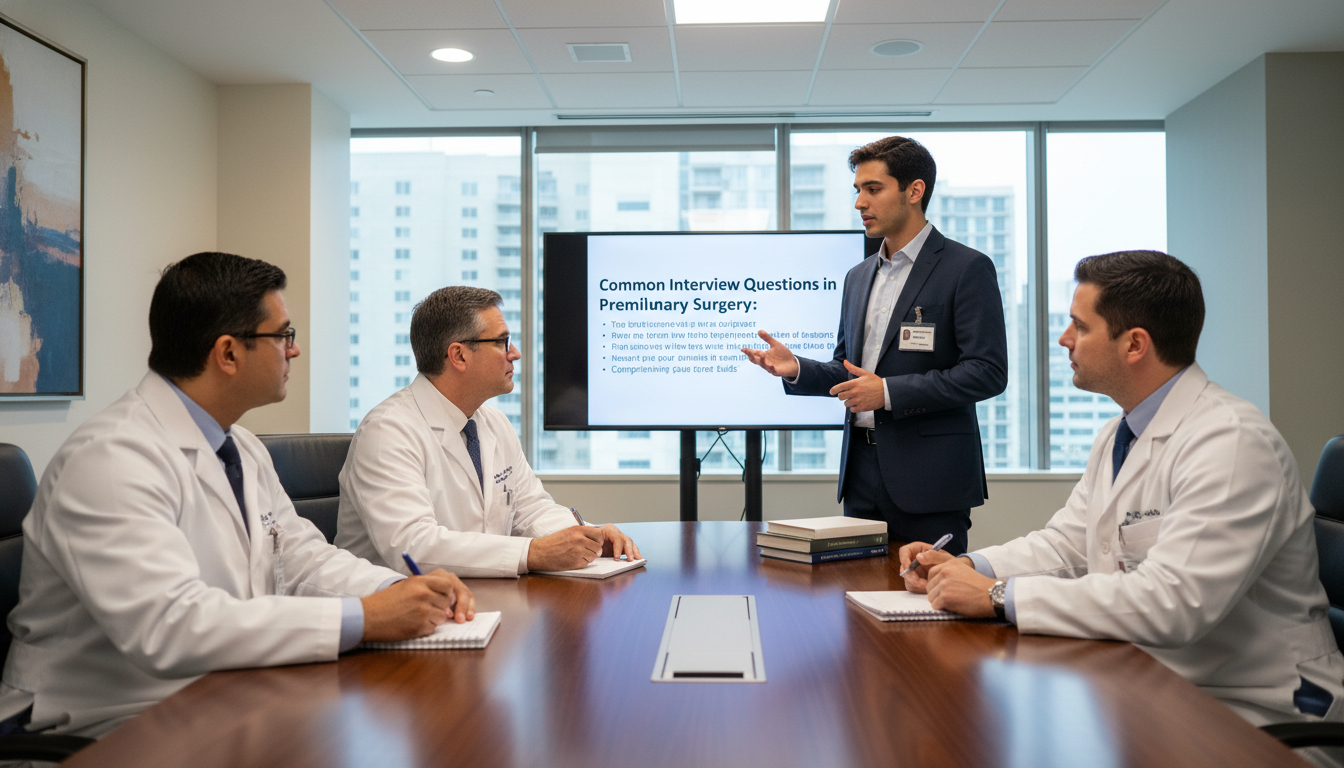
Handle Panel and Multiple Mini Interviews
Some programs use panels or multiple mini-interviews (MMIs). The core principles remain:
- Listen carefully to the entire question before answering
- Take 3–5 seconds to organize your thoughts if needed
- Be concise—respect time and let interviewers ask follow-ups
- Maintain professionalism with everyone: coordinators, residents, faculty
Virtual Interview Etiquette
If interviews are virtual:
- Test your camera, microphone, and internet in advance
- Choose a quiet, well-lit, neutral background
- Maintain eye contact by looking at the camera, not just the screen
- Dress exactly as you would for an in-person interview
Frequently Asked Questions (FAQ)
1. How is interviewing for a preliminary surgery year different from categorical surgery?
Preliminary interviews:
- Focus more on your short- and medium-term goals and how a prelim year fits into your trajectory
- Assess whether you will be a reliable, low-drama, high-output team member for one year
- May probe more deeply into why you didn’t match categorical or why you’re choosing a prelim path
Categorical interviews place heavier emphasis on long-term fit, research interests, and potential as a future chief resident or faculty member. For a prelim surgery residency, highlight your readiness to work hard, learn quickly, and contribute fully during the year you’re there.
2. What are some residency interview questions specific to prelim surgery?
Common prelim-specific residency interview questions include:
- “How does a preliminary surgery year fit into your long-term goals?”
- “What are your plans after this year?”
- “If you received a categorical position elsewhere next year, how would you approach this prelim year?”
- “How would you handle it if you don’t secure a categorical spot after this year?”
Prepare honest, thoughtful answers that balance ambition with a strong commitment to the work in front of you.
3. How should I answer if they ask directly, ‘Why do you want a prelim and not categorical spot?’”
Clarify whether:
- You are reapplying and using the prelim year to strengthen your application, or
- You are pursuing a field that benefits from a surgical foundation (e.g., anesthesia, IR, EM)
Emphasize the intentional value of the prelim year: operative exposure, acute care experience, and team-based care skills. Avoid implying you view the year as a mere stepping stone or formality.
4. How polished should my answers be? Is it okay to sound rehearsed?
You should practice extensively, especially for common questions like “tell me about yourself”, “why preliminary surgery,” and typical behavioral prompts. However:
- Aim for structured but natural-sounding responses
- Avoid memorizing full paragraphs word-for-word
- Be ready to adapt based on how the interviewer phrases the question
Use bullet-point practice (key ideas) instead of memorized scripts so you can respond flexibly and authentically.
Preparing well for interviews in preliminary surgery requires more than reading lists of common questions. It means understanding the program’s needs, anticipating their deeper concerns, and crafting thoughtful narratives that show you are safe, engaged, and purposeful about this training year. With clear stories, structured responses, and honest reflection, you can present yourself as exactly what prelim programs are seeking: a hardworking, resilient, and team-oriented physician ready to thrive in a demanding surgical environment.