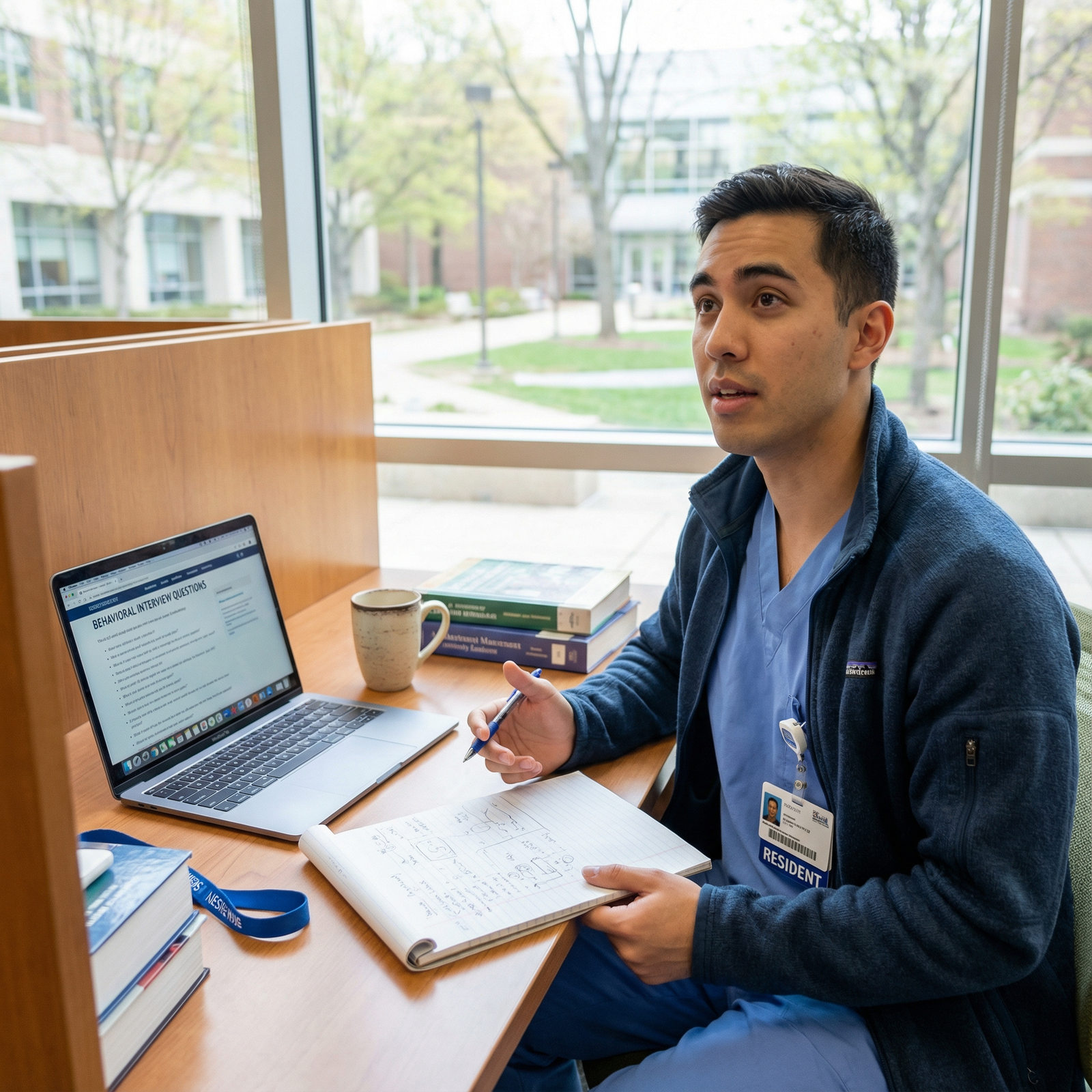
Understanding the Landscape of Radiation Oncology Residency Interviews
Radiation oncology is a small, competitive specialty where every interaction counts. Your radiation oncology residency interview is not just about testing your medical knowledge—it’s a high‑stakes behavioral interview designed to assess how you think, communicate, collaborate, and fit into a tightly knit department.
Faculty know that who they choose will affect their call schedules, patient care, and team culture for years. They will use targeted questions—many of them behavioral interview medical questions—to understand your motivations, professionalism, resilience, and fit.
This guide focuses on common interview questions in radiation oncology residency, how to structure your answers, and what program directors are really listening for. You’ll see example answers, specific rad onc–relevant twists, and practical strategies you can use immediately.
Throughout, keep these overarching goals in mind:
- Show you understand what radiation oncology actually involves day‑to‑day
- Demonstrate teachability, humility, and reliability
- Convey professionalism and emotional maturity
- Make it easy for interviewers to remember and advocate for you on the rank list
Core Introductory Questions: Setting the Tone
These early questions often shape how the entire interview unfolds. Prepare well-rehearsed—but not robotic—answers.
“Tell me about yourself”
This is almost guaranteed and is central to both general and behavioral interview medical formats. Programs want a 1–2 minute professional narrative, not your full life story.
Purpose:
- See how you organize information and communicate
- Understand your path to medicine and ultimately to radiation oncology
- Identify themes they can revisit later (research, service, leadership)
Structure (3-part framework):
- Brief background – where you’re from, undergrad, med school
- Key experiences & strengths – 2–3 themes relevant to rad onc
- Current focus & future goals – why rad onc, why now
Sample radiation oncology–tailored answer (condensed):
“I grew up in a small town in Ohio and completed my undergraduate degree in biomedical engineering at X University, where I became interested in how technology can improve patient care. In medical school at Y, I gravitated toward oncology early on through a longitudinal experience with patients receiving chemotherapy and palliative care.
During my second year, I was introduced to radiation oncology through a mentor who invited me to tumor boards. I was struck by how rad onc combined careful quantitative planning with longitudinal relationships and close collaboration with surgeons, medical oncologists, and physicists. That led to a year of research in outcomes for patients with head and neck cancers receiving IMRT, where I learned to manage data, work in a multidisciplinary team, and appreciate the complexity of treatment planning.
Now I’m looking for a radiation oncology residency where I can build strong clinical fundamentals, continue outcomes research, and work in a program that values teaching and patient-centered care. I’m particularly interested in [specific interest—e.g., CNS or palliative radiation] and in programs with early resident responsibility within a supportive environment.”
Tips:
- Avoid reciting your CV. Focus on a coherent story.
- Mention radiation oncology explicitly and briefly signal your exposure.
- Practice out loud until it flows naturally in 90–120 seconds.
“Why radiation oncology?”
This is one of the most important radiation oncology residency interview questions. Interviewers want reassurance that you understand the specialty beyond “I like physics” or “I enjoy procedures.”
What they’re assessing:
- Informed interest vs. superficial fascination
- Understanding of trade-offs: clinic-heavy, long-term follow‑up, emotional demands
- Fit between your personality and the field’s nature
Components of a strong answer:
- Exposure – how and where you encountered rad onc
- Core features you value – clinical, intellectual, and human aspects
- Self-insight – how your strengths and preferences align
- Realism – awareness of challenges (e.g., job market, treatment toxicities)
Example answer elements:
- You appreciate long-term patient relationships and follow-up.
- You enjoy clinically applying physics and anatomy.
- You like being part of multidisciplinary cancer care.
- You’re comfortable with technology and iterative planning.
- You understand the emotional and logistical complexity of cancer care.
Avoid clichés like “I like technology” without specifics. Tie your interest to tangible experiences: participating in contouring, sitting in simulation, discussing fractionation schemes, or following patients from consult through follow-up.
“Why our program?”
This question is about fit and preparation, and essentially tests how seriously you’ve approached the rad onc match.
Do your homework:
Before the interview, know:
- Key disease-site strengths (e.g., strong head and neck, pediatrics, proton therapy)
- Notable research areas
- Department culture and size
- Educational structure (e.g., disease-site rotations, mentorship model, contouring bootcamps)
Structure a compelling answer:
- Start with genuine program-specific features
- “Your strong emphasis on…”
- “I was particularly impressed by your…”
- Connect to your goals and prior experiences
- Close with culture/fit
Sample outline:
“I’m especially drawn to your program’s strength in [disease site/research area], as reflected in [example: trials, faculty].
I also value your [educational structure / early responsibility / global health / physics integration], which aligns with my interest in [specific aim].
Finally, during the pre-interview dinner and my rotation here, I got the sense that residents support each other and faculty are invested in teaching, which is exactly the environment I’m looking for in a radiation oncology residency.”
Be specific enough that your answer could not apply equally to every program.

Classic Behavioral Interview Questions (with a Rad Onc Twist)
Radiation oncology interviews increasingly use behavioral interview medical questions: “Tell me about a time when…” These aim to predict future performance based on past behavior.
Use the STAR framework:
- Situation – brief context
- Task – your responsibility
- Action – what you did
- Result/Reflection – outcome and what you learned
“Tell me about a time you handled a conflict on a team”
In a small department, interpersonal dynamics matter immensely.
What they want to see:
- Maturity and non-defensiveness
- Ability to address issues directly but respectfully
- Emphasis on patient care and team function over ego
Example (structure):
- S: Group project/quality improvement project/clinic team situation.
- T: Role and what went wrong (miscommunication, unequal work).
- A: How you initiated a conversation, sought understanding, negotiated a plan, involved leadership if necessary.
- R: Improved relationship/process, what you’d do differently next time.
Avoid stories where you are the “hero” and others are caricatured as unreasonable; show nuanced insight into both sides.
“Tell me about a mistake you made in clinical care”
This is common in rad onc interviews because patient safety is critical in a field where small errors can have large consequences.
Key principles:
- Choose a real but contained error (not catastrophic, not trivial).
- Focus on owning your role without over-apologizing.
- Emphasize systems-thinking and process improvement.
Example scenario elements:
- Missed a lab result that slightly delayed chemotherapy.
- Incorrectly prepped part of a patient’s chart that needed last-minute correction.
- Miscommunicated follow-up instructions, caught at next visit.
Answer outline:
- Briefly describe the situation and mistake.
- Take responsibility: “I realized that I…”
- Explain immediate corrective steps.
- Describe systemic or personal changes you implemented (checklists, better handoffs).
- Reflect on what you learned and how you now practice differently.
Avoid blaming others or saying, “I can’t think of any mistakes.”
“Describe a time you were overwhelmed and how you handled it”
Radiation oncology can involve heavy clinic days, complex planning, and emotionally intense patient conversations.
They’re probing:
- Your stress-management strategies
- Insight into your own limits
- Willingness to seek help appropriately
Example response elements:
- Balancing clinical rotation, research deadline, and personal obligation
- Managing a sudden influx of patients needing urgent radiation consults
- Being on a busy service with multiple competing deadlines
Highlight:
- Prioritization strategies
- Communication with your team and supervisors
- Healthy coping (exercise, schedule optimization, time blocking, using institutional resources if appropriate)
Avoid portraying yourself as chronically overwhelmed or helpless; focus on growth and skill development.
“Tell me about a challenging patient interaction”
In radiation oncology, you will encounter patients who are anxious, frustrated, non-adherent, or distrustful of treatment.
What matters most:
- Empathy and listening
- Boundary-setting and professionalism
- Clear, plain-language communication
You might describe:
- A patient skeptical about radiation side effects
- A family demanding unrealistic outcomes
- A patient angry about delays or scheduling
Walk through how you:
- Validated emotions (“I can see why you’re frustrated”)
- Clarified misunderstandings in accessible language
- Sought help from your attending, social work, or nursing
- Ensured safety and follow-up plans
End with what it taught you about communication in oncology.
Radiation Oncology–Specific Clinical and Ethical Questions
Beyond general behavioral questions, expect specialty-directed scenarios. These assess how you think, not what you already know as a resident.
“Describe a patient you saw in radiation oncology and what you learned”
If you’ve done a rad onc elective, this is very likely.
Choose a case that:
- Highlights key rad onc principles (e.g., multidisciplinary care, balancing benefit vs. toxicity, palliative vs. curative intent)
- Shows your genuine engagement with patients
- Allows ethical or communication reflection
Example approach:
- Briefly describe patient and diagnosis (e.g., locally advanced head and neck cancer).
- Summarize the treatment decision-making (chemoradiation vs. surgery, goals of care).
- Focus on a specific learning point: managing toxicities, discussing PEG tube, mask claustrophobia, simulation process.
- Reflect on how this shaped your view of rad onc (e.g., the importance of close follow-up or multidisciplinary collaboration).
“How would you explain radiation therapy to a patient with limited health literacy?”
This tests communication skills—a core competency.
Strong answer should include:
- Avoiding jargon (no “fractionation,” “dosimetry,” “IGRT” without explanation)
- Using analogies (“It’s like using focused X-ray beams to treat the tumor from the outside, similar to getting an X-ray but with a stronger, targeted dose”)
- Emphasizing what the patient will experience: simulation, mask, daily treatments, what they feel (usually nothing during treatment)
- Checking for understanding (“Can I ask you to put in your own words what you understood?”)
Also note the importance of:
- Using interpreters when needed
- Written materials at appropriate literacy levels
- Involving family/caregivers with permission
“How do you see the future of radiation oncology?”
Programs want to know you’ve thought about where the field is heading and your place in it.
Potential themes:
- Integration with systemic therapy and immunotherapy
- Hypofractionation and value-based care
- Proton therapy and advanced modalities
- AI in contouring and treatment planning (with awareness of limitations)
- Workforce and job market considerations
Show curiosity and awareness, not rigid certainty. You might say you’re interested in learning the fundamentals broadly, then adapting to evolving technologies and evidence.

Challenging, Introspective, and “Curveball” Questions
Some questions are less predictable but recur frequently in radiation oncology residency interviews, especially at academic centers.
“What are your weaknesses?”
This is ubiquitous across the rad onc match and other specialties.
Do:
- Pick a real, relevant but non-fatal weakness
- Explain concrete steps you’ve taken to address it
- Show measurable progress and ongoing vigilance
Examples:
- Initially overcommitting to projects → learned to set limits and prioritize.
- Struggling with delegation → learned to trust teammates and communicate expectations.
- Anxiety giving talks → sought feedback, practiced, joined a speaking workshop.
Don’t:
- Claim a fake virtue as a weakness (“I work too hard”).
- Mention something that directly undermines core rad onc duties (e.g., “I’m very disorganized” without a strong remediation story).
“What is your greatest failure?”
This probes resilience and honesty.
Choose something substantial but not catastrophic:
- A failed grant or research project that didn’t produce expected results
- Not matching into a prior specialty (if applicable and honest), now redirected to rad onc
- A leadership role that didn’t achieve its intended impact
Answer with:
- Ownership of your role
- What you learned
- How it changed your future actions
- Evidence that you applied those lessons
“How do you handle uncertainty in medicine?”
Radiation oncologists constantly navigate imperfect data: dose constraints versus tumor control, use of new modalities, unclear survival benefits.
You might:
- Acknowledge that uncertainty is inherent in oncology.
- Describe relying on evidence-based medicine, guidelines, and expert consultation.
- Explain how you communicate uncertainty to patients honestly but constructively.
- Emphasize shared decision-making and ongoing learning.
“What would you do if you saw something unsafe in the department?”
This could refer to wrong patient setup, time-out issues, or plan discrepancies.
Show you understand:
- The primacy of patient safety
- The team-based nature of rad onc (therapists, dosimetrists, physicists, nurses, physicians)
- The value of speaking up respectfully regardless of hierarchy
Outline:
- Immediate assessment (is there an imminent risk to patient safety?)
- Speaking up right away (“I’d confirm identifiers, respectfully question the issue”).
- Following institutional protocols for reporting if needed.
- Emphasizing a culture of safety rather than blame.
Questions You Should Ask Programs (and How They Perceive You)
Near the end of your interview, you’ll almost always be asked: “What questions do you have for us?”
Your questions can strongly influence how interviewers remember you. They should be:
- Specific and thoughtful
- Not easily answerable by a quick Google or website skim
- Focused more on fit and education than on vacation days or salary
High-yield question areas
Education and feedback
- “How is feedback typically given to residents after clinics or simulations?”
- “Can you describe how contouring and planning skills are taught and assessed over PGY-2 to PGY-5 years?”
Clinical responsibility
- “How does resident responsibility evolve, particularly with independent on-treatment visits or urgent consults?”
Research and mentorship
- “How are research mentors assigned, and how is resident time protected for scholarly work?”
Department culture and wellness
- “What do residents do outside of work? How would you describe the culture among residents and between residents and faculty?”
Program direction
- “What changes or improvements are you hoping to implement in the residency over the next few years?”
Prepare 8–10 strong questions overall, then ask 2–4 per interviewer depending on time and what has already been answered.
Practice Strategies and Final Preparation Tips
Beyond reading common residency interview questions, you need deliberate practice.
1. Build a “story bank”
Create a list of 10–15 experiences that you can adapt to many behavioral prompts:
- A teamwork success and a teamwork conflict
- A time you advocated for a patient
- A research setback and a research success
- A cross-cultural or language-challenging encounter
- A difficult feedback you received and how you responded
For each, jot down:
- Situation, Task, Action, Result
- Skills demonstrated (communication, leadership, resilience, ethics)
This way, when a behavioral interview medical question arises, you’re not scrambling.
2. Rehearse aloud—especially for “Tell me about yourself”
Record yourself answering:
- “Tell me about yourself”
- “Why radiation oncology?”
- “Why our program?”
- “What are your weaknesses?”
Listen for:
- Length (target 1–2 minutes each)
- Clarity and structure
- Excessive filler (“like,” “um,” “you know”)
- Overly technical jargon without explanation
3. Prepare for virtual interviews
Many radiation oncology residency interviews remain at least partially virtual.
- Test your camera, microphone, and internet connection.
- Use a neutral, well-lit background.
- Dress as you would for an in-person interview (full professional attire—assume you may need to stand).
- Keep your notes minimal; relying heavily on scripts tends to look unnatural.
4. Reflect after each interview
Right after an interview day:
- Write down questions you were asked—this becomes your own database of rad onc match questions.
- Note which answers felt strong or weak.
- Record specific program details that matter for your rank list (resident culture, call schedule, mentorship vibes).
This reflection helps both with continuous improvement and with ranking decisions.
FAQs: Radiation Oncology Residency Interview Questions
1. Are radiation oncology residency interviews more technical or behavioral?
They usually lean more behavioral and fit-focused than deeply technical. Faculty understand that as a graduating medical student you’re not expected to know complex planning algorithms or radiation physics in depth. However, expect a few clinically oriented questions to assess your reasoning:
- “How would you approach a patient with painful bone metastases?”
- “What’s an example of when palliative vs. curative radiation might be used?”
Emphasis is on how you think, communicate, and acknowledge limitations.
2. How specific should my answers be about future subspecialty interests?
It’s fine—and even positive—to express emerging interests (e.g., CNS, GU, pediatrics, global oncology), but avoid sounding rigidly committed to a narrow path. Programs want residents who will explore broadly and adapt.
You might say:
“I’m especially interested in [X area] based on my research and rotation experience, but I’m very open to where residency exposure leads me.”
3. How personal is too personal when answering “Tell me about yourself” or “What do you do outside of medicine?”
You can absolutely mention personal interests—music, sports, family, travel—as part of your tell me about yourself answer or when asked about hobbies. The key is relevance and professionalism:
- Brief, positive, and non-controversial.
- Show how these activities sustain you or build transferable skills (teamwork, discipline, empathy).
- Avoid divisive topics (politics, religion) unless you’re very comfortable and it’s clearly relevant to your path.
4. How can I stand out among many strong radiation oncology applicants?
You don’t need a gimmick. You stand out by being:
- Prepared – polished responses to core questions.
- Genuine – consistent narrative aligned with your application.
- Engaged – asking thoughtful questions, showing curiosity.
- Reflective – sharing insight about your experiences, not just listing them.
A coherent story that clearly explains your path to radiation oncology, your values in patient care, and how you hope to grow during residency is more memorable than any single achievement.
A strong performance on radiation oncology residency interviews comes from preparation, honest self-reflection, and the ability to connect your experiences to the needs of this unique specialty. Use these common residency interview questions and frameworks to rehearse, refine, and ultimately present the clearest, most authentic version of who you are and how you’ll contribute to a future rad onc program.