Navigating residency and fellowship interviews as a Caribbean IMG in addiction medicine presents a unique set of opportunities and challenges. Beyond clinical knowledge, programs want to understand who you are as a person, how you think, how you handle stress, and why you are drawn to working with patients affected by substance use disorders.
This guide focuses on common interview questions you can expect as a Caribbean medical graduate pursuing addiction medicine—whether you’re applying directly to an addiction medicine fellowship, or to a core residency (psychiatry, internal medicine, family medicine, emergency medicine) with a long-term goal of an addiction medicine fellowship.
Understanding the Addiction Medicine Interview Landscape as a Caribbean IMG
Residency and fellowship programs in addiction medicine are looking for three broad things:
- Clinical readiness – Can you provide safe, evidence-based care, including for patients with complex co-occurring conditions?
- Professionalism and cultural fit – Do you align with the program’s mission and work well in a multidisciplinary team?
- Commitment to the field – Do you have a genuine interest in addiction medicine, and will you likely pursue a career in it?
As a Caribbean IMG, you also carry additional perceptions—both positive and negative—that you should be prepared to address:
Positives programs may see:
- Adaptability to new systems and cultures
- Resilience and perseverance
- Broad clinical exposure, often with high patient volume
Concerns you may need to address:
- Questions about the quality of your clinical training
- Need for stronger proof of academic readiness (exams, letters, US clinical experience)
- Communication style and “fit” in a U.S.-based training environment
Your strategy is to anticipate these concerns and prepare targeted, confident, and honest responses.
Behavioral Interview Questions: How You Think, Act, and Adapt
Behavior-based questions are central to residency and addiction medicine fellowship interviews. Programs want to see how you behave in real-world scenarios—especially with vulnerable, high-risk patients.
A useful tool is the STAR method:
- Situation – Brief context
- Task – Your role
- Action – What you did
- Result – Outcome + what you learned
Below are common behavioral interview medical questions you’re likely to face, with guidance tailored to Caribbean IMGs and addiction medicine.
1. “Tell me about yourself.”
This is almost guaranteed. It sets the tone and often determines whether the interviewer becomes truly engaged.
What they’re really asking:
- Who are you, beyond your CV?
- Can you communicate clearly and concisely?
- How does your background naturally lead to addiction medicine?
How to structure your answer (2–3 minutes):
- Brief background – Origin, medical school (e.g., SGU, AUC, Ross), any distinctive life experiences.
- Medical journey – Key steps: why medicine, why Caribbean medical school, key clinical experiences.
- Interest in addiction medicine – Turning points, mentors, meaningful patient stories.
- Where you’re headed – Your goals in residency and beyond (e.g., addiction medicine fellowship, academic involvement).
Example (adapted for a Caribbean IMG):
I grew up in [Country/City] and completed my medical education at a Caribbean medical school where I was exposed to a diverse patient population with significant mental health and substance use challenges. During my core rotations, I found myself drawn to patients struggling with substance use disorders—especially those with limited access to care and strong social determinants of health.
In my U.S. clinical rotations, I worked in an inner-city clinic where I helped care for patients with opioid use disorder and co-occurring conditions. Seeing how medication-assisted treatment and integrated behavioral care could dramatically change someone’s trajectory is what solidified my interest in addiction medicine.
Now I’m seeking a residency program that will provide strong training in [psychiatry/internal medicine/family medicine] with robust exposure to addiction care, so that I can ultimately pursue an addiction medicine fellowship and work in an academic or community setting serving high-need populations.
Caribbean IMG tip:
Subtly frame your Caribbean education as a strength: diverse exposure, adaptability, resilience, and a high burden of addiction and mental health conditions in local populations.
2. “Why addiction medicine?” / “Why are you interested in patients with substance use disorders?”
This is the core question if you are explicitly applying for an addiction medicine fellowship or a residency with a strong addiction focus.
Key elements to include:
- A personal or clinical story that sparked your interest (avoid overly graphic details).
- Appreciation of addiction as a chronic brain disease, not a moral failing.
- Recognition of stigma, and your desire to reduce it.
- Long-term vision (e.g., combining clinical care, teaching, advocacy, research).
Stronger answer components:
- Link your Caribbean context: perhaps early experiences seeing alcoholism, limited resources, or punitive responses to addiction.
- Mention your exposure to evidence-based treatments—e.g., buprenorphine, methadone, naltrexone, motivational interviewing, harm reduction.
Avoid:
- Answering only with “I like psychiatry” or “I’ve seen a lot of addiction” without reflecting on what that means for your career.
- Sounding like you’re using addiction medicine just as a backup or niche to get into a program.
3. “Describe a difficult patient interaction you’ve had, especially with someone with substance use issues.”
Addiction medicine involves complexity: ambivalence, relapse, boundary testing, trauma, legal issues.
What they want to see:
- Empathy and professionalism
- Awareness of bias and stigma
- Safety-conscious decision-making
- Ability to use the team (nurses, social workers, counselors)
Using STAR (sample outline):
- S: “During my internal medicine acting internship in a U.S. hospital, I cared for a patient with opioid use disorder who frequently left against medical advice.”
- T: Your responsibility (e.g., primary student/extern following the patient).
- A:
- Validated the patient’s concerns
- Assessed withdrawal/symptoms
- Collaborated with the resident and addiction consult team
- Discussed evidence-based options (e.g., buprenorphine in hospitalization)
- R:
- Patient stayed for treatment, or at least opened up and partially engaged
- You learned about harm reduction and non-judgmental communication
Focus on what you learned: about not taking behavior personally, importance of trauma-informed care, or addressing social factors like housing or legal issues.
4. “Tell me about a time you made a mistake or missed something important.”
Programs want to know: Can you admit errors and learn?
Key points:
- Choose a real but not catastrophic example (e.g., delayed follow-up on labs, overlooking a psychosocial detail, not clarifying a medication dose promptly).
- Emphasize:
- Taking responsibility (no blaming)
- How you disclosed or addressed the issue appropriately with your team/supervisor
- The specific change you made to prevent recurrence (e.g., new checklist, double-check habit, asking for help earlier)
Addiction medicine tie-in (optional): If relevant, show that the experience improved your care for patients with substance use: better screening, asking directly but sensitively about substances, etc.
5. “Describe a situation where you had to deal with conflict in the healthcare team.”
Addiction care is inherently interdisciplinary—physicians, nurses, therapists, social workers, peer recovery specialists.
Example scenarios:
- Disagreement about a patient’s readiness for discharge vs. your concern for relapse risk
- Team member with a stigmatizing attitude toward a patient with substance use disorder
- Different views on using opioid agonist therapy vs. abstinence-only approach
Best practices in your answer:
- Stay respectful—do not attack previous colleagues.
- Show you:
- Listened to the other perspective
- Used clear, calm communication
- Escalated appropriately when needed
- Kept the patient’s best interest at the center
6. “Tell us about a time you worked with a patient from a background very different from your own.”
As a Caribbean IMG, you likely have strong multicultural experiences—use them.
Highlight:
- Your ability to adapt to U.S. cultural norms while respecting patient values.
- Specific strategies: using interpreters, asking about beliefs around substances or mental health, involving family respectfully.
Example:
Caring for a patient from a different immigrant community with cultural stigma around addiction; you approached the conversation by:
- Asking open-ended questions about how their community views substance use
- Explaining addiction in non-judgmental, medical terms
- Offering treatment options consistent with their beliefs and readiness
This demonstrates readiness for culturally competent substance abuse training.

Core Residency Interview Questions Every Caribbean IMG Should Master
Whether your immediate goal is an addiction medicine fellowship or a primary residency that will serve as your foundation, there are universal residency interview questions you must be ready for.
1. “Why this specialty?”
Examples:
- For psychiatry: emphasize co-occurring disorders, integrating psychotherapy and pharmacology, and your interest in substance use.
- For internal/family medicine: highlight chronic disease management, continuity of care, and how addiction intersects with diabetes, liver disease, infectious diseases, etc.
- For emergency medicine: stress acute stabilization, harm reduction, and being a gateway to treatment.
Blend in addiction medicine: Show you understand that addiction is interwoven into every specialty, and you want to develop strong foundational skills to be an excellent addiction clinician later.
2. “Why this program?” / “What do you know about our program?”
Programs often ask this to determine if you’re truly interested or just mass-applying.
Research in advance:
- Identify:
- Addiction medicine electives or tracks
- Availability of an addiction medicine fellowship at that institution
- Rotations in detox, rehab, consult liaison, or community-based treatment
- Faculty with substance use research or leadership roles
Your answer should connect:
- Your prior experiences and goals
- Their specific strengths
- How you see yourself using their opportunities (clinics, QI projects, research, community outreach)
Example pivot:
I’m particularly excited about your addiction consult service and the opportunity to work under Dr. X, whose work on opioid use disorder in hospitalized patients aligns with my interest in integrated inpatient–outpatient addiction care.
3. “What are your strengths and weaknesses?”
Strengths: Choose 2–3 that are demonstrable and relevant to addiction medicine:
- Empathy and non-judgmental listening
- Strong communication with patients and families
- Cultural competence from training in the Caribbean and U.S.
- Resilience and adaptability from relocating for medical training
Weaknesses: Pick a genuine but manageable area, and show active improvement:
- Initially being overly detailed in notes → now learning to be concise
- Hesitation in speaking up early in new teams → now practicing structured communication (e.g., SBAR)
- Limited early exposure to research → now involved in a quality improvement or addiction-related project
Avoid weaknesses that raise major red flags: poor work ethic, unreliability, lack of empathy.
4. “How has your Caribbean medical school experience shaped you?”
Programs familiar with Caribbean medical school residency applicants—from SGU, AUC, Ross, etc.—know that many graduates succeed, but they still want your personal narrative.
Highlight:
- Why you chose a Caribbean school honestly (e.g., timing, opportunity, U.S. options were limited).
- The rigor and volume of your clinical experience.
- How being an international student taught:
- Self-discipline and time management
- Adaptation to multiple healthcare systems
- Comfort with diverse patient populations
Optional SGU example:
If you are an SGU graduate, you might tie in SGU residency match outcomes to show that you are part of a strong tradition of graduates who perform well in U.S. training.
5. “Do you have any questions for us?”
Never say “No, I think you covered everything.” Use this to reinforce your interest in addiction medicine and the program specifically.
Good questions include:
- “How are residents exposed to patients with substance use disorders in your program?”
- “Is there formal substance abuse training or a dedicated curriculum in addiction medicine?”
- “Do your residents commonly pursue an addiction medicine fellowship, and how does the program support them?”
- “Is there an opportunity to participate in research or community outreach projects related to addiction?”
These questions show strategic thinking about your pathway to addiction medicine.
Addiction Medicine–Specific Questions You Should Expect
As addiction medicine grows as a specialty, interviews probe deeper into how you think about substance use, stigma, and systems of care.
1. “How do you define addiction?”
Your answer should reflect a modern, evidence-based understanding:
- Chronic, relapsing brain disease
- Involving compulsive substance use despite harmful consequences
- Influenced by genetic, environmental, psychological, and social factors
- Treatable, but requiring ongoing management and support
Avoid moralistic or oversimplified definitions.
2. “How would you approach a patient who denies having a substance use problem?”
Show:
- Empathy, patience, and respect for autonomy
- Use of motivational interviewing techniques:
- Open-ended questions
- Reflective listening
- Exploring ambivalence
- Eliciting change talk
Mention:
- Meeting the patient “where they are”
- Focusing on harm reduction when abstinence is not yet a chosen goal
- Avoiding confrontation or shaming
3. “What is your view on harm reduction, such as needle exchanges or supervised consumption sites?”
Programs want to see if you can think public health–wise and are comfortable with complex ethical issues.
Balanced answer:
- Acknowledge evidence that harm reduction:
- Reduces transmission of HIV and hepatitis C
- Lowers overdose deaths
- Provides a gateway to treatment
- Note that it should be integrated with:
- Access to treatment (e.g., buprenorphine, methadone)
- Social support, housing, mental health care
- Recognize that some communities may have concerns, and that part of your role is education and advocacy.
4. “How do you manage your own emotional response to relapse or patient deaths?”
Burnout and compassion fatigue are real risks in addiction medicine.
Your answer should mention:
- Acknowledging your emotional response instead of suppressing it
- Using supervision and debriefing with your team
- Maintaining healthy boundaries and self-care
- Retaining a long-term view—that relapse is often part of the disease process, not individual failure
If you’ve had experience with patient relapse/overdose, briefly mention what you learned without violating confidentiality.
5. “What challenges do you foresee in addiction medicine in the next 5–10 years?”
Demonstrate awareness of:
- Evolving opioid epidemic (e.g., synthetic opioids, fentanyl analogs)
- Rising stimulant use (methamphetamine, cocaine)
- Integration of addiction treatment into primary care and hospital medicine
- Policy changes affecting access to medications for opioid use disorder (MOUD)
- Persistent stigma and criminalization vs. treatment approaches
Then briefly say how you hope to contribute (e.g., advocacy, quality improvement, education).
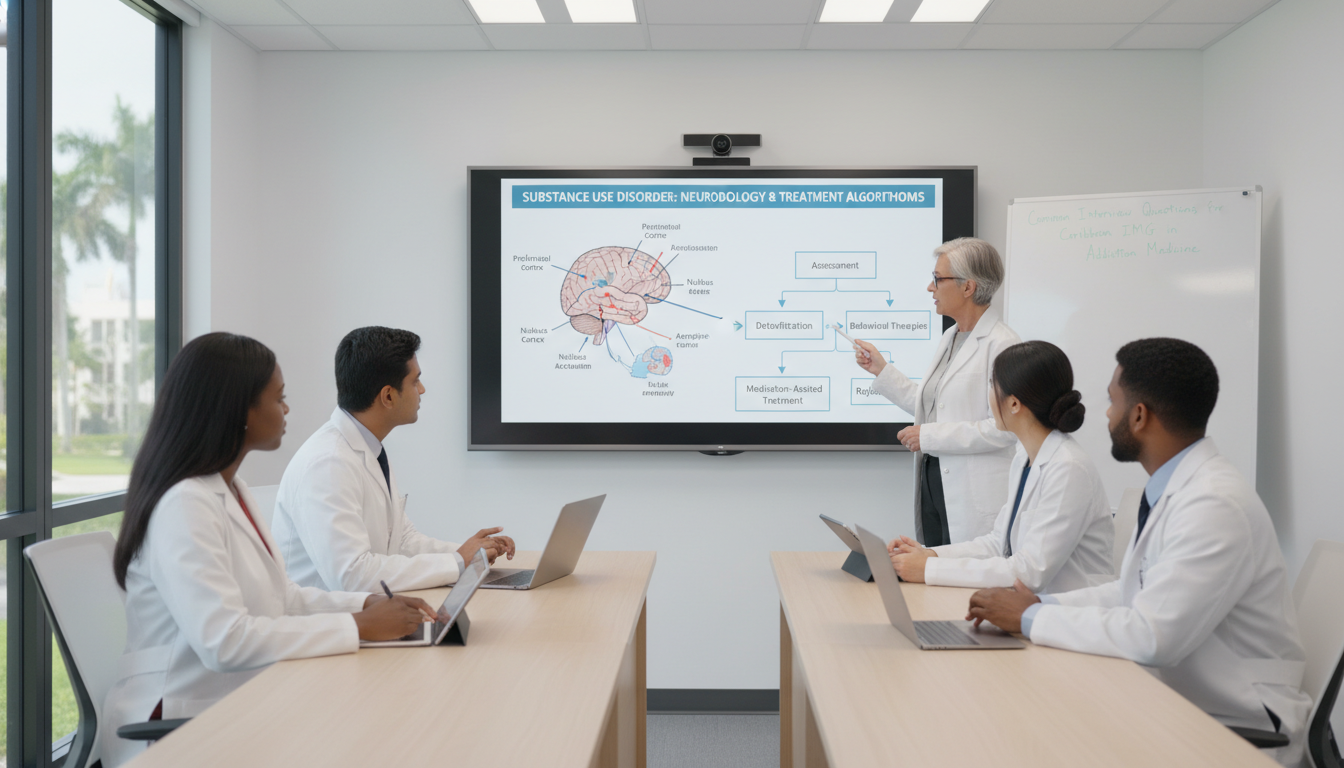
Strategies to Stand Out as a Caribbean IMG Applicant
Beyond individual common interview questions, your overall narrative matters—especially as a Caribbean IMG aspiring to addiction medicine.
1. Build a coherent “story arc”
Everything should connect:
- Your background → why medicine → why Caribbean school → key clinical experiences → why addiction medicine → why this program now.
You’re not just listing experiences—you’re showing a trajectory toward becoming an addiction medicine physician.
2. Highlight U.S. clinical and addiction-related experiences
Residency committees often ask:
- “Tell me about your U.S. clinical experience.”
- “What exposure have you had to addiction treatment in the U.S. healthcare system?”
Be ready to discuss:
- Rotations in psychiatry, internal medicine, emergency medicine, or primary care with significant substance use populations.
- Any work or volunteer roles in:
- Detox/rehab facilities
- Methadone or buprenorphine clinics
- Community outreach or harm reduction programs
Show that you understand both Caribbean and U.S. contexts, giving you a broader clinical lens.
3. Practice “behavioral interview medical” skills
To perform well, you must practice out loud, not just in your head.
Concrete steps:
- Record yourself answering:
- “Tell me about yourself”
- “Why addiction medicine?”
- A few challenging behavioral questions (conflict, mistake, difficult patient)
- Time your responses (aim for 1.5–3 minutes each).
- Ask a mentor or friend to simulate an interview and provide feedback.
4. Address potential red flags calmly and confidently
As a Caribbean IMG, you may be asked about:
- Gaps in training
- Step score delays or failures
- Transfers between schools
- Visa needs
When these arise:
- Answer directly and briefly.
- Take responsibility where appropriate, then pivot to:
- What you changed
- Evidence of improvement (e.g., later scores, strong clinical performance, solid letters).
Do not get defensive or overly apologetic. The focus should be on growth and resilience.
5. Prepare for virtual interview specifics
Many programs now use virtual formats. Be prepared for:
- Technical setup: stable internet, neutral background, good lighting.
- Eye contact: look at the camera, not just the screen.
- Professional appearance: full professional attire, not just from the waist up (in case you need to stand).
- Notes: Brief bullet points near your screen are fine, but do not read verbatim.
Your goal: replicate the professionalism you’d show in person.
Frequently Asked Questions (FAQ)
1. As a Caribbean IMG, do I need addiction-specific experience before applying to residency or an addiction medicine fellowship?
It’s not mandatory, but it is very helpful. Programs like to see:
- Rotations with high exposure to substance use (psychiatry, internal medicine, emergency medicine).
- Any formal or informal substance abuse training, such as workshops, online modules, or local QI projects.
- Volunteer work or research related to addiction.
Even a small, well-reflected experience can significantly strengthen your narrative.
2. How important is it to explicitly mention my goal of an addiction medicine fellowship during a core residency interview?
It’s generally advantageous to mention it, as long as:
- You also show enthusiasm for the full scope of the specialty (e.g., all of psychiatry or internal medicine, not only addiction).
- You remain open to growth and other interests.
Many programs value residents who have a clear focus like addiction, especially if they have an in-house addiction medicine fellowship or faculty with that expertise.
3. What if I’m asked a question and I don’t understand it or need time to think?
It’s acceptable—and professional—to say:
- “That’s a great point; let me think about an example that best reflects my experience.”
- Or, “Could you clarify if you’re more interested in my clinical or research experience with that?”
Taking a few seconds to gather your thoughts is better than giving a rushed, unfocused answer.
4. How can I practice “Tell me about yourself” effectively as a Caribbean IMG?
Write a short script hitting:
- Origin and background
- Caribbean medical school and key clinical experiences
- Why addiction medicine or why you’re drawn to patients with substance use disorders
- Your short- and long-term goals
Then:
- Practice speaking it out loud until it feels natural—not memorized.
- Record and watch yourself to adjust pacing and clarity.
This one answer, if done well, can set a strong, confident tone for the entire interview.
Preparing for interviews as a Caribbean IMG in addiction medicine demands honesty, reflection, and deliberate practice. By anticipating common residency interview questions and crafting responses that highlight your resilience, multicultural perspective, and passion for caring for patients with substance use disorders, you can present yourself as exactly what programs seek: a thoughtful, committed future addiction medicine physician.