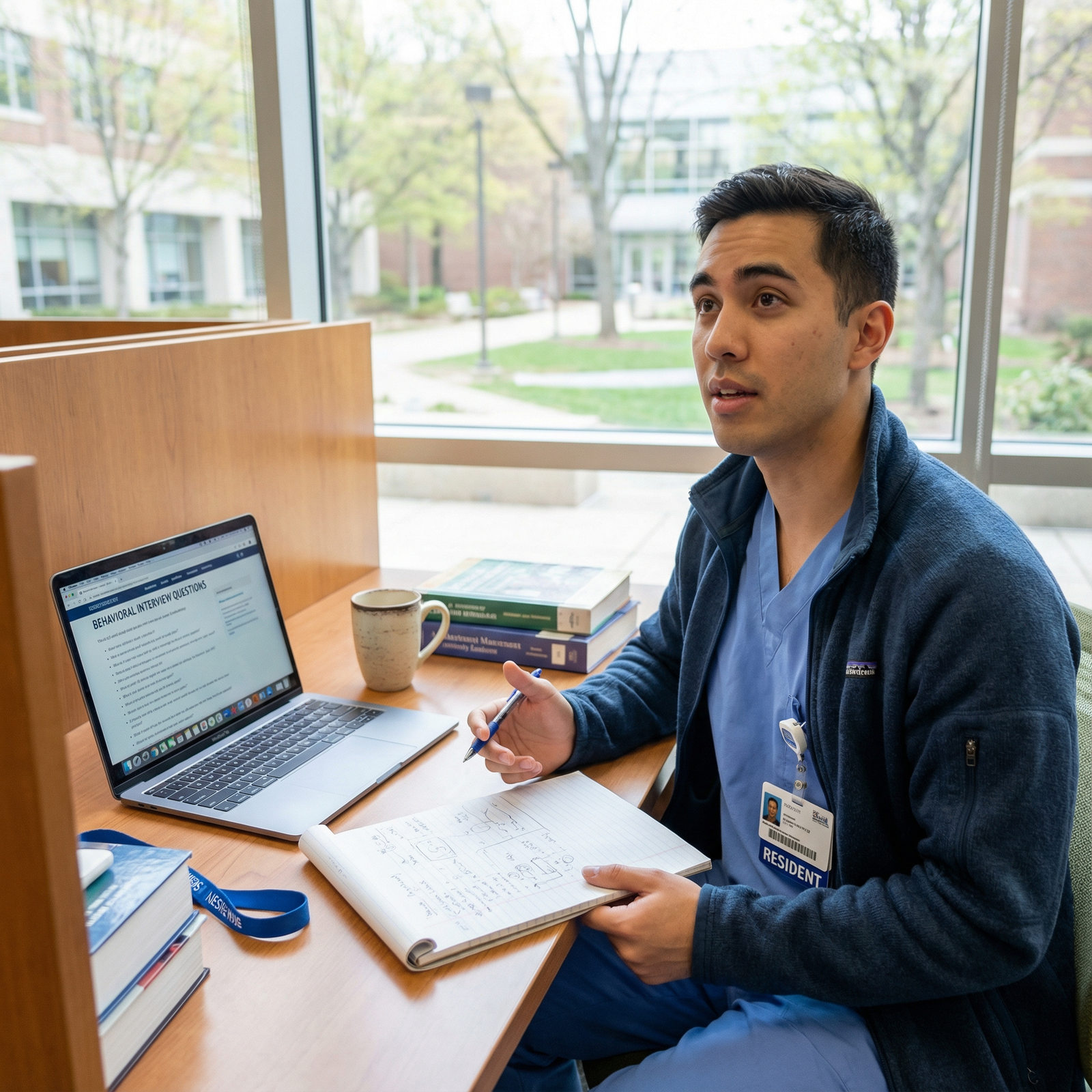
Understanding Transitional Year Interviews for Non‑US Citizen IMGs
For a non-US citizen IMG or foreign national medical graduate, a Transitional Year (TY) program can be a strategic pathway into US graduate medical education. These interviews, however, come with unique challenges: immigration questions, “US-fitness” concerns, communication style, and questions about career direction.
This article focuses on the most common interview questions you’ll face as a non-US citizen IMG applying to Transitional Year residency programs, how to structure strong answers, and what program directors are really assessing—especially in behavioral interview medical contexts.
We will cover:
- How TY programs think about non-US citizen IMGs
- Classic “getting to know you” questions (including “tell me about yourself”)
- Behavioral and situational questions you should expect
- Questions specific to your immigration and IMG status
- Questions you should ask programs
- Sample answers and practical preparation strategies
1. What Transitional Year Programs Look for in Non‑US Citizen IMGs
Transitional Year residencies are unique. They are broad-based, typically one-year programs designed either:
- As a clinical foundation before an advanced specialty (e.g., Radiology, Anesthesiology, Dermatology, PM&R, Ophthalmology), or
- As a flexible year to gain US clinical experience and strengthen your profile if you aim to reapply to categorical positions.
For a non-US citizen IMG, program directors commonly focus on five core domains in their residency interview questions:
Clinical readiness in the US system
- Can you function safely with indirect supervision?
- Have you adjusted to US medical culture, documentation, EMR, team-based care?
Communication skills
- Is your spoken English clear under stress?
- Can you communicate with patients and interprofessional teams effectively?
Professionalism and reliability
- Will you show up, follow through, and meet deadlines?
- Will you adapt quickly to expectations and hospital workflows?
Career direction and honesty about your goals
- Why are you choosing a Transitional Year residency, not a categorical one?
- Is this truly part of a coherent long-term plan?
Visa and long-term feasibility
- Can the program realistically sponsor your visa?
- Are you likely to remain in good standing and complete the year?
When you prepare for common interview questions, everything you say should reassure programs on these five points.
2. Core “Getting to Know You” Questions
These are almost guaranteed to appear and set the tone for the rest of the interview. For a non-US citizen IMG, the key is to be concise, structured, and intentional.
2.1 “Tell me about yourself”
This is the single most common opening question. Programs use it to gauge your communication, organization, and priorities. As a non-US citizen IMG, “tell me about yourself” is your chance to:
- Quickly frame your international training
- Highlight your path to the US
- Connect your story to a Transitional Year program
Use a simple 3-part structure: Present → Past → Future
Example approach:
- Present – Who you are now (briefly)
- Past – Key experiences that explain how you got here
- Future – Why TY and what you want to do next
Sample answer (condensed):
I’m a foreign national medical graduate from India, currently completing a clinical observership in internal medicine at a community hospital in New Jersey.
I completed my MBBS at XYZ Medical College, where I developed an interest in diagnostic reasoning and multidisciplinary care through my internal medicine and radiology clerkships. After graduation, I worked for a year as a junior resident in internal medicine and simultaneously prepared for the USMLEs, which strengthened my foundation in evidence-based medicine.
Over the past year in the US, my observerships and research have shown me how much I value a broad clinical base and close clinical supervision as I transition into the US system. I’m particularly interested in pursuing a diagnostic radiology residency, and I see a Transitional Year as the ideal foundation to refine my clinical judgment, learn US workflows, and build strong relationships with faculty before entering an advanced program.
Tips for non-US citizen IMGs:
- Avoid a chronological “bio data” list (high school → medical school → every activity).
- Keep it 1.5–2 minutes. Practice out loud.
- Mention being a non-US citizen IMG only in a neutral/positive, matter-of-fact way.
- Link your narrative clearly to why a TY program fits your goals.
2.2 “Why Transitional Year and not [categorical specialty]?”
Program directors want to ensure you’re not treating a TY as backup or a vague “filler year.”
Core points to include:
- You value broad-based clinical training.
- You see TY as complementary to your intended advanced specialty.
- You understand the structure of TY (rotations, flexibility, call).
- You’re committed to engaging fully in the year.
Sample answer:
I’m ultimately aiming for an advanced position in anesthesiology. I deliberately chose to apply for Transitional Year residency programs first because I want a solid, broad-based clinical foundation before starting specialty training.
As a non-US citizen IMG, I also recognize the importance of becoming fully comfortable with the US healthcare system, documentation standards, and interprofessional communication. A strong TY program, with rotations in internal medicine, emergency medicine, and intensive care, will help me refine my bedside assessment, manage acutely ill patients, and collaborate effectively with teams—skills that will serve me daily as an anesthesiologist.
I don’t see this year as just a requirement; I see it as the year that will turn me from a good medical knowledge test-taker into a confident, US-ready clinician.
2.3 “Why our program?”
This is a question where non-US citizen IMGs sometimes sound generic. Programs are testing:
- Did you research them?
- Do you understand what makes their TY program different?
- Will you be a good fit with their culture (community-heavy, inpatient-heavy, academic, advanced specialty ties)?
Actionable approach:
Before interviews, prepare 3–4 specific points for each TY program:
- Structure: Rotations, ICU months, electives offered
- Culture: Resident comments, program size, mentorship structure
- Location-related factors: Patient population, community needs
- Visa/research/mentorship opportunities: Especially relevant to you as a foreign national medical graduate
Sample answer (framed for a community-based TY):
I was drawn to your TY program for three main reasons. First, the strong inpatient internal medicine exposure with dedicated ICU time aligns with my goal to strengthen acute care skills before entering radiology.
Second, during the virtual open house and after speaking with two of your current residents, I heard consistently that teaching here is very hands-on and that attendings are approachable and supportive, which is especially important for me as a non-US citizen IMG transitioning into the US system.
Finally, I appreciate that your program has successfully matched previous Transitional Year residents into advanced programs in radiology and anesthesiology. The combination of a strong clinical foundation, supportive teaching environment, and proven track record makes this program an excellent fit for my goals.

3. Common Behavioral and Situational Interview Questions
Behavioral interview medical questions are designed to predict your future performance based on your past behavior. They frequently begin with:
- “Tell me about a time when…”
- “Describe a situation where…”
- “Give me an example of…”
Use the STAR method to structure your responses:
- Situation – Brief context
- Task – Your role and goal
- Action – What you did
- Result – Outcome and what you learned
3.1 Teamwork and Communication
Typical questions:
- “Tell me about a time you had a conflict with a colleague or team member.”
- “Describe a situation where you had to work with a difficult team member.”
- “Tell me about a time you worked in a multidisciplinary team.”
Programs are assessing:
- Can you handle interpersonal difficulties without blaming others?
- Can you communicate respectfully, especially across cultures and hierarchies?
- Are you self-reflective?
Sample answer (conflict with colleague):
Situation: During my internal medicine internship overseas, I was part of a ward team with another intern who often arrived late to rounds, which delayed our work and occasionally frustrated the residents.
Task: As co-interns, we were both responsible for ensuring our patients were pre-rounded and notes completed on time. I wanted to address this in a way that preserved our working relationship and improved patient care.
Action: I invited my colleague for a brief coffee break and started by acknowledging their strengths, such as their thorough handoffs. Then I shared my observations about our delays, framed around how it impacted patient care and team efficiency, not their character. I asked if there were barriers I didn’t know about. They explained they were struggling with late-night family responsibilities and transportation. We agreed to share some early-morning tasks differently and I offered to send a summary of key overnight events the night before so they could plan better.
Result: Over the next month, our rounds became more efficient, and the senior resident commented on the improvement. I learned that addressing conflicts early, privately, and with empathy leads to better teamwork and avoids building resentment.
As a non-US citizen IMG, be conscious of how you describe hierarchy and conflict. US programs value respectful assertiveness and patient-centered reasoning, not blind obedience.
3.2 Dealing with Stress and Workload
Transitional Year programs can be busy with high call volumes. Programs want to know:
- How do you handle fatigue, pressure, and emotional stress?
- Do you recognize your limits and ask for help?
Typical questions:
- “Tell me about a time you were overwhelmed. How did you handle it?”
- “Describe a stressful clinical situation and what you did.”
Sample answer (stressful workload):
Situation: During a night shift in my internship abroad, I was covering both the emergency department admissions and the medical ward due to a last-minute staffing shortage. Several sick patients arrived within a short period.
Task: My priority was to ensure that all critical patients received timely evaluation and that no urgent issues were missed on the ward.
Action: I quickly triaged patients by severity, prioritizing those with respiratory distress and chest pain. I notified my senior resident early about the situation and requested help with admissions. I also asked the nursing staff to alert me immediately about any vital sign abnormalities on the ward. To stay organized, I created a simple list of patients with brief notes and time-stamped tasks.
Result: All critical patients were evaluated promptly; one patient with evolving STEMI was transferred urgently for PCI. At the end of the shift, my senior resident praised my decision to call for help early and maintain clear communication with nursing. The experience reinforced the importance of triage, team collaboration, and recognizing when to escalate rather than trying to manage everything alone.
Highlight that you are willing to seek help, understand triage, and maintain patient safety.
3.3 Ethical and Professional Challenges
These questions test your integrity and maturity:
- “Tell me about a time you made a mistake.”
- “Describe a situation where you saw something you felt was wrong.”
- “Tell me about a time you had to deliver bad news or handle a difficult conversation.”
Key principles:
- Never claim you’ve never made a mistake.
- Avoid stories that reveal major ethical violations without clear learning and remediation.
- Emphasize honesty, accountability, and follow-up.
Sample answer (mistake):
Situation: During my internship, I once wrote an incomplete order for IV fluids on a congestive heart failure patient because I hurried while covering multiple admissions. The nurse noticed the inconsistency between my fluid order and the patient’s condition and paged me to clarify.
Task: I needed to correct the order immediately and prevent harm, and then understand how to avoid this in the future.
Action: I returned to the patient’s chart, reassessed their volume status, and modified the order to a lower maintenance rate with close monitoring. I thanked the nurse for catching the error and later discussed the incident with my senior resident. Together, we reviewed the case and identified that my rushed workflow and failure to pause before signing orders contributed to the near-miss. I implemented a personal checklist to double-check orders in high-risk patients.
Result: The patient remained stable without fluid overload. The event improved my appreciation for nursing colleagues and the importance of a “mental pause” before finalizing orders. Since then, I have been more deliberate, especially in high-risk situations, and more open to feedback from the team.
3.4 Leadership and Initiative
Transitional Year residents are often expected to take initiative even without formal leadership titles.
Typical questions:
- “Tell me about a time you took initiative to improve something.”
- “Describe a situation where you led a project or group.”
For a non-US citizen IMG, this is also a chance to show how you adapt to new systems and contribute positively.
Sample answer (initiative):
Situation: In my home institution, we had frequent delays in getting lab results to the medical team, partly because interns were not consistently checking the electronic system.
Task: I wanted to improve timely recognition of abnormal lab results for our ward patients.
Action: I proposed a simple system where one intern on each shift was responsible for a scheduled lab check twice per day, with critical values immediately reported to the senior resident. I created a brief written guideline and presented it at our intern meeting, then asked for feedback from residents and nurses.
Result: Over the next two months, we observed fewer missed abnormal labs, and the residents reported improved efficiency in rounds. While this was a small change, it taught me that structured workflows and clear division of responsibilities can significantly impact patient care. I’m eager to participate in similar quality improvement efforts in a Transitional Year residency.

4. Questions Specific to Non‑US Citizen IMGs and Visa Status
As a non-US citizen IMG or foreign national medical graduate, you will almost certainly encounter questions that touch directly or indirectly on:
- Your immigration status
- Gaps in training
- US clinical experience
- Long-term career plans in the US
4.1 “What is your visa status?” / “Do you require visa sponsorship?”
Programs need clarity for planning and compliance. Answer honestly, briefly, and confidently.
Example:
I am currently on a B1/B2 visa for observerships and will require J-1 sponsorship for residency. I have reviewed your website and understand that your institution sponsors J-1 visas, which aligns with my needs.
Or:
I am already on an F-1 visa with OPT eligibility and will require an H-1B or J-1 visa for residency, depending on your institution’s policies.
Avoid long explanations about consular issues unless directly asked.
4.2 “Why did you choose to come to the US for training?”
This question explores your motivations and long-term intentions.
Good elements to include:
- Commitment to evidence-based, guideline-driven care
- Exposure to diverse patient populations
- Interest in structured training and subspecialty opportunities
- Respectful mention of home country, not criticism
Sample answer:
I chose to pursue residency in the US because of the structured training environment, strong emphasis on evidence-based practice, and opportunities for subspecialty exposure. During my observerships, I was struck by how multidisciplinary teams function efficiently, with clear roles and standardized protocols.
As a non-US citizen IMG, I also appreciate the diversity of the patient population and the emphasis on patient safety and quality improvement. These aspects align with the type of physician I aspire to be: clinically competent, research-informed, and comfortable working in diverse teams and communities.
4.3 “You have a gap since graduation. Can you explain this?”
Many non-US citizen IMGs have gaps due to exam preparation, observerships, visa issues, or research.
Approach:
- Be honest and factual.
- Emphasize what you did during the gap (USCE, research, CME, volunteering).
- Show that you maintained or advanced your clinical skills and knowledge.
Sample answer:
After graduating in 2020, I spent one year preparing for the USMLE exams and working as a junior doctor in internal medicine at my home institution. Following that, I moved to the US and completed several observerships in internal medicine and radiology, engaged in retrospective research, and completed online CME courses to stay clinically updated.
While there was a transition from full clinical duties to more observational and academic work, I have remained actively involved in medicine and continuously improved my understanding of the US healthcare system.
4.4 “Where do you see yourself in 5–10 years?”
Programs want to know whether your goals are realistic and compatible with a TY program.
Balanced response for a non-US citizen IMG:
- State your intended advanced specialty or field.
- Express openness to practicing in underserved or academic settings.
- If you are unsure about permanent US practice, keep the answer broadly positive but honest.
Sample answer:
In five to ten years, I see myself as a board-certified radiologist practicing in a setting where I can balance clinical work with teaching and possibly some research. I hope to be part of a team that values multidisciplinary collaboration, particularly in oncology and emergency radiology.
In the near term, my priority is to complete a strong Transitional Year residency, adapt fully to the US system, and become a reliable and effective member of any team I join.
5. Questions You Should Prepare to Ask the Program
Residency interviews are two-way conversations. Asking thoughtful questions shows maturity and genuine interest. As a non-US citizen IMG aiming for a TY program, consider questions that reveal:
- Educational quality
- Support for IMGs
- Visa and career guidance
- Wellness and workload
Examples of good questions:
About education and structure
- “How is the Transitional Year curriculum structured to prepare residents for advanced specialties, especially for those coming from outside the US system?”
- “How often do residents receive formal feedback on their performance?”
About IMG support
- “What support systems are in place for international medical graduates adjusting to documentation, EMR, and communication expectations?”
- “Do you have mentorship programs that pair TY residents with faculty in their intended specialties?”
About visas and career planning
- “How has the program historically supported non-US citizen IMGs with visa-related processes?”
- “Could you share examples of where previous Transitional Year residents have matched for their advanced positions?”
About culture and workload
- “How would you describe the culture among residents here?”
- “What does a typical call schedule look like for TY residents, and how do you support wellness?”
Avoid questions that can be easily answered by the program website or that suggest you are mainly interested in lifestyle and not education.
6. Practical Preparation Strategy for Non‑US Citizen IMGs
To perform well in residency interview questions, especially behavioral interview medical scenarios, create a structured preparation plan:
List 10–12 core stories from your experience that show:
- Teamwork
- Leadership
- Dealing with conflict
- Handling stress
- A mistake and what you learned
- An ethical dilemma
- A time you went above and beyond
- Adaptation to a new system (important for IMGs)
Map each story to common behavioral prompts using the STAR method.
Practice aloud
- Do mock interviews with friends, mentors, or online platforms.
- Record yourself to assess clarity, pace, and fillers.
Refine your introduction and key answers
- “Tell me about yourself”
- “Why Transitional Year?”
- “Why this program?”
- “Why the US?”
- “What is your visa status?”
Prepare your own questions for each program ahead of time.
Simulate the interview environment
- If virtual: test audio, video, lighting, background.
- If in person: plan routes, attire, and bring printed copies of your CV/ERAS.
Address accent and communication concerns
- If English is not your first language, consider brief speech coaching or practice with native speakers.
- Focus on slowing down, enunciating clearly, and pausing briefly between points.
FAQ: Transitional Year Interview Questions for Non‑US Citizen IMGs
1. Are interviewers allowed to ask detailed questions about my immigration plans?
Programs can ask whether you require visa sponsorship and what type (e.g., J-1, H-1B), but they should not ask about your country of origin in a discriminatory way or your intention to stay permanently in the US. If a question feels overly personal, you can gently redirect to your professional goals and training needs.
2. How should I handle “tell me about yourself” if I have multiple career interests?
Choose one primary narrative that makes sense for a Transitional Year residency. You can mention secondary interests, but keep your story coherent. For example: “I’m primarily interested in radiology but also open to internal medicine subspecialties; that’s part of why a broad-based Transitional Year is attractive to me.”
3. What if I don’t have US clinical experience yet?
Focus on:
- Strong clinical experiences in your home country
- Transferable skills (teamwork, leadership, acute care)
- Any steps you’ve taken to understand the US system (CME courses, guidelines, virtual observerships)
- A clear plan to adapt quickly and seek feedback
Be honest about the limitation but demonstrate readiness and humility.
4. How honest should I be about my long-term plan to practice in the US?
You should be truthful but professional. It is acceptable to express that your current goal is to complete high-quality training in the US and become board-certified, while leaving some flexibility about long-term geographic plans. Avoid sounding like you will definitely leave immediately after training if the program invests in you, but do not fabricate a commitment you don’t intend to keep.
By anticipating these common interview questions and preparing thoughtful, structured responses tailored to your journey as a non-US citizen IMG, you can demonstrate that you are not only clinically capable, but also adaptable, communicative, and ready to thrive in a Transitional Year residency program.