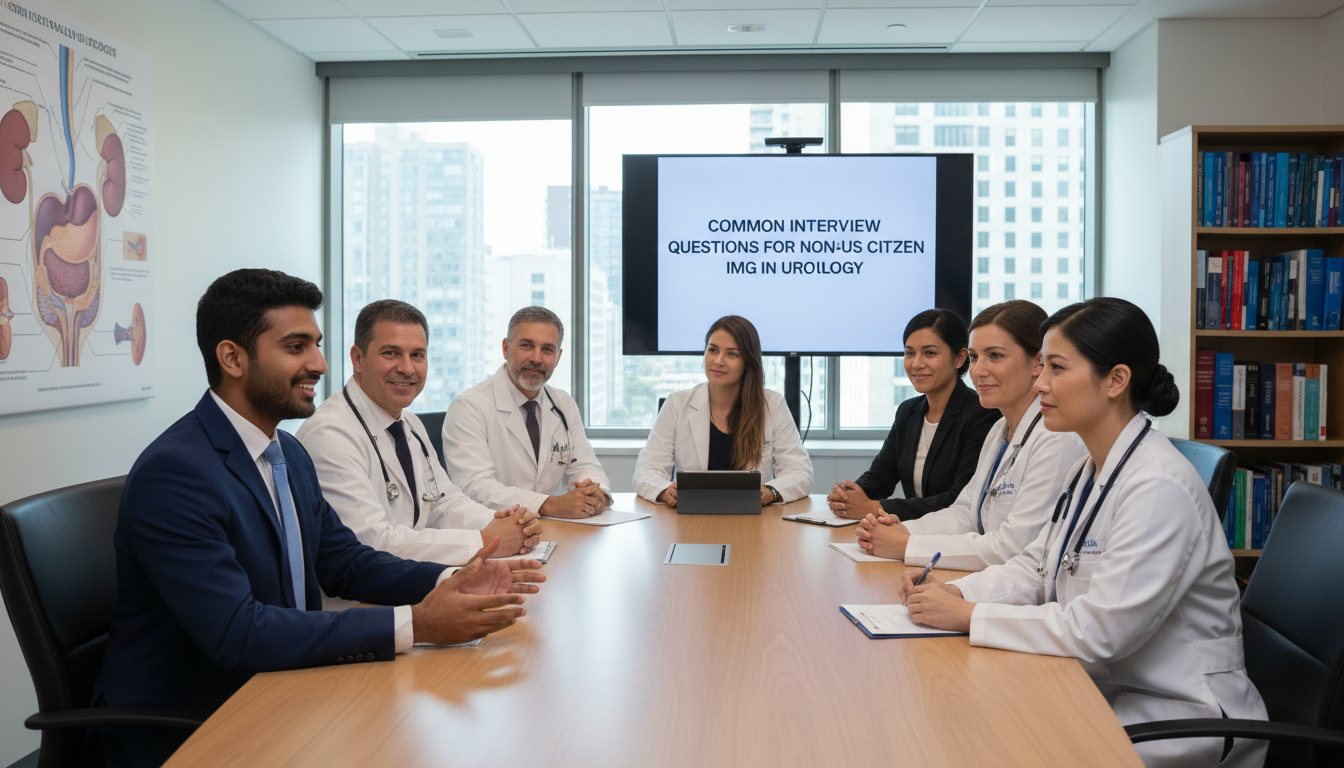
Understanding the Interview Landscape for Non‑US Citizen IMGs in Preliminary Surgery
Non‑US citizen international medical graduates (IMGs) applying for a preliminary surgery year in the United States face a distinct interview environment. Programs know that prelim positions are often stepping stones—either to categorical surgery, another specialty, or a transition year. At the same time, they must ensure that each prelim surgery resident is reliable, hardworking, and able to handle the intense pace of surgical training.
For a foreign national medical graduate, interviews can feel especially high‑stakes: you are simultaneously being evaluated for fit, clinical skills, and visa logistics. Many questions you’ll encounter are classic residency interview questions, but there are nuances in how they are asked and how you should answer as a non‑US citizen IMG.
This guide breaks down the most common interview questions for non‑US citizen IMGs in preliminary surgery, explains what programs are really assessing, and offers sample frameworks and example answers. It also highlights how to approach behavioral interview medical questions and how to craft strong responses to broad prompts like “Tell me about yourself.”
1. Foundational Questions You Will Almost Certainly Be Asked
These are the core questions that appear in nearly every residency interview, regardless of specialty. As a preliminary surgery applicant, your answers should emphasize reliability, work ethic, and adaptability—key traits for someone who may carry a heavy clinical load in a one‑year position.
1.1 “Tell Me About Yourself”
This is almost always the first question. It’s not small talk; it is your chance to set the tone, highlight your identity as a non‑US citizen IMG, and connect your past to your interest in surgery and this prelim year.
What they are really asking
- Can you present yourself clearly and concisely?
- Do you understand your own story and trajectory?
- How do your experiences make you a good fit for a prelim surgery residency?
How to structure your answer (3‑part framework)
- Past (Brief)
Origin (country, school) + major milestones (e.g., why medicine, early interest in surgery). - Present (Focused)
Current position, recent experiences (US clinical experience, research, observerships), and what you are doing now to prepare for surgical training. - Future (Linked to prelim surgery)
Clear short‑term goal (strong prelim year) and long‑term aspirations (categorical surgery, related specialty, academic career, etc.).
Example (abbreviated)
“I am a non‑US citizen IMG from India, where I completed my medical degree at XYZ University. During my clinical years, I was drawn to surgery because I enjoyed acute decision‑making and the immediate impact of operative care… Currently, I am completing observerships in general surgery and working on outcomes research in trauma surgery. In the short term, I am focused on building strong operative and peri‑operative skills in a demanding environment like your preliminary surgery year. Long term, I hope to transition into a categorical general surgery position and contribute to quality improvement initiatives in surgical care, especially for underserved populations.”
Key tips
- 60–90 seconds maximum.
- Avoid reciting your entire CV.
- Make sure “non‑US citizen IMG” is framed as a strength (diversity, global perspective, resilience).
1.2 “Why Surgery?” and “Why Preliminary Surgery?”
Even for a prelim spot, programs want to see authentic motivation. They need residents who will show up and perform, not simply “fill a gap year.”
What they are evaluating
- Commitment to a surgical career or surgery‑adjacent path.
- Insight into the demands of surgical training.
- Whether you will add value, even if you won’t be with them for more than a year.
Answering “Why Surgery?”
Include:
- A defining clinical moment or pattern of experiences.
- What aspects of surgery match your personality (e.g., hands‑on work, team‑based care, acute problem‑solving).
- Evidence that you understand the lifestyle and emotional demands.
Answering “Why a Preliminary Surgery Year?”
Programs often ask this explicitly for non‑categorical positions.
Good themes for a foreign national medical graduate:
- You want intensive US clinical and operative exposure to become a stronger candidate.
- The prelim year will help refine your long‑term path (categorical surgery vs. related specialty).
- You value the chance to prove yourself in a US surgical environment and grow quickly.
Example points to include
- “As a non‑US citizen IMG, I know that a strong preliminary surgery residency year is critical to demonstrating that I can handle the pace and complexity of US surgical training.”
- “I am looking for a program where prelim residents are integrated into the team and given real responsibility—exactly the environment I see here.”

2. Questions Specific to Non‑US Citizen IMGs and Visa Issues
As a non‑US citizen IMG, you should expect targeted questions that explore your background, adaptability to the US healthcare system, and visa status.
2.1 “Why Did You Choose to Train in the United States?”
What they are probing
- Your understanding of the US system.
- Long‑term intentions (stay in the US? return to your home country?).
- Whether your goals align with what a US prelim surgery program can realistically offer.
Strong talking points
- Breadth and complexity of surgical cases.
- Exposure to structured residency training and quality improvement.
- Research opportunities and multidisciplinary care.
- Desire to bring back skills to your home country or to continue in the US long term, depending on your plans—but be clear and consistent.
Avoid vague or superficial statements like “better opportunities.” Be specific.
2.2 “What Is Your Visa Status?” / “Do You Need Visa Sponsorship?”
These are practical questions, not personal judgments.
How to respond
- Be brief, factual, and confident.
- Know in advance whether the program sponsors J‑1, H‑1B, or both.
- Clarify your eligibility (e.g., USMLE scores for H‑1B, ECFMG certification timing).
Example
“I am a non‑US citizen IMG currently living in [country]. I will require J‑1 visa sponsorship; I’ve already obtained my ECFMG certification and will be fully eligible for J‑1 sponsorship by the start of residency.”
Key tip:
Have a one‑sentence summary ready that connects your visa needs to your reliability:
“…I have already prepared the necessary documentation and do not anticipate any delays in starting on time.”
2.3 “How Do You Plan to Overcome Challenges as a Foreign National Medical Graduate in the US System?”
Programs know that adaptation is a major hurdle.
Points to highlight
- Prior experience in US clinical settings (observerships, externships, research).
- Proactive strategies: asking for feedback, reading US guidelines, practicing documentation in English.
- Cultural competence and openness: willingness to learn local norms in communication with staff and patients.
Example angle
“Being a foreign national medical graduate, I am aware of differences in documentation, communication styles, and system‑based practices. In my US observerships, I made it a habit to review EMR notes daily, ask for feedback on my presentations, and read the local protocols. I plan to continue this approach during residency—especially in my first months—so I can quickly reach the level of efficiency and clarity expected here.”
3. Core Behavioral Interview Questions for Prelim Surgery
Programs increasingly use behavioral interview medical questions—“Tell me about a time…” prompts—because they predict how you will behave under pressure.
A simple framework for answering: STAR
- Situation
- Task
- Action
- Result & Reflection
Each answer should be 1–2 minutes, with emphasis on your actions and lessons learned.
3.1 “Tell Me About a Time You Faced a Major Challenge in Clinical Training.”
What they want to see
- Resilience and coping strategies.
- How you respond to failure or stress.
- Honesty and self‑reflection.
For a prelim surgery residency, good stories might involve:
- Managing multiple critical patients.
- Navigating limited resources in your home country.
- Adjusting to US clinical culture or language barriers.
Example structure
- Situation: “During my internship in [country], our hospital had limited access to imaging…”
- Task: “I was the intern responsible for triaging surgical emergencies overnight…”
- Action: “I created a simple triage checklist, communicated early with the senior resident, and prioritized patients based on hemodynamic stability and suspected pathology…”
- Result: “We reduced delays to OR for unstable patients. I learned to prioritize tasks under pressure and to involve my seniors early—skills I know are essential in a busy prelim year.”
3.2 “Tell Me About a Time You Made a Mistake.”
Many IMGs attempt to avoid this question by choosing a trivial error. That often appears evasive. Programs are testing whether you can own your mistakes and learn from them.
Key principles
- Choose a real but non‑catastrophic mistake.
- Focus on what you did to correct it and prevent recurrence.
- Highlight systems‑based learning and humility.
Example angle
- Miscommunication about lab follow‑up.
- Incomplete pre‑op workup recognized and corrected before harm.
- Documentation omission that you later fixed.
End with:
“Since then, I always… [new habit, checklist, communication style].”
3.3 “Tell Me About a Time You Had a Conflict with a Colleague or Supervisor.”
They want to know whether you can work in a hierarchical, team‑based environment like surgery without causing disruption.
Pitfalls to avoid
- Blaming others excessively.
- Describing a conflict where you appear unprofessional or insubordinate.
- Being vague or evasive.
Stronger approach
- Choose a conflict about work style, communication, or expectations.
- Emphasize active listening, seeking clarification, and compromise.
- Show that you value team harmony and patient safety over ego.
Example
“In my surgery rotation, I worked with a resident who preferred very concise presentations, while I was used to giving more detailed ones. Initially, he seemed frustrated… I asked him privately to clarify what he expected in presentations. We agreed on a focused template. Once I adjusted, our rounds became more efficient, and our relationship improved. I learned that early clarification of expectations can prevent conflict and is especially important for me as I adapt to new systems.”
3.4 “Describe a Time You Took Initiative or Went Above and Beyond.”
Prelim surgery residents are often the workhorses of the team. Programs seek self‑starters.
Strong examples:
- Implementing a small quality improvement project (e.g., checklist for pre‑op orders).
- Volunteering for extra call or extra tasks during a crisis (COVID surges, staffing shortages).
- Developing a teaching tool for junior students.
Be sure to connect your initiative to concrete outcomes (better patient care, smoother workflow, improved education).
4. Academic, Research, and Performance‑Related Questions
Prelim programs scrutinize academic performance to predict how you will manage intense workloads, exams, and possibly in‑service training tests.
4.1 “Walk Me Through Your CV” / “What Are the Highlights of Your Application?”
This is a more directed version of “Tell me about yourself” focusing on achievements.
Strategy
- Choose 3–4 highlights that align with surgery and US training:
- A key surgical rotation or internship.
- US clinical or research experience.
- A leadership role or teaching experience.
- A significant publication or presentation.
- For each, briefly describe what you did and what you learned that is relevant to residency.
4.2 “Can You Explain Any Gaps or Irregularities in Your Timeline or Scores?”
Many non‑US citizen IMGs have gaps (visa processing, exam preparation, family responsibilities, research years). Programs mainly want transparency and reassurance that the issue is resolved.
How to respond
- Be honest but concise.
- Avoid defensiveness or oversharing.
- Emphasize productive use of that time if applicable (research, observerships, USMLE prep, language courses).
Example
“After medical school, I took 18 months to focus on USMLE preparation and to complete two research projects in colorectal surgery. Although it prolonged my timeline, it allowed me to achieve competitive scores and deepen my understanding of outcomes research. I now feel better prepared for evidence‑based surgical practice.”
If you had a low score or a failed attempt:
- Take responsibility.
- Identify specific changes you made (study methods, time management).
- Highlight subsequent improvement (better scores on later exams, in‑service, etc.).
4.3 “Tell Me About Your Research” (if applicable)
If you have research, especially in surgery or related fields, you must be able to explain it clearly to a non‑specialist.
Key elements
- One‑sentence background and question.
- Your specific role (data collection, analysis, writing).
- Main finding or contribution.
- What skills you gained (critical appraisal, statistics, perseverance).
Programs want to see that you can think critically and communicate complex information—a core part of surgical decision‑making.
5. Program Fit, Motivation, and Future Plans
Even in a preliminary surgery year, programs want residents who will be engaged and aligned with their environment.
5.1 “Why Our Program?”
Generic answers hurt you here. Show that you did your homework.
Research in advance:
- Case volume and case mix (trauma, vascular, minimally invasive, community vs. academic).
- Role of prelims: Are they primarily on floor services, do they get OR time, what is their call schedule?
- Any structured teaching, simulation labs, or research opportunities.
Structure your answer
- You know them – mention 2–3 specific, accurate details.
- They fit you – connect those details to your needs as a non‑US citizen IMG.
- You will contribute – explain how your background adds value.
Example
“I am particularly impressed that your preliminary surgery residency integrates prelim residents fully into the trauma and acute care surgery teams, including regular OR exposure. As a non‑US citizen IMG, I’m looking for a program where I can gain intensive hands‑on experience and adapt quickly to the US system. Your structured simulation curriculum and emphasis on early operative autonomy match my learning style. With my prior experience managing surgical emergencies in a resource‑limited setting, I believe I can contribute to your busy trauma service while continuing to grow as a surgical clinician.”
5.2 “What Are Your Long‑Term Career Goals?”
Programs accept that many prelims are aiming for categorical spots—either at their institution or elsewhere. It is better to be honest, within reason.
Common acceptable goals:
- Obtain a categorical general surgery position.
- Pursue a surgical subspecialty after categorical training.
- Transition to a related field (e.g., anesthesia, radiology, emergency medicine) if surgery is not possible, while still giving 100% during your prelim year.
- Combine clinical work with research or medical education.
How to phrase it
- Be aspirational but flexible.
- Emphasize that regardless of outcome, you will commit fully to the prelim year.
Example closing line:
“Whether I continue here in a categorical position or match elsewhere, my priority is to make the most of this preliminary surgery year—to be a reliable team member and to develop strong surgical fundamentals.”
5.3 “If You Do Not Match into a Categorical Position, What Is Your Plan?”
This is a reality‑based question, especially for IMGs.
Good responses include
- Considering another prelim year or a related specialty.
- Continuing research while re‑applying.
- Returning to your home country to practice while keeping connections with US mentors.
The key is to show maturity and resilience: you understand the competitiveness of surgery and have a plan B, but you are committed and optimistic.
6. Practical Preparation Strategies and Sample Question List
To prepare effectively, you should anticipate and rehearse answers to a wide range of residency interview questions, especially those used in behavioral interview medical formats.
6.1 Core Question Categories to Practice
Background & Motivation
- Tell me about yourself.
- Why did you choose surgery?
- Why a preliminary surgery year rather than categorical right away?
- Why the US? Why our program?
IMG‑Specific & Visa‑Related
- How has being a non‑US citizen IMG shaped you as a physician?
- What challenges do you anticipate as a foreign national medical graduate in a US surgical residency?
- What is your visa status and what support will you need?
Behavioral & Professionalism
- Tell me about a time you disagreed with an attending’s or senior’s plan.
- Describe a time you had to deliver bad news or deal with a distressed family.
- Tell me about a time you were under extreme time pressure and how you prioritized.
- Describe your most stressful clinical day and how you managed it.
Academic & Performance
- Explain any gaps or low scores.
- How do you handle feedback and criticism?
- How do you study or prepare for exams and in‑service tests?
Teamwork & Communication
- How would your colleagues describe you?
- Tell me about a time you helped a struggling teammate.
- Have you ever worked with nurses or allied staff who disagreed with your plan? What did you do?
Ethics & Professionalism
- Describe a time you witnessed unprofessional behavior. How did you respond?
- Have you ever had to advocate for patient safety against pressure to do otherwise?
Closing Questions
- Do you have any questions for us?
- Is there anything else you would like us to know?
6.2 Actionable Preparation Tips
Mock interviews
Practice with mentors, friends, or through IMG organizations. Specifically request feedback on:- Clarity of speech and accent.
- Conciseness (avoid over‑long answers).
- Professional body language, especially over video interviews.
Record yourself
Answer “Tell me about yourself” and two behavioral questions on video. Review for filler words, pace, and clarity.Create a story bank
Write down 8–10 concrete clinical experiences that illustrate:- Leadership
- Teamwork
- Conflict resolution
- Handling error
- Going above and beyond You can adapt these to multiple behavioral questions.
Prepare US‑style examples
If possible, include at least one example from US clinical experience (observerships, externships). This reassures programs that you understand US practices.Know your application intimately
Anything on your CV or personal statement is fair game. Be ready to discuss research, volunteer work, or hobbies in depth.Prepare thoughtful questions for programs
At the end, you will be invited to ask questions. Avoid questions easily answered on the website. Instead, ask:- “How are prelim residents integrated into the OR schedule?”
- “What proportion of your prelims usually transition to categorical positions, here or at other programs?”
- “How do you support non‑US citizen IMG residents adjusting to the system?”
Frequently Asked Questions (FAQ)
1. Are interview expectations different for non‑US citizen IMGs applying to preliminary surgery?
The core clinical and professional expectations are the same, but non‑US citizen IMGs are more closely evaluated on adaptability to the US system, communication skills in English, and visa feasibility. Programs may ask additional questions about your path to the US, your understanding of US healthcare, and your long‑term plans. They want assurance that you can quickly function within their system and that you will fully commit to the year.
2. How should I answer “Tell me about yourself” as a foreign national medical graduate?
Use a clear structure: Past–Present–Future. Briefly describe your background (country, medical school, key experiences that led you to surgery), your current activities (US clinical exposure, research, exam completion), and your immediate goal (a strong prelim surgery residency year) plus long‑term aspirations. Highlight how your journey as a foreign national medical graduate has developed resilience, cultural awareness, and dedication—qualities valuable in a surgical team.
3. Do programs expect prelim residents to stay for categorical positions?
Programs understand that many prelims are seeking categorical positions, either at their institution or elsewhere. Some programs regularly transition strong prelims into categorical spots; others rarely do. In interviews, you can honestly express interest in a categorical path while emphasizing that you will work hard and fully engage in the preliminary surgery year, regardless of whether you stay at that program long‑term.
4. How can I best prepare for behavioral interview medical questions?
Create a list of 8–10 significant clinical or professional experiences, then practice framing them with the STAR method (Situation, Task, Action, Result). Choose examples that show teamwork, leadership, error management, conflict resolution, and initiative. Practice speaking these stories aloud, focusing on your specific actions and what you learned. As a non‑US citizen IMG, try to include at least one example from US clinical experience if possible to demonstrate that you can apply these behaviors in the US system.
By understanding the underlying purpose of these common interview questions and preparing structured, authentic answers, you can present yourself as a confident, resilient, and highly motivated candidate—ready to thrive in a demanding prelim surgery residency as a non‑US citizen IMG.