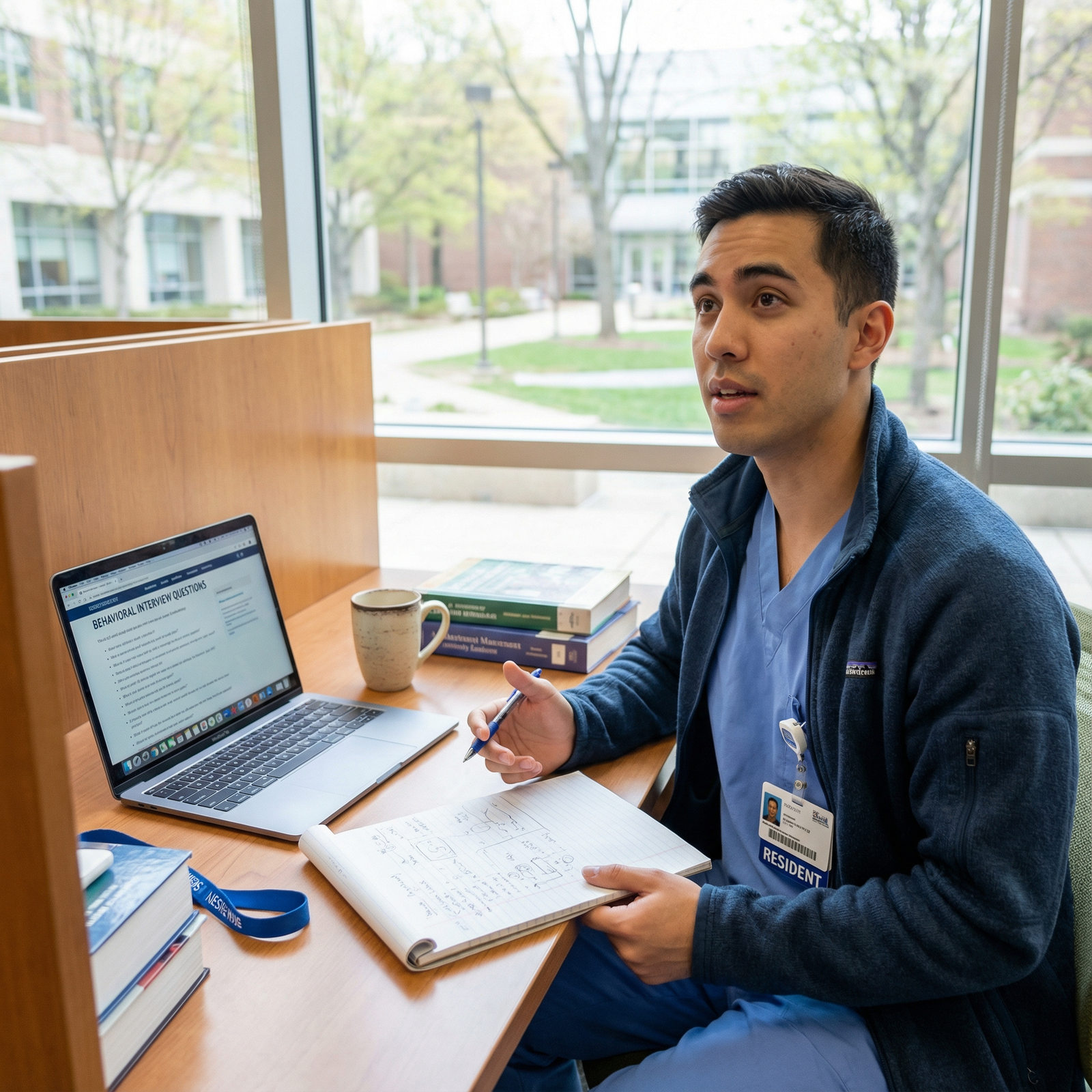
Preparing for a general surgery residency interview can feel like scrubbing in for a major case: you know your fundamentals, but the pressure, uncertainty, and high stakes make everything more intense. The stronger your preparation, the more confidently you’ll perform when it matters.
This guide breaks down the most common interview questions in general surgery, explains why programs ask them, and offers strategies, sample answers, and pitfalls to avoid. While every program is different, the underlying themes are remarkably consistent—especially around behavioral interview medical questions, which focus on how you think, act, and function in a team.
Understanding What Surgery Programs Are Really Looking For
Before diving into specific residency interview questions, it helps to understand what general surgery residency programs are actually assessing. Surgery is demanding—physically, cognitively, and emotionally—so interviewers are looking far beyond board scores and CV bullet points.
Across most general surgery residency interviews, programs are evaluating:
Clinical and technical potential
- Ability to think critically and logically
- Comfort with uncertainty and complex decision-making
- Curiosity and commitment to surgical excellence
Resilience and professionalism
- How you respond to stress, fatigue, and failure
- Reliability, accountability, and integrity
- Insight into your limitations and growth areas
Teamwork and communication
- How you function on multidisciplinary teams
- Communication style with nurses, colleagues, and patients
- Ability to handle conflict and give/receive feedback
Fit with the culture of the program
- Alignment with the program’s mission (academic vs community, research-heavy vs clinically focused)
- Interest in the specific strengths of their general surgery residency
- Whether you are someone they can trust in the OR at 3 a.m.
Most of the common interview questions in general surgery are designed to quietly probe these qualities, especially through behavioral questions (“Tell me about a time when…”) and reflective prompts. Treat each question as an opportunity to demonstrate how you will function as a surgical resident and future colleague.
Classic “Getting to Know You” Questions
These questions usually appear early in the conversation and set the tone. They may sound simple but are often the most influential.
“Tell me about yourself”
This is almost guaranteed. Programs use this prompt to assess how you structure your thoughts, what you prioritize, and how well you can summarize your story without rambling. In many ways, this is your “opening statement.”
What they’re really asking:
- Can you communicate clearly and concisely?
- Do you have a coherent professional identity and narrative?
- How does your background logically lead to general surgery?
How to structure your answer (3-part framework):
- Present: Who you are now (fourth-year medical student, prelim resident, etc.), your current interests, and your role.
- Past: Briefly summarize key experiences that shaped you—clinical, research, or personal—especially those leading to surgery.
- Future: What you’re looking for in a general surgery residency and your longer-term goals.
Example (condensed):
“I’m a fourth-year medical student at XYZ University, currently completing my sub-internship in general surgery, where I’ve particularly enjoyed managing complex acute care patients.
I grew up in a small town where access to surgical care was limited, which initially pushed me toward medicine. During medical school, I found that I loved the OR environment—the immediacy of decision-making and the way surgical interventions can rapidly change a patient’s trajectory. My research in colorectal outcomes helped me appreciate the importance of systems-based care in surgery.
I’m now looking for a general surgery residency that will push me clinically, allow me to grow as an educator, and provide mentorship in outcomes research, with the goal of becoming an academic colorectal surgeon working in an underserved region.”
Tips:
- Keep it 2–3 minutes maximum.
- Avoid repeating your CV line-by-line; focus on your story and motivations.
- Practice out loud so it sounds natural, not memorized.
“Why general surgery?”
This is foundational for the surgery residency match. Interviewers want to confirm that you understand what the field entails and are choosing it for the right reasons.
Strong answers usually:
- Combine head and heart: both emotional resonance and rational reflection.
- Demonstrate realistic insight into the lifestyle and demands.
- Connect your experiences to core surgical values: responsibility, decisiveness, technical mastery, longitudinal care.
Example elements to include:
- First exposure that sparked interest (but don’t stop there).
- Specific qualities of surgery that continue to appeal to you:
- Procedural, hands-on problem solving
- Managing acutely ill patients
- Team-based OR and ICU environment
- Longitudinal relationships in certain subspecialties
- Evidence that you’ve tested this interest: sub-Is, call nights, research, mentorship.
Weak answers focus only on:
- “I love working with my hands”
- “I want instant gratification”
- “I liked the personalities of surgeons” (too superficial if not elaborated)
Your goal is to show a mature, tested commitment, not a fleeting fascination.
“Why our program?”
This question distinguishes applicants who mass-applied from those who have done their homework. It’s also your chance to show how you see yourself fitting and contributing.
How to prepare:
Research each general surgery residency program before the interview:
- Case volume and spectrum (trauma, HPB, vascular, community exposure)
- Resident-run services, autonomy, and graduated responsibility
- Research strengths (outcomes, basic science, quality improvement)
- Program culture, wellness initiatives, mentorship structure
- Fellowships graduates obtain; where alumni practice
Format your answer:
- Specific program features (at least 2–3 concrete details)
- How those features align with your goals
- How you hope to contribute
Example (condensed):
“What stands out to me about your general surgery residency is the strong operative exposure in complex HPB and foregut, combined with an early focus on autonomy through your resident-run service at the county hospital. I’m particularly interested in academic HPB surgery, so the chance to work with Dr. X on outcomes research in pancreatic surgery is very appealing.
I’m also drawn to your culture of resident-led teaching, with the weekly skills lab where seniors train juniors. Teaching has been a consistent part of my medical school experience, and I’d look forward to contributing to that environment while growing as both a surgeon and educator.”
Avoid generic answers like: “You have strong clinical training and good fellowship matches.” Everyone says that.

Behavioral Interview Questions in General Surgery
Behavioral interview medical questions are now standard in many surgery residency interviews. They often start with “Tell me about a time when…” and are designed to predict future behavior based on your past behavior.
The STAR Method
Use the STAR framework to organize your answers:
- S – Situation: Brief context
- T – Task: Your role or responsibility
- A – Action: What you did (focus here)
- R – Result/Reflection: Outcome and what you learned
Aim for 2-minute responses, with emphasis on your actions and insight.
Common Behavioral Themes & Sample Questions
1. Handling conflict
Examples:
- “Tell me about a time you had a conflict with a team member.”
- “Describe a situation where you disagreed with a supervisor or attending.”
What they’re assessing:
- Professionalism and emotional regulation
- Respect for hierarchy while advocating for patient safety
- Ability to collaborate and resolve issues constructively
Pitfalls to avoid:
- Throwing others under the bus
- Blaming without self-reflection
- Describing unresolved, ongoing drama
Better approach:
Choose an example where:
- The conflict was real but manageable (not catastrophic).
- You communicated directly, respectfully, and sought a solution.
- You can articulate what you learned (e.g., clarifying expectations, speaking up earlier).
2. Managing stress, failure, or high-pressure situations
Examples:
- “Tell me about a time you were overwhelmed. What did you do?”
- “Describe a significant failure and how you handled it.”
What programs want to know:
- Do you have healthy coping mechanisms?
- Can you maintain performance under pressure?
- Are you honest about your mistakes and proactive in addressing them?
Stronger answers will:
- Acknowledge a specific challenge (e.g., exam failure, difficult call, personal crisis).
- Demonstrate adaptive strategies: prioritization, seeking help, time management, self-care.
- Show how the experience changed your behavior going forward.
3. Teamwork and leadership
Examples:
- “Tell me about a time you led a team.”
- “Tell me about a time you had to adapt your communication style for a team member.”
Focus on:
- Situations such as student leadership, quality improvement projects, or team-based clinical care.
- How you made others’ work easier, not just your own accomplishments.
- How you balanced accountability and collaboration.
4. Ethics and professionalism
Examples:
- “Tell me about a time you saw something you felt was wrong. What did you do?”
- “Describe a situation where you had to choose between two imperfect options.”
Here, they’re probing your judgment, integrity, and willingness to appropriately escalate concerns while maintaining respect for colleagues and systems.
Building Your Behavioral Answer Bank
Before interview season, list 8–10 specific stories that showcase:
- A time you:
- Made a mistake
- Managed a difficult patient or family
- Resolved a conflict on the team
- Led a project or initiative
- Dealt with time pressure or high workload
- Adapted when something didn’t go as planned
- Advocated for a patient
You’ll find that most behavioral interview questions can be answered with variations on these stories, tailored with the STAR framework.
Clinical, Ethical, and Scenario-Based Questions
While many general surgery residency interviews are not structured as oral exams, programs still want to see how you think like a clinician and future surgeon.
Clinical Reasoning Questions
Examples:
- “How would you work up a patient with right lower quadrant pain?”
- “A patient is hypotensive on the floor post-op day 1. What’s your approach?”
They’re not expecting full attending-level management, but they want to see:
- Organized approach (ABC, vitals, history, focused exam, labs, imaging)
- Recognition of red flags and when to call for help
- Comfort with uncertainty and prioritization
Prepare by reviewing common surgical presentations:
- Acute abdomen
- GI bleed
- Postoperative fever
- SBO vs ileus
- Trauma basics
Ethical and “Gray Zone” Scenarios
Examples:
- “You suspect that another team member’s oversight led to a patient complication. How do you handle this?”
- “A family requests that you withhold a diagnosis from the patient. What do you do?”
Here, interviewers want to see:
- Respect for autonomy, beneficence, nonmaleficence, and justice
- Awareness of institutional policies and team dynamics
- Willingness to seek guidance from seniors, ethics committees, or risk management
You don’t need the “perfect” answer, but you should demonstrate principled, patient-centered reasoning, respect for team processes, and an understanding that you’re part of a larger system.

Personal, Values-Based, and “Fit” Questions
These questions help programs understand who you are outside of your CV and whether you’ll mesh with their residents and culture.
Common Questions
- “What are your strengths?”
- “What are your weaknesses or areas for growth?”
- “How do you handle stress?”
- “What do you like to do outside of medicine?”
- “What are you looking for in a co-resident?”
Strengths:
Choose 2–3 strengths that are:
- Authentic
- Relevant to surgery (e.g., composure under pressure, reliability, team orientation, willingness to seek feedback)
- Supported by brief, concrete examples
Weaknesses:
Avoid clichés like “I work too hard” or “I’m a perfectionist” unless you can honestly unpack how that has created problems and what you’re doing about it.
A more effective approach:
- Choose a real, but non-fatal growth area (e.g., delegating, asking for help early, overcommitting, public speaking).
- Describe a specific example that made you aware of it.
- Detail the steps you’re taking to improve and any progress you’ve seen.
This shows self-awareness, insight, and a growth mindset—qualities essential for safe surgical practice.
Goals and Career Plans
Questions may include:
- “Where do you see yourself in 5–10 years?”
- “Are you interested in fellowship? Which area?”
- “How important is research to you?”
Residency is investing in your future; they don’t need a fully fixed plan but do want to see:
- You’ve thought about potential directions (academic vs community, subspecialty interests).
- Your goals are broadly compatible with what their general surgery residency offers (e.g., research years available, fellowship placement patterns).
It’s fine to say you’re undecided between a few paths, as long as you show how their program could support several of your possible trajectories.
Program-Directed and Resident-Focused Questions
Your questions for the program are also part of the interview. Thoughtful, specific questions signal real interest and preparation.
Asking Questions of Faculty
Examples:
- “How do you support residents who are interested in outcomes research or quality improvement?”
- “Can you describe how resident autonomy evolves over the five years?”
- “How does your program approach wellness and handling residents in difficulty?”
Avoid questions easily answered on the website (e.g., “How many residents do you take?”) unless you’re asking for clarification or context.
Asking Questions of Residents
Residents are your best source of “on-the-ground” reality. Consider asking:
- “What characteristics make residents successful here?”
- “How do you feel about the operative autonomy by PGY level?”
- “What changes has the program made in response to resident feedback?”
- “If you had to rank programs again, would you still rank this one first? Why or why not?”
Listen carefully not only to what they say, but how they say it—tone, consistency across different residents, and whether they can honestly discuss both strengths and challenges.
Practical Preparation Tips for the Surgery Residency Match
To make all of this concrete, here’s how to systematically prepare for residency interview questions in general surgery.
1. Build Your Story Inventory
- Draft your “Tell me about yourself” answer and refine it.
- Write bullet-point notes for:
- Why general surgery
- Why each specific program
- Your long-term goals
- List 8–10 STAR stories across common behavioral themes.
2. Rehearse Out Loud
- Practice with:
- Peers applying in surgery
- Mentors or advisors
- Your phone camera (record and review your body language and clarity).
- Focus on:
- Keeping answers organized and concise
- Avoiding filler words (“um,” “like,” “you know”)
- Maintaining calm, confident pacing
3. Anticipate Common Residency Interview Questions
Have clear, practiced responses for:
- “Tell me about yourself.”
- “Why general surgery?”
- “Why our program?”
- “What are your strengths and weaknesses?”
- “Tell me about a time you made a mistake.”
- “Tell me about a time you had a conflict on your team.”
- “How do you handle stress and long hours?”
You don’t need scripts—but you do need structured, memorable talking points.
4. Know Your Application Cold
Interviewers frequently ask:
- “Tell me more about this research project.”
- “I see you took a leave of absence. Can you describe that experience?”
- “What did you learn from your sub-internship at XYZ Hospital?”
Review your ERAS application, personal statement, and CV the night before each interview. Be prepared to discuss anything you’ve listed in detail and with authenticity.
5. Reflect After Each Interview
Immediately after each interview day:
- Jot down:
- Who you spoke with and their roles
- Impressions of resident culture and faculty support
- Strengths/concerns of the program
- Any red flags or particularly positive interactions
- Note questions you struggled with so you can refine your responses for the next program.
This reflection will help both your performance across interviews and your eventual rank list decisions.
FAQs: Common Questions About General Surgery Residency Interviews
1. How long should my answers be during a surgery residency interview?
Aim for 1–2 minutes for most answers. “Tell me about yourself” can stretch up to 3 minutes. If you find yourself talking longer, you’re probably including unnecessary detail. Use the STAR method for behavioral questions to stay organized and concise.
2. How personal is “too personal” when answering behavioral or “failure” questions?
You can discuss personal challenges (family illness, burnout, financial hardship) if:
- You feel comfortable sharing them.
- You can explain concretely how you coped and grew from the experience.
- You keep the focus on your resilience, insight, and functioning, not just the hardship.
Avoid highly sensitive details you’re not ready to discuss or situations that could raise concerns about your current stability unless you also clearly describe the support and systems in place that allow you to function safely and reliably.
3. How honest should I be if I’m unsure about fellowship or my exact career path?
It’s completely acceptable to be uncertain, as long as you:
- Show you’ve thought about several possible directions (e.g., trauma vs colorectal vs surgical oncology).
- Can articulate what you value in your future practice (case mix, patient population, academic vs community).
- Explain how the program’s resources would help you explore and refine those interests.
What worries interviewers is not uncertainty itself, but lack of reflection or vague, generic answers.
4. How can I stand out among other strong general surgery applicants?
You don’t need to be flashy. You stand out by being:
- Clear and coherent in your narrative (“This is who I am, this is why surgery, this is what I seek.”)
- Reflective and honest about your growth, including failures.
- Specifically engaged with each program: asking thoughtful questions, referencing what’s truly unique about them.
- Consistently professional and kind—to coordinators, residents, and faculty alike.
Programs remember applicants who are easy to talk to, show insight into themselves and the field, and feel like future colleagues they’d trust in high-stakes situations.
Well-prepared answers to common interview questions in general surgery won’t make you sound rehearsed if you anchor them in your real experiences and authentic motivations. The goal is not to perform a script, but to know your story so well that you can tell it clearly, confidently, and consistently—no matter which attending, chief, or resident is asking the questions.