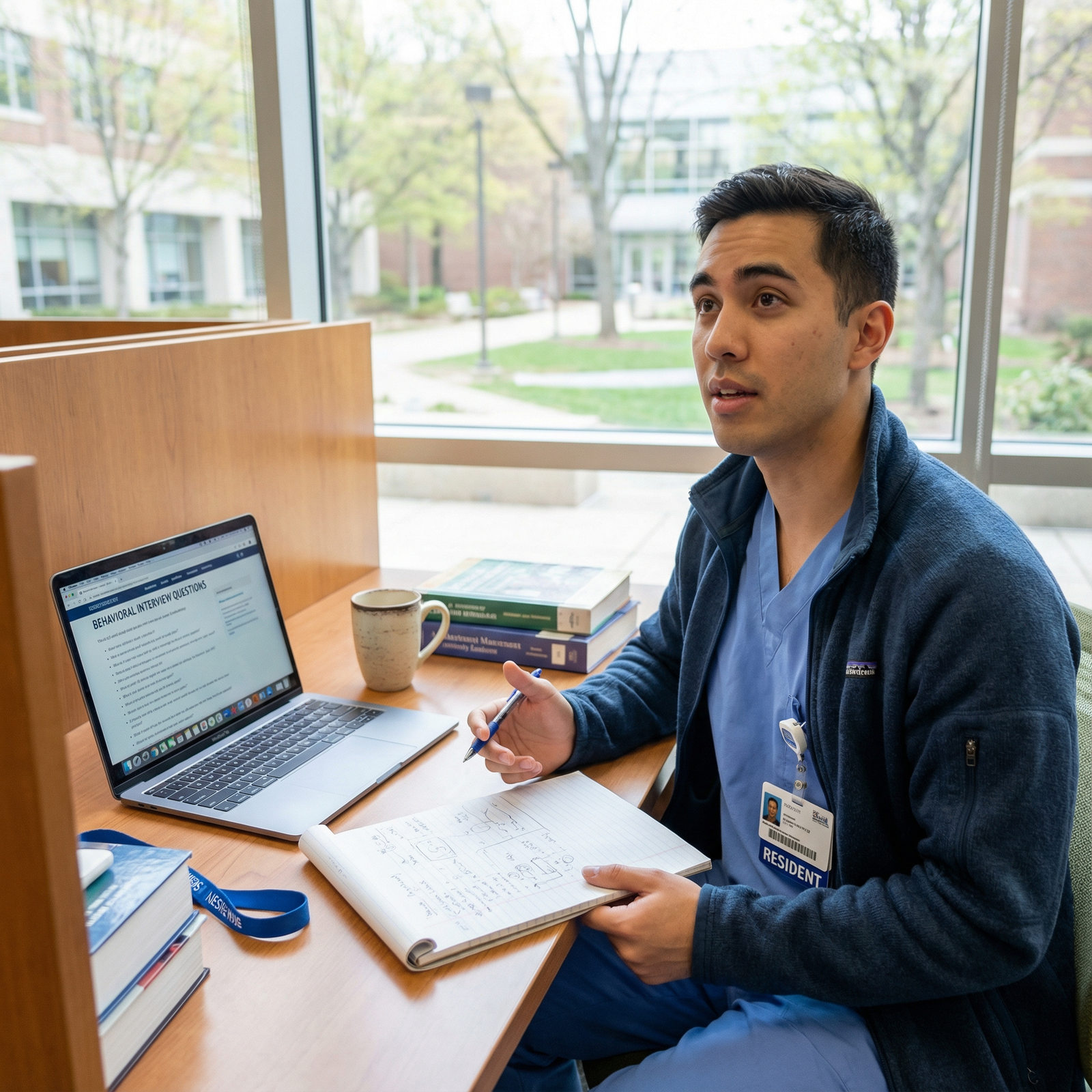
Understanding the Transitional Year Residency Interview Landscape
Transitional year residency (TY program) interviews can feel uniquely challenging. TY spots are limited, applicants come from many specialties, and programs are trying to predict not just who will be a strong intern, but who will represent their institution well across multiple departments.
Most TY interviews lean heavily on behavioral and fit-based questions rather than hyper-technical clinical grilling. Programs want to see how you think, how you work with others, and how you’ll manage a demanding but flexible intern year before starting your advanced residency.
Common themes you should expect:
- Your story and motivation (e.g., “tell me about yourself”)
- Understanding of the transitional year residency and why you chose it
- Professionalism, teamwork, and communication
- Resilience, stress management, and time management
- Fit with the culture and structure of that specific TY program
This guide breaks down the most common residency interview questions you’ll encounter in transitional year programs, outlines what programs actually want to hear, and offers concrete examples you can adapt.
Core Personal and Background Questions
These questions show up in almost every residency specialty, but have nuances in a TY program.
“Tell me about yourself”
This is often the very first question you’ll get—and it sets the tone. In a transitional year residency interview, they’re not only hearing your story; they’re asking, “Does this person have a clear path, and will they thrive in a broad-based intern year?”
Purpose of the question
- Assess your communication skills and organization
- Understand your trajectory: where you came from, where you are, where you’re going
- See if your goals align with using a transitional year as a stepping stone
Structure your answer in 3 parts
Brief background
- Where you grew up or went to college
- Medical school, maybe a few defining experiences
Core identity and interests
- Clinical interests, research, leadership, or service themes
- A few characteristics that describe how you work (e.g., collaborative, calm under pressure)
Current goals and why TY
- Your chosen advanced specialty
- Why you want a transitional year and how this specific program fits
Example answer outline
I grew up in [City] and studied [Major] at [University], where I first became interested in [clinical or service theme]. In medical school at [School], most of my time outside of class was spent on [key activities: e.g., student-run clinic, teaching, or research in your future specialty]. Clinically, I’ve been drawn to [future specialty] because of [1–2 specific, personal reasons].
I’m applying to a transitional year residency because I value a broad-based clinical foundation and the chance to work with multiple specialties before I begin [advanced specialty]. Your program’s strong [e.g., ICU exposure, ambulatory focus, procedures, night float structure] matches my goals to develop solid inpatient skills, refine my efficiency, and become a reliable member of any team I work with.
Pitfalls to avoid
- Reciting your CV chronologically
- Overemphasizing future specialty and ignoring why this TY program matters
- Going beyond 2–3 minutes
“Why a Transitional Year Residency?”
This is crucial for TY applicants. Interviewers want to make sure you’re not just applying to any internship, but that you understand the rationale for this path.
What they’re really asking
- Do you understand how a transitional year differs from a categorical program?
- Is your reasoning more than “I heard it’s easier” or “I want a lighter year”?
- Will you engage fully even though your “home” specialty is elsewhere?
Strong points to include
- Desire for broad clinical exposure across multiple specialties
- Interest in strong general medicine and inpatient skills
- Value of flexibility (electives) to tailor the year to your advanced specialty
- Commitment to being an asset to all services, not just your future field
Example answer elements
- “I want to enter [advanced specialty] with confidence managing acutely ill patients, and I see a transitional year as the best way to gain that foundation.”
- “I like the idea of rotating through several departments and learning how different teams function; that perspective is valuable in any specialty.”
- “I am looking for a year that emphasizes clinical maturity, communication, and efficiency rather than an early narrow focus.”
What to avoid
- Saying you want an “easy” year or more free time
- Suggesting TY is just something you “have to get through”
- Seeming disinterested in general medicine or inpatient care
“Why our TY program?”
Programs know you’re often interviewing at multiple institutions, but they want to hear a thoughtful answer specific to them, not generic flattery.
Research before the interview
- Rotations offered: ICU, ED, electives relevant to your advanced specialty
- Program structure: night float, call, continuity clinic
- Teaching environment: morning report, didactics, simulation
- Resident culture: camaraderie, wellness initiatives, mentoring, community
Answer structure
Program-specific details
Mention 2–3 concrete program features that matter to you.Connection to your goals
Explain how those specific aspects help you become the intern—and future specialist—you want to be.Fit and contribution
Add 1–2 sentences about how you see yourself contributing to the program.
Mini-example
I’m particularly drawn to your transitional year because of the strong ICU experience and the flexibility in electives that would allow me to tailor time in [related specialty]. The structure seems well-designed for learning to manage complex inpatients while still having space to explore my future field. I also appreciated hearing from your residents about the close relationship with faculty; I learn best in environments where feedback is frequent and collegial, and I see myself contributing to that culture as a reliable, team-oriented intern.

Behavioral Interview Questions in Transitional Year Programs
Many TY programs lean heavily on behavioral interview medical questions—designed to see how you’ve acted in real situations as a predictor of future behavior.
Use the STAR method in your answers:
- Situation – Brief context
- Task – Your role or responsibility
- Action – What you did
- Result – Outcome + what you learned
Teamwork and Communication
These are core to any intern role; almost every program will assess them.
Common questions
- “Tell me about a time you worked on a difficult team.”
- “Describe a conflict you had with a colleague or supervisor and how you resolved it.”
- “Give an example of when you had to advocate for a patient.”
What programs want
- Evidence you can collaborate respectfully
- Ability to handle conflict directly but professionally
- Willingness to speak up for patient safety and quality care
Example (difficult team situation)
- Situation: On your surgery clerkship, team communication was disorganized, and tasks were often duplicated or missed.
- Task: As the student, you were responsible for helping with pre-rounds and handoffs.
- Action: You suggested and helped implement a brief structured “task board” or shared note during sign-out to clarify responsibilities and deadlines.
- Result: Fewer missed tasks, smoother rounds, and positive feedback from residents; you learned the importance of structured communication and speaking up with concrete solutions.
Key tips
- Show humility; avoid portraying teammates purely as the problem.
- Emphasize listening, clarifying expectations, and follow-through.
- End with what you’d do even better next time.
Handling Stress, Workload, and Mistakes
TY interns often cover busy services. Programs want to know if you can hold up under pressure without burning out or compromising care.
Common questions
- “Tell me about a time you were overwhelmed and how you handled it.”
- “Describe a significant challenge or failure in medical school.”
- “Tell me about a clinical mistake you made or almost made.”
What they’re testing
- Self-awareness and emotional regulation
- Ability to prioritize and seek help
- Honesty and ownership of mistakes
- Growth mindset and resilience
Example (overwhelmed situation)
- Situation: On your internal medicine rotation, several patients decompensated simultaneously while you were post-call and behind on notes.
- Task: Help ensure care was not compromised while managing your responsibilities.
- Action: You triaged tasks with your senior, identified which patients needed immediate attention, deferred lower-priority tasks, and communicated clearly with nursing staff about response times. Later you reflected on how better pre-rounding organization might have helped.
- Result: The team stabilized all patients appropriately; you learned to communicate early when overwhelmed and to use prioritization tools (e.g., to-do lists, checklists).
When discussing mistakes
- Choose a real, non-catastrophic example.
- Emphasize your accountability (no blame-shifting).
- Focus on systems awareness (e.g., how you changed your workflow, double-check process).
- Highlight how you prevent similar issues now.
Professionalism and Ethics
Because TY interns rotate broadly, they interact with many teams and patients. Programs need to trust your professionalism across the hospital.
Common questions
- “Tell me about a time you saw something unethical and what you did.”
- “Describe a difficult interaction with a patient or family.”
- “Have you ever had to give or receive difficult feedback?”
Strong elements to show
- Respect for patients and team members
- Awareness of hierarchy without being passive
- Comfort with honest, compassionate communication
- Willingness to seek guidance when unsure
Example (difficult patient/family interaction)
- Situation: A family was upset about delays in care and raised their voices at the team.
- Task: As the student/interpreter/primary contact, you needed to de-escalate and maintain trust.
- Action: You listened without interrupting, acknowledged their frustration, clarified what had been done so far, and outlined a clear plan including what you would personally follow up on. You updated the resident and attending and helped coordinate a family meeting.
- Result: The family’s tone became more cooperative; you learned that validation and clarity can transform a tense encounter.
Motivation, Goals, and Specialty Alignment
Because TY residents are headed into a wide range of advanced specialties, programs want to understand your motivations and whether your expectations are realistic.
“Why [Your Future Specialty]?”
Even though this is a transitional year interview, they will almost always ask about your intended specialty.
Goals of the question
- Confirm that you have a genuine, thoughtful interest in your future field
- See if the TY year you’re seeking logically supports that path
- Assess if you’ll engage with rotations that relate to your long-term goals
Answer tips
- Share 1–2 specific experiences that drew you to the specialty (a patient, rotation, or mentor).
- Emphasize aspects that tie into core intern skills (communication, critical care, longitudinal care, procedures).
- Mention how the TY year will help you transition more smoothly into your advanced program.
Example elements
I’m drawn to anesthesiology because I enjoy acute physiology, hands-on procedures, and working closely with surgeons and patients in high-stakes moments. During my anesthesia elective, I liked the mix of rapid decision-making and pre-op counseling. A transitional year with strong exposure to medicine wards and the ICU will help me become more comfortable managing comorbidities and decompensations—skills I see as fundamental to being a safe anesthesiologist.
“Where do you see yourself in 5–10 years?”
They’re not looking for a rigid roadmap; they want to see direction and maturity.
Good points to include
- Becoming a competent clinician in your advanced specialty
- Interest in teaching, quality improvement, leadership, or research
- Openness to evolving interests as you gain experience
- Acknowledgment that the TY year is a foundation, not a detour
Pitfalls
- Overly grandiose answers that minimize the importance of internship (“I’ll be a world expert”).
- Sounding like you’re already done training and just need to “get through” intern year.
Questions About Your Application: Strengths, Weaknesses, and Red Flags
Most interviews will address your self-assessment and any notable features in your application.
Common questions
- “What are your strengths as a future intern?”
- “What are your weaknesses, and how are you addressing them?”
- “Can you explain this gap/leave of absence/USMLE attempt/etc.?”
Answer strategies
For strengths:
Link them to concrete behaviors: reliability, organization, communication, calm under pressure. Back them up with examples from clinical rotations or work.For weaknesses:
- Choose a real but manageable area (e.g., tendency to over-document, initial discomfort speaking up in large groups).
- Describe specific steps you’ve taken to improve.
- Show ongoing monitoring, not perfection.
For red flags:
- Be honest and concise.
- Take responsibility where appropriate.
- Emphasize what changed: study strategies, wellness, time management, support systems.
- Highlight how subsequent performance demonstrates growth.

Program-Fit and Culture Questions
Programs care deeply about fit, especially in a one-year setting where team cohesion and trust are critical.
“What are you looking for in a transitional year residency?”
This is an opportunity to communicate your priorities and show you’ve thought about the realities of the year.
Examples of reasonable priorities
- Strong general medicine and inpatient training
- Teaching and mentorship
- Exposure to specific electives that support your advanced specialty
- A supportive, collegial culture with approachable attendings
- Reasonable balance between workload and time for self-directed learning or research
Tie your preferences to patient care and your development, not just lifestyle.
“How do you handle feedback?”
Interns receive a lot of feedback; program leadership is watching for openness and non-defensiveness.
Effective answer components
- Describe a specific time you received constructive feedback.
- Share your initial reaction honestly (e.g., surprised, a bit discouraged).
- Emphasize how you reflected and changed your behavior.
- Mention how you solicit feedback proactively now.
“What do you like to do outside of medicine?”
They’re gauging:
- Whether you have healthy coping mechanisms
- If you’ll get along with peers and contribute to community
- Whether you can maintain balance in a demanding year
Be honest, and avoid joking about high-risk hobbies in a way that might raise concerns. Normal, grounded hobbies (sports, music, reading, family time, creative arts, volunteering) are all fair game.
Your Questions for the Interviewers
Programs almost always ask, “Do you have any questions for us?” This is still part of the interview; it signals your interest and preparation.
Use this time to:
- Clarify aspects of the TY program structure
- Understand their expectations for interns
- Learn about resident culture and support
Examples of strong questions
- “How would you describe the culture among the transitional year residents and between TYs and categorical residents?”
- “What qualities distinguish residents who thrive in this program?”
- “Can you tell me about how electives are scheduled and how flexible they are for aligning with advanced specialties?”
- “How does the program support wellness and prevent burnout, especially during heavier rotations like ICU or nights?”
- “What changes or improvements is the program currently working on?”
Avoid questions that:
- Are easily answered on the website
- Focus solely on perks (vacation, moonlighting) without showing interest in education
- Sound like you’re primarily concerned with minimizing work
Practical Tips for Preparing for TY Residency Interview Questions
Build a Personal Story Bank
List 8–10 specific experiences from medical school that you can draw on for residency interview questions:
- A challenging patient
- A conflict with a team member
- A situation where you were overwhelmed
- A time you made or nearly made a mistake
- A leadership or teaching experience
- A time you advocated for a patient
- An ethical or professionalism challenge
Write brief STAR outlines for each. Many different questions can be answered with variations of these core stories.
Practice Out Loud, Not Memorized
- Record yourself answering “tell me about yourself” and a few behavioral questions.
- Aim for organized but natural responses:
- 2–3 minutes for complex questions
- 60–90 seconds for simpler ones
- Avoid memorized scripts; instead, memorize structures and key points.
Prepare Specialty- and Program-Specific Angles
- Be ready to connect your answers to both transitional year goals and your future specialty.
- For each program, know:
- 2–3 specific things you like about them
- 1–2 questions you genuinely want to ask
Mock Interviews and Feedback
- Use your school’s career office, advisors, or mentors for mock interviews.
- Ask them to evaluate:
- Clarity and conciseness
- Professionalism and demeanor
- Whether your answers actually address the question asked
- Nonverbal communication (eye contact, posture, filler words)
Frequently Asked Questions
1. How different are transitional year interviews from categorical residency interviews?
Content-wise, they’re similar: you’ll face many of the same behavioral interview medical questions and classic prompts like “tell me about yourself” and “what are your strengths and weaknesses.” The main differences:
- TY interviews focus more on your future specialty plans and how the year fits into your trajectory.
- Programs often emphasize flexibility and broad training, and may ask more questions about how you’ll integrate into multiple teams.
- They may probe your understanding of what a transitional year residency entails and whether you’ll stay engaged despite rotating through specialties you’re not ultimately pursuing.
2. Will I be asked detailed clinical or specialty-specific questions?
Most TY program interviews are not heavily clinical. You might get a basic clinical question or two, but they rarely resemble an oral boards exam. The emphasis is on:
- Professionalism
- Communication
- Teamwork
- Stress management
- Fit with the program’s structure
Be ready to talk about how you think and behave under pressure rather than reciting guidelines.
3. How should I explain that TY is a backup if I prefer a categorical spot?
Be cautious here. Even if that’s true, avoid framing transitional year as a consolation prize. Instead:
- Emphasize what you genuinely value about a TY program (broad exposure, intern skills, flexibility).
- If asked directly about backup plans, you can be honest but tactful:
- “My goal is to train in [specialty], and I see both categorical and transitional year pathways as viable. If I match into a transitional year, I’ll fully commit to the program, knowing that the skills I gain will make me a stronger candidate and a better physician in any setting.”
Programs want to know you’ll engage fully for the year.
4. How can I stand out in TY interviews when everyone is from different specialties?
You stand out less by your future specialty and more by your approach to the intern role:
- Show that you value generalist skills and can work well with any team.
- Emphasize adaptability—being comfortable stepping into varied services.
- Highlight interpersonal qualities: reliability, humility, clear communication, and willingness to help peers.
- Use concrete stories that demonstrate you’re trustworthy under pressure and pleasant to work with.
If you can consistently convey, “I’ll be a solid, low-drama team member who improves the day for my colleagues and my patients,” you’ll leave a strong impression across transitional year residency interviews.
By preparing deliberately for these common transitional year residency interview questions—especially the behavioral ones—you’ll be ready to communicate your story, demonstrate your readiness for internship, and show programs that you’ll be a strong contributor during this pivotal year.