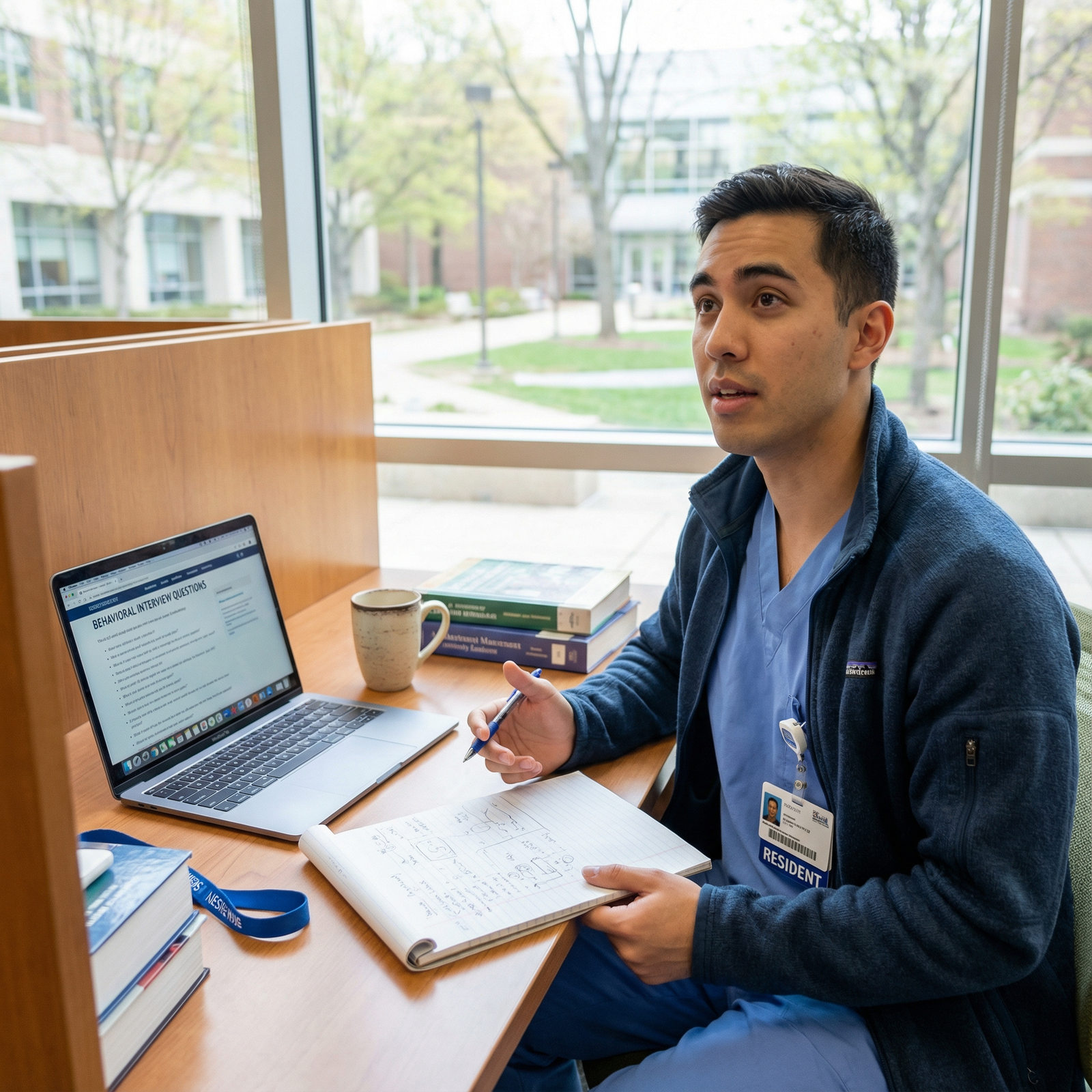
Understanding the Transitional Year Interview Landscape for Caribbean IMGs
Transitional Year (TY) programs can be highly valuable for Caribbean medical school graduates—especially if you’re planning to pursue advanced specialties like radiology, anesthesiology, PM&R, neurology, dermatology, or ophthalmology. But they are also competitive, and as a Caribbean IMG you will be scrutinized closely in the interview process.
Program directors use behavioral and situational questions to assess more than your scores: they want evidence of professionalism, resilience, teamwork, communication, and self-awareness. If you trained at SGU, AUC, Ross, or another Caribbean school, your preparation for Caribbean medical school residency interviews—especially for a transitional year residency—must be intentional and structured.
This article will walk through:
- The types of common interview questions you will likely face as a Caribbean IMG applying to TY programs
- Why each question is being asked
- How to structure high-yield, residency-level answers
- Sample responses tailored to Transitional Year and Caribbean IMGs
- Practical preparation tips and an FAQ
1. Setting the Stage: What Transitional Year Programs Look For
Before diving into questions, understand what a TY program actually wants from you. Unlike categorical internal medicine or surgery, Transitional Year is:
- A broad-based clinical year designed to build strong generalist foundations
- Often used as a preliminary year before entering an advanced specialty
- Focused heavily on:
- Clinical reliability and work ethic
- Ability to function on busy ward services
- Team-based communication
- Adaptability and professionalism
For Caribbean IMGs, program directors may also be thinking:
- Can this candidate transition smoothly into a U.S. hospital system?
- Have they demonstrated they can excel despite a non-traditional path?
- Are they dependable and low-drama, or will they need hand-holding?
That context should shape how you answer residency interview questions, especially behavioral interview medical scenarios (e.g., conflict, mistakes, stress).
2. Core Introductory Questions: Building Your Narrative
These “warm-up” questions set the frame for your entire interview. Your answers must be polished yet authentic, and clearly connect your Caribbean medical school residency journey to a transitional year residency in the U.S.
2.1 “Tell me about yourself.”
This is almost guaranteed. Programs are listening for:
- A concise, logical story (not your entire life history)
- How you connect your background → medical school → current goals
- Why a TY program fits your trajectory
Use a simple 3-part structure:
- Brief background (1–2 lines)
- Medical journey + key strengths
- Connection to Transitional Year and future goals
Sample structure (for a Caribbean IMG):
“I was born and raised in [Country], and completed my medical degree at [Caribbean School] where I developed a strong foundation in internal medicine and patient-centered care. During my clinical rotations in the U.S., I was particularly drawn to the multidisciplinary environment of hospital medicine and the chance to manage complex, undifferentiated patients.
Along the way, I’ve built strengths in communication, especially working with diverse patients and teams, and in staying organized on busy inpatient services. I’m applying for a Transitional Year because I want a rigorous, broad-based clinical year that will prepare me to be an effective resident in [your intended advanced specialty] and a dependable team member from day one.”
Avoid:
- Starting with “I was born in…” and then telling a 5-minute biography
- Repeating your CV line-by-line
- Over-focusing on test scores or defending your Caribbean education
Practice this “tell me about yourself” answer out loud until it’s smooth but not robotic.
2.2 “Walk me through your CV.”
Different from “tell me about yourself,” this is more chronological and detail-oriented.
Focus on:
- Major transitions (undergrad → Caribbean medical school → US rotations)
- Key clinical experiences that demonstrate readiness
- Briefly explaining any gaps or unusual paths
Keep it structured, ~2–3 minutes max, and emphasize progression: how you grew and what each step added to your skills.
2.3 “Why did you attend a Caribbean medical school?”
As a Caribbean IMG, this is common and sensitive. Programs are gauging:
- Insight and honesty
- Ownership of your decision
- Lack of resentment or defensiveness
High-yield approach:
- State your reason without shame.
- Highlight what you gained from the experience.
- Connect it to your readiness for residency.
Sample approach:
“I chose [Caribbean School] because I was committed to becoming a physician, and this pathway allowed me to begin my training without delay. Being in a Caribbean medical school pushed me to be very self-directed and disciplined, especially in preparing for the USMLE exams and arranging strong U.S. clinical rotations.
The experience taught me resilience, adaptability, and how to thrive in new environments—skills that I believe translate directly to being an effective and reliable transitional year resident.”
Avoid blaming, complaining, or sounding apologetic.

3. Motivation & Fit: Transitional Year–Specific Questions
Because the Transitional Year is broad and not specialty-specific, interviewers are trying to ensure:
- You’re not “hiding” or just using TY as a backup with no clear plan
- You understand what the TY year actually is (schedule, workload, goals)
- You will be engaged, not disengaged, regardless of your advanced specialty
3.1 “Why Transitional Year instead of a categorical program?”
Programs want clarity and realism.
Key points to hit:
- You value broad-based clinical training
- You see TY as a foundation year for your chosen specialty
- You are genuinely committed to working hard, not just “getting by”
Sample points:
“I’m pursuing a Transitional Year because I value strong generalist training before entering [advanced specialty]. I want a year that emphasizes inpatient medicine, team-based care, and cross-specialty exposure. I think the TY structure—with rotations in medicine, emergency, electives, and sometimes surgery—will give me a solid platform to manage complex patients, coordinate care, and communicate effectively with different services.
I’m not looking for a lighter year; I’m looking for a year that challenges me broadly so I can be an asset when I transition into my advanced residency.”
3.2 “Why our program?”
This is one of the most important residency interview questions. Generic answers are fatal.
Research beforehand:
- Program structure (medicine vs elective time, night float, ICU exposure)
- Unique features: community vs academic, diversity focus, mentorship
- Alumni match (especially relevant if they have a strong SGU residency match or history of training Caribbean IMGs)
Then connect your needs + values to what they offer:
“I’m particularly interested in your program because of the balance between inpatient medicine and elective time, and your emphasis on teaching and bedside rounds. I appreciate that your graduates have matched into strong positions in [radiology/anesthesia/etc.], which suggests a culture of mentorship for residents pursuing advanced specialties.
As a Caribbean IMG, I also value that your program has successfully trained international graduates who have integrated well into U.S. hospital systems. I feel the structure here would push me clinically while giving me opportunities to explore [field] more deeply through electives.”
3.3 “What do you want to do after your Transitional Year?”
They want reassurance you have a realistic plan.
- Clearly name your intended field (if known)
- Briefly state your reasons (1–2 sentences)
- Re-emphasize the value of TY
“After a Transitional Year, I plan to pursue an advanced residency in anesthesiology. I’m drawn to anesthesiology’s mix of physiology, acute care, and patient safety, and I’ve had several rotations that confirmed this interest. I see the Transitional Year as essential for giving me broad exposure to medicine and perioperative care that will make me a better anesthesiologist long term.”
If you’re undecided, it’s okay—but frame it thoughtfully:
“I’m currently deciding between internal medicine and neurology. A Transitional Year appeals to me because it will give me structured exposure to both, while ensuring I build strong generalist skills that are valuable in either path.”
4. Behavioral & Situational Questions: Showcasing Your Professionalism
Behavioral questions are central to the behavioral interview medical style used in many U.S. programs. They often start with:
- “Tell me about a time when…”
- “Describe a situation where…”
- “Give an example of…”
Use the STAR method for structure:
- Situation – brief context
- Task – your responsibility
- Action – what you did
- Result – outcome, what you learned
4.1 Teamwork and Communication
Sample questions:
- “Tell me about a time you had a conflict with a team member.”
- “Describe a situation where you disagreed with a senior or attending.”
- “Tell me about a time you had to give or receive critical feedback.”
What they’re assessing:
- Emotional maturity and professionalism
- Ability to work in teams without escalating conflict
- Comfort in speaking up respectfully
Example:
S: “During my internal medicine clerkship at [U.S. hospital], I worked with a senior resident who preferred limited family updates, while I noticed the patient’s family becoming increasingly anxious.”
T: “As the medical student, my task was to support the team while also advocating for clear communication with the family.”
A: “I requested a private moment with the resident and shared my concern that the family seemed confused and worried. I framed it as wanting to help the team by reducing family anxiety. The resident appreciated the feedback, and we agreed I would provide brief, supervised updates and help answer basic questions.”
R: “The family expressed gratitude for the updates, the tension on rounds decreased, and I learned how to raise concerns respectfully while still supporting team hierarchy.”
Always end with a take-home lesson that applies to residency.
4.2 Handling Mistakes and Clinical Uncertainty
Common questions:
- “Tell me about a time you made a mistake.”
- “Describe a situation where you felt overwhelmed or unprepared.”
- “Have you ever missed something important in patient care?”
Programs are checking for:
- Honesty and accountability
- Safety mindset (asking for help early)
- Ability to learn and implement changes
High-yield approach:
- Pick a real, modest but meaningful error—not something catastrophic, but not trivial.
- Own your role (no blaming).
- Explain what you changed afterward.
Example outline:
“During a busy day on my medicine rotation, I delayed following up on a pending lab for a patient with worsening renal function. It did not harm the patient because the team caught it later that day, but I realized I had underestimated the urgency of trending labs. I took responsibility, discussed it with my resident, and we reviewed strategies to better track critical labs. Since then, I’ve developed a checklist system and prioritize follow-up on any abnormal or potentially dynamic labs early in the day. This experience reinforced for me the importance of vigilance and systems to prevent errors, especially in a busy inpatient environment.”
Never say, “I’ve never made a mistake.” That is not credible.
4.3 Stress, Burnout, and Resilience
Sample questions:
- “Tell me about a time you were under significant stress and how you handled it.”
- “Residency is demanding. How do you prevent burnout?”
- “What do you do when you feel overwhelmed?”
They want evidence you:
- Recognize stress
- Use healthy coping strategies
- Don’t become unsafe when tired or overwhelmed
Example:
“During my dedicated USMLE Step preparation, I was studying long hours while also balancing a family obligation. I noticed my concentration dropping, and my anxiety increasing. I created a structured schedule that built in regular exercise, short breaks, and one ‘off’ evening per week. I also reached out to a mentor to adjust my study plan realistically. This approach helped me stay productive without burning out. In clinical settings, I use similar strategies—prioritizing tasks, communicating early when I need help, and ensuring I take short breaks when appropriate to maintain patient safety.”
As a Caribbean IMG, you can highlight the resilience it took to adapt to a new system, move countries, and pass exams—without presenting yourself as a victim.
4.4 Ethics and Professionalism
Common prompts:
- “Tell me about an ethical dilemma you encountered.”
- “Have you ever seen something you felt was unprofessional?”
- “What would you do if you saw a colleague cutting corners?”
They are assessing your judgment, courage, and respect for process.
High-yield themes:
- Protect patient safety and dignity
- Address issues at the most appropriate level (direct if safe, escalate if needed)
- Document and follow institutional channels when serious
You don’t need a dramatic case. A realistic, moderate example with thoughtful reflection is best.

5. Caribbean IMG–Specific Concerns: Gaps, Scores, and Red Flags
As a Caribbean graduate, you will likely face more detailed questions about your application. Anticipate them and prepare clear, confident responses.
5.1 “Can you explain this gap in your timeline?”
Honesty + structure:
- State the reason (illness, family, visa, exam prep, research, personal issue).
- What you did during that time (studying, caring for family, volunteering).
- What you learned/how you ensured you stayed clinically engaged.
Avoid over-explaining or sounding defensive.
5.2 “You have multiple attempts / lower scores. What happened?”
This can be uncomfortable, but programs care more about:
- Insight
- Improvement
- Reliability moving forward
Do:
- Briefly state the cause (poor test strategy, adjustment to system, personal stressors).
- Take responsibility, not excuse.
- Emphasize specific steps you took to improve.
- Point to improved performance (later exams, clinical evaluations).
Example outline:
“I did not pass Step 1 on my first attempt. Looking back, I underestimated the exam and did not use question banks effectively. I took responsibility for that, and I completely restructured my approach: I used [specific resource], completed full question banks, tracked my performance, and sought mentorship from residents. As a result, I passed on my second attempt with a significantly higher score and later scored [better performance] on Step 2. The experience taught me how to identify weaknesses early and systematically address them—skills I have since applied to my clinical work as well.”
5.3 “How do you think your Caribbean training prepared you for a U.S. transitional year?”
Highlight:
- Strong exposure to diverse pathologies
- Need for self-directed learning
- U.S. clinical rotations integrated into later years
- Adaptability and cultural humility
“My training at [Caribbean School] required a high degree of independence and self-direction, especially in mastering core sciences and preparing for USMLE exams. During my U.S. clinical rotations, I adapted quickly to different hospital systems and EMRs, and consistently received feedback for being prepared and reliable. The combination of rigorous exam preparation and real-world U.S. clinical experience has prepared me to step into a Transitional Year role where I can handle a high patient load, communicate effectively with teams, and continue learning actively.”
6. Classic Residency Questions You Must Be Ready For
Regardless of specialty, there are “must-know” questions for every Caribbean medical school residency interview. As a TY applicant, tailor your responses to highlight generalist skills.
6.1 “What are your strengths?”
Choose 2–3, and back them up with examples:
- Strong work ethic and reliability
- Communication skills with patients and teams
- Organization and time management on busy services
- Adaptability to new environments (key for Caribbean IMGs)
Tie each to Transitional Year demands:
“One of my strengths is staying organized on busy inpatient services. During my internal medicine rotation at [Hospital], I handled multiple patients, kept a running to-do list, and prioritized tasks based on acuity. My attendings commented on my ability to stay calm and systematic. I think this will be essential in a Transitional Year program where patient volume can be high and responsibilities broad.”
6.2 “What is your biggest weakness?”
Avoid clichés (“I’m too much of a perfectionist”) unless you can make them real and specific.
Structure:
- Real but non-fatal weakness
- Concrete steps you’re taking
- Evidence of progress
“I tend to be very detail-oriented, and early in my training I sometimes spent too long on individual notes, which impacted my efficiency. Recognizing this, I started using templates wisely, focusing my notes on key clinical decisions, and asking residents how they balance thoroughness with time. Over my last few rotations, my feedback has reflected improved efficiency without compromising quality, and I continue to work on this with each new rotation.”
6.3 “Why should we rank you highly?”
This is your closing pitch.
Include:
- Your work ethic and reliability
- Your team contributions
- Your alignment with the program’s goals
- Your long-term aspirations
“You should rank me highly because I bring a strong work ethic, proven resilience as a Caribbean IMG, and a genuine commitment to patient-centered care. I have thrived in diverse clinical environments and consistently been seen as a dependable team member. I’m looking for a Transitional Year where I can contribute fully to a busy clinical service while continuing to grow, and I see your program as an ideal fit for that. I’m confident I would represent your program well in my future advanced specialty and as part of your alumni network.”
FAQs: Transitional Year Interview Questions for Caribbean IMGs
1. How can I best prepare for behavioral interview questions as a Caribbean IMG?
- Make a list of 8–10 core experiences: a mistake, a conflict, a stressful period, a leadership moment, a time you helped a struggling teammate, etc.
- For each, write a STAR outline (Situation, Task, Action, Result).
- Practice out loud with a friend, mentor, or recorded sessions.
- Focus on U.S. clinical examples when possible, as they’re most relatable to interviewers.
- Reflect on how your Caribbean background shaped your resilience and adaptability and weave that into your stories.
2. Are there any Transitional Year–specific residency interview questions I should expect?
Yes, you’re likely to be asked:
- Why TY vs categorical?
- What do you plan to do after your TY?
- How will you use elective time?
- How do you feel about doing a lot of inpatient medicine or night shifts?
Prepare answers that show:
- You understand the TY structure and workload
- You’re not searching for an “easy year”
- You have a clear plan to maximize the year for your future specialty
3. How important is it to discuss my intended advanced specialty during TY interviews?
Very important. TY programs want to know:
- You have a realistic long-term goal
- You won’t disengage because “this is just one year”
- You understand how generalist skills support your specialty
You don’t need every detail figured out, but you should articulate either:
- A clear specialty (e.g., radiology, anesthesia, neurology) and how TY supports it, or
- A focused set of options with a rationale for why TY is good preparation.
4. Do Caribbean IMGs get judged differently in interviews compared to U.S. grads?
Program directors do often scrutinize Caribbean IMGs more closely due to variability in training environments and historical match data. However, many programs also value the resilience, diversity, and determination IMGs bring.
You can counter implicit concerns by:
- Showing polished, fluent communication
- Demonstrating understanding of the U.S. healthcare system
- Highlighting strong U.S. clinical evaluations and letters
- Giving thoughtful, structured answers to interview questions
- Presenting your Caribbean path as a source of strength, not deficiency
Focused preparation for these common interview questions—with special attention to behavioral scenarios and thoughtful explanations of your Caribbean background—will significantly strengthen your performance in any transitional year residency or TY program interview. Aim to be concise, reflective, and specific, and treat every question as a chance to show you’re ready to be a reliable, team-oriented intern from day one.