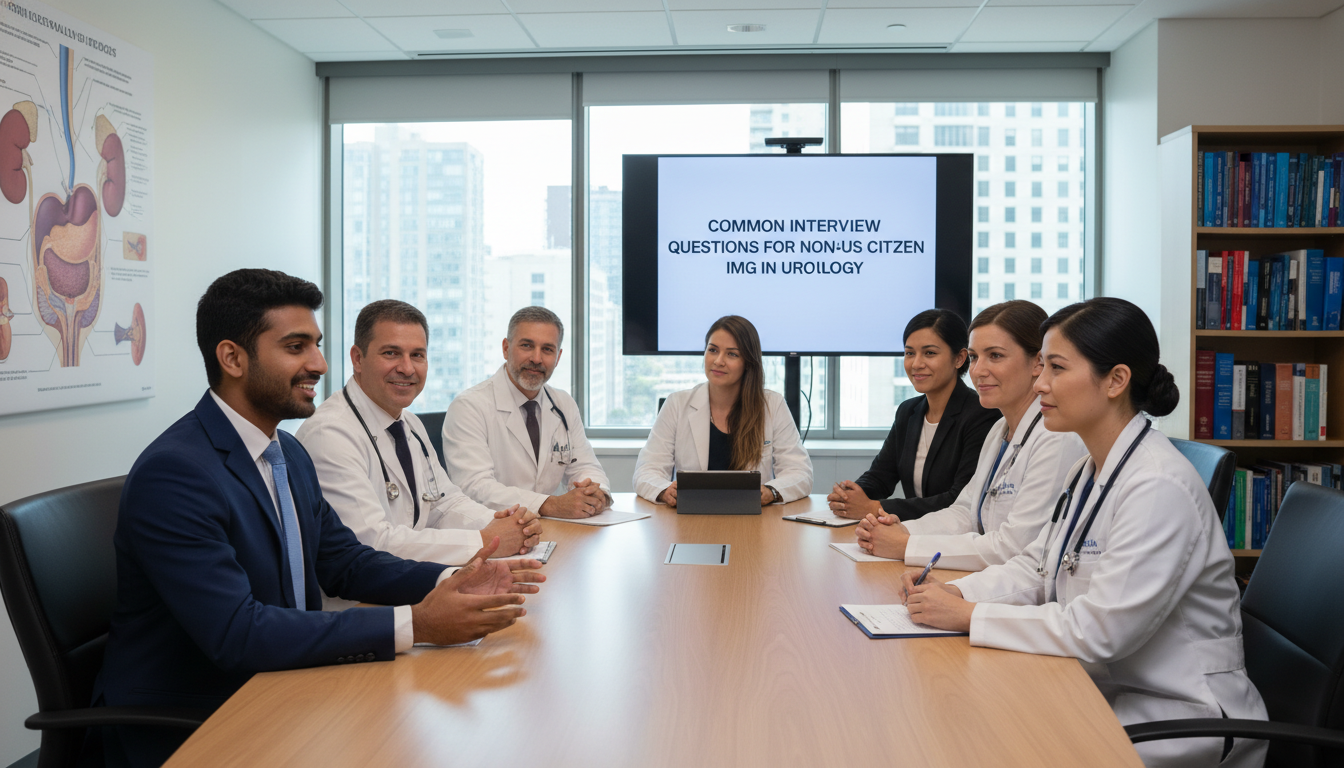
Understanding the Urology Residency Interview as a Non‑US Citizen IMG
For a non‑US citizen IMG (international medical graduate), the urology residency interview in the United States is both a test of your qualifications and your ability to integrate into a new healthcare system. The urology match is competitive for everyone, but you face additional scrutiny related to:
- Visa status and long‑term plans
- Clinical exposure to US healthcare
- Communication and cultural fit with the team
- Perceived readiness for a surgical, procedure‑heavy specialty
Most programs will not differentiate their formal questions for IMGs versus US graduates—but how they interpret your answers will be different. Understanding the most common urology residency interview questions, especially behavioral interview medical questions, will help you answer strategically and confidently.
Below, you’ll find:
- The most common question categories
- Sample answers tailored to a foreign national medical graduate
- How to highlight your strengths as a non‑US citizen IMG
- Red flags to avoid and ways to recover if you get stuck
Core Personal Questions: “Tell Me About Yourself” and Beyond
These questions are designed to understand who you are, your motivations, and how you’ll fit into the culture of a urology program.
1. “Tell me about yourself.”
This is almost guaranteed. It also sets the tone for the entire interview. Many non‑US citizen IMGs either give their full CV chronologically or start reciting personal history with too much detail.
Goal of the question:
- Assess your communication clarity
- See how you prioritize information
- Get a sense of your professional identity and story
Structure your answer (3–4 minutes):
- Present: Who you are now in one line
- Past: Key experiences that shaped your interest in urology and US training
- Urology focus: Why urology specifically
- Future: What you hope to do in residency and beyond
Example (non‑US citizen IMG–focused):
“I’m a foreign national medical graduate from India, currently completing a research fellowship in endourology at [US institution]. During my clinical rotations in medical school, I was drawn to the combination of surgery, technology, and long‑term patient relationships in urology.
After graduation, I spent one year working in a resource‑limited government hospital, where I saw patients presenting late with advanced urologic cancers and obstructive uropathy. That experience motivated me to pursue formal urology training in the US where I could learn minimally invasive techniques and evidence‑based management.
Over the past year, I’ve focused on building a strong foundation for urology residency—completing observerships in US academic centers, participating in urology‑specific research, and improving my communication skills with patients in English.
Looking ahead, I hope to train in an academic urology program like yours where I can become an excellent clinician‑surgeon, contribute to research in endourology, and eventually serve as a bridge between US and international urology training programs.”
Tips for non‑US citizen IMGs:
- Mention your country of origin briefly, but focus on what’s relevant to urology and US training.
- Show that your decision to pursue urology residency in the US is intentional, not just “because the US is better.”
- Avoid overly personal details (family history, politics, financial hardship) unless directly relevant to your journey and presented professionally.
2. “Why urology?”
Programs want to know you are committed to this field and not simply choosing any surgical specialty.
Components of a strong answer:
- A specific clinical or personal story that sparked your interest
- What you enjoy about day‑to‑day urology practice (not just “surgery is cool”)
- Alignment between your strengths and what urology requires
Example answer:
“My first exposure to urology was during my internship, when I assisted with the care of a young man with obstructing ureteric stones and sepsis. I was struck by how rapidly the urology team intervened and completely changed the trajectory of his illness within hours.
As I saw more cases, I realized urology uniquely combines minimally invasive surgery, evolving technology like lasers and robotics, and longitudinal care for chronic conditions such as BPH and incontinence. I enjoy the mix of clinic, OR, and procedures, and I like that urologists often build long‑term relationships with patients.
My strengths—manual dexterity, a systematic approach to problem‑solving, and comfort with technology—fit well with urology. Through my endourology research fellowship, this interest has only grown. I find satisfaction in performing detailed, precise work and seeing clear outcomes for patients, which is why I’m committed to a career in urology.”
Common pitfalls:
- Being vague: “I like surgery and procedures” (so do many specialties).
- Overemphasizing lifestyle; urology does have favorable aspects, but programs want to hear passion for the work, not just for hours or income.
- Not linking your skills and experiences to urology specifically.
3. “Why do you want to train in the United States?” (IMG‑specific)
As a non‑US citizen IMG, you’ll almost always be asked this directly or indirectly.
What they’re really asking:
- Are you choosing the US for thoughtful educational reasons?
- Do you understand the US healthcare system and training differences?
- Are you likely to commit to the length and intensity of residency?
Sample answer:
“I want to train in the United States because of the structured, rigorous residency training and the strong emphasis on evidence‑based medicine. In urology specifically, the US has been at the forefront of minimally invasive techniques, robotic surgery, and clinical trials that shape global guidelines.
During my observerships and research experience here, I’ve seen how multidisciplinary cancer care is organized, how residents are supervised yet given progressive responsibility, and how patient safety and quality improvement are integrated into daily practice. This is a model of training I haven’t seen to the same extent in my home country.
My goal is to become a well‑rounded urologist who can practice at an international standard. Training here will allow me to gain skills and perspectives that I can carry throughout my career—whether I stay in the US long term or eventually build collaborative programs with institutions in my home country.”
Avoid answers that suggest you are here mainly for immigration reasons or to “leave your country.” Focus on training quality, structure, and opportunities.

Behavioral Interview Questions: How You Think, React, and Work With Others
Behavioral interview medical questions are designed around the idea that past behavior predicts future performance. They usually start with:
- “Tell me about a time when…”
- “Describe a situation where…”
- “Give an example of…”
Use the STAR method in your answers:
- Situation – Brief context
- Task – Your role or goal
- Action – What you did (focus here)
- Result – Outcome and reflection
4. “Describe a time you faced a conflict on a team.”
Urology is a team sport. Programs want to see emotional intelligence and professionalism, especially from a foreign national medical graduate adapting to new cultures.
Strong answer components:
- Avoid personal attacks; stay neutral and professional
- Show that you listened, clarified, and communicated
- Emphasize resolution and what you learned
Sample answer:
“During my internship, I was part of a surgical team managing a patient with hematuria and possible bladder tumor. The senior resident and I disagreed about the timing of cystoscopy; I felt it was urgent due to ongoing blood loss, while he preferred to wait for additional labs and imaging.
I requested a few minutes to discuss the case privately. I explained my concerns about the patient’s dropping hemoglobin and he shared his reasoning, including the patient’s comorbidities and need for anesthesia clearance. We realized we had both focused on different risks.
We agreed to urgently involve the attending, presenting both perspectives clearly. The attending decided to proceed with cystoscopy that day but with additional precautions. The discussion remained professional, and later the resident thanked me for raising my concerns respectfully.
This experience taught me the importance of speaking up for patient safety, while also acknowledging hierarchy and collaborating rather than confronting.”
5. “Tell me about a time you made a mistake.”
This often worries IMGs, who fear that admitting mistakes will harm them. But denying any mistake appears unrealistic and defensive.
What they’re looking for:
- Honesty and accountability
- Capacity for self‑reflection
- Evidence you changed behavior to prevent recurrence
Example answer (moderate‑impact mistake, not catastrophic):
“During my early clinical years, I once failed to follow up timely on a patient’s abnormal renal ultrasound that showed hydronephrosis. I had ordered the study but became busy with other tasks and assumed someone else had checked it. The delay was discovered at the next clinic visit when the patient reported worsening flank pain.
I immediately informed my supervising physician, apologized to the patient, and helped arrange urgent urology referral and further imaging. Fortunately, there was no permanent damage, but the situation could have been serious.
I learned the importance of owning the entire process when I order tests. Since then, I’ve implemented a personal system: tracking tests in a log, setting reminders, and verifying results before closing the loop. In my US observerships and research position, I’ve applied a similar approach to ensure I follow up on pending labs, imaging, and tasks.”
Avoid describing major ethical violations or life‑threatening negligence. Use an example that shows real error but also responsible recovery.
6. “Tell me about a time you worked with someone from a very different background.”
As a non‑US citizen IMG, this is a chance to show cultural competence and adaptability.
Key elements:
- Show you can work effectively within diverse teams
- Demonstrate respect for others’ perspectives and communication styles
- Relate to how this will help you in a US urology residency
Sample answer:
“In my research fellowship, I worked on a multicenter urology study with team members from several countries, including the US, Brazil, and Germany. One of my co‑investigators had a very direct communication style, which initially seemed abrupt to me compared to what I was used to in my home culture.
Instead of reacting negatively, I scheduled a brief video call to clarify expectations. I shared how I usually work and asked about their preferred way of communication. We agreed to give each other direct feedback but also to include brief context so written messages wouldn’t sound too harsh.
Over time, we developed a productive collaboration and completed the manuscript ahead of schedule. This experience taught me not to interpret different communication styles as personal criticism, and to proactively align expectations when working in diverse teams. I believe this will help me a lot in a US residency, where colleagues and patients come from many backgrounds.”
Urology‑Specific and Clinical Questions: Showing You’re Ready for the Field
Even though you are not yet a urologist, programs want to gauge your clinical reasoning, exposure to urology, and commitment.
7. “Tell me about a urology patient that made a strong impact on you.”
Choose a case that:
- Involved meaningful decision‑making, communication, or follow‑up
- Reflects urology’s core aspects (oncology, stones, BPH, incontinence, infertility, etc.)
- Allowed you to demonstrate empathy and reflection
Sample answer:
“One patient who impacted me deeply was a 52‑year‑old man I saw during my observership who presented with gross hematuria and was ultimately diagnosed with muscle‑invasive bladder cancer.
I observed the attending counsel him about treatment options, including radical cystectomy and urinary diversion. The patient was very anxious about how this would change his body image and social life. The urology team spent time explaining the procedure, possible complications, and life after surgery, even arranging for him to meet another patient living with a stoma.
I was struck by how much of urology involves not only surgery but also guiding patients through life‑changing decisions. It reinforced that I want to be a urologist who not only operates but also supports patients emotionally and helps them maintain quality of life.”
Avoid overly technical detail; focus on your role, your learning, and what it meant for your career choice.
8. “What areas of urology interest you most?” / “Do you see yourself doing a fellowship?”
You’re not expected to have a final answer, but many urology programs appreciate a candidate who has begun to explore subspecialty interests.
Relevant urology areas:
- Endourology / stone disease
- Urologic oncology
- Reconstructive urology
- Andrology / infertility
- Female pelvic medicine and reconstructive surgery (FPMRS)
- Pediatric urology
Sample balanced answer:
“At this stage, I’m open to all areas of urology and I understand residency is the time to get broad exposure. Based on my current experiences, I’m particularly interested in endourology and stone disease, because I enjoy minimally invasive procedures and the rapid relief they can provide patients.
I also find urologic oncology meaningful, especially the combination of surgery and long‑term survivorship care. I could see myself pursuing a fellowship if, during residency, I find a field where I’m especially passionate and can contribute academically.
That said, my first priority is to become a strong general urologist with solid surgical and clinical skills.”
Programs worry if you appear too rigid (e.g., “I only want robotics and nothing else”) or if your fellowship plan seems unrealistic (e.g., “I must do peds urology at one specific famous program or nothing”).
IMG‑Specific Concerns: Visa, Adaptation, and Perceptions
Programs may not always ask directly about these topics, but you should anticipate and prepare.
9. “What challenges do you anticipate as a non‑US citizen IMG in residency?”
Use this to show insight and preparation, not anxiety.
Example answer:
“I anticipate that adapting to the pace and documentation requirements of the US healthcare system will be a challenge initially, especially with electronic medical records and billing details. I also expect there will be subtle cultural differences in how patients express concerns or expectations.
To prepare, during my observerships and research work, I’ve familiarized myself with common EMR workflows, clinical abbreviations, and typical progress note structures. I’ve also taken communication skills courses and sought feedback from US physicians on my patient interactions.
I know there will be a learning curve, but I’m used to adapting quickly; moving from my home country to the US for research required the same flexibility. I’m comfortable asking questions and I appreciate structured feedback, which I believe will help me integrate well into a residency program.”
Avoid saying “no challenges” (appears naïve) or focusing heavily on visa stress during this answer.
10. “What are your visa needs and long‑term plans?”
This is very common for a non‑US citizen IMG. Be brief, clear, and confident.
Approach:
- State your required visa type if you know (often J‑1 or H‑1B eligible).
- Emphasize commitment to complete residency.
- For long‑term plans, be honest but flexible (e.g., academic vs community, US vs home country).
Sample answer:
“I will require visa sponsorship to train in the US and I am eligible for both J‑1 and H‑1B, depending on the program’s policy. My immediate goal is to complete a full urology residency and, if possible, a fellowship in the US.
In the long term, I see myself working in an academic environment with a mix of clinical care, teaching, and research. I’m open to where that will be geographically. Because of my background, I’m interested in eventually building partnerships between US centers and hospitals in my home country, but my first priority is to become an excellent urologist through high‑quality US training.”
Never argue with the program’s stated visa policy during the interview. If they say they cannot sponsor a certain visa type, acknowledge it professionally.
Common “Fit” Questions and How to Handle Them
11. “Why our program?” / “What are you looking for in a urology residency?”
You’ll get some version of this in nearly every interview.
Prepare by researching:
- Case volume, subspecialty strengths
- Research opportunities and recent publications
- Unique aspects (early OR exposure, mentorship, resident wellness, robotics volume)
Sample answer:
“From my research and conversations with your residents, what stands out about your program is the combination of strong surgical volume—especially in endourology and oncology—and the close faculty–resident relationships.
I’m looking for a residency that will challenge me technically but also support my development as an educator and researcher. I appreciate that your residents start hands‑on experience in the OR early, and that you have structured opportunities for outcomes research in stone disease and minimally invasive surgery.
As a non‑US citizen IMG, I also value the diversity of your patient population and the fact that you’ve successfully trained other IMGs who are now in academic positions. I believe this environment would allow me to grow into a confident, compassionate urologist.”
Avoid generic phrases that could apply to any program (“great training,” “nice city”) without specifics.
12. “What are your strengths and weaknesses?”
Use 2–3 relevant strengths, and 1–2 genuine but manageable weaknesses.
Example strengths (tailored to urology):
- Strong work ethic and reliability
- Technical skills / manual dexterity
- Calm under pressure (emergencies, OR)
- Cross‑cultural communication
Example weaknesses (with improvement plan):
- Over‑preparation, difficulty delegating
- Initial hesitancy to speak up in large groups
- Need to work on speed of documentation
Sample answer:
“My main strengths are my work ethic, attention to detail, and ability to stay calm under pressure. During my surgical rotations and urology research, I’ve been consistently reliable with patient follow‑up and data collection, and I’ve received feedback that I maintain composure in stressful situations, which I know is important in the OR and during emergencies.
A weakness I’ve been working on is that I can be hesitant to speak up in large group settings, especially when I first join a new team. In the past year, I’ve deliberately pushed myself to present at lab meetings and to ask more questions during conferences, and I’ve noticed that as I prepare more and gain familiarity with the group, my confidence improves. I plan to continue developing this skill during residency so I can fully contribute to discussions and advocate effectively for my patients.”
Avoid cliché non‑weaknesses like “I work too hard” or “I care too much.”
Practical Preparation Tips for Non‑US Citizen IMGs
To succeed with these common urology residency interview questions:
Create a story bank:
- Write down 8–10 clinical or professional experiences (team conflict, mistake, leadership, research project, difficult patient, cross‑cultural interaction).
- Practice telling each story using the STAR method.
Record yourself answering “tell me about yourself.”
- Aim for 3–4 minutes.
- Check for clarity, pacing, and whether you emphasize your identity as a motivated, thoughtful future urologist.
Practice behavioral questions out loud with peers or mentors.
- Especially critical if English is not your first language.
- Focus on simple, clear sentences rather than complex vocabulary.
Prepare 3–4 thoughtful questions to ask the program:
Examples:- “How do you support residents who are interested in a particular subspecialty like oncology or endourology?”
- “What qualities have you seen in your most successful residents?”
- “How is feedback typically given to residents, and how often?”
Be ready for small talk and informal questions:
- “What do you like to do outside of medicine?”
- “How do you deal with stress?”
- “What have you enjoyed most about living in the US so far?”
These are opportunities to show you’re a well‑rounded person who will be pleasant to work with during long call nights and in the OR.
FAQ: Urology Residency Interview Questions for Non‑US Citizen IMGs
1. Will I be asked different residency interview questions because I’m a non‑US citizen IMG?
Most structured interview questions are similar for all applicants, but as a non‑US citizen IMG you are more likely to be asked about:
- Your visa needs and eligibility
- Your reasons for pursuing US training
- How you will adapt to the US healthcare system and culture
Prepare well for standard questions like “tell me about yourself” while also having clear, honest answers about your background and plans.
2. How should I address limited US clinical experience in interviews?
Be transparent but focus on what you have done to compensate:
- Observerships, research, or externships in the US
- Efforts to learn EMR workflows, documentation, and US healthcare structure
- Strong letters from US‑based faculty when possible
If asked directly, you can say:
“Although my direct clinical experience in the US is limited to observerships, I have made the most of those opportunities by focusing on communication, documentation, and systems‑based practice. I’m eager to expand that experience in a structured residency.”
3. What if I don’t understand a question because of accent or wording?
It is completely acceptable to ask for clarification. For example:
- “I’m sorry, could you please repeat or rephrase the question?”
- “Just to make sure I understand, you’re asking about a time I dealt with conflict with a colleague, correct?”
Programs prefer clear communication over guessing and giving an unrelated answer. This also shows professionalism and self‑awareness.
4. How can I stand out positively as a foreign national medical graduate in a competitive urology match?
You stand out by combining:
- A coherent story of why you chose urology and US training
- Evidence of resilience, adaptability, and work ethic
- Specific examples of teamwork, integrity, and patient‑centered care
- Clear, well‑structured answers to common behavioral and clinical questions
Being a non‑US citizen IMG can be a strength—highlight your diverse perspective, cross‑cultural experience, and motivation to contribute to both US and global urology. With thoughtful preparation and honest reflection, you can turn the interview into an opportunity to show you are exactly the kind of resident programs want on their team.