
The way most people talk about academic promotion tracks is misleading. You are not choosing a “label.” You are choosing what kind of work you will be rewarded for over the next 10–20 years.
Let me break that down specifically.
The Three Big Tracks: What You Are Actually Signing Up For
Every institution has its own jargon, but almost all U.S. academic medical centers boil down to three dominant tracks:
- Tenure / Tenure-eligible (sometimes called “Professor of X,” ladder faculty)
- Clinician-Educator / Clinical Track (titles often with “Clinical” in them)
- Research Track (sometimes “research faculty,” “scientist track,” or “non-clinical tenure”)
There are others—adjoint, affiliate, instructor, volunteer—but those are side streets. The real career-defining decision is between these three.
At a practical level, each track is a different answer to three questions:
- What work dominates your week (clinic, teaching, or funded research)?
- What will your promotion committee count as “real” accomplishment?
- How much job security can you expect if things go sideways?
You cannot pick all three. Institutions pretend you can “do it all.” You cannot. Not at a high level, and not for long.
| Feature | Tenure / Ladder | Clinical / Clinician-Educator | Research Track |
|---|---|---|---|
| Main currency | Grants + papers | Teaching + clinical metrics | Grants + papers |
| Typical effort mix | 50–80% research | 60–90% clinical/teaching | 75–95% research |
| Job security ceiling | Highest (once tenured) | Moderate, productivity-based | Low–moderate, grant-based |
| Primary evaluator | Promotion committee | Dept. chair + promo committee | Promotion committee + PI |
| Common title wording | Professor of X | Clinical Professor of X | Research Professor of X |
Nothing about this is neutral. Each track has built-in constraints that will shape:
- How your chair assigns your time
- What your colleagues expect you to produce
- How you are judged when your promotion packet goes forward
Let’s take them one by one.
Tenure Track: High Risk, High Reward, High Grind
Tenure track sounds prestigious. For many departments it is also the most unforgiving track.
What tenure track really means
You are being hired with the expectation that you will become a nationally recognized, independently funded expert in a focused area within a fixed time window (often 6–9 years to promotion/tenure review).
The committee does not care how “busy” your clinic is. It cares whether you can sustain a funded research program and produce peer-reviewed work that other people actually cite.
Typical expectations by the first major review (associate professor with tenure, or tenure decision):
- Sustained extramural funding
- For physician-scientists: usually at least one major grant as PI (e.g., NIH R01, VA Merit, equivalent foundation grant).
- For PhD scientists: often multiple major grants and clear evidence of renewal likelihood.
- Publication record
- Consistent first- or senior-author publications in peer-reviewed journals in a coherent theme.
- Total number matters less than impact and trajectory.
- National reputation
- Invited talks, committee service, guideline panels, leadership roles in professional societies.
- Recognizable name in your niche when your external reviewers read your CV.
Typical time allocation
Most ladder/tenure-track physician-scientists end up around:
- 50–80% protected research
- 10–30% clinical
- 10–20% teaching/administration
If you are doing 60–70% clinical on a “tenure” contract, something is off. Either the department is not serious about your tenure, or you are being set up to fail. I have watched that movie; it ends with a “non-renewal” conversation and a sudden interest in community practice jobs.
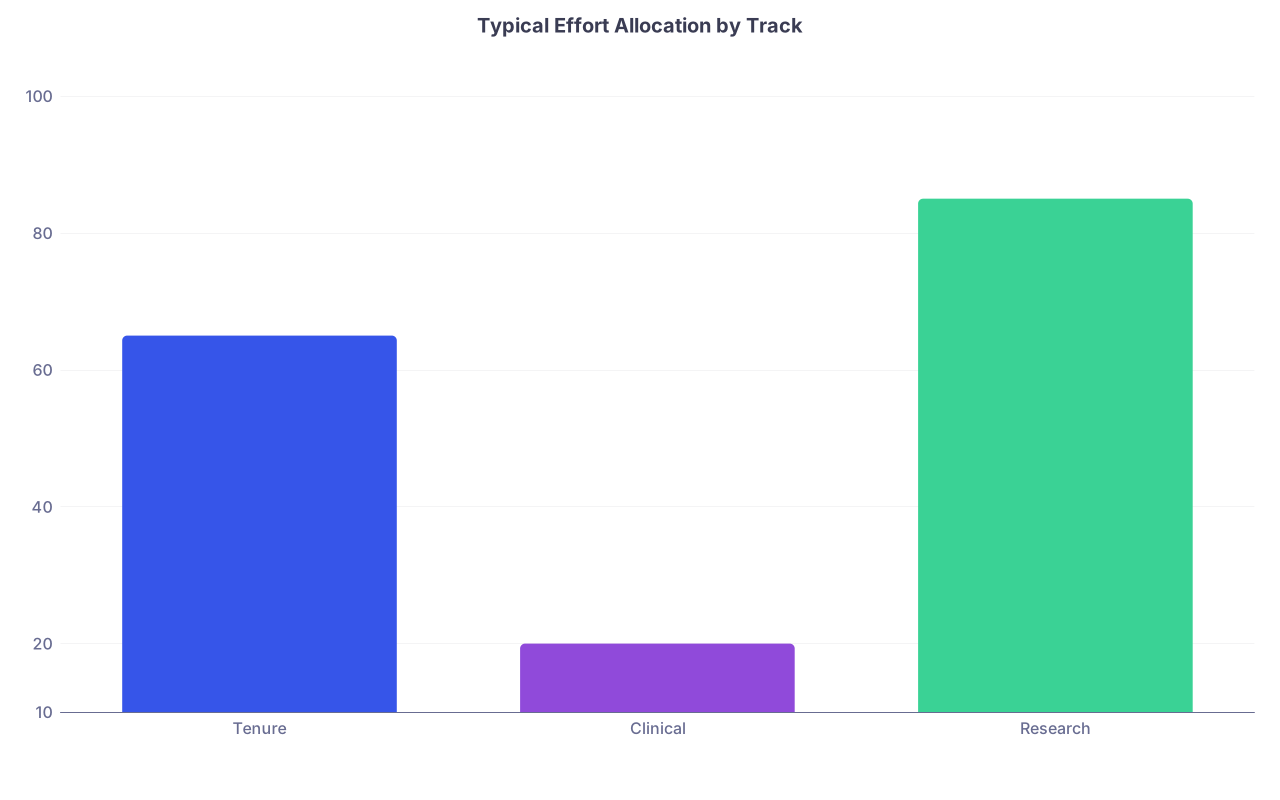
| Category | Value |
|---|---|
| Tenure | 65 |
| Clinical | 20 |
| Research | 85 |
(Think of those numbers as approximate research effort percentages.)
How tenure decisions are actually made
Promotion committees look at three things, in this order:
External letters
Do recognized leaders in your field call you “one of the top emerging investigators in X” or do they write a bland paragraph about how you “have potential”? That difference is fatal.Grants and funding history
Not just “Did you ever get a grant?” but “Is there a credible path to continuous funding for the next decade?”Publications and impact
Bibliometrics are annoying but real: h-index, citation counts, journal reputation, consistency.
Teaching and clinical work are usually “threshold” criteria: be competent, not terrible, have good evaluations. They rarely rescue a weak research record on a true tenure-track.
Who should choose tenure track
You are a good fit for tenure/ladder track if:
- You already have serious research momentum: e.g., productive fellowship, K award, or first major grant submitted or scored.
- You like writing grants more than you hate them.
- You are willing to say “no” to extra clinical sessions and committee work to protect your research time. Repeatedly.
- You can tolerate uncertainty for 6–9 years.
If you are passionate about teaching residents, love clinics, and have never submitted a grant, tenure track is probably a bad bet. No matter what flattering things your chair says at recruitment.
Clinical / Clinician-Educator Track: The Workhorse Path
If tenure track is about grants, the clinical/clinician-educator track is about service and teaching. This is where most academic physicians actually live.
The problem is many people slide into this track by default, without understanding how promotion works here. Then they sit at assistant professor for 15 years and wonder why nothing moves.
What this track prioritizes
Your main deliverables are:
- Clinical productivity (RVUs, access, patient satisfaction, quality metrics)
- Educational contributions (direct teaching, curriculum roles, mentoring, program leadership)
- “Service” in a broad sense (committees, operations work, quality improvement, sometimes community outreach)
Research is optional and often undervalued in formal criteria unless you are in a very academic-heavy department. A few outputs are nice. A full research portfolio is not expected.
Typical effort split
Varies by institution and specialty, but a typical clinician-educator appointment:
- 60–90% clinical work
- 10–30% teaching and education leadership
- 0–20% scholarly / admin (QI projects, educational scholarship, small studies)
Some places rebrand this as “Clinical Scholar” or “Academic Clinician.” Ignore the title; look at the FTE table in your contract.
Promotion criteria that actually matter
For promotion to associate professor on a clinical track, committees look for:
Clinical excellence
- Strong evaluations from patients and peers.
- Often some evidence of system-level impact (quality metrics, new clinic models, procedural volume if proceduralist).
Educational contribution
- Clear, longitudinal roles: course directorship, clerkship director, residency APD, fellowship director, etc.
- Evaluations from students/residents that are consistently strong.
Scholarly output in your realm This is where people get tripped up. “Clinician-educator” does not mean “no scholarship.” It means scholarship that is often:
- Educational research, curriculum development with publication
- Clinical reviews, practice guidelines, book chapters
- Quality improvement projects written up and published
- Contributions to multi-center clinical trials (even as co-investigator or site PI)
The bar is lower than tenure track for high-impact original science, but not zero. “I teach a lot” without anything on paper translates to “stagnant at assistant professor.”
For full professor on clinical track, the bar moves to:
- Regional or national reputation in a defined area (education, a clinical niche, or systems/operations)
- Leadership roles (program director, vice chair for education, clinical unit director, etc.)
- A body of scholarly or practice-changing work, even if not basic science or R01-funded
Where clinical track can sour
Common pitfalls I have seen:
- 90–100% clinical time, minimal support for scholarship or educational leadership, but promotion language that still asks for “significant scholarly products.”
- Being “the reliable clinician” means you get more and more clinical FTE each year, and less and less time to do the work that counts for promotion.
- Taking on program leadership roles without protected time, then being judged against faculty at other institutions who have 30–50% FTE for the same role.
If your weekly schedule looks like a community practice job with academic pay and a couple of noon lectures, yet you are evaluated by academic promotion standards, that mismatch will hurt you.
Who should choose clinical track
You are aligned with this path if:
- You genuinely like clinical work, and want to see patients most days.
- You enjoy teaching and mentoring enough to do it consistently and visibly.
- You want institutional stability more than scientific fame.
- You are willing to turn your clinical or educational work into at least modest scholarship (posters, papers, curricula) rather than just “doing the work quietly.”
If you have zero interest in documenting work, writing anything, or taking on educational or operational leadership roles, an academic clinical track is going to feel like constant nagging about “promotion.” You may be happier in a pure practice job with different metrics.
Research Track: All-In on Grants and Papers
The research track exists for one reason: to keep highly productive scientists (often PhDs, sometimes MDs) focused on research output without the formalities or job protections of tenure.
Think of it as “tenure track expectations, staff scientist security.”
What the research track promises—and what it does not
You are evaluated almost entirely on:
- Grant funding (ideally as PI, sometimes as key co-investigator)
- Publications in your scientific niche
- Contributions to the institutional research mission (core facilities, methods, collaborative work)
Things that usually matter less:
- Teaching (unless you have specific PhD/graduate teaching roles)
- Clinical work (many on this track do none; MDs might do a small amount)
The catch is job security. Many research-track positions are either:
- “Soft money” (your salary is tied heavily to grants)
- Term contracts renewed based on funding and departmental priorities
Tenure-like protections are rare; some institutions offer multi-year contracts but reserve the right not to renew if funding collapses.
Typical profiles on research track
You will see:
PhD basic scientists
Running labs, supervising postdocs and graduate students, with 90–100% effort on research.MD/PhD or MD investigators
Minimal clinic (0–10%), heavy research. Often core lab or method development roles.Data and method specialists
Biostatisticians, informatics faculty, outcomes researchers embedded in multiple collaborative projects.
Promotion criteria often mirror tenure track: external reputation, grants, papers. The difference is that the institution is less constrained by tenure rules if they decide not to renew your contract.
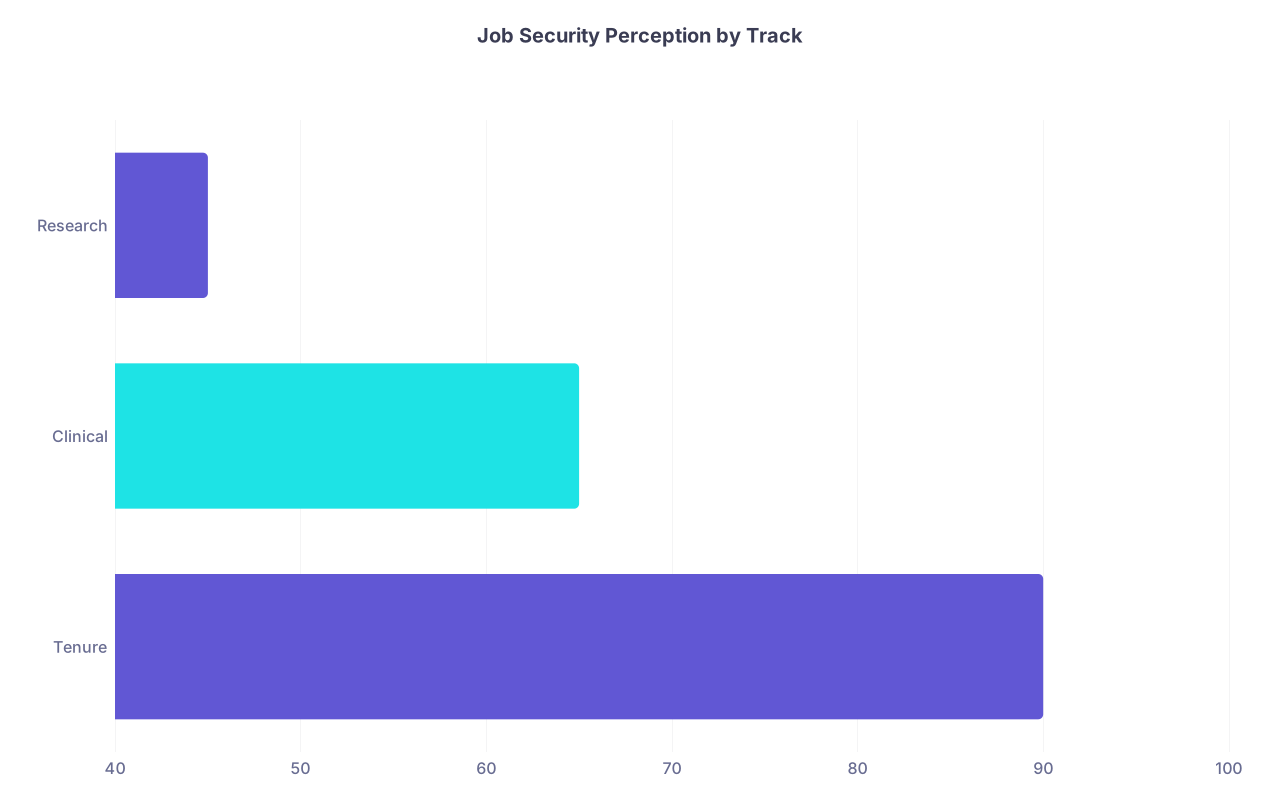
| Category | Value |
|---|---|
| Tenure | 90 |
| Clinical | 65 |
| Research | 45 |
(Those are conceptual “security scores,” not real percentages.)
Who should choose research track
The research track fits if:
- You want to run a lab or lead research as your primary identity.
- You prefer less teaching/committee obligations and more time at the bench or with data.
- You understand and accept the financial volatility of grant cycles.
- You value scientific autonomy more than formal job security.
For many pure scientists, especially PhDs, this track is logical. For MDs, it can be ideal if you truly do not want heavy clinical responsibilities. But do not confuse “freedom to research now” with “guaranteed position forever.”
How Institutions Name and Split These Tracks (And Why It Confuses You)
The naming conventions are a mess. One school’s “Clinician-Educator” track is another’s “Non-Tenure Ladder.” A third will call everyone “Professor of Medicine” and hide the track in internal HR codes.
You cannot rely on title wording. You have to interrogate the structure.
Look for these clues:
- Does the word “tenure” appear in the offer letter or promotion guidelines?
- Are there formal tenure clocks, mid-tenure reviews, and explicit references to “tenure committees”?
- Does the contract specify what portion of your salary is “hard money” versus “grant-dependent”?
- Do the promotion guidelines have separate sections for “tenure track” and “clinical track” criteria?
Some typical systems:
Classic dual-track:
- Tenure-track: Professor of X
- Clinical track: Clinical Professor of X
Triple-track:
- Tenure-eligible: Professor of X (ladder)
- Clinical educator: Clinical Professor
- Research: Research Professor
Unified-title systems:
- Everyone is “Assistant Professor of X,” but HR and promotion manuals still differentiate “Tenure eligible,” “Clinical series,” “In-residence,” “Adjunct,” etc.
If the department cannot hand you a PDF with clearly separated track criteria, be suspicious. Lack of transparency almost always favors the institution, not you.
How Track Choice Interacts With Your Career Phase
You are in the post-residency, job selection phase. That is both the best and worst time to pick a track. Best because you still have options. Worst because your leverage and clarity are limited.
Here is how to think by situation.
Scenario 1: You have heavy research training (PhD, strong fellowship, K award)
You are the intended customer for tenure or research tracks. The questions you should push:
- How much protected time is guaranteed in writing, and for how long?
- How is “protected time” enforced when clinical demand spikes?
- What is the department’s track record of actually getting junior faculty to tenure / promotion?
(Ask specifically: “How many people hired on this track in the last 10 years are still here and tenured?”)
If the department cannot protect at least 50–60% research time for the first 3–5 years, do not pretend you are on a viable tenure path.
Scenario 2: You are a strong clinician-teacher, minimal research portfolio
You probably belong on a clinical/clinician-educator track. The key is avoiding the trap of “100% clinic plus some nights you teach.”
Negotiate:
- Formal educational role with protected time (clerkship, residency teaching blocks, curriculum work).
- Clear promotion expectations: How many scholarly products? Of what type?
Ask to see the CVs of recently promoted clinical-track associate professors in your department. If they all have 20+ papers and you have zero, that mismatch matters.
Scenario 3: You are not sure yet
Many people in fellowship are torn. They like research intellectually but do not know if they want to live on grant cycles. Chairs, not surprisingly, may encourage “keeping the door open” with tenure track.
If you are truly unsure:
- Look for flexibility to change tracks within the first 3–5 years.
Many institutions allow movement from tenure to clinical track if research does not materialize, but almost never the reverse. - Do not agree to a tenure-track role with 70% clinical load “for now.” That is fantasy. Your CV after 3 years of that will not be competitive for a K or R-level grant.
- Be explicit with mentors: “I am trying to understand if a research-heavy career is realistic for me. What would my first two years need to look like?”
Changing tracks later is possible but politically messy. Better to be “under-ambitious” on paper and outperform, than “tenure-track” and under-deliver.
Questions You Must Ask Before Signing
Here is the part people skip. They get dazzled by the institution name and the starting salary and ignore the machinery that will determine promotion.
You should be asking, in writing if possible:
How is my track defined in your official promotion guidelines?
Ask for the actual document and find the section that matches your appointment.What are the typical time-to-promotion numbers on this track in this department?
Not institution-wide; department-specific.How will my effort be allocated the first 3 years?
Get numbers: % clinical, % research, % teaching, % admin. Not hand-waving.How is “protected time” protected?
Who can change it? What happens when the clinic is short-staffed?How many people in my role have successfully been promoted in the last 10 years?
Names, not just “most people.”What happens if I do not meet criteria on time?
Is there a hard clock? Can the clock be extended? Are there non-renewal risks?
If the answers are vague or “we do not usually put that in writing,” assume worst-case.
Putting It Together: Choosing Intentionally, Not By Default
You are picking a career architecture, not a luxury trim package. The wrong track can box you into years of misaligned expectations and stalled promotion.
The simple version:
- If your primary currency is grants and papers → tenure or research track.
- If your primary currency is clinical care and teaching → clinical/clinician-educator track.
- If you are tempted to “do everything” → pick one primary and one secondary, and align your track with the primary.
You can be an excellent clinician on a tenure track or do some research on a clinical track. But the promotion committees will not grade you on the side projects. They will grade you on the core promise of your track.
Get that part right.
FAQ (Exactly 6 Questions)
1. Can I switch from clinical track to tenure track later if I suddenly get a big grant?
Rarely, and only under very specific circumstances. Most institutions make movement from tenure → clinical relatively straightforward, but movement from clinical → tenure is treated like a new hire: full external review, sometimes national search, and strong evidence you already meet or are close to tenure-track benchmarks (major grants, high-impact publications). If you think you might want tenure, you need to build that case early, not wait for a miracle.
2. Does tenure still matter in modern academic medicine, or is it mostly symbolic?
It still matters. Tenure is not a total shield against layoffs, but it changes the default. Tenured faculty are harder to remove, have more leverage in institutional politics, and often get preferential treatment in resource allocation. In some public systems, tenure is codified in state rules that give you very real procedural protections. In private systems, it may be weaker, but it still signals higher institutional commitment.
3. I love teaching. Should I pick tenure track so I can “advance more”?
No. Advancement for teaching-heavy faculty usually lives on the clinical/educator tracks, where teaching and educational scholarship are main evaluation pillars. On most tenure tracks, teaching excellence is expected but will not offset a weak research record. If you truly want to build a career around teaching, curriculum development, and program leadership, you belong on a clinician-educator or education-focused track with explicit criteria for educational scholarship.
4. How much research do I need on a clinical track to get promoted?
It depends on the department, but nearly everywhere, you need something: usually a modest portfolio of peer-reviewed papers (often 5–15) where you are meaningfully involved, plus presentations, curricula, or QI projects written up. The exact number is less important than showing a coherent theme, sustained activity, and some external recognition (invited talks, committee roles). Pure “work done” with no documentation is very hard to credit in promotion discussions.
5. Is a research track position “worse” than tenure track for a PhD scientist?
Not necessarily. Many PhD scientists have long, successful careers on non-tenure research tracks, especially in heavily grant-driven environments where even tenure does not guarantee salary coverage. The tradeoff is formal security versus flexibility. Research tracks can sometimes offer more focus on science with less institutional service, but you accept more vulnerability to funding swings and administrative decisions. The real question is how your institution treats research-track faculty in practice—look at senior people on that track and see if they look stable and supported.
6. What if my department’s expectations are unclear or internally inconsistent?
That is a red flag. When promotion criteria are fuzzy, decisions default to politics, personalities, and budget cycles. In that environment, the safest strategy is to overshoot: build a record that would satisfy a more demanding, transparent system. Simultaneously, document everything—effort allocations, leadership roles, outcomes from your projects—so you have hard evidence when you go up for review. And keep an exit option in mind; unclear criteria rarely get better over time.
Key points:
First, tracks are not cosmetic. They define what work “counts” toward your advancement. Second, match your track to your real primary output: grants, clinic, or teaching—not to flattery or vague promises. Third, demand specificity—on effort, criteria, and history of actual promotions—before you sign anything.