
The way you get paid will change your career more than your subspecialty choice.
Most residents obsess over RVU vs salary vs private practice buy-in about three weeks before signing their first contract. That is backward. You should understand compensation structures as deeply as you understand sepsis bundles. Because you will live with this math for years.
Let me break this down specifically: RVU, collections, and blended models are not just "how much" you get paid. They dictate how you practice, how much you chart, what patients you avoid, and how burned out you get.
We will walk straight into the guts of each model, then talk honestly about who should choose what.
1. The Three Main Compensation Languages
Think of compensation like dialects. Every job posting is speaking (a) RVU, (b) collections, or (c) some hybrid blend. If you do not speak that dialect, you will get taken advantage of. Period.
At a high level:
- RVU-based: You are paid for work performed (relative value units), not cash collected.
- Collections-based: You are paid as a percent of money actually received by the practice.
- Salary / blends: You get a base plus some combination of RVU or collections bonus.
Here is the rough landscape you are walking into:
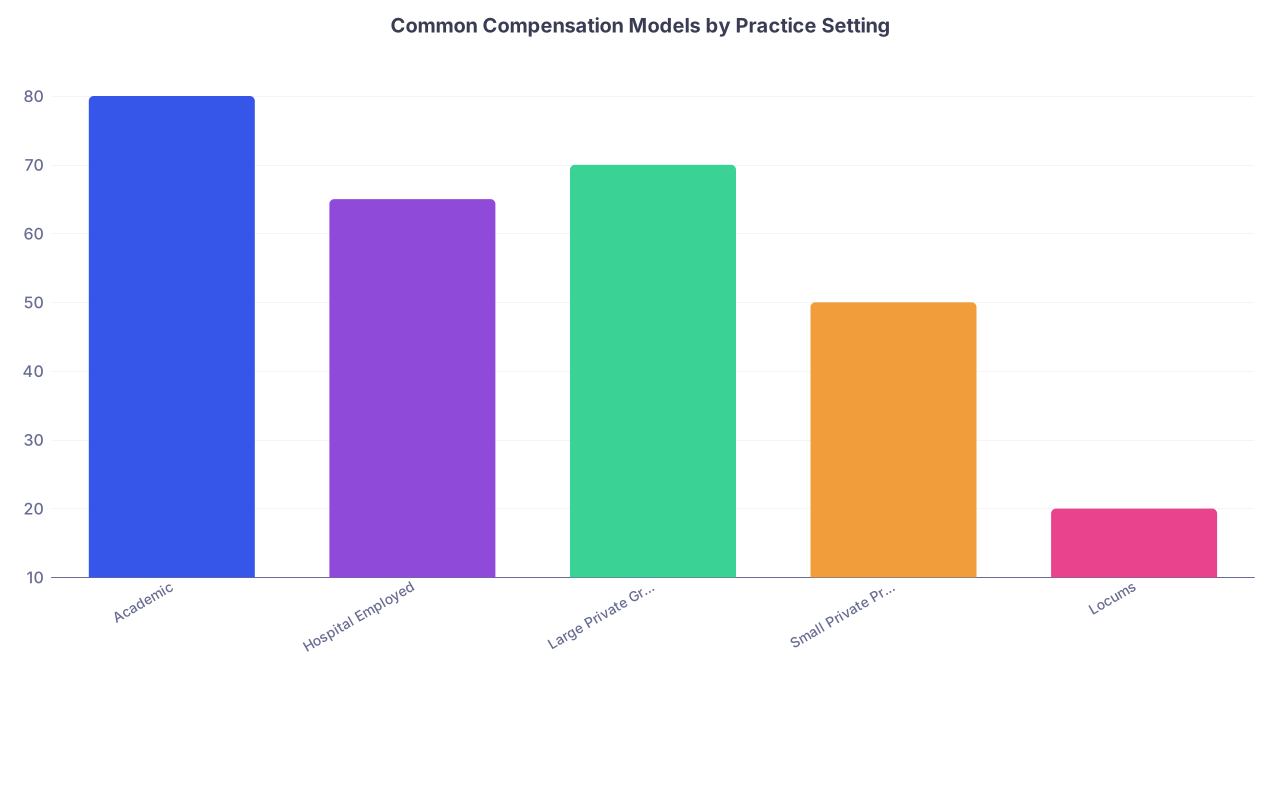
| Category | Value |
|---|---|
| Academic | 80 |
| Hospital Employed | 65 |
| Large Private Group | 70 |
| Small Private Practice | 50 |
| Locums | 20 |
That chart is not “exact” for every region, but it reflects what I actually see when reviewing contracts:
- Academic: Mostly salary with small productivity components.
- Hospital employed: RVU-heavy, often with quality bonuses.
- Large private group: Collections-based or blended.
- Small private practice: Collections and eventual partnership.
- Locums: Hourly or daily rate, almost no productivity tie-in.
Hold that framework. Now we get granular.
2. RVU Compensation: The Hospital’s Favorite Game
RVU (Relative Value Unit) compensation is the darling of hospital-employed models. It sounds objective. It feels fair. It is neither simple nor always fair.
What RVUs Actually Are
You already know CPT codes. Each CPT has an assigned total RVU, made of:
- Work RVU (wRVU) – the part you care about for compensation
- Practice expense
- Malpractice component
Compensation models almost always pay per work RVU.
Typical wRVU examples (ballpark):
- Established office visit 99213: ~0.97 wRVU
- 99214: ~1.50 wRVU
- Colonoscopy (45378): ~3.36 wRVU
- Lap chole (47562): ~10.0 wRVU
- New patient 99204: ~2.60 wRVU
- Hospital subsequent visit 99232: ~1.39 wRVU
If you do not know the wRVU values for your top 15 CPT codes, you are flying blind in an RVU contract.
The RVU Contract Formula
The core math:
Annual compensation = (wRVUs generated × conversion factor) + any quality / call / admin pay.
The “conversion factor” is dollars per wRVU. This is the number that matters. You will see:
- Primary care: often $40–$60 per wRVU
- Procedural subspecialties: $45–$80+ per wRVU
- Highly competitive markets or desperate hospitals: sometimes higher
Now look at the reality across productivity distributions:
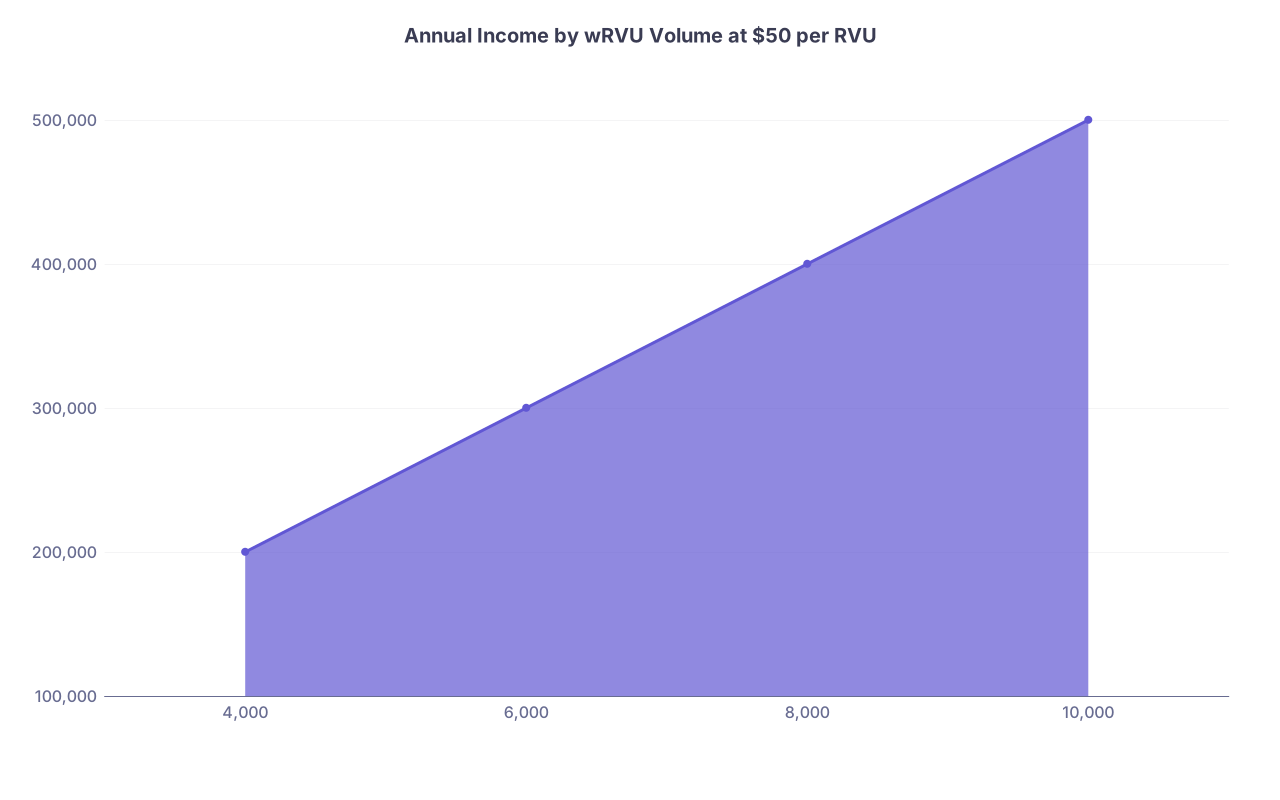
| Category | Value |
|---|---|
| 4,000 | 200000 |
| 6,000 | 300000 |
| 8,000 | 400000 |
| 10,000 | 500000 |
Interpretation: same rate, totally different lives. A hospitalist cranking 8,000 wRVUs at $50/wRVU will “earn” $400k in pure productivity, assuming no caps. A part-time primary care doc at 4,000 wRVUs lands at $200k.
Now add in all the contract tricks.
Common RVU Structures
You’ll typically see 4 main variants:
- Pure RVU from day one
- Base salary plus RVU bonus
- RVU with guarantee for 1–3 years, then pure RVU afterward
- Tiered RVU models (higher rate after a certain threshold)
Example:
- Base: $250,000
- Expected wRVUs: 5,000/year
- Conversion factor: $50/wRVU
- Bonus: Paid on wRVUs above 5,000
If you generate 7,000 wRVUs, your total =
- “Implied” RVU value at base: 5,000 × $50 = $250,000 (that is your base)
- Bonus: 2,000 × $50 = $100,000
- Total: $350,000
That looks solid. Now the catch: if the “expected” wRVUs are unrealistic for your setting, you will never see a bonus.
RVU Red Flags I See Repeatedly
Pay attention here. These are the traps that burn young attendings:
- Unrealistic wRVU expectations
- Example: outpatient IM with 20-min slots, weak referral base, “target” 7,000+ wRVUs. That usually fails.
- No transparency in your RVU reports
- If you cannot see monthly wRVUs by CPT code, you cannot protect yourself.
- No adjustment for payer mix or clinic support
- Understaffed MA and RN support means fewer patients, fewer RVUs. That is not “a you problem,” but RVU models make it your loss.
- Using MGMA “75th percentile” as your target
- Hospitals love quoting benchmarks to justify high RVU thresholds and low conversion factors. You need to see both compensation and wRVU percentiles side by side.
Here is how that often looks in practice:
| Metric | Contract Pitch | Hidden Reality |
|---|---|---|
| Target wRVUs | 7,000 (75th percentile) | 7,000 impossible locally |
| Conversion factor | $48/wRVU | Below regional median |
| Base salary year 1–2 | $260,000 | Guarantee drops after year 2 |
| Actual typical wRVUs in group | ~5,000–5,500 | Bonus rarely triggered |
If everyone in the group is missing bonus, the model is mis-set. They will tell you “it’s attainable.” Ask for anonymized wRVU and compensation data from current physicians.
Who RVU Models Work Well For
RVU-heavy compensation tends to reward:
- High-volume primary care with good support and stable referral streams
- Proceduralists in hospital-employed settings with strong OR access
- Hospitalists and intensivists with predictable census and throughput
RVU models punish you when:
- You inherit a dead clinic panel
- The hospital slow-rolls marketing or referral support
- You are pushed into low-acuity, low-RVU visits (post-op checks, phone visits, etc.) without adjustment
Bottom line: RVU models are not evil. They are just unforgiving. They reward throughput and coding accuracy and punish chaos.
3. Collections-Based Compensation: Welcome to Business School
Collections-based compensation is standard in private practice and some hybrid models. You are paid as a percentage of the money actually collected from payers and patients.
The key phrase: “Net collections” – not charges, not RVUs.
The Core Collections Equation
Annual compensation = (Net collections × your percentage) – sometimes plus call / admin stipends.
“Net collections” = total payments received for your professional services, minus refunds and some adjustments.
Typical split ranges:
- Straight associate (non-partner): 35–45% of net collections
- Senior associate / near-partner track: 40–50%
- Full partner: effectively 100% of your collections minus shared overhead
Private groups love to pitch “you eat what you kill.” That can be fantastic – or it can ruin your income if you do not control the variables.
What Actually Drives Your Collections
I have watched smart, efficient physicians get crushed on collections-based pay because they ignored one thing: you cannot spend collections. You spend profit after overhead.
The pipeline looks like this:
- You generate charges (CPTs, procedures, etc.)
- Billing team submits claims
- Payers adjudicate (deny, reduce, delay)
- Payments arrive (or do not)
- Group takes overhead off the top
- You get your percentage of the remainder
So, the key drivers:
- Payer mix (commercial vs Medicare vs Medicaid vs self-pay)
- Group’s contracts with insurers (how well-negotiated the rates are)
- Billing office competence and denial management
- Overhead structure (rent, staff, equipment leases, EMR, malpractice)
- Your own efficiency and procedure mix
A 45% collections contract in a sloppy, high-overhead practice can pay worse than a 35% contract in a lean, well-run group.
Example: Two Hypothetical Practices
Let’s compare two practices where you generate the same revenue.
- You produce $1,000,000 in collected revenue in each.
- Overhead varies. Percentage split varies.
| Factor | Practice A | Practice B |
|---|---|---|
| Annual collections (you) | $1,000,000 | $1,000,000 |
| Overhead rate | 70% | 50% |
| Net profit before split | $300,000 | $500,000 |
| Your share of net profit | 60% | 40% |
| Your annual compensation | $180,000 | $200,000 |
Practice B looked “worse” at 40%, but because it is better run and leaner, you walk away with more money.
This is why you must ask private groups directly:
- What is total overhead as a percentage of collections?
- How is overhead allocated between physicians?
- What is the historical collection per wRVU for the group?
Most young physicians never ask those questions. Then they spend 2–3 years confused why the partner across the hall makes double their income seeing similar patients.
Collections Model Red Flags
These are the patterns that should make you pause:
- No transparent reporting of your charges, adjustments, and net collections
- “You will get 40%” but no clarity on how overhead is divided or what overhead even includes
- You are responsible for your own staff or MA salary but your percentage is not adjusted
- Group keeps ancillary revenue (imaging, infusion, lab) entirely off your books while using your time to generate that business
And the most common one: collections-based comp with a weak or dysfunctional billing office. You can do everything right clinically and still get penalized.
Who Collections-Based Models Favor
These models shine when:
- You have a procedure-heavy practice with strong payer mix
- The group is well established with good contracts and efficient billing
- You are willing to work like an owner even if you are not one yet
They are brutally unforgiving when:
- You join a “fixer upper” practice with no clue how bad their AR (accounts receivable) is
- Group leadership hides financial data or hand-waves your questions
- You are risk-averse or prefer predictability over upside
If you want to learn the business of medicine and eventually be a partner, collections-based models are where you get your MBA by force.
4. Salary and Blended Models: The “Safe” Middle That Can Be a Mirage
Guaranteed salary feels safe, especially coming out of residency where your paycheck is predictable and tiny. The problem: pure salary with no meaningful productivity component can cap you hard, or worse, be quietly adjusted downward in future renewals.
Most real-world jobs end up being blends:
- Base salary
- Productivity bonus (RVU or collections)
- Quality / value-based components
- Call stipends
- Admin pay for leadership roles
Let’s outline the common blends you will see.
Common Blended Structures
- Salary + RVU bonus
- Base salary, with bonus for exceeding a set RVU target.
- Salary + Collections bonus
- Base until collections exceed some threshold, then you share in extra revenue.
- Salary “draw” against future collections
- Often in private practice. Your “salary” is basically an advance on what they expect you to generate; reconciled later.
- Tiered or ramped models
- Years 1–2 guaranteed higher base with low or no bonus, then shift more toward productivity.
Here’s what a typical hospital-employed IM or FM contract might look like for years 1–3:
| Year | Base Salary | RVU Target | RVU Rate | Notes |
|---|---|---|---|---|
| 1 | $240,000 | 4,000 | $50 | Guarantee, weak bonus |
| 2 | $230,000 | 5,000 | $52 | Partial productivity |
| 3 | $210,000 | 6,000 | $55 | Heavier RVU focus |
You see what they are doing: shifting risk to you over time. That is not inherently bad. It just needs to be realistic with your expected patient volume.
Value-Based and Quality Components
More contracts now include 5–15% of compensation tied to:
- HEDIS metrics
- Readmission rates
- Patient satisfaction scores
- Panel size and risk adjustment
- “Citizenship” metrics (meeting attendance, notes closed in x days, etc.)
Most places will say, “You can earn up to X% more for quality.” The real question you should ask: historically, what percentage of that pool do physicians actually receive? If the “max” is 15% but most colleagues get 3–5%, your actual upside is smaller than it looks.
The Locums Outlier
Locum tenens work is usually straight hourly or daily rate. No RVUs. No collections. No bonus. You trade upside and long-term stability for simplicity and freedom.
This model is underrated early in a career when you:
- Need time to explore regions or practice types
- Want to aggressively pay down loans with high daily rates
- Are burned out and want zero meetings / committees
It is a pure time-for-money trade. But it will not build equity or long-term leverage.
5. Matching Model to Specialty, Personality, and Risk Tolerance
Here is where people go wrong: they pick a job based on specialty and city, then “accept” whatever compensation model is attached. That is backwards.
You need to actively choose the structure that matches you.
By Specialty Cluster
Let me be blunt about patterns I see repeatedly:
- Outpatient IM / FM / Pediatrics
- Hospital-employed with RVU-based comp is now the norm. If you want upside, large multi-specialty groups with transparent RVU or collections bonuses are better than tiny single-specialty practices with weak contracts.
- Hospitalist / Intensivist
- RVU rarely matters as much as schedule, shift count, and nocturnist differentials. If someone wants to push RVUs hard in hospital medicine, watch for under-staffing and creeping admission expectations.
- Procedural surgical specialties (ortho, ENT, ophtho, GI, cards interventional)
- Collections-based or RVU-heavy models can be extremely lucrative if OR access and payer mix are good. Be more aggressive about upside structures if you are in this group.
- Cognitive subspecialties (endocrine, rheum, ID, geriatrics)
- Pure collections models are dangerous unless there is a stable referral base and the group has worked out realistic overhead. RVU with guaranteed base is usually safer starting out.
- ED
- Typically hourly or shift-based plus RVU or door-to-doc metrics. Watch for productivity pressures that compromise safety or documentation burden.
By Personality / Risk Profile
Be honest about yourself:
- If you hate uncertainty, have major family obligations, and lose sleep over variable income, a salary with modest productivity component is your lane.
- If you are competitive, willing to work harder for more reward, and comfortable with business risk, a collections or aggressive RVU model with realistic volume can triple your income.
- If you are burned out and want maximal autonomy, locums or part-time salary beats every other structure as a bridge.
There is no single “best” model. There is only the best fit for you in a particular season of your career.
6. How to Read a Compensation Offer Like an Adult, Not a Resident
You do not need to become a healthcare economist. But you do need to stop letting recruiters throw opaque numbers at you.
Here is a practical reading framework.
Step 1: Ignore the Total Compensation Headline
“Total potential compensation up to $450,000” is a sales pitch, not reality. Strip it down to:
- Guaranteed base (for how long?)
- Realistic productivity bonus (based on actual wRVUs or collections of current physicians)
- Realistic quality / call income
Ask directly:
- “What did your last three hires in my specialty actually earn in years 1, 2, and 3?”
- “Where does that fall on MGMA or other benchmarks for compensation and productivity?”
Step 2: Map the Productivity Math
For RVU offers:
- Target wRVUs per year?
- Dollars per wRVU?
- What is the historical median and 75th percentile wRVUs for my eventual partners/colleagues?
- Do they cut the rate above or below certain thresholds?
For collections offers:
- Typical annual collections per FTE physician?
- Overhead percentage?
- Your share of collections or profit? When does that change (e.g., at partnership)?
If they cannot or will not give you these numbers, that is your answer.
Step 3: Pressure-Test Assumptions
You want to know how fragile the model is.
For RVUs:
- How many clinic slots per day?
- No-show rate?
- New patient vs established mix?
- MA and RN staffing ratios?
- Are there any “protected” non-billable tasks that eat your time (teaching, admin)?
For collections:
- Payer mix breakdown by percent (commercial vs Medicare vs Medicaid vs self-pay)
- Days in AR for the practice (how long it takes to get paid)
- Denial rate and who handles appeals
If this sounds like extra work, remember: this is the difference between a $220k and a $400k career trajectory in many fields.
7. Common Myths That Keep Physicians Underpaid
Let me call out a few lies that float around residency lounges and physician Facebook groups.
“Academic = bad pay, private practice = good pay”
Overly simplistic. The reality:
- Some academic departments quietly pay near-private levels with better benefits, protected time, and lower hustle.
- Some “private” groups pay poorly because of regional saturation, bad contracts, or greedy senior partners.
You compare models. Not labels.
“RVUs protect you from bad payer mix”
Partially true. RVUs decouple your income from your individual payer mix. But they do not protect you from:
- System-level underfunding of your clinic
- Unrealistic RVU targets based on fantasy patient volumes
- RVU devaluation when CMS revises codes
RVUs are better than raw collections for stability, but they are not magic.
“Partnership always means more money”
Sometimes partnership means:
- Buying into a badly structured corporation with messy financials
- Accepting personal liability for leases and loans
- Sharing overhead for ancillaries you do not control
Partnership can be the path to 2–3× income. It can also be a golden handcuff to a mediocre situation. Scrutinize the actual numbers.
8. How to Train Yourself Now, Before Signing Anything
You can prepare for this while still in residency or fellowship. No extra degree required.
Here is the short list:
- Learn the wRVU values of your top 20 CPT codes. Keep them in a note on your phone.
- Ask attendings (who trust you) what their compensation model is and where they feel squeezed. Listen carefully.
- Read at least 3 full contracts before your own, ideally from different practice types.
- During electives, ask clinic managers about payer mix, days in AR, and coding support. Watch their face when you ask. You will learn a lot.
And when the offers start coming, do not skip professional review. A good healthcare contract attorney or seasoned mentor is worth every penny in this process.
Key Takeaways
- Compensation structure (RVU, collections, blend) will shape your daily life and long-term income more than almost any other job feature. Learn the math, not just the headline number.
- RVUs reward throughput and coding accuracy; collections reward business efficiency and payer mix; salary blends try to trade stability for upside, often shifting risk to you over time.
- The smartest physicians match compensation models to their specialty, risk tolerance, and career stage—and they always demand transparent data before signing anything.