You are two years out of residency. Your RVUs look great, your comp is decent, and the senior partner pulls you aside after clinic: “We should start talking about partnership track.”
You nod. Because that is what you are supposed to do.
But walking back to your office, you realize something: you have no idea what “partnership track” actually means beyond “more money later.” Buy-in? Equity? Governance rights? How any of this is structured? Not clear. And this is where people get burned.
Let me break this down properly. Partnership track mechanics are not mystical. They are a mix of basic finance, corporate law, and practice politics. Once you see the moving pieces—buy-ins, equity, and governance—you can look at any offer and know: good deal, bad deal, or run for the door.
1. What “Partnership Track” Actually Means
Partnership track gets thrown around like a generic perk: “Two-year track,” “No buy-in,” “Fast path to partner.” None of that means anything until you know:
- What you are buying into
- What ownership actually gets you
- How decisions are made once you are “in”
Partnership track is essentially a multi-year probation period where the group decides if you are:
- Clinically safe
- Economically productive
- Culturally tolerable
If you clear that bar, they offer you a chance to purchase an ownership stake (or earn it via sweat equity) in the entity that owns the business. That entity might be:
- A professional corporation (PC / PA)
- A professional limited liability company (PLLC)
- A partnership/LLP
- A holding company that in turn owns sub-entities (e.g., ASC, imaging, real estate)
The phrase “becoming a partner” could mean:
- You own equity in the main professional entity only
- You own equity in some ancillaries but not others
- You become an income partner (profit share) but not an equity partner (no asset value)
- You gain voting rights, or you do not
I have seen offers where “partnership” meant a slightly higher RVU rate and zero actual ownership. They still called it “partner.” That is marketing, not governance.
So first principle: when someone says “partnership track,” your immediate follow-up is, “Define precisely what partner status includes: equity, profit share, voting, and any separate entities.”
2. Buy-Ins: What You Are Actually Paying For
Buy-in is where most younger physicians get anxious—and where some groups quietly extract a premium.
Conceptually, a buy-in should reflect the fair value of what you are acquiring:
- Tangible assets (equipment, furniture, accounts receivable if applicable)
- Intangible assets (goodwill, brand, referral patterns, contracts)
- Ownership in ancillaries (ASC, imaging, labs, real estate LLCs)
- Your share of working capital
Common Buy-In Structures
Let us sort through the usual models you will see.

Fixed Buy-In Amount
“Partnership buy-in is $200,000, payable over 5 years via salary reduction.”
Simple. But “simple” is only good if the number is rational. You should ask:
- When was that number last valued?
- Is it the same for everyone regardless of revenue or seniority?
- Does it include all entities (ASC, imaging, real estate) or only the main practice?
Formula-Based Buy-In
Example: “Buy-in equals 1x your trailing-12-month collections share” or “0.7x average partner net collections share over past 3 years.”
Better, if the formula is transparent. It at least gestures toward fair market value rather than a random legacy number from 2005.
Sweat Equity / Reduced Compensation
“We gradually ramp your comp and hold back X% as equity accumulation instead of a lump-sum buy-in.”
You effectively “pay” by working at a discount relative to full partner comp until you reach your target equity share. Often seen in hospital-employed to partner-track hybrids or large multispecialty groups.
No Buy-In (Yes, but read the fine print)
Sometimes groups say “no buy-in” but:
- You do not receive equity, only a higher productivity bonus
- You receive “phantom equity” or profit units that are not true ownership and disappear when you leave
- Ancillary income goes only to founding partners
“No buy-in” can mean “no real ownership.” That is not always bad, but you must see it clearly.
How Buy-Ins Are Actually Financed
Most physicians do not stroke a $300k check. Typical mechanisms:
- Salary deferral: e.g., $60k/year for 5 years withheld pre-tax as equity purchase
- Bank loan: often secured by your future income and sometimes backed by practice guarantees
- Hybrid: initial down payment + ongoing salary reduction
What you care about is after-tax, after-debt true take-home during buy-in years versus as a non-partner elsewhere. I have seen “great” partner tracks that left people functionally poorer for 7–8 years because the group over-valued itself.
Here’s a simplified comparison to help anchor:
| Scenario | Year 3-7 Net Take-Home (Annual) | Long-Term Upside (Post Buy-In) |
|---|---|---|
| Non-partner job | $350,000 | Minimal profit share |
| Partner-track with $250k buy-in over 5 yrs | $320,000 during buy-in | $500,000+ thereafter |
| Partner-track with inflated $500k buy-in over 5 yrs | $270,000 during buy-in | $520,000 thereafter |
The last scenario looks impressive on the back end, but many people underestimate how punishing those lean years feel—especially with loans, childcare, and housing.
3. Equity: What Do You Actually Own?
Equity is ownership. But ownership of what is specific—and this is where groups bury landmines.
The Layers of Ownership
Many practices are fragmented into multiple entities. A very common layout:
- Professional entity (PC/PLLC) – where clinical revenue flows
- ASC LLC – if surgery or procedures
- Imaging LLC – CT/MRI
- Real Estate LLC – owns the building and leases to the practice
- Management company – sometimes used for “fees” and profit shifting
When you are told, “You will own 1/10th of the group,” they might mean:
- 1/10th of the PC only
- 0% of the ASC and real estate LLC (those are “founder only”)
- No claim on undistributed historical retained earnings
You want a clear breakdown:
- What percentage of each entity do I get at full partnership?
- Do I receive the same class of units/shares as senior partners, or a junior/non-voting class?
- Are distributions proportional to equity percentage or some other formula?
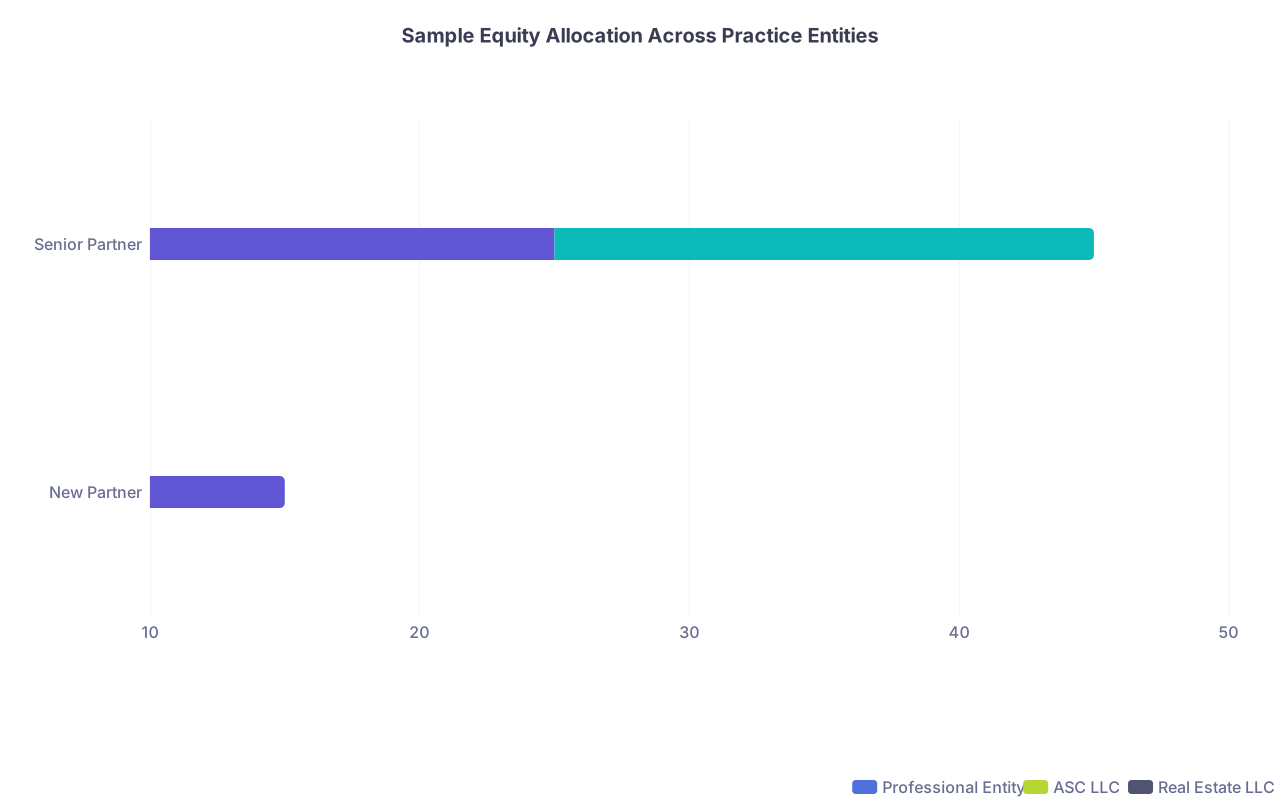
| Category | Professional Entity | ASC LLC | Real Estate LLC |
|---|---|---|---|
| New Partner | 10 | 5 | 0 |
| Senior Partner | 10 | 15 | 20 |
In the example above, both partners have 10% of the main practice, but the senior partner holds significantly more of the profitable ancillaries and all of the real estate upside. That is not inherently unfair, but it must match the story you are being told.
Economic vs Voting Rights
Do not assume 10% equity = 10% of the vote.
Some groups have:
- Economic units: determine your share of profits
- Voting units: determine your say in governance
You might get 10 economic units and 1 voting unit. Or none. I have seen “partners” with zero voting rights on anything that matters; they essentially function as high-paid employees.
If the operating agreement or shareholder agreement uses the phrase “classes” of ownership, read very carefully. Or have an attorney do it.
4. Governance: Who Actually Runs the Show
Governance is the boring, dense-language part of the partnership documents. It is also where your future sanity lives or dies.
You want to know three things:
- How decisions are made
- Who can be forced out and on what terms
- How money moves (distributions, capital calls, major expenditures)
Basic Governance Models
In physician groups, you generally see variations of these:
One-partner-one-vote, majority rule
- Each partner has equal vote
- Some decisions require supermajority (2/3) or unanimous consent
- A board/executive committee handles day-to-day, but full partner votes on major changes
Ownership-weighted voting
- Your vote share scales with your equity percentage
- Founders or major producers can effectively control outcomes
Hybrid
- Certain matters (adding partners, selling the practice, major capital expenditures) need supermajority or one-partner-one-vote
- Routine business governed by an executive committee with weighted input

You are trying to figure out your future power. Not tomorrow. Five to ten years from now when you care deeply about call schedules, midlevel supervision, or selling to private equity.
Clauses That Should Make You Sit Up
There are particular governance clauses that I always tell people to flag.
Forced Buy-Out / Termination Provisions
Look for language about:
- “Without cause” removal of a partner
- Mandatory retirement ages
- Non-renewal of shareholder employment agreements
Then: what is the buy-out formula if you are pushed out?
- Book value (often low) vs fair market value
- Payment timing (lump sum vs drawn out)
- Any haircuts if you leave before a set age or tenure
Non-Compete and Restrictive Covenants
- Radius and duration of non-compete
- Whether restrictions differ for partners vs non-partners
- Scope (just your specialty, or broader service lines?)
A “great” equity deal becomes irrelevant if getting forced out means you cannot practice within 30 miles for two years.
Capital Call Provisions
- Under what conditions can the group demand more capital from partners?
- What happens if you refuse or cannot pay? Dilution? Forced sale of your shares?
Sale / Merger Voting Thresholds
- What percentage of partners must approve selling to a hospital, PE, or large group?
- Do you have drag-along rights (you must sell if majority sells) or tag-along rights (you can join the deal on same terms)?
If governance is essentially “founders do whatever they want,” you might accept that as an early-career partner if you are compensated fairly. But do not lie to yourself that you are joining a democracy.
5. How Money Really Flows: Compensation and Distributions
Many physicians focus only on W-2 salary and bonuses and ignore distributions, which is where the leverage of partnership usually lies.
Income Components to Track
- Base salary / draw – predictable monthly income
- Productivity bonus – RVU/collections-based
- Ancillary distributions – ASC, imaging, labs, PT, etc.
- Real estate distributions – rent income if you own the building LLC
- Management or admin stipends – medical director roles, committee work
| Component | Senior Partner | Junior Associate |
|---|---|---|
| Base salary/draw | $325,000 | $300,000 |
| Productivity bonus | $150,000 | $75,000 |
| Ancillary distributions | $200,000 | $0 |
| Real estate distributions | $50,000 | $0 |
| Total | $725,000 | $375,000 |
You can see why people put up with brutal buy-ins. But you also see the trick: if ancillaries and real estate are excluded from your track, your upside is capped.
Distribution Rules You Must Understand
- Timing: Quarterly vs annual. Some groups play games with timing to keep cash in the entity.
- Formula: Strictly pro-rata to ownership? Weighted by productivity? Blended?
- Reserves: How much is held back for capital needs before distributions? Who decides?
- Catch-up provisions for new partners: Do you step into full distribution rights immediately, or ramp up over several years?
I have seen “partners” whose equity was technically identical on paper, but their distribution formula kept them at 60–70% of senior partner ancillaries for 5–10 years. That matters.
6. Evaluating a Partnership Track Offer Step-by-Step
Let me give you a practical framework you can actually use.

| Step | Description |
|---|---|
| Step 1 | Receive Offer |
| Step 2 | Clarify Definitions |
| Step 3 | Request Documents |
| Step 4 | Model Finances |
| Step 5 | Assess Governance |
| Step 6 | Negotiate Details |
| Step 7 | Walk Away |
| Step 8 | Acceptable Risk? |
Step 1: Clarify Definitions in Plain English
Before you get buried in PDFs, ask them to spell out, in writing:
- Timeline to partnership (earliest and typical)
- Objective criteria (RVUs, quality metrics, behavioral expectations)
- Whether any partners have been denied in the last 5–10 years, and why
- What “partner” concretely includes: entities, equity %, voting rights
If they cannot or will not answer that clearly, that is your first red flag.
Step 2: Get the Right Documents
You want to review, preferably with an attorney who does physician contracts regularly:
- Employment agreement (associate phase and partner phase, if separate)
- Shareholder/operating agreement (PC/PLLC)
- Operating agreements for any ASC/imaging/real estate LLCs you are involved in
- Any buy-sell or redemption agreements
- Summary of current partner compensation model (it can be de-identified, but you need the formulas and ranges)

If they balk at sharing governance or operating agreements “until later,” be suspicious. You should not commit to a track without seeing the rules of the game.
Step 3: Build a 10-Year Financial Model
This sounds tedious; it is not. You can do a simple spreadsheet in an hour:
- Years 1–2: associate salary + typical bonus
- Years 3–7: associate or partial partner comp minus buy-in costs (salary deferral or loan payments)
- Years 8–10: full partner comp + distributions, with conservative assumptions
Compare that to:
- A pure employed job at market rate with no partnership
- A different partnership model with lower/no buy-in
Use pessimistic assumptions for collections and distributions. Groups never project down years; those still happen.
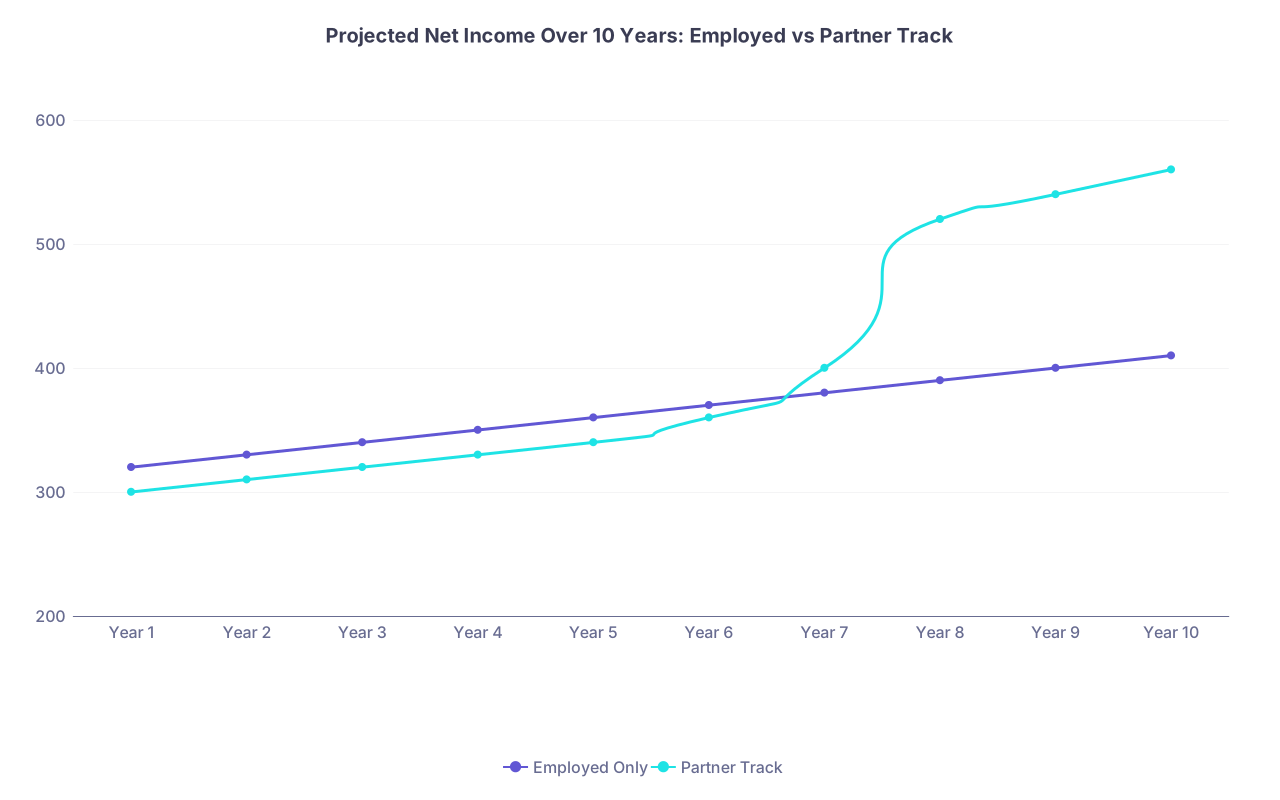
| Category | Employed Only | Partner Track |
|---|---|---|
| Year 1 | 320 | 300 |
| Year 2 | 330 | 310 |
| Year 3 | 340 | 320 |
| Year 4 | 350 | 330 |
| Year 5 | 360 | 340 |
| Year 6 | 370 | 360 |
| Year 7 | 380 | 400 |
| Year 8 | 390 | 520 |
| Year 9 | 400 | 540 |
| Year 10 | 410 | 560 |
This is where you see whether the “pain years” are worth the back end—and how much risk you are taking if the back end never fully materializes.
Step 4: Interrogate Governance and Culture
Talk to:
- A junior partner who joined in the last 3–5 years
- Someone who left the group, if you can find them
- Non-physician staff who have been there forever (they see the dysfunction earlier than anyone)
Ask specific questions:
- Have any associates been denied partnership recently? Why?
- How often do major decisions go to full partner vote?
- Does one person or small clique effectively run everything?
- Have there been disputes over money or call schedules that got ugly?
You are not looking for perfection; you are looking for whether problems are acknowledged and managed, or hidden and festering.
7. Red Flags and Green Flags
To save you some pain, here is how I categorize common patterns.
| Area | Green Flag | Red Flag |
|---|---|---|
| Buy-in | Transparent formula, recent valuation | Legacy number, “because that is what we always did” |
| Equity | Same class units, clear % across entities | Multiple classes, you excluded from ancillaries/real estate |
| Governance | Written rules, supermajority for big decisions | Founders veto everything, documents vague |
| Culture | Recent partners happy, clear expectations | Associates “not ready” for vague reasons, high turnover |
| Non-compete | Narrow, reasonable | Broad radius and duration, enforced aggressively |
If you stack up more than two serious red flags, you are not in a “quirky but fine” group. You are stepping into a power imbalance that heavily favors incumbents.
8. How Private Equity and Hospitals Warp Partnership Mechanics
One last layer you need to understand post-2020: a lot of “partnership tracks” now live inside PE-backed platforms or hospital-aligned entities.
The mechanics change:
- You might receive synthetic equity (profit interests, RSUs, phantom units) in a management company rather than true ownership of the clinical entity.
- “Equity” might be heavily tied to an exit event (sale or recapitalization); if that does not happen while you are there, your upside is limited.
- Governance can sit at the management company or investor level, not with the physicians.
In PE models, common patterns:
- Solid near-term comp
- Some ancillary upside
- Very unclear long-term governance and practice autonomy
This can be fine if you treat it as a 5–10 year high-earning phase and do not romanticize it as “my forever home.” Just do not confuse PE-flavored “equity participation” with old-school, physician-controlled partnership.
9. Bottom Line: How to Think Like an Owner Before You Are One
You do not need an MBA. You do need to stop thinking only like an employee.
When you evaluate a partnership track:
- Ask: “What am I actually buying?” Not just “How much is the buy-in?”
- Ask: “What rights come with this equity?” Economic, voting, information.
- Ask: “How can this go wrong, and what happens to me if it does?”
If the group welcomes those questions and answers them cleanly, that is a good sign. If they tell you, “We are like a family; do not worry about it,” you should worry about it.
Key points to keep in your head:
- Partnership track is a package of three things: buy-in cost, equity scope, and governance power. All three must make sense, not just the dollar figure.
- Demand clarity on what “partner” means: which entities, what percentage, what vote, and how money is actually distributed.
- Model your 10-year finances and read the governance documents; the back-end upside only matters if you are not locked out, pushed out, or structurally sidelined.