
It is late on a Wednesday. You just finished a 10‑hour block in clinic and a surgery day that bled over. Your CEO pulls you aside: “We’re moving away from direct employment. Legal will bring you a new PSA next week. There may also be an MSO opportunity and a co‑management deal for the service line.”
Everyone around the table nods like they understand.
You do not.
You know base salary, wRVUs, maybe a quality bonus. Beyond that, “PSA vs MSO vs co-management” might as well be three different subspecialties. You also know one thing for sure: signing the wrong structure can lock you into a decade of misaligned incentives, handcuffed autonomy, and tax / compliance problems you only discover when it is too late.
Let me break this down properly.
We will walk through:
- What PSA, MSO, and co-management actually are
- How they show up in real hospital-physician deals
- Where the money really flows
- Compliance and risk traps (the Stark / AKS landmines)
- How to decide what structure fits your career and your group
This is post‑residency reality. You are not playing with theoretical models; these are the contracts that dictate your income, your schedule, and your leverage for years.
Big Picture: Why Hospitals Use These Structures
Hospitals do not pick PSA vs employment vs MSO vs co‑management because of “philosophy.” They pick them because of:
- Stark Law and Anti-Kickback Statute risk
- State corporate practice of medicine (CPOM) restrictions
- Payer contracting strategies
- Tax and reimbursement optimization
- Control. Over you, your schedule, and the service line.
So before definitions, anchor one thing:
These models are about control of three levers:
- Who employs the physicians
- Who controls the revenue and expenses
- Who controls the operations and clinical decision-making
All three models—PSA, MSO, co‑management—rearrange those levers differently.

| Category | Value |
|---|---|
| Direct Employment | 90 |
| PSA | 70 |
| MSO | 40 |
| Co-Management | 60 |
90 = near-total hospital control; 40 = much more shared / physician-side control. Is this “scientific”? No. But it matches what you will feel day to day.
Professional Services Agreements (PSAs): The “We Hire Your Services, Not You” Model
PSA is the one you encounter most when a hospital wants to control a service line but not be the technical employer of every physician.
What a PSA Actually Is
At its core:
- Your group (or you, if solo) remains a separate legal entity.
- You, as a physician, stay employed by your group.
- The hospital contracts with your group for your professional services.
- You may work almost entirely on hospital premises, in their clinics, under their branding.
So the hospital says: “We will pay your group X dollars for Y services configured as full-time equivalents (FTEs), shifts, wRVUs, or covered hours.”
They are “buying” your time and effort, not necessarily your practice assets.
Common PSA Use Cases
You see PSAs most often in:
- Cardiology, GI, ortho, anesthesia, intensivists
- ED coverage for community hospitals
- Hospital-based specialty clinics where the hospital wants brand control but not direct employment due to CPOM laws
A classic pattern:
A five‑physician cardiology group signs a PSA. The group keeps its Tax ID but moves into hospital-owned clinics with hospital staff. The hospital bills the professional fees under your NPI, collects, then pays the group a contractually defined amount.
How You Get Paid Under a PSA
There are three main payment structures:
Fixed stipend per FTE
Example: $500,000 per 1.0 FTE cardiologist, based on MGMA medians and fair market value (FMV).
Stable. Less upside. Good when volume is unpredictable.wRVU-based compensation
Similar to direct employment:- Guaranteed base tied to expected wRVUs
- Per‑RVU rate above/below threshold
Hospital pays your group, group pays you via internal formula.
Hybrid
- Fixed base to cover a portion of expected income
- Productivity or quality bonus on top
This is the most common in more sophisticated PSAs.
| PSA Model Type | Income Stability | Upside Potential | Admin Complexity |
|---|---|---|---|
| Fixed FTE Stipend | High | Low | Low |
| Pure wRVU-based | Medium | High | Medium |
| Hybrid (Base+Bonus) | Medium-High | Medium-High | High |
Key Control Points in a PSA
Here is what the PSA actually shifts:
- Scheduling: Hospital usually sets clinic and call coverage expectations in the PSA. You negotiate FTE, call frequency, minimum clinic sessions.
- Staffing: The hospital often provides staff; your influence depends on contract language and local politics.
- Billing: Typically hospital does the billing (for both professional and facility fees), then pays your group. You must insist on audit rights.
- Non-compete and exclusivity: PSAs often bundle de facto noncompetes via panel restrictions, medical staff bylaws, and “exclusive provider” language.
Where PSAs Go Wrong
I have watched several PSAs implode for the same predictable reasons:
Underestimated work
Your group signs for 1.0 FTE of coverage but real demand is 1.3–1.5 FTEs. Everyone works harder for the same pay.RVU rate or FTE value decays over time
Year 1 looks great, but there is a “rebase to FMV” clause where the hospital unilaterally re‑values the deal after 2–3 years with a consultant. Suddenly your per‑RVU or FTE dollar drops.Billing opacity
Hospital controls billing. Denials go up. Collection efficiency drops. But your PSA rate stays static. You end up working more for effectively less net revenue.Call coverage creep
“We only need 1:4.” Two retirements later, you are 1:2 and no one has updated the PSA or your compensation.
Legal and Compliance Anchors
You cannot ignore these:
- Stark Law: Any financial relationship with a hospital that can refer DHS (designated health services) must be FMV and commercially reasonable. No kickbacks for referrals.
- Anti-Kickback Statute (AKS): Same story, criminal version, intent-based.
- Fair Market Value (FMV): Usually determined by national benchmarks (MGMA, AMGA) and third‑party valuations.
Hospitals will always tell you: “Legal has blessed this.” That does not mean it is fair to you. It means it is safe for them.
Management Services Organizations (MSOs): The “We Run The Business, You Run The Medicine” Model
Different animal. MSO is about infrastructure and admin, not directly about your professional services.
What an MSO Does
An MSO (Management Services Organization) provides non-clinical management and support services. Examples:
- Billing and coding
- HR and payroll for non-physician staff
- IT and EHR infrastructure
- Office space and leasing
- Supply chain and purchasing
And sometimes:
- Strategic planning, marketing, and service line development
The MSO can be:
- Hospital-owned
- Jointly owned by hospital and physicians
- Physician-owned (less common with hospital MSOs)
How an MSO Interacts With You
Two broad setups:
Hospital-owned MSO contracts with your practice
- Your group stays independent and bills under its own Tax ID.
- MSO provides back-office support for a fee (often % of collections or a PMPM for value-based deals).
- You keep professional revenue, pay MSO for services.
“Friendly PC” / CPOM workaround structures (in CPOM states like CA, NY, NJ, TX)
- Physicians own a professional corporation (PC).
- Hospital/health system (or private equity, but we are focusing hospital) owns the MSO that provides everything but clinical decisions.
- MSO has a long-term management contract with the PC.
- PC employs doctors. MSO runs operations and collects a management fee.
Viewed correctly: MSO = business shell; PC = clinical shell.

Your Income Under an MSO Model
This part confuses people. MSO by itself does not dictate your clinical compensation; it dictates the cost structure around you.
So your pay comes from:
- Professional fee collections to your group/PC
- Minus MSO fees (often 5–15% of collections or a defined service fee)
- Minus overhead / staff / benefits
If the MSO is efficient—better contracting, better billing, scale on staffing—you still do well. If it is bloated and misaligned, your collections improve on paper but your net drops because their management fee eats the gain.
Red Flags in MSO Deals
I get skeptical quickly with:
Percentage-of-collections arrangements with weak value-add
If the MSO takes 10–15% for “management” but you do not see substantially better payer rates, denial management, or staffing leverage, you are subsidizing their bureaucracy.Excessively long management contracts (10+ years) with high termination penalties
This handcuffs your group to the hospital MSO even if the relationship becomes toxic.Operational control creeping into clinical control
Language like “MSO shall determine staffing models, clinical protocols, and scheduling templates” starts to blur the CPOM line and mess with your autonomy.Required use of MSO-owned ancillaries
If you are forced to send all imaging/labs to specific entities with questionable FMV, you can drift into Stark/AKS territory.
Where MSO Actually Helps You
There are situations where MSO involvement is genuinely beneficial:
- You are a small or mid‑size group overwhelmed by HR, IT, and compliance.
- The hospital MSO has stronger payer contracting power, and they show you concrete uplift (e.g., +15% on commercial rates).
- You negotiate transparent reporting: monthly P&L, deny reports, AR days, collection rates—real data.
- The contract has reasonable termination rights and options to buy back certain functions.
The key is this: MSO is about administrative outsourcing. It should not quietly convert into economic control of your professional fees without commensurate value.
Co-Management Agreements: “You Run the Service Line With Us—and We Pay You For It”
Co‑management is where things start to feel interesting, because this is one of the few structures that can genuinely reward physicians for operational excellence and quality improvements beyond their individual wRVUs.
What a Co-Management Agreement Is
In a co‑management structure:
The hospital and a physician group (or physicians individually) enter a contract to co‑manage a specific service line.
Examples: Orthopedic service line, cardiovascular service line, oncology program.The co‑management entity (often an LLC) is responsible for:
- Developing and implementing clinical protocols
- Managing throughput, length of stay, OR block utilization
- Quality metrics (infection rates, readmissions, patient satisfaction)
- Operational initiatives (e.g., bundle implementation, ER triage pathways)
You get paid not just for seeing patients or doing cases, but for managing.

| Step | Description |
|---|---|
| Step 1 | Hospital |
| Step 2 | Co Management LLC |
| Step 3 | Physician Group |
| Step 4 | Service Line Management |
| Step 5 | Quality Metrics |
| Step 6 | Operational Efficiency |
Payment in Co-Management: How the Money Flows
Co‑management compensation usually has two components:
Base management fee
- Fixed annual amount, paid in monthly or quarterly installments.
- Intended to cover time and effort of governance meetings, protocol development, admin tasks.
- Must be FMV and tied to actual services rendered.
Performance-based incentive fee
- Up to a defined percentage of the base (e.g., 50–100%).
- Tied to specific, measurable metrics:
- Door‑to‑balloon time
- Readmission rates
- Patient satisfaction scores
- Cost per case, OR turnover time, etc.
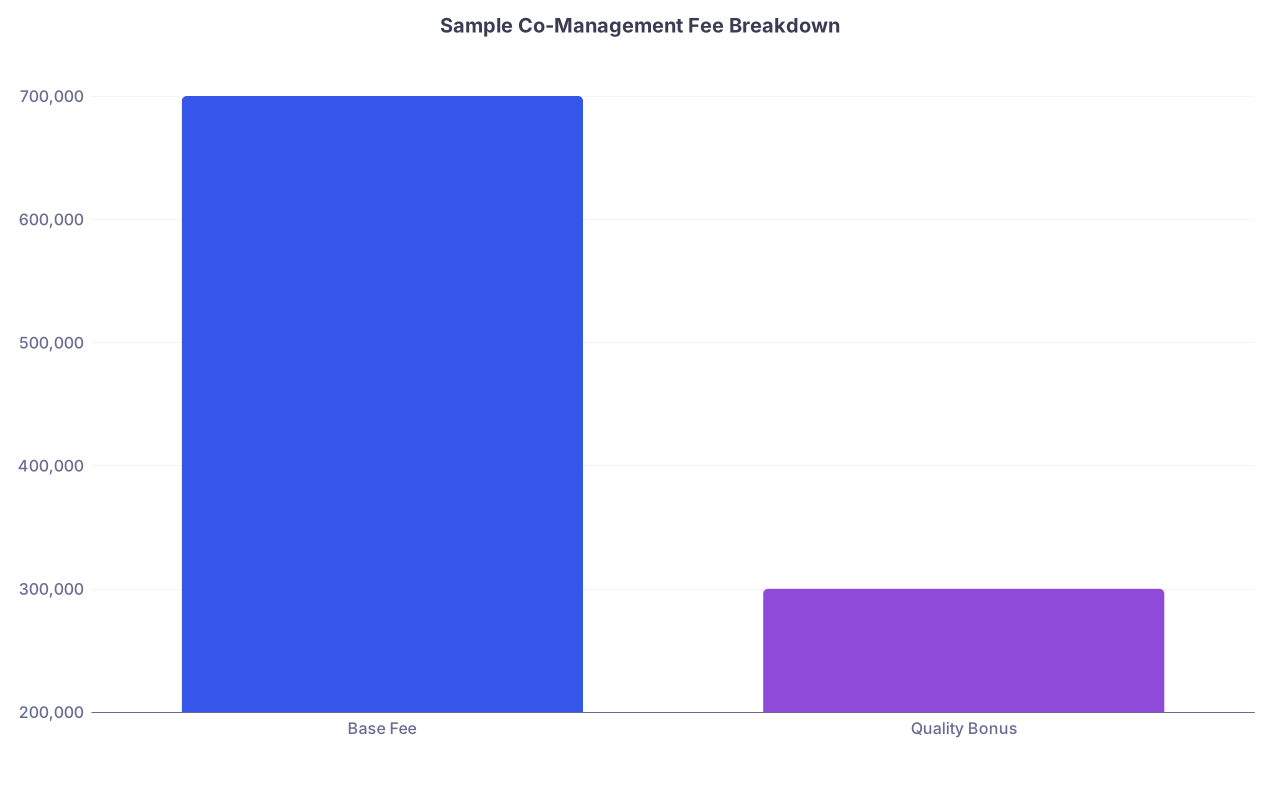
| Category | Value |
|---|---|
| Base Fee | 700000 |
| Quality Bonus | 300000 |
In a typical medium hospital cardiovascular co‑management deal, you might see:
- $700k base fee for the co‑management LLC
- Up to $300k available in quality/efficiency incentives
- Paid proportionally to physician owners based on shares, or to the physician group which then distributes.
Your Role and Time Commitment
Co‑management is not “free money.” If it is, it is illegal.
You will have:
- Standing committee meetings (quarterly or monthly)
- Task forces around protocol changes, EMR build-outs, order sets
- Data review and action plans based on metrics
- Coordination with nursing leadership, administration, and ancillary departments
The OIG has been very clear: there must be documented services for the management fees. “Medical staff loyalty” or “high volume referral” is not a service.
Compliance Landmines in Co-Management
This is the structure Stark/AKS lawyers look at with a magnifying glass.
Restrictions include:
- Compensation must be FMV and commercially reasonable, without regard to volume or value of referrals.
- Quality metrics must be legitimate clinical / operational metrics, not simply volume growth.
- No double‑paying physicians for the same work (e.g., you cannot bill for clinical time and also claim the same time as “management services”).
I have seen agreements where the hospital tried to bake in measures like “increased case volume through our cath lab” as an incentive metric. That is a red flag. It is essentially paying for referrals.
When Co-Management Is Worth Your Time
Co‑management is attractive if:
- You are already acting as de facto service line leaders, unpaid.
- The hospital is willing to share governance and listen to your input on protocols, staffing, capital investments.
- You want leadership experience without becoming a full‑time administrator.
- The incentive metrics are within your influence (throughput, protocols, scheduling) and not purely administrative fantasy.
But it is not for everyone. If you are clinically maxed out and allergic to meetings, chasing 10–20% extra income through co‑management may not be rational.
Putting It All Together: Comparing PSA, MSO, and Co-Management
Let me simplify how these three models differ across key dimensions.
| Dimension | PSA | MSO | Co-Management |
|---|---|---|---|
| Core Purpose | Buy physician services | Provide admin/management | Manage a specific service line |
| Who Employs Physicians | Group/PC | Group/PC | Usually unchanged (group/PC) |
| Main Revenue Source | Hospital payment for services | Management fees from practice | Management & incentive fees |
| Your Pay Driver | FTE/wRVUs/quality bonus | Professional collections net | Management + quality incentives |
| Control Shift | Clinical time & schedule | Business ops & overhead | Service line operations |

| Category | Clinical Work | Business Ops | Quality/Leadership |
|---|---|---|---|
| PSA | 60 | 20 | 20 |
| MSO | 30 | 50 | 20 |
| Co-Management | 40 | 30 | 30 |
This is why you feel confused when a hospital bundles them:
- PSA = how they buy your clinical labor
- MSO = how they structure the business / admin support
- Co‑management = how they share leadership and quality incentives for a line of service
Hospitals often layer them. Example:
- You sign a PSA for your cardiology work.
- Your group contracts with the hospital MSO for billing and IT.
- A subset of your cardiologists join a co‑management LLC for the cardiovascular service line.
Three contracts. Three flows of money. Three sets of obligations.
Practical Scenarios: What This Looks Like in Real Life
Let us walk through a few scenarios you are likely to see.
Scenario 1: The Independent Group Offered a PSA + Co-Management
You are part of a 7-physician orthopedic group covering a community hospital.
Hospital proposal:
- PSA: They will pay your group $550,000 per 1.0 FTE surgeon, wRVU-based bonus above 8,000 wRVUs.
- Co‑management: A joint LLC for orthopedic service line management with $400,000 base + $200,000 quality/efficiency bonus pool, split 50/50 between hospital and physician members.
Key questions you should ask:
PSA:
- How are FTE and call defined? Will they “re‑base” compensation after 2 years?
- Who controls clinic templates and OR block allocation?
- What are the noncompete / exclusivity terms?
Co‑management:
- Exactly what metrics drive the $200,000 bonus? Are they realistic?
- How much time will be required, and how is physician time documented?
- Who are the physician members? Does your group control its own representation?
Scenario 2: The Employed Group Being “Transitioned” to MSO + PSA
You are hospital-employed cardiology now. Administration says they are “moving to a more integrated model”:
- Your future:
- You will form a professional corporation (PC).
- The hospital’s MSO will provide all business infrastructure for a 12% collections fee.
- A PSA will pay your PC for cardiology coverage and clinic services at FMV.
Here is the real translation:
- You are moving off W‑2 hospital employment.
- The hospital wants you to bear more of the risk and overhead.
- They want to maintain referral control and service line control without your salary on their books.
Your decision revolves around:
- Can you, as a group, run a PC profitably with a 12% drag to the MSO?
- How tight is the PSA—does it protect your income floor, or are you fully exposed to volume shifts and hospital whims?
- Is the MSO actually adding value (contracting, billing lift) or just adding cost?
How to Evaluate Which Model Serves You Best
You do not need to become a healthcare attorney, but you do need a framework. Think in five buckets:
1. Income Stability vs Upside
PSA with FTE guarantees = more stability, less upside.
MSO with independent billing = more upside if you have strong volumes and payer mix, more downside if you do not.
Co‑management = side income tied to leadership effort and system performance.
If you have young kids, high fixed costs, and no appetite for swings, you will lean toward stability.
2. Autonomy and Control
Rank them roughly like this for day‑to‑day clinical autonomy (best to worst):
- Independent practice with MSO support, light PSA
- Independent practice with limited PSA, no co‑management
- PSA with tight hospital operational control
- Direct employment with heavy top‑down management
Co‑management can improve your voice in hospital decisions if structured honestly.
3. Administrative Burden
Where do you want your time to go?
- PSA: modest extra admin, mostly contract reporting and committee work.
- MSO: front‑loads administrative complexity when setting up, ideally offloads you later.
- Co‑management: ongoing meeting and project work. The more serious the hospital, the more time it will eat.
Be realistic. If you are already working 60+ hours clinically, you will not magically find 10 “management” hours that feel good.
4. Legal and Compliance Risk
Your exposure rises when:
- Payments look like they track referrals or volume growth, not actual services.
- Metrics in co‑management look suspiciously like “do more procedures here.”
- MSO fees are not clearly tied to FMV services.
You should absolutely have your own healthcare counsel (not the hospital’s) look at anything with co‑management or MSO involvement.
5. Exit Options and Leverage
This is the part people ignore until the relationship sours.
Ask:
- How can I get out? What are termination clauses?
- Who owns the charts, the staff, the space if we separate?
- Can we take our patients and payer contracts with us?
Long-term, non‑terminable MSO contracts and PSAs with one‑sided termination rights are how hospitals trap groups.
What You Should Do Before Signing Anything
Very concretely, here is what I tell physicians facing these structures:
Get the full stack of documents
Do not agree based on a PowerPoint. You want:- PSA draft
- MSO agreement draft
- Co‑management agreement draft
- Any related bylaws or medical staff policies referenced
Map the money
On one sheet of paper, draw:- Where every dollar of professional revenue goes
- What the MSO keeps
- What the hospital pays to the PSA
- What the co‑management fees could realistically be
Then compare to your current net income.
Stress-test the downside
What happens if:- Volume drops by 20%?
- The hospital “rebases” FMV downward in 3 years?
- Key partners leave or retire?
Bring in your own experts
- Healthcare attorney for compliance and Stark/AKS review
- Accounting advisor for tax and cash flow implications
- Maybe a consultant who has actually negotiated PSAs and co‑management deals
Decide what you actually want
Do you want to be an operator and leader (MSO/co‑management), or do you want to be mostly a clinician with predictable pay (tight PSA / employment)?
You cannot optimize for everything simultaneously.

Final Thoughts
Three things I want you to leave with:
PSA, MSO, and co‑management are not buzzwords. They are levers hospitals use to control labor, operations, and revenue. Understand who employs you, who bills, and who really controls decisions.
Follow the money and the control. If the MSO or co‑management layer adds complexity without clear value or shared governance, you are probably being used to de‑risk the hospital’s position, not to truly partner.
Protect your downside before you chase upside. Lock in clear definitions of FTEs, call, metrics, termination rights, and FMV rebasing. Then, if the partnership is honest, you can actually win in these models instead of being quietly squeezed by them.