
Most physicians sign away their nights and weekends without ever negotiating the call schedule. That is a mistake. A big one.
If you remember nothing else, remember this: call is work. Call is money. Call is risk. It belongs in the contract as clearly as your base salary and RVU targets. Anything less is charity for the hospital.
Let me break this down specifically, because this is where even smart people get steamrolled.
The Core Principle: Call Must Be Defined, Quantified, and Paid
Every call-schedule problem I have seen post-residency comes back to three missing things:
- No hard numbers.
- No definitions.
- No enforcement mechanism.
You fix that with clauses. Written. In the contract. Not “we’ll be reasonable,” not “we generally do Q4,” not “you’ll be similar to the group.” That language is how people end up Q2 for 18 months “until we recruit.”
At minimum, your contract needs to lock down:
- What type of call you do (home, in-house, backup, hospitalist cross-cover, etc.).
- How often you do it (max nights per month, max weekends, holiday rotation).
- How and when you get paid for it (flat rate, per shift, per wRVU, differential).
- What happens if the hospital/group fails to recruit as promised.
- What off-ramps you have if call becomes excessive or unsafe.
We will go clause by clause. I will show you specific language patterns that protect your time vs language that will hang you.
Step 1: Define Call Explicitly (No More Vague Promises)
Most contracts toss in one harmless-looking line: “Physician shall participate equitably in group call.” That line is a knife. “Equitably” means whatever the person making the schedule feels like.
You need definitions first.
A. Types of Call – Put Them in Writing
You should see something close to this level of specificity:
- “In-house call” – physically in the hospital, on site, for X-hour shifts.
- “Home call” – phone coverage with requirement to present within X minutes if called in.
- “Backup call” – second-tier call only if primary is unavailable or census crosses trigger.
- “Subspecialty call” – e.g., stroke call, cath lab call, trauma panel, OB backup, etc.
- “Cross-coverage call” – covering other services (e.g., you cover ICU + wards overnight).
Your contract should list exactly which call pools you are expected to participate in. No “and other reasonable duties as assigned” attached to call.
Problem pattern I see all the time: general surgeon signs for “general surgery call,” then finds out that includes trauma panel, emergency hernias all night, unbalanced transfers from 4 feeder hospitals. None of that was spelled out.
You want something like:
“Physician shall participate in general surgery home call for Hospital A only. Physician will not participate in trauma call, Pediatric surgery call, or coverage for Hospital B or C without a separately negotiated written amendment including compensation terms.”
That last sentence is your shield when the hospital buys another campus and tries to add you to a second call pool “temporarily.”
B. Response Times and Expectations
If you have home call or backup, the contract should define:
- Required response time to phone/page (e.g., within 10 minutes).
- Required in-person arrival time when called in (e.g., within 30–45 minutes).
- Whether you are expected to be within X miles of the hospital.
If those are not defined, they will be defined against you later by policy or “standard of care.” I have seen credentialing committees wave a generic “within 30 minutes” rule written nowhere in the contract and use it to discipline someone.
You can require this instead:
“Home call shall require physician to be available by phone within ten (10) minutes and, when requested to present in person, to be able to arrive at Hospital A within forty-five (45) minutes.”
If they balk at putting numbers, that tells you what you need to know about how they will treat your time.
Step 2: Cap the Frequency — Hard Numbers, Not “Equitable”
Here is where you protect your sanity.
You need absolute maximums. Not “around” or “usually” or “typical for the group.” If a recruiter says, “We’re usually Q6–Q7,” your follow-up line is: “Good. Then you will not mind putting Q6 minimum, Q4 maximum into the contract.”
A. Nights, Weekends, and Holidays – Put Exact Caps
Use separate caps for:
- Weeknight call (Sunday–Thursday nights).
- Weekend call (Friday 5 pm – Monday 7 am).
- Holiday call (defined list of holidays).
Example language:
“Physician shall not be scheduled for more than:
- Six (6) weeknight call shifts per month, and
- Two (2) weekend call shifts per month, and
- Three (3) major holiday call shifts per calendar year.”
Then define “major holiday” explicitly in the contract. Do not assume.
You can also push for an annual call cap to prevent a front-loaded year:
“Total call shifts shall not exceed ninety (90) per calendar year without physician’s written consent and additional compensation at the agreed call shift rate.”
B. “Equitable” – If It Stays, It Must Be Quantified
If the employer insists on “equitable,” you counter with:
“Equitable call shall mean within plus or minus one (1) call shift per month of the average number of call shifts assigned to full-time physicians in the same specialty in the group.”
Now “equitable” has teeth. If everyone else is Q7 and they push you to Q3 “for a few months,” you have a contractual argument.
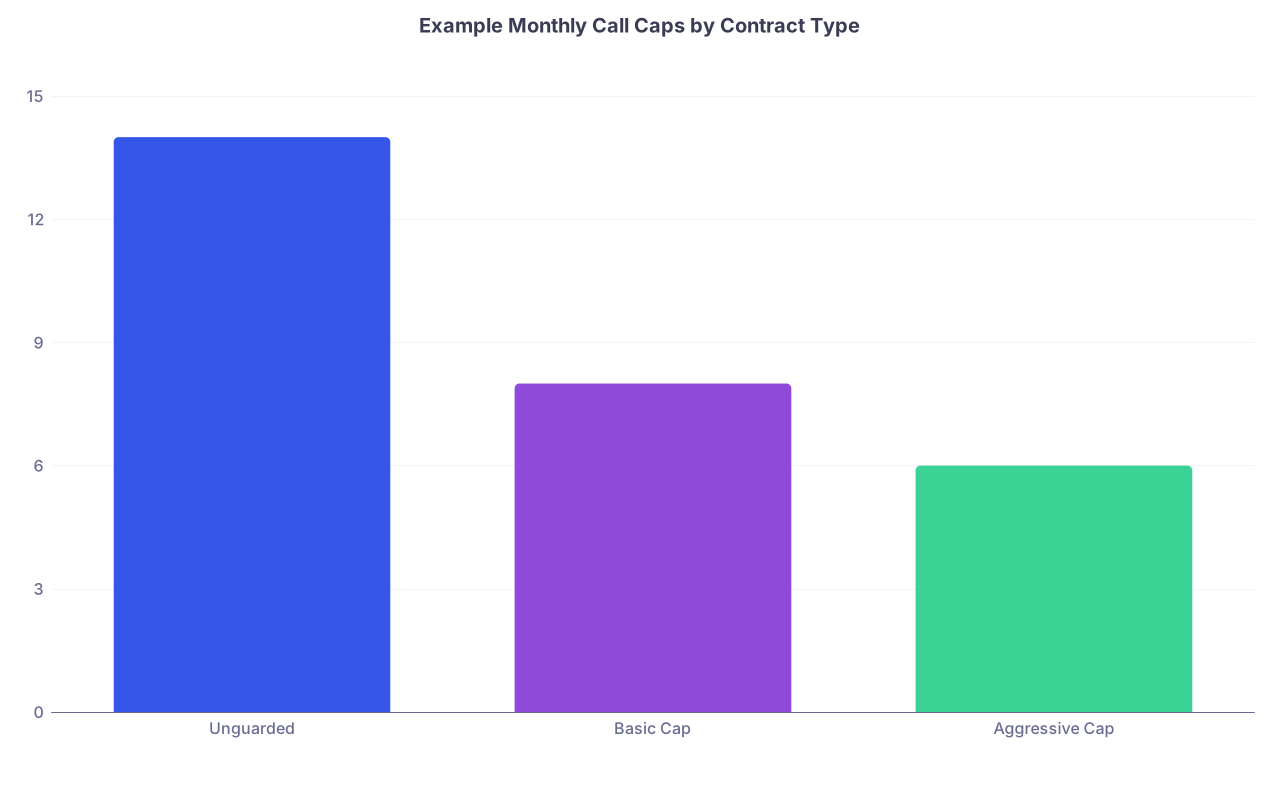
| Category | Value |
|---|---|
| Unguarded | 14 |
| Basic Cap | 8 |
| Aggressive Cap | 6 |
- Unguarded: what I routinely see quietly happen to new partners with no cap.
- Basic: what a cautious new hire can usually get.
- Aggressive: what a shortage market or highly competitive candidate can negotiate.
Step 3: Tie Call to Money — Not Just “Part of Your Duties”
Call that is “just included in salary” is the employer’s favorite trick. It lets them dump as many shifts as they want onto you with no marginal cost.
Sophisticated contracts treat call as one of three things:
- Fully separate compensation line item.
- Included up to a point, then paid extra beyond that.
- Structured as a differential for nights/weekends/holidays.
A. Straight Call Pay Clause
Best-case scenario, especially for hospital-employed or multispecialty groups:
“Call coverage shall be compensated at a rate of $X per weeknight call shift and $Y per weekend or holiday call shift, payable monthly.”
You can split rates by:
- In-house vs home.
- Primary vs backup.
- Regular weekend vs major holiday.
The numbers vary by specialty and region, but the structure should be there. When people say, “Our call is unpaid,” what they really mean is, “Our call is infinitely cheap for the hospital.”
B. Included up to a Threshold
Sometimes you will not win straight call pay, especially early in your career. Then you negotiate quantifiable “included call” and “excess call.”
Example:
“Base salary includes up to:
- Five (5) weeknight calls per month, and
- Two (2) weekend calls per month.
Any call shifts beyond these amounts shall be compensated at $X per additional weeknight call and $Y per additional weekend or holiday call.”
This prevents the slide into “we’re short-staffed, so we just need you to pick up more for the same salary.” They want more of your nights; they pay more.
C. RVUs and Call – Do Not Let Them Double Count
If you are on an RVU-based plan, the classic scam is: “We do not pay for call, but you get RVUs for the work you do on call.” Translation: you carry the risk, the fatigue, the restriction of your time, and they pay you only for the extra work, not the availability.
If call is heavy, this is not acceptable.
What you can do:
- Either get per-shift call pay on top of RVUs, or
- Negotiate a call stipend (monthly) based on expected burden.
Example:
“In addition to wRVU-based compensation, physician shall receive a call stipend of $3,000 per month in consideration for night and weekend availability.”
If they push back: remind them that availability with no patients still prevents you from leaving town, drinking, sleeping normally. That has value.
Step 4: Protect Yourself from “Temporary” Overload and Recruiting Failures
This is where people get burned the worst.
Hospital says: “We are recruiting two more partners, so call will be Q6. You’ll just help us for a bit.” Then a year later, nothing. You are doing Q2 call and feel like you have no recourse.
You can fix this with explicit “recruitment failure” and “temporary burden” clauses.
A. Temporary Increased Call – With Time and Money Limits
Spell out what “temporary” means:
“In the event of unexpected physician departure or short-term staffing shortage, physician may be scheduled for additional call beyond the caps described above for a period not to exceed ninety (90) consecutive days. Any such additional call shall be compensated at 150% of the standard call rate per shift.”
Notice two protections:
- Time boxed (90 days).
- Paid at a premium, not regular rate.
After 90 days, if they still have staffing problems, that is not a temporary crisis. That is a structural issue. Your contract should treat it that way.
B. Recruitment Contingency Clause
If they are waving “we’re hiring three more surgeons” in front of you, put it in the contract as a conditional schedule:
“Call schedule projections provided to physician assume recruitment of two (2) additional full-time surgeons by June 30, 2027. If such recruitment has not occurred by that date, physician’s call obligations shall be reduced to no more than five (5) call shifts per month, or, at physician’s option, physician may elect to reduce FTE status or terminate this agreement without penalty with ninety (90) days’ written notice.”
This is how you avoid getting trapped as the only night coverage for an entire region.
Step 5: Holidays, Post-Call, and Recovery Time
Hospitals and groups are very good at acting surprised when you ask for post-call protections. “We all just push through here.” I have watched 60-year-old cardiologists say that to a new grad while clearly half-dead themselves.
You negotiate this up front, not in your third year when you are already “the workhorse.”
A. Post-Call Clinic Expectations
Worst pattern: full clinic day after in-house call because “that is how we do it.” That is how you break. That is how errors happen.
Contract language to aim for:
“Physician shall not be scheduled for routine clinic duties on the calendar day immediately following an in-house overnight call shift ending after 7:00 am.”
If they will not give you a full recovery day, calibrate down but still carve out something:
“Clinic scheduling the day after overnight call shall not exceed four (4) hours of non-procedural appointments.”
The key idea: the post-call day is not invisible. Your outpatient schedule must reflect your call burden.
B. Mandatory Rest Between Shifts
You are not a resident anymore. If your contract is silent, they will treat you worse than a resident.
Aim for something like:
“There shall be at least ten (10) hours of uninterrupted time off between the end of a call shift and the start of the next scheduled clinical duty, except in declared emergencies.”
This type of clause is common in anesthesia, critical care, EM, and high-risk surgical fields. If your specialty is not used to it, you will get resistance, but it is worth pushing.
C. Holiday Rotation – Stop the “New Doc Takes Extra” Trap
I have watched groups “traditionally” dump more holidays on the new person because “you’re young, you can take it.” Then that “tradition” somehow never gets reversed.
Quantify it:
“Holiday call shall be shared equally among full-time physicians in the group such that no physician is assigned more than one (1) major winter holiday (Thanksgiving Day, December 24–25, December 31–January 1) per calendar year unless by voluntary swap.”
Put the exact holidays in the contract. And specify swap is voluntary. No “we all agreed you should take Christmas this year.”
Step 6: Multi-Site Coverage and the “Creep” Problem
Hospitals consolidate. Systems merge. Suddenly you are on call for 3 campuses 45 minutes apart.
If your contract does not lock your call to specific locations, they will spread you thin and say, “This is still the same job.”
You prevent this with a very simple listing clause:
“Physician’s call obligations under this agreement shall be limited to Hospital A and its attached outpatient surgery center. Physician shall not be required to provide call coverage for any additional facilities, hospitals, or campuses without physician’s written consent and an amendment to this agreement including revised compensation.”
I have personally watched an orthopedic surgeon lose every third weekend to covering a surgically weak satellite hospital an hour away, because his contract just said “hospital system” call. Do not do that to yourself.

Step 7: Call and FTE Status – Tie the Two Together
Full-time status and call burden are linked. If you ever want to downshift your FTE, you want your call load to decrease proportionally. That does not happen by magic. It happens because you write it down now.
Example:
“Call obligations shall be proportional to physician’s FTE status. At 1.0 FTE, physician shall participate at the full call level described above. If physician reduces to 0.8 FTE, call obligations shall be reduced to 80% of full call.”
Why this matters: Highly common scenario is a mid-career physician dropping to 0.7–0.8 FTE for family or burnout reasons, only to discover their call remains essentially full-time “because the group needs it.” Then their “day off” becomes recovery from free call.
Tie call to FTE, explicitly.
Step 8: Enforcement: What Happens If They Ignore the Contract
If your contract sets beautiful caps and pay structures but has zero mechanism when they blow past them, you are relying on goodwill. Which is not a plan.
You need two things:
- Automatic triggers (e.g., extra pay, right to refuse).
- A clear out clause (termination/reduction of duties without penalty).
A. Automatic Extra Compensation for Over-Cap Call
This should not require you to argue every quarter. Build it in:
“Any call shifts assigned beyond the monthly caps specified shall be compensated at 150% of the standard call shift rate and shall be itemized in the following month’s paycheck without the need for additional written request by physician.”
They will still screw this up at times, but now you have something concrete to point to.
| Scenario | Standard Rate | Over-Cap Rate |
|---|---|---|
| Weeknight primary call | $600 | $900 |
| Weekend primary call | $1,000 | $1,500 |
| Holiday call | $1,500 | $2,250 |
| Backup call (any day) | $300 | $450 |
B. Right to Decline Additional Call
You will not always get this, but it is powerful:
“Physician shall have the right to decline call assignments beyond the contractual caps without this being considered a breach of duties or grounds for adverse action.”
At minimum, you want language that extra call must be mutually agreed, not unilaterally imposed:
“Additional call assignments beyond contractual caps shall be by mutual agreement between physician and group.”
C. Early Termination for Material Breach of Call Terms
Call is not a “soft” promise. For many of you, it is the main determinant of quality of life. Treat it as a core term whose violation lets you leave.
Something like:
“Persistent scheduling of physician for call in excess of the maximum caps described, for three (3) or more consecutive months, shall constitute a material breach of this agreement. In such event, physician may terminate the agreement with thirty (30) days’ written notice without repayment of any signing bonus or relocation assistance.”
That last part matters: you do not want them threatening to claw back your bonus if you leave because they abused your call.
Step 9: Sample Clause Bundle – How This Actually Looks
Let me put this together in a compact example so you see the structure. This is a rough bundle for a hospital-employed general internist with hospitalist call:
Section X – Call Coverage
Physician shall participate in internal medicine hospitalist home call for Hospital A only. Physician shall not be required to provide call coverage for any other facility without a written amendment including revised compensation.
Home call requires physician to be available by phone within ten (10) minutes and, if requested to present in person, to be able to arrive at Hospital A within forty-five (45) minutes.
Call obligations shall not exceed:
a. Six (6) weeknight call shifts per month; and
b. Two (2) weekend call shifts per month; and
c. Two (2) major holiday call shifts per calendar year (Thanksgiving Day, December 25, January 1).Base salary includes up to four (4) weeknight and one (1) weekend call shift per month. Any call shifts beyond these included amounts shall be compensated at $600 per additional weeknight and $1,000 per additional weekend or holiday call shift.
Call obligations shall be proportional to physician’s FTE status.
In the event of short-term staffing shortage, physician may be scheduled for additional call for up to ninety (90) days. Any such additional call beyond the caps in Section 3 shall be compensated at 150% of the rates in Section 4.
Physician shall not be scheduled for routine clinic duties on the calendar day immediately following an in-house overnight call shift ending after 7:00 am.
Persistent scheduling of physician for call in excess of Section 3 caps, for three (3) consecutive months, shall constitute material breach and permit physician to terminate this agreement with thirty (30) days’ notice without repayment of signing bonus or relocation assistance.
Is this aggressive? Yes. Will you get every line? No. But you will get more than if you walk in with nothing but “I hope they are fair.”

| Step | Description |
|---|---|
| Step 1 | Review Offer |
| Step 2 | Request detailed call terms |
| Step 3 | Propose monthly and annual caps |
| Step 4 | Negotiate call pay or stipends |
| Step 5 | Add recruitment contingency clause |
| Step 6 | Finalize with attorney review |
| Step 7 | Call defined clearly |
| Step 8 | Caps on call present |
| Step 9 | Is extra call compensated |
| Step 10 | Recruitment promises written |
Step 10: How Hard Can You Push? Reality Check by Specialty
You do not negotiate in a vacuum. Some specialties have more leverage. Others have deeply entrenched call cultures.
Broad, honest snapshot:
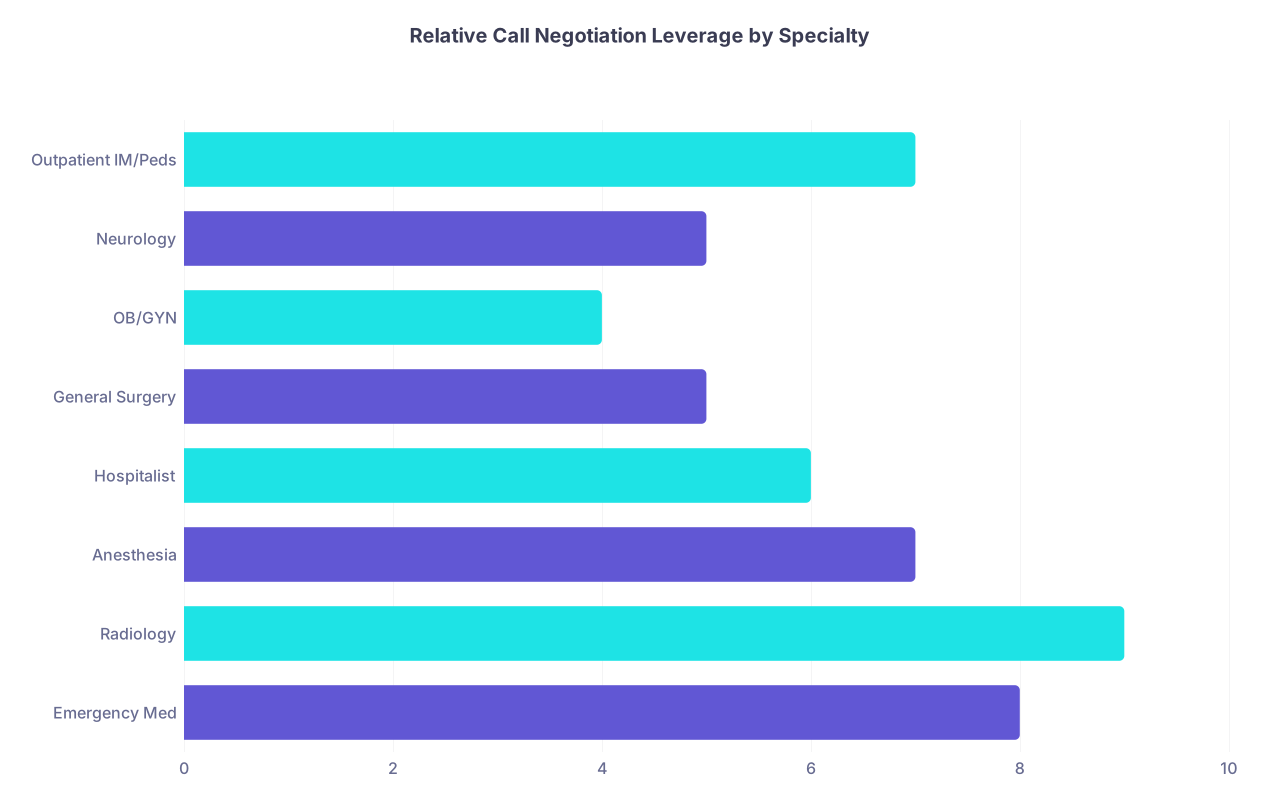
| Category | Value |
|---|---|
| Emergency Med | 8 |
| Radiology | 9 |
| Anesthesia | 7 |
| Hospitalist | 6 |
| General Surgery | 5 |
| OB/GYN | 4 |
| Neurology | 5 |
| Outpatient IM/Peds | 7 |
Scale 1–10, higher means more typical leverage for structured call negotiation at many sites. Not scientific. Just what I see repeatedly.
Patterns:
- Radiology and some procedural subspecialties: call stipends and structured nighthawk coverage already common. Easier to quantify.
- EM: more shift-based than “call,” but night/weekend differentials and holiday premiums are very negotiable.
- OB/GYN, Gen Surg: call is often “traditionally included,” but recruitment shortages give you leverage. Rural hospitals will pay real money for you to take their nights.
- Outpatient IM/Peds: many jobs have no real call, or light phone-only call. Here you negotiate hard limits on “admit creep” and inpatient obligations more than raw call stipends.
One more ugly truth: your leverage is highest before you sign. Once you are in the door, they will praise your “team spirit” while quietly assigning you more call.
FAQ (Exactly 6 Questions)
1. Can I really walk away from a job offer just over call schedule issues?
Yes, and you probably should if red flags stack up. If a group refuses to define call, refuses caps, and will not even consider paid extra call, they are telling you their business model relies on exploiting physician time. I have seen people accept anyway because “the salary is good,” then regret it for years. There will be other offers. There will not be another decade of your life.
2. How much call is “reasonable” for a new attending?
There is no universal number. But here is a rough sanity check: if your average month has more than 1 in 3 nights on call (Q3 or worse), or more than 3 full weekends of significant responsibility, that is high. You might tolerate it for a defined, paid, short term. As a baseline for multiple years? That is a recipe for burnout. The best benchmark is what mid-career physicians in that group are actually doing. Not what they say. What they live.
3. Should I hire an attorney just for call clauses?
For your first attending contract, yes. Especially if call is non-trivial. A healthcare contract attorney will see patterns you will miss and can translate your concerns into enforceable language. They are not cheap, but neither is losing 15 weekends a year for the next 5 years. I have never seen a physician regret getting a competent attorney. I have seen many regret skipping it to “save money.”
4. What if the group says, “We never put call details in contracts”?
That is not a tradition; that is a control tactic. You respond: “Then how do I know what I am agreeing to? I am not comfortable signing a blank check on nights and weekends.” At minimum, you insist on an attached written call policy with hard numbers, referenced in the contract. If they will not do even that, assume call will be worse than described and absolutely non-negotiable once you start.
5. How do I handle being the newest hire without looking entitled?
You focus on clarity and fairness, not special treatment. Say explicitly: “I am not asking for less call than others. I am asking that my call burden be defined and limited in line with the group.” Then push for language like “within one shift of group average,” proportional to FTE, and clear caps. Senior partners who are reasonable will respect that. The ones who do not respect it are the same ones who will happily dump their weekends on you if you stay vague.
6. Is it better to negotiate fewer call shifts or higher call pay?
Ideally both, but if you must choose, I favor caps first, compensation second. Time is the non-renewable resource. A well-defined cap protects your life. Higher call pay is nice but can seduce you into tolerating an unsustainable schedule. The best structure is: reasonable caps, fair base expectations included in salary, and premium pay for anything beyond that. That way, if you choose to do extra, you are properly compensated. If not, your nights are protected.
Key takeaways:
- Call that is not explicitly defined, capped, and compensated in your contract will expand until you break.
- You have real leverage before you sign; use it to hard-wire numbers, locations, post-call protections, and breach remedies.
- Treat call like salary: quantifiable, negotiable, and central to whether the job is actually livable, not just theoretically “good.”