
The safest job in medicine right now is not a “full-time position.” It is a well-designed portfolio career.
Let me be blunt. The idea that you should finish residency, sign a single W‑2 job, and stay there for 20 years is outdated for most specialties. Reimbursement volatility, RVU games, non-compete traps, and admin creep have made the classic “stable job” feel anything but stable.
The physicians who are actually insulated? The ones who can earn from several different clinical streams: telemedicine, locums, and per-diem work that fit together like gears instead of random side gigs.
You are not trying to “collect jobs.” You are engineering a system that:
- Covers your baseline financial needs reliably
- Gives you leverage when any one employer misbehaves
- Preserves your sanity and clinical standards
- Leaves optionality for future shifts (academics, admin, niche clinics, or partial retirement)
Let me break this down specifically.
1. What a Portfolio Career Actually Is (And What It Is Not)
A portfolio career is not “I’m burned out and picking up a random telemed shift on Wednesdays.” That is just overtime in disguise.
A real portfolio career has three properties:
- Multiple income streams that are deliberately chosen and partially independent of each other.
- Defined role boundaries (you know exactly what you provide and what you do not) for each stream.
- An intentional floor and ceiling: you know your guaranteed minimum income and your realistic upside if you decide to push.
For a post‑residency clinician, the three most synergistic building blocks are:
- Telemedicine (predictable, location-flexible, usually W‑2 or 1099)
- Locums (high yield blocks, geographic leverage, usually 1099)
- Per-diem / PRN local work (anchor relationships, skill maintenance, and sometimes benefits)
Why these three? Because they stress different axes:
- Telemed → location-flexible, lower intensity, heavy on protocols and throughput
- Locums → high pay compressing weeks of work into blocks, some travel burden
- Per-diem → ties you to a community and hospital system, supports credentialing and skills
Mixed correctly, they hedge each other’s weaknesses.
2. Start With the Hard Constraints: Money, Risk, and Life
Before you chase job postings, you need hard numbers and personal limits. Otherwise you will build chaos.
Define your non-negotiables
You need to actually write this down:
- Annual after-tax number to support your life and loan payments
- Maximum nights per month you are willing to do
- Maximum weekends per month
- Travel tolerance: “airport twice a month” vs “only driving distance”
- Non-clinical priorities: childcare, partner’s job, academic projects, research, health
Most people skip this step and then wonder why their schedule feels like it was built by a robot with a gambling problem.
Translate lifestyle into minimum clinical volume
You want a floor: the combination of telemed + PRN that reliably produces your minimum target, with no locums assumed. Locums should be treated as upside, not survival.
Example: Early-career hospitalist, target $260K after tax, in a no-income-tax state, single, loans $2K/month.
Back-of-envelope: aim for ~$350–380K gross. You might structure:
- Telehospitalist: 6–8 12-hr shifts/month @ $2000–2300/shift
- Local per-diem: 4–6 12-hr shifts/month @ $1900–2300/shift
- Optional locums: 5–7 shifts/month in chunks @ $2500–3200/shift
There are regional variations, but the logic holds. The floor is what you can do without traveling or abusing yourself. You then layer locums.
3. Understanding Each Component: Telemedicine, Locums, Per-Diem
You cannot combine what you do not understand. So, one by one.
Telemedicine: The Backbone of Flexibility
Telemed is not just “easy money from home.” Done wrong, it is a legal and moral minefield. Done correctly, it is the most flexible pillar of a portfolio career.
Common telemed models:
- Direct-to-consumer urgent care (plenty of volume; risk = scope drift + antibiotic pressure)
- Asynchronous visits / e-consults (chart review, photo review, messaging)
- Specialty tele-consults (ID, psych, endocrine, cards reading, radiology, etc.)
- Telehospitalist / tele-ICU (inpatient cross-coverage, admissions, night coverage)
- Employer / payer-based telehealth (chronic care, wellness, triage)
Key variables for you:
- Pay structure: per-visit, per-hour, per-shift, or RVU
- Expected volume and “soft quotas”
- Malpractice coverage and tail
- Protocols / guardrails (or lack of them)
- Tech support and documentation burden
The smarter play is to avoid stacking multiple DTC urgent care companies that all pay per-visit and push throughput. You are just replicating one risk stream.
Better pairing:
Telehospitalist (hourly) + one lower-intensity asynchronous platform + a specialty tele-consult side if you have the training.
Locums: Income Spikes and Negotiation Leverage
Locums is the sharp tool in the box. Powerful, but easy to cut yourself if you do not respect the edge.
Core features:
- Short or medium-term contracts (weeks to months)
- Higher pay per unit time than equivalent employed roles
- Varying control over schedule (some extremely rigid, some negotiable)
- Travel + lodging covered or stipend
- 1099 income (you are the business)
Locums is fantastic for:
- Crushing debt faster with scheduled bursts of high income
- Testing different practice environments before committing
- Maintaining leverage in negotiations (“I do not need your job at this rate”)
- Geographic arbitrage – living in a cheaper city while working in high-rate markets
The main mistake I see: people treat locums as a random patchwork of shifts instead of block scheduling. You want 5–7+ consecutive days at a site so your travel time is amortized and your brain is not constantly re-loading different EMRs and protocols.
Per-Diem / PRN: Your Local Anchor
Per-diem work is not glamorous. But the strategic value is underrated.
Local PRN roles provide:
- Community and professional relationships (referrals, references, future offers)
- Ongoing credentialing and hospital privilege stability
- Hands-on skills maintenance, especially for procedures or higher acuity care
- A fallback if telemed regulations or reimbursement change
Good per-diem is:
- Predictable enough (you get offered X shifts/month, even if you decline some)
- Not so underpaid that it feels exploitative
- In a setting that gives you clinical range that telemed cannot
For an EM doc, this might be a community ED 2–4 shifts/month. For a psychiatrist, a partial hospital program or inpatient weekend coverage. For a family physician, urgent care or a high-functioning primary care clinic that tolerates part-time.
4. Fitting the Pieces Together: Patterns That Actually Work
Let me give you real patterns that I have seen work. Not theoretical.
Pattern 1: Telemed-Heavy With Strategic Locums
Who this fits: Psych, IM, FM, EM, pulm/critical care (with tele-ICU available), ID.
Skeleton:
- 8–10 telemed shifts/month (mix of telehospitalist + specialty or urgent care)
- 2–4 local per-diem shifts/month
- 7–10 days of locums every 1–2 months
This pattern creates:
- A stable telemed base (often from one dominant employer and one smaller platform)
- Local clinical presence for skills and credentialing
- Locums bursts timed to your financial goals (e.g., two heavy locums blocks in Q1 to front-load retirement and loan payments)
Pattern 2: Locums-First With Telemed Floor
Who this fits: Hospitalists, anesthesiologists, EM, some surgical subspecialties, OB if you can find laborist locums.
Skeleton:
- 10–15 days/month of locums in consolidated blocks
- 4–6 telemed shifts/month to keep cash flowing between contracts
- Optional per-diem if local options exist and do not conflict with locums contracts
This is the “I want max income and flexibility and I am willing to travel” model. The key is to avoid creating long periods of zero work because a contract slipped. Telemed fills that void.
Pattern 3: Local PRN Anchor With Telemed Overlay (Minimal Travel)
Who this fits: People with strong geographic constraints, heavy family obligations, or travel aversion.
Skeleton:
- 6–10 local per-diem shifts/month across 1–2 systems or urgent care chains
- 6–10 telemed shifts/month
- Occasional regional locums (driving distance) for targeted savings goals
This can easily hit a full-time income while keeping you home, at the cost of giving up some of the highest locums rates.
5. Time, Energy, and Burnout Math (Not Just Dollars)
If you design your portfolio on dollars alone, you will blow yourself up in 12–18 months. The whole point of a portfolio is better control over how you work, not just more cash.
You need a basic energy budget.
Categories:
- High-intensity clinical: ED, ICU, complex inpatient
- Moderate: standard ward, urgent care, fairly bounded telemedicine
- Low to moderate: asynchronous work, chronic care check-ins, routine outpatient follow-up
You cannot string together:
3 nights of in-house ICU locums
- 2 days of ED per-diem
- 2 heavy tele-urgent care shifts
and call that a sustainable “week.”
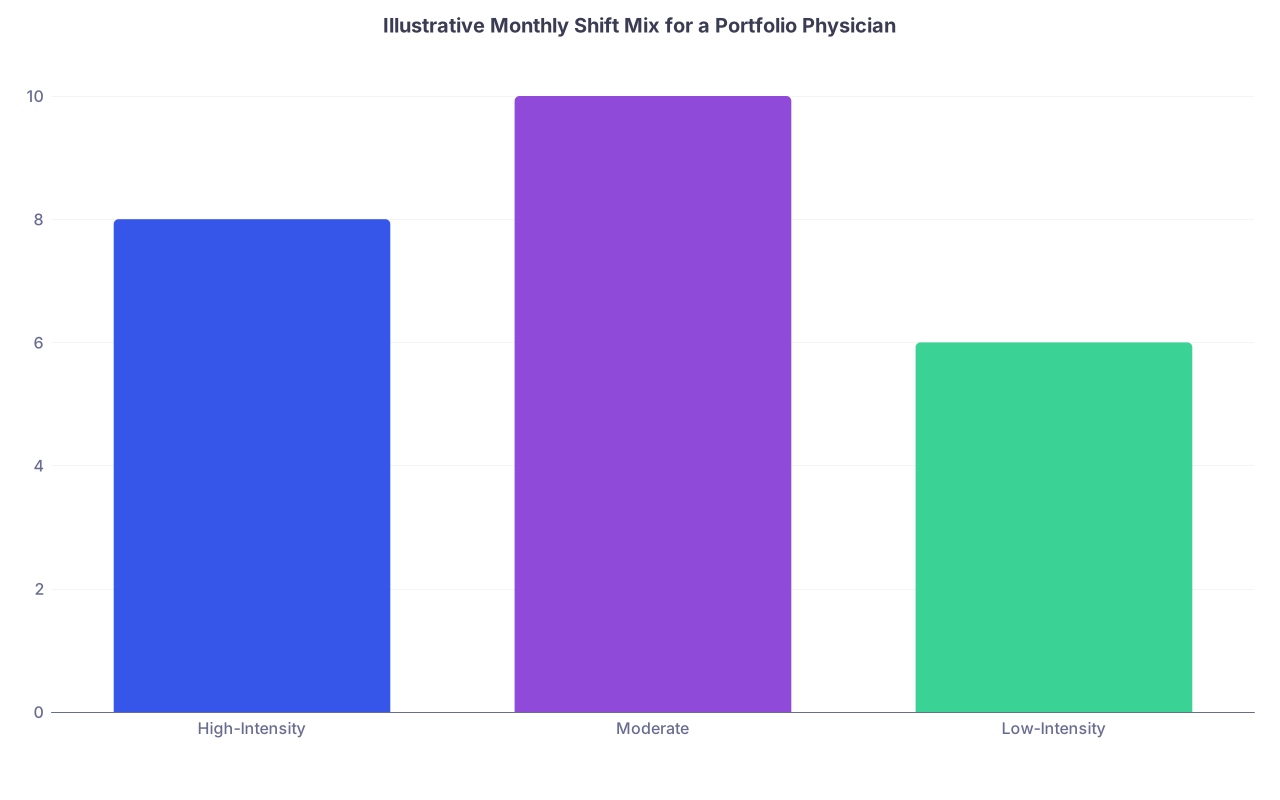
You should be mapping your month roughly like this:
- High-intensity days/nights: cap them. Many safe-acting clinicians find 8–10 true high-intensity shifts/month is their limit.
- Moderate: you can flex here, but stack them with recovery windows.
- Low-intensity telemed: use these as income bridges and “light” weeks.
| Category | Value |
|---|---|
| High-Intensity | 8 |
| Moderate | 10 |
| Low-Intensity | 6 |
This is illustrative, not prescriptive. The point is the ratio. If high-intensity days are creeping into the mid-teens every month, you are running hot.
6. Credentialing, Licensing, and Malpractice: The Hidden Infrastructure
This is where most people underestimate the grind. A multi-stream career rests on boring infrastructure.
State licenses
Telemed and locums both reward multi-state licensing.
For telemed-heavy practice:
- Prioritize large-population states your platforms actually serve (CA, TX, FL, NY, PA, IL, etc.)
- Use the Interstate Medical Licensure Compact if eligible to accelerate
For locums-heavy:
- Let agencies tell you where current high-rate demand is, then target those states.
- Do not hold ten licenses you never use; every renewal is time and money.
Hospital privileges
You want at least one stable set of local privileges that are not constantly opening/closing based on locums contracts. That is usually your per-diem or a core locums site you remain loyal to.
Pro tip: be extremely organized with your:
- Case logs
- Procedure logs
- CME certificates
- Immunizations and employee health records
- Malpractice history and explanation letters
I have watched physicians lose months of earning potential because their packet was a mess and credentialing committees just kept punting.
Malpractice alignment
You must know, explicitly, for each stream:
- Who covers malpractice? (company vs you)
- Is there tail coverage, and who pays for it?
- Occurrence vs claims-made?
- Any gaps when you leave an employer or platform?
If you do substantial 1099 work, talk to a broker about a personal policy that can serve as primary or excess depending on context. Do not assume “the platform handles it” without documentation.
7. Scheduling Mechanics: Turning Theory into an Actual Calendar
This is where the whole system either works or implodes.
Step 1: Choose your anchor
Decide which of the three is your primary anchor for the coming 6–12 months.
- If telemed is your anchor: lock in a minimum number of shifts per month and days of the week you are consistently available.
- If locums is your anchor: sign one or two medium-term engagements with clear block expectations.
- If per-diem is your anchor: negotiate a rough pattern (e.g., “two weekends and two weekdays per month”) that you can rely on.
Everything else gets scheduled after the anchor is set.
Step 2: Map your “red days”
Mark non-negotiable personal days: family events, vacations, conferences, exam dates. Protect these before you accept anything.
Step 3: Insert high-intensity blocks
Place locums blocks and the bulk of your inpatient / ED PRN shifts. Ensure:
- At least one full recovery day after each intense block
- You are not hopping between three EMRs in 4 days
Step 4: Layer telemed
Use telemed to:
- Smooth income in lighter clinical weeks
- Add partial days (e.g., 4–6 hour shifts) around your other work
- Maintain some weekly rhythm: for instance, “Telemed Tuesdays and Thursdays.”
Step 5: Build in no-clinical zones
You need actual days off. Not “just a half-day telemed” every gap. Hard off days.

| Step | Description |
|---|---|
| Step 1 | Set income and lifestyle goals |
| Step 2 | Choose primary anchor stream |
| Step 3 | Block anchor shifts on calendar |
| Step 4 | Add personal red days |
| Step 5 | Insert locums or high intensity blocks |
| Step 6 | Layer telemed and lower intensity work |
| Step 7 | Protect true off days |
If you do this in reverse (telemed first, then random PRN, then cram locums), you end up with nonsense.
8. Sample Integrated Schedules (Concrete Examples)
Let me give you specific examples for different specialties to make this real.
Example 1: EM Physician, 2 Years Out of Residency
Goals: $400K+ gross, no more than 6 nights/month, maintain procedural skills, live in one city, travel ok twice a month.
Structure:
- Local per-diem ED: 4 shifts/month, mix of days and evenings @ ~$2500/shift
- Tele-urgent care: 6–8 6-hour shifts/month @ effective $130–160/hr
- Locums ED: 5–7 shifts/month in 2–3 blocks, often weekends or week-long @ $3000–3500/shift
Rough month:
- Week 1: 3 local ED shifts (1 evening, 2 days), 1 telemed shift
- Week 2: 4-day locums block + 1 telemed half-day
- Week 3: Lighter: 2 telemed shifts, 1 local ED
- Week 4: 3–4 day locums block, 1 telemed shift
Total: 12–14 ED shifts + 6–8 telemed half-shifts. Heavy, but with conscious recovery days baked in and substantial pay.
Example 2: Outpatient Psychiatrist With Young Kids
Goals: $280–320K gross, home most nights, minimal weekend work, strong telemed preference.
Structure:
- Tele-psych platform: 3 days/week, 6–7 hours/day seeing follow-ups @ $140–180/hr
- Local partial hospital PRN: 2 days/month @ $1200–1500/day
- Occasional regional inpatient psych locums: 5–7 days every 2–3 months for debt payoff, @ $1500–2000/day
Rough steady month (no locums):
- Mon, Wed, Thu: tele-psych 9–3 or 10–4
- One Friday: PH program in person
- Remaining days: admin, family, CME, or additional telemed if desired
Add a big locums block every quarter timed with school breaks or extra childcare support.
9. Financial and Tax Structure: You Are Now a Business
Multiple 1099 streams mean you have to stop thinking like a pure W‑2 employee.
At minimum, you should:
- Work with a CPA who understands physicians with locums/telemed income
- Track expenses: licensing, CME, home office, travel to locums, equipment, legal, accounting
- Consider an S‑corp or PLLC structure if your 1099 income is substantial (commonly once you cross ~150–200K of net 1099, the S‑corp conversation gets serious)
You also need:
- Separate business checking account
- A basic accounting system (QuickBooks, Wave, or even an organized spreadsheet if you are disciplined)
- Quarterly estimated tax payments scheduled and automated so you do not get crushed next April
And then: a deliberate savings and investment plan. Because the real power of a portfolio career is not just high income today, it is compressing your timeline to financial independence.
| Stream | Typical Pay Structure | Pros | Cons |
|---|---|---|---|
| Telemedicine | Hourly or per visit | Location flexible, scalable | Volume pressure, protocol risk |
| Locums | Daily or per shift | High pay, negotiation power | Travel, variable stability |
| Per-diem PRN | Hourly or per shift | Local ties, skill maintenance | Often lower pay, politics |
10. Risk Management: What Blows Up Portfolio Careers (And How to Avoid It)
The failure patterns are predictable. I have seen them repeated by smart, well-trained physicians who thought their clinical skill was enough. It is not.
Common failure modes:
- Over-commitment. Saying yes to every shift while you are excited by the hourly rates. Six months later, you are clinically sharp but personally wrecked.
- Under-anchoring. No stable base; everything is short contracts and “we will see how volume looks.” Then a telemed platform loses a big employer contract, and suddenly you are scrambling.
- Regulatory whiplash. Especially in telemed: state rules change, DEA prescribing flexibilities tighten, a platform shifts policies overnight.
- Documentation and compliance sloppiness. You are juggling multiple EMRs and workflows and cut corners. Eventually someone notices.
- Lifestyle inflation. You normalize $400–500K working hard and build fixed expenses around that. Then you want to scale down and cannot without pain.
Guardrails that actually help:
- Hard caps: “No more than X nights/month,” “At least 4 completely off days/month,” etc.
- Written annual review: once a year, you sit down and look at each stream: revenue, hassle factor, risk, and future prospects. You cut or reduce at least one thing that is not pulling its weight.
- A minimum cash reserve: 6–12 months of baseline expenses so you can say no when needed.
- A peer or mentor sounding board who can call you out when your plan makes no sense.
11. How to Actually Transition From Traditional Full-Time to Portfolio
If you are in a standard job now, do not delude yourself into thinking you will quit on Friday and magically have three perfect income streams on Monday.
The cleaner transitions usually follow one of these paths:
Gradual ramp with telemed first
- Pick up 1–2 telemed shifts/week while still employed.
- Get licensed in 1–2 additional states during this time.
- Trial 1–2 per-diem shifts at a local site on your off weekends.
- Once you see that telemed + PRN could cover 60–80% of your baseline if full, then resign or negotiate down your main job to part-time.
- Layer locums once you are out of your non-compete or scheduling restrictions.
Sabbatical + locums reset
- Finish your current contract, negotiate a clean end date.
- Take a defined 4–6 week break (no clinical) to recover and think clearly.
- During that break, aggressively apply for locums + telemed + PRN roles.
- Start with one main locums contract and one telemed platform as your base.
- Add second/third streams over 3–6 months, then prune.
Both routes work. The worst route is rage-quitting a job with no plan and hoping “something will come through.”

12. Where Synergy Shows Up (The Upside You Actually Want)
When you do this well, you start to see compound benefits:
- Negotiation power. You walk into any W‑2 offer or new contract knowing you already have viable alternatives. Your tolerance for nonsense plummets. And that is healthy.
- Skill cross-pollination. The tempo and exposure from locums sharpen you; the protocol rigor of telemed makes your documentation and efficiency cleaner; local PRN keeps your hands-on feel.
- Optionality. You can dial up or down each stream in response to life changes—childbirth, illness, partner’s job move—without total career reset.
- Early autonomy. You are not waiting until age 60 to “cut back.” You can right-size at 35 or 40 because you never locked yourself into a brittle single-employer identity.
The most content physicians I see today are not the ones with the biggest single job. They are the ones with control and enough diversification that one email from admin cannot wreck their year.
Distilled Takeaways
- A post-residency portfolio career built from telemedicine, locums, and per-diem is not random gig work; it is a deliberate system with a financial floor, clinical variety, and real leverage.
- You design from constraints outward: money, nights/weekends, travel, family, then match each stream (telemed, locums, PRN) to a specific role in your schedule and cash flow.
- The physicians who win in this setup stay ruthless about scheduling, licensing/credentialing infrastructure, and energy limits—and they treat locums as upside, not survival.