
The biggest mistake new locums physicians make is underestimating credentialing. It is not paperwork. It is the gatekeeper to whether you work this quarter or sit at home refreshing your email.
You want to do locums seriously? You need to understand credentialing, privileging, licensure, and lead times at a level most recruiters themselves do not.
Let me break this down specifically.
The Three Pillars: Credentialing, Privileging, Licensure
People toss these words around like they are interchangeable. They are not. Conflating them is how you blow up a start date.
1. Credentialing – “Who are you and can we trust you?”
Hospital credentialing = the institution verifying that you are who you say you are, trained where you say you trained, and have the record you claim.
Typical elements:
- Medical school / residency / fellowship verification
- State licensure verification (every state you hold or held a license)
- Board certification / eligibility verification
- NPDB (National Practitioner Data Bank) query
- DEA / CDS (state controlled substance registration) checks
- Reference checks (usually 2–3 recent supervising physicians)
- Work history for at least the last 5–10 years, no gaps
- Malpractice claims history and loss runs
- Background check (criminal, sanctions, OIG, SAM, etc.)
This is about identity and risk. It answers: “Should we let this person on our medical staff at all?”
2. Privileging – “Exactly what can we let you do here?”
Privileging is procedure- and scope-specific.
Credentialing says “you pass the bar to join our staff.”
Privileging says “you can perform laparoscopic colectomies but not Whipple procedures,” or “you can manage ventilators but not place epidurals.”
Privileges are defined in tightly written checklists or forms:
- Core privileges for your specialty (e.g., hospitalist internal medicine, ED physician, general anesthesiology)
- Special privileges (e.g., cardiac anesthesia, ERCP, TAVR, interventional pain procedures)
- Volume / case log requirements for specific procedures
- Sometimes proctoring or case reviews before being fully approved
Locums angle: if you are going into a facility expecting to do certain high-revenue procedures (cardiac, endoscopy, OB, IR, etc.), you must confirm those privileges are requested and supported. Otherwise you arrive and discover you are essentially downgraded.
3. Licensure – “Can you practice at all in this state?”
State medical licenses are separate from hospital credentialing. Hospital cannot grant you privileges without a valid state license.
For locums you will often juggle:
- Home-state license
- Multiple additional state licenses for assignments
- Sometimes temporary or “compact” routes (IMLC) if eligible
- Hospital-based or health-system-based license assistance
Where locums physicians get burned: assuming “the agency will handle licensing” means “it will be fast.” Agencies can help shepherd. They cannot force the board to move faster, fix your incomplete training history, or erase an old board action.
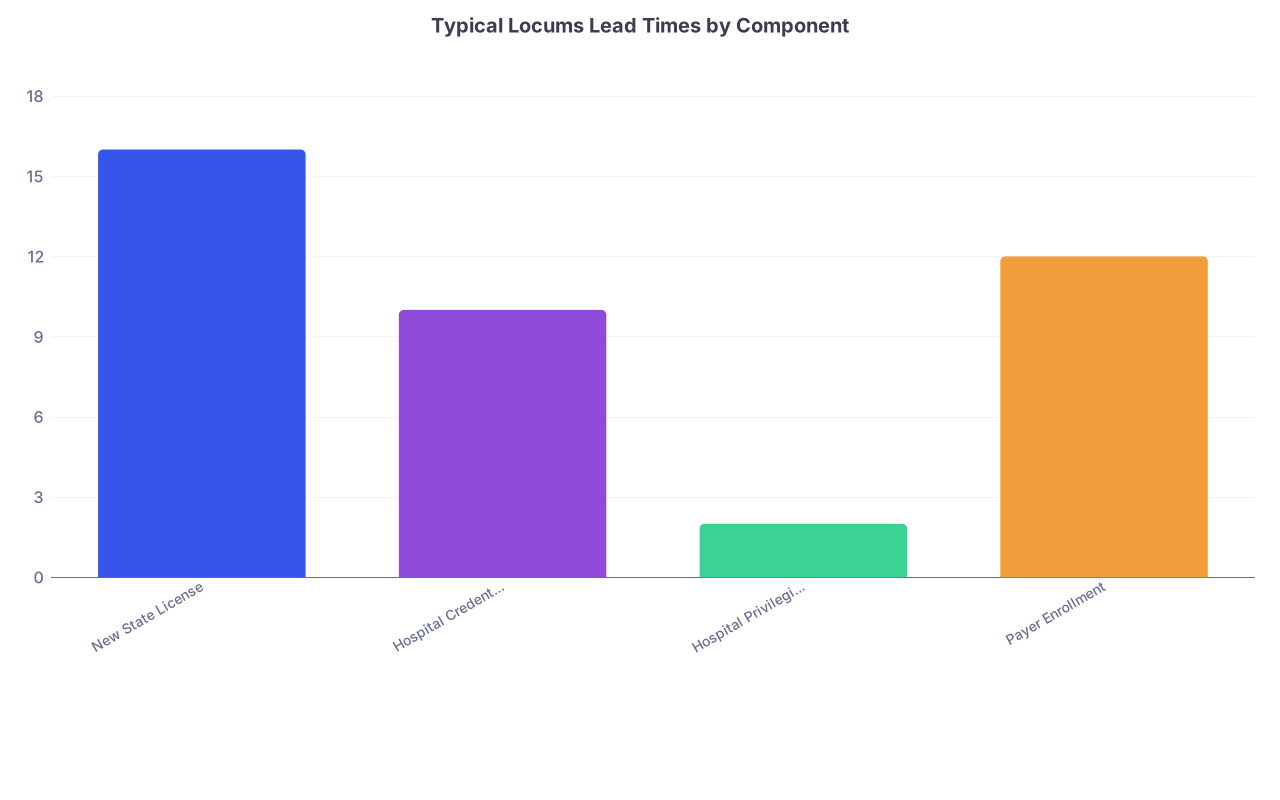
| Category | Value |
|---|---|
| New State License | 16 |
| Hospital Credentialing | 10 |
| Hospital Privileging | 2 |
| Payer Enrollment | 12 |
How Locums Credentialing Actually Flows (Not the Polished Version)
Here is how this usually plays out in reality, not in the fantasy timeline you got on the first phone call.
Step 1: Verbal Offer and “Profile”
You talk to a recruiter. They pitch:
- “Lead time is about 60 days.”
- “Credentialing is straightforward.”
- “They will take you with an active license or we can help you get one.”
Reality check: none of this is guaranteed. What matters is:
- Is there an existing active locums vendor relationship with that system?
- Have other locums worked there recently in your specialty?
- Does the medical staff office use a modern credentialing system (Echo, Cactus) or are they still on fax-and-paper?
You then send your “profile”:
- CV (and this is where sloppiness kills you if dates do not match, or there are gaps)
- Copy of licenses, certifications, DEA, board cert
- Malpractice history summary
- Reference list
If your CV is not month/year accurate and continuous for the last 5–10 years, you are already adding weeks. I have seen applications sit on someone’s desk simply because “the months do not line up.”
Step 2: Hospital Application Packet
Next, the hospital sends its actual medical staff application. Sometimes directly to you, sometimes through the locums agency.
This packet is usually 20–40 pages including:
- Detailed practice history with no gaps
- Explanation of any gaps > 30–60 days
- Questions about prior privileges denials, terminations, resignations while under investigation
- Malpractice claim disclosure in painful detail
- Authorization for release and NPDB query
- Privilege request form
This is where most delays originate. Not in the med staff office. In you.
Common delay triggers:
- Leaving gaps – “I took a year off to travel” with no explanation or dates
- Listing “2019–2020” rather than “07/2019–06/2020”
- Failing to list moonlighting, telemed, PRN roles
- Not disclosing a prior denied application (“they will never find it” – nonsense, they usually do)
- Sloppy email responses back-and-forth instead of one clean, complete packet
You should be returning the packet in 48–72 hours, fully completed, with all supporting documents attached. Anything longer, you are now part of the problem.

| Step | Description |
|---|---|
| Step 1 | Recruiter identifies assignment |
| Step 2 | Physician submits CV and docs |
| Step 3 | Hospital sends app packet |
| Step 4 | Physician completes and returns |
| Step 5 | Med staff office primary source verification |
| Step 6 | Committee or chair review |
| Step 7 | Privileges approved |
| Step 8 | Start date confirmed |
Lead Times: What Is Realistic vs Fantasy
Every locums agency loves to say “30–60 days.” It sounds tidy. It often is not true.
Let me give you realistic ranges for a physician without major red flags.
| Step | Fast Track (days) | Typical (days) | Slow / Problem (days) |
|---|---|---|---|
| CV/profile screening | 1–3 | 3–7 | 7–14 |
| Hospital app completion (you) | 1–3 | 5–10 | 10–21 |
| Primary source verification | 10–20 | 20–45 | 45–90 |
| Privileging approval | 3–10 | 10–30 | 30–60 |
| New state license (non-IMLC) | 30–60 | 60–120 | 120–180+ |
Key patterns I have seen repeatedly:
- Hospitals with monthly or bimonthly medical staff committee meetings: your app can be “complete” and then sit 2–6 weeks waiting for the next meeting.
- Systems with delegated credentialing or MEC authority to the chief medical officer or department chair can approve within days.
- Academic centers move slower. Community hospitals, especially where you are filling a critical gap, will bend over backwards to move faster.
If a recruiter tells you “We credential in 30 days,” you should ask:
- “Who signs off on privileges – a committee that meets on a schedule, or delegated authority?”
- “How many locums physicians have you on-boarded there in the last 6 months?”
- “What was the shortest and longest time they took?”
State Licensure for Locums: Where Assignments Go to Die
If you are doing locums across state lines, licensure is usually the longest pole in the tent. Underestimate it and the rest of the timeline becomes irrelevant.
Core variables for license timelines
- Whether the state participates in the Interstate Medical Licensure Compact (IMLC)
- Whether you qualify for the IMLC (not everyone does, plenty are excluded on technicalities)
- How many other licenses you already hold
- Existence of any board actions, malpractice payouts, or disciplinary issues
- How responsive your training programs and prior hospitals are to primary source verification requests
Some examples:
- IMLC states, clean background, organized documents: 4–8 weeks is possible.
- Non-IMLC, relatively efficient boards (e.g., some Midwestern states): 8–12 weeks.
- Historically slow boards or those requiring in-person interviews or extensive committee review: 3–6 months.
A very common trap: You accept an assignment in a state where the board is notoriously slow based on a recruiter’s “average” timeline, then end up blocked while the hospital is fully ready to bring you in. You lose months of income while that license crawls forward.
You need your own strategy here, not just vibes from salespeople.
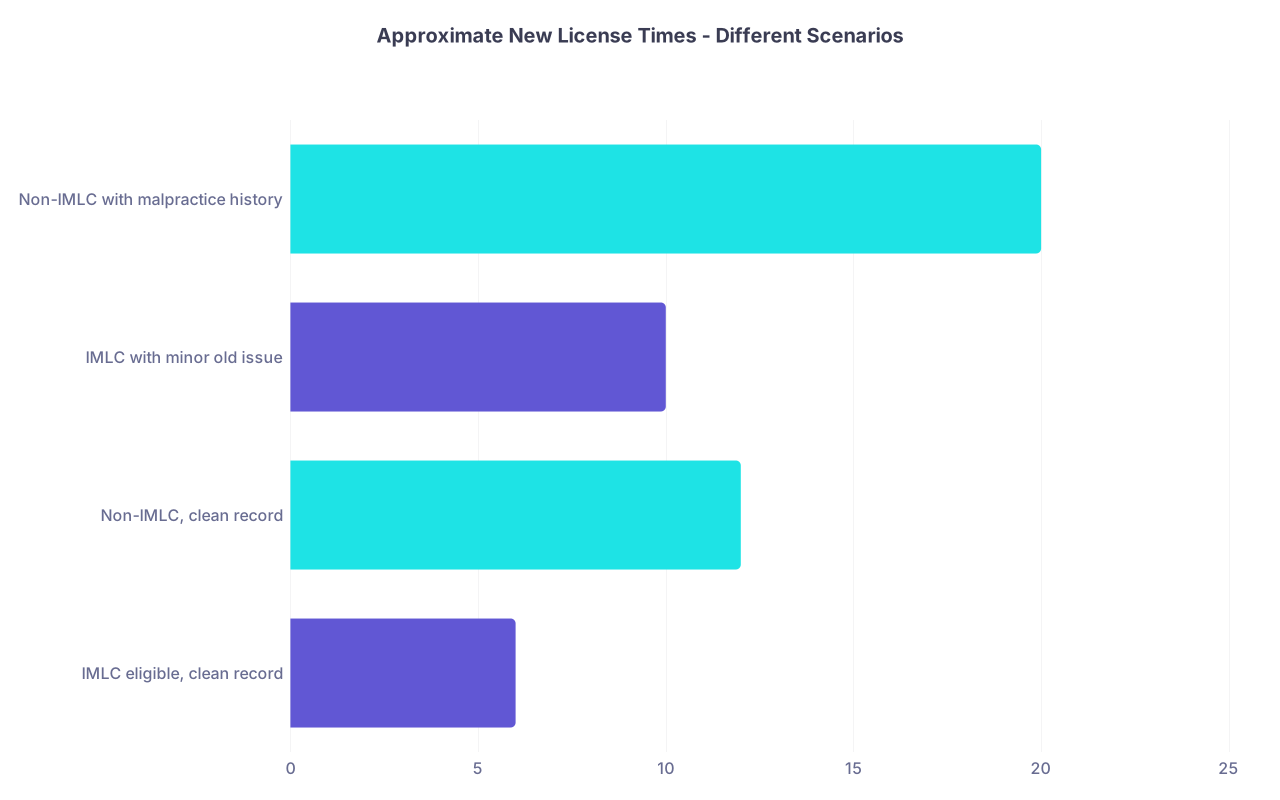
| Category | Value |
|---|---|
| IMLC eligible, clean record | 6 |
| Non-IMLC, clean record | 12 |
| IMLC with minor old issue | 10 |
| Non-IMLC with malpractice history | 20 |
Privileging Nuances That Matter for Locums
Hospital privileging packets are not suggestions. If a privilege is not explicitly requested and granted, you technically should not perform that procedure at that facility.
For locums, a few specific problems recur.
1. Procedural scope mismatch
Example scenarios I have actually seen:
- Locums general surgeon expects to perform endoscopy. Hospital’s privilege form lists EGD and colonoscopy as “special” privileges requiring case logs from the last 12–24 months. The surgeon has not done enough recently. They are credentialed but cannot do scopes. Income and morale both drop.
- Hospitalist expects critical care management including central lines and intubations. Hospital’s hospitalist core privileges exclude procedures; those belong to intensivists or ED only. The locums physician is frustrated on day one.
This is avoidable.
Before you sign anything, ask for:
- The actual privilege form for your specialty at that facility.
- An explicit list (from recruiter or medical staff office) of what you will be allowed and expected to do.
- Clear understanding of whether your requested privileges will be supported by your case logs.
If you are light on recent procedures, get your case logs now. Do not wait for the hospital to request them; they often will, and every email back-and-forth is more days lost.
2. “Provisional” or time-limited privileges
Some hospitals will grant provisional or temporary privileges:
- Pending board scores or verification
- Pending a full committee meeting
- Pending additional references or case review
Locums trick: temporary / disaster privileges can sometimes be used to start you earlier in true staffing crises. But they are not universal, and they often require:
- Current clean license
- NPDB check completed
- At least partial verification of training and references
You should ask explicitly:
- “Do you use temporary/emergency privileges for locums when there is urgent need?”
- “What are the criteria?”
- “Who decides – CMO, department chair, MEC?”
If the system uses temporary privileges routinely for new hires, they will sometimes do the same for locums and shave weeks off your lead time.
Where Locums Physicians Themselves Cause Delays
Let me be blunt: I have watched more locums starts get delayed by the physician than by the hospital.
Recurring self-inflicted wounds:
Disorganized documentation
You should have a personal “credentialing packet” ready at all times:- Master CV with exact month/year dates, updated every new job or assignment
- PDFs of licenses, DEA, board certs, BLS/ACLS/ATLS/PALS as applicable
- Malpractice claim summary sheet with dates, venues, outcomes
- Contact info for at least 3 current references who actually respond to email
Hiding or “softening” red flags
Old board action? Prior privilege denial? Past malpractice payout? If you try to bury it, it just explodes later when the NPDB or primary source verification turns it up. That turns a manageable issue into a trust problem.Slow or partial responses
Med staff emails you a question Monday, you respond Friday, half-answering it and raising two new questions. That back-and-forth alone can add 2–3 weeks.Inconsistent information across applications
If your dates differ between two hospitals’ applications or between a license application and a hospital application, some credentialing specialists will hold everything until you reconcile it. Their job is to protect the hospital, not your feelings.
Strategies to Control Lead Times (Instead of Being Controlled by Them)
You cannot make the state board move faster by willpower. But you can cut a lot of wasted time from your side and from the hospital’s.
1. Build a credentialing-ready “locums folder”
Do this once and keep it updated:
- Master CV (month/year, no gaps, all roles)
- Digital copies of every license, DEA, CSR, certificates
- Case logs for key procedures from your last 12–24 months
- Malpractice declarations and claim summaries
- Reference list with direct mobiles and emails
- Photo ID, passport, and SSN card scans (many apps ask)
Then when a new hospital sends an application, you can fill it in properly in one sitting.
2. Ask timeline questions before accepting an assignment
Non-negotiable questions:
- “When did you last onboard a locums in my specialty at this facility?”
- “How long did their credentialing take, fastest and slowest?”
- “Who gives final sign-off – committee or delegated authority?”
- “Do you have a history of granting temporary privileges?”
If the recruiter cannot answer, that tells you a lot. Push them to ask the med staff office or the client manager.
3. Stagger licenses strategically
If locums is your long-term plan, stop living license-to-license.
Pick 3–5 target states based on:
- Job volume in your specialty
- IMLC participation
- Tax / lifestyle considerations
- Board speed and pain level
Work on those licenses before the dream assignment appears. Treat it as infrastructure. Not a last-minute scramble.
4. Be brutally prompt with every credentialing request
Your personal rule: no med staff email sits more than 24 hours. If they ask for something that will take time, respond same day with:
- “I have received this; I will get you X, Y, Z by [specific date].”
Then actually do it.
Hospitals move fastest for physicians who behave like professionals and respond like they care about starting on time.

Red Flags That Will Slow You Down (and How to Handle Them)
If you have any of the following, expect extra scrutiny:
- Prior state board action, even a minor reprimand
- Prior privileges denial, revocation, or resignation while under investigation
- Multiple malpractice payouts, especially recent
- Large unexplained gaps in practice
- Frequent short-term jobs that make you look unstable
This does not mean you cannot do locums. It means you need a strategy.
Write your own explanations first
Draft concise, factual narrative letters for each issue:- What happened
- When
- Your role
- Outcome and current status
- What has changed since
Have these ready to upload or attach. Hospitals will ask.
Stay consistent everywhere
The story on your license app, hospital app, and NPDB must match in essentials. Small differences are fine. Contradictions are not.Accept that some facilities will pass
Very conservative systems may simply decline to proceed. Do not waste time arguing. Focus on those with actual experience managing locums with complex histories.
Payer Enrollment: The Hidden Delay for Longer-Term Locums
If you are doing short stints (weekend ED, 7-on/7-off hospitalist, pure shift work), hospitals will usually bill you under the facility or an existing group and not worry about payer enrollment.
If you are doing:
- Long-term locums (6+ months)
- Outpatient clinic-based locums
- Locums-to-perm transitions
Then payer enrollment might matter: Medicare, Medicaid, major commercial plans.
This can add:
- 30–90+ days for full enrollment
- Extra forms, contracts, and signatures beyond hospital privileging
Always ask up front:
- “Will I be billing under my own NPI with payer enrollment, or under the hospital/group umbrella?”
- “If payer enrollment is needed, does that delay the start date?”
Quite a few new locums physicians have been credentialed and privileged but then told: “We cannot put you on the schedule yet because BlueCross has not loaded you.” That is avoidable with one conversation at the beginning.

How To Work With (Not Against) Recruiters and Med Staff Offices
You do not need to love recruiters. But if you treat them like adversaries, you just slow yourself down.
Use them as force multipliers:
- Ask them to obtain and send you the actual privilege forms, not just job descriptions.
- Have them chase references, old hospitals, and training programs for verification.
- Insist on updates: “What is still outstanding on my file?” and “Has the NPDB come back?”
- Make sure they know your non-negotiables: procedures you must have privileges for, states you will or will not license in.
For med staff offices:
- Be polite, direct, and relentlessly responsive.
- Do not argue over every line in the application; if you do not understand something, ask.
- If you have a complex history, offer to jump on a quick phone call rather than writing three pages of emails.
Their job is risk management. Your job is to supply accurate information quickly enough that they can say “yes” without worrying about missing landmines.
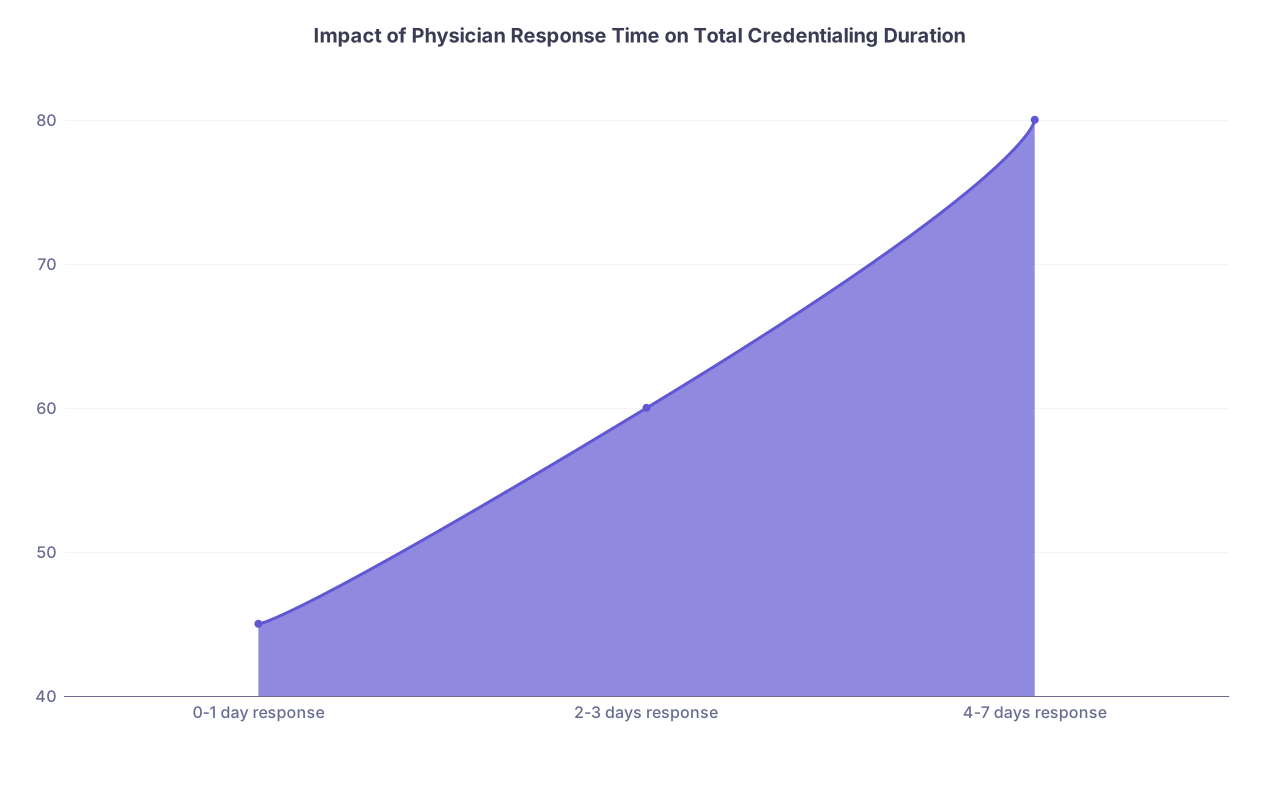
| Category | Value |
|---|---|
| 0-1 day response | 45 |
| 2-3 days response | 60 |
| 4-7 days response | 80 |
FAQs – Locums Credentialing, Privileging, and Licensure
1. How early should I start the credentialing process for a new locums assignment?
For a new state license plus hospital credentialing, you should target 4–6 months lead time if you want to sleep at night. If the license is already in place and your record is clean, 60–90 days is usually safe. Anything shorter than 45 days is an expedited sprint, and you should assume there is at least a 20–30% chance something slips.
2. Do I really need to list every small telemedicine or moonlighting gig on my applications?
Yes. Hospitals increasingly expect a complete practice history with no gaps longer than 30–60 days. That includes moonlighting, telehealth platforms, PRN shifts, and locums stints. If something shows up on an NPDB query, malpractice history, or another hospital’s application and it is missing from your current one, the med staff office will pause and ask why. Better to list everything up front.
3. Can I work before my privileges are fully approved if the hospital is desperate?
In most cases, no. Some hospitals use temporary or emergency privileges in genuine crisis situations, but those still require a baseline level of verification (license, NPDB, basic training, often references). Working without granted privileges is a serious regulatory and liability problem for the hospital. If someone hints that you might “just start and we will finish the paperwork later,” that is a red flag.
4. How much do past malpractice cases actually hurt my chances of locums work?
One or two older, reasonably explained cases rarely kill locums opportunities, especially in high-risk fields like OB, surgery, or EM. Persistent patterns, large payouts, or very recent serious cases absolutely slow things down and may lead some hospitals to decline. What matters is your narrative: own the facts, show insight, and keep your story consistent across all applications. The worst case is when the med staff office finds discrepancies between your explanation and the NPDB.
5. Is it worth prioritizing IMLC states for locums if I am eligible?
If you qualify for the Interstate Medical Licensure Compact, you should absolutely use it strategically. It does not make every license instant, but it reliably compresses timelines compared with traditional routes, often cutting months off. That said, some excellent locums markets are in non-IMLC states, so you should blend: a core of compact states for speed plus 1–2 non-compact states where you see long-term opportunity.
6. What is the single best way to avoid credentialing delays as a new locums physician?
Have an obsessively accurate, month-by-month CV and a ready-to-go digital credentialing packet. That means every license, certificate, case log, and malpractice summary in a single organized folder, updated in real time. Most avoidable delays come from missing documents, inconsistent dates, and slow physician responses. If you can return fully completed applications within 48 hours and answer follow-ups within 24, you will move through systems faster than 90% of your peers.
Three points to remember if you want locums to work for you rather than against you:
- Credentialing, privileging, and licensure are separate bottlenecks. Understand each one, and plan around the slowest.
- Your own organization and honesty matter more than any recruiter’s optimism. A clean, consistent paper trail beats charm every time.
- Treat licensing and credentialing as infrastructure. Build it ahead of time, keep it sharp, and the assignments – and income – follow.