
What exactly did you just sign up for when they said, “You’ll be taking over Dr. X’s panel”?
You finish residency, land a job, and they tell you you’ll “inherit Dr. Patel’s panel” or “take over an established practice.” It sounds great. Patients day one. No empty schedule. Maybe even talk of a future partnership or buy-in.
Then day one hits. Double-booked slots, impossible follow-ups, random chronic pain patients on sky-high opiates, a schedule that makes no sense, and overhead numbers nobody explains.
If you’re in that situation, this is for you. Here’s how to evaluate what you’ve inherited—and how to quietly, systematically restructure it into something sustainable without burning bridges or burning out.
Step 1: Get Oriented – What Did You Actually Inherit?
Before you fix anything, you need a clear picture. Not vibes. Data.
You’re looking at three buckets: patients, operations, and money.
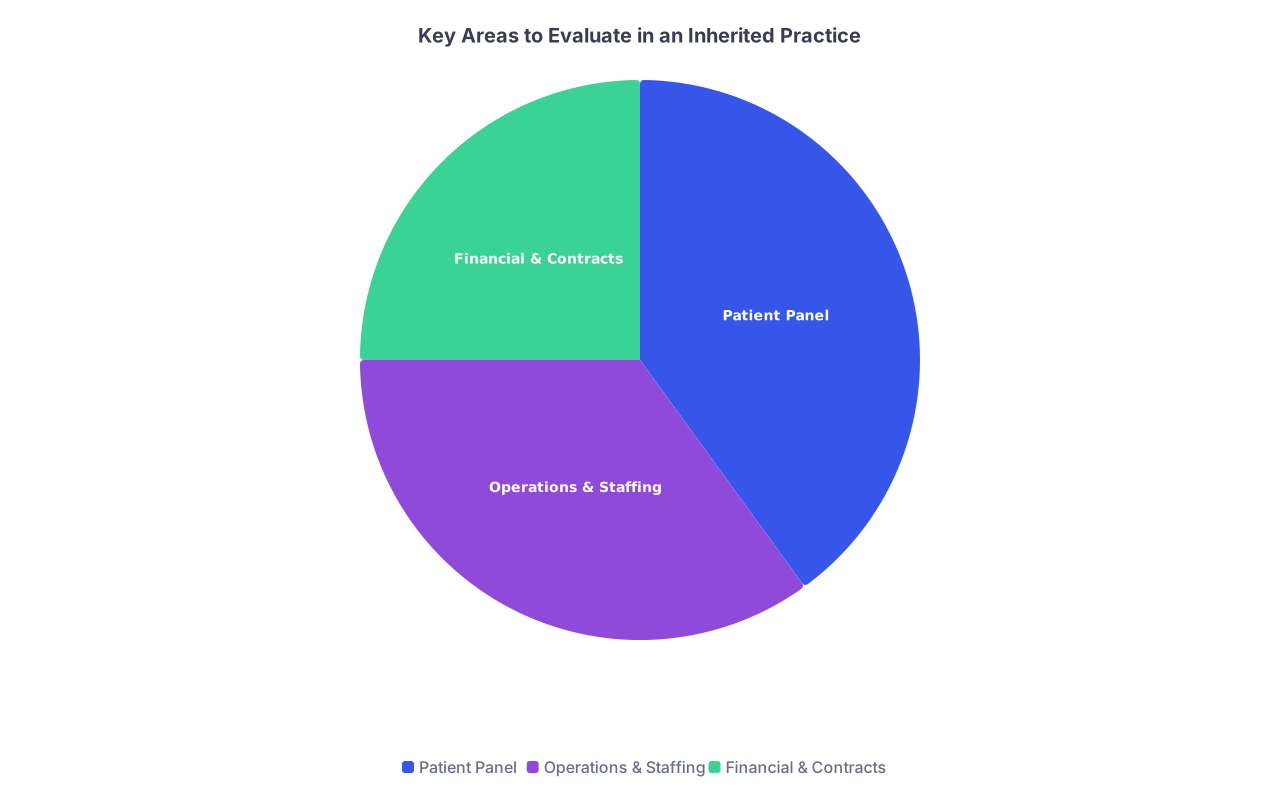
| Category | Value |
|---|---|
| Patient Panel | 40 |
| Operations & Staffing | 35 |
| Financial & Contracts | 25 |
A. The patient panel: volume, complexity, and risk
Ask for hard numbers. If you’re in a large system, this data exists, even if people pretend it’s hard to pull.
You want:
- Panel size: Active patients seen in the last 18–24 months, not just “chart count.”
- Visit volume: Average visits per day/week/month over the last year.
- Payer mix: Percent Medicare, Medicaid, commercial, self-pay.
- Complexity: Rough idea—chronic conditions per patient, risk scores if your system uses them (HCC, etc.).
- Problem patients: Anyone on controlled substances, with behavior issues, or recurrent no-shows.
If admin gives you hand-wavy answers, that’s your first red flag. Push (politely but firmly) for a report.
What you’re assessing:
- Is the current visit volume even humanly doable?
If your predecessor routinely saw 28–30 patients a day and retired “because it was time,” translation: they might have been burning out or relying heavily on shortcuts you won’t want to use. - Is the panel overgrown?
A “2,500-patient panel” sounds impressive. If 60% are complex Medicare patients and you’re expected to see 20–25/day with no robust support, that’s a trap. - Any major risk areas?
Like 30 chronic opioid patients with sloppy documentation. Or a ton of disability paperwork and workers comp cases with missing notes.
Make a quick written summary for yourself. Half a page max. Something like:
- Panel: ~1,900 active
- Volume: 18–22/day, more if double-booked
- Payer mix: 45% Medicare, 30% commercial, 25% Medicaid
- Risk: ~20 high-dose opioids, several benzo/opioid combos, many >5 chronic conditions
You’ll use this later when you push back on expectations.
B. Operations: how this place actually runs
Next, watch the workflow with your eyes, not just the EMR.
Spend a week mostly observing:
- How does check-in actually function? Are patients consistently roomed on time?
- How do refills come in? Fax, portal, phone, triage queue?
- Who handles messages? MA? Nurse? You?
- How does lab and imaging follow-up happen? Is there a standard process or pure chaos?
- How is same-day/urgent care handled? Squeezed into an already full schedule?
You’re looking for bottlenecks and “this is how we’ve always done it” nonsense that makes no sense.
Pay particular attention to:
- The front desk: Are they overbooking you just to “make admin happy”? Are they scheduling 15-minute visits for everyone, including complex new diabetics?
- Your MA/nurse: Are they working at the top of their license? Or are they glorified roomers?
- Messaging: Are you walking into 60+ unread messages every morning?
Write down the dumb stuff you see. You’ll tackle it later, in phases.
C. Money: understand the business, even if you “just want to see patients”
Even if you’re salaried, you need to understand the money. Because the money drives expectations, staffing, and your schedule.
Things to get:
- Your contract details: RVU targets, base salary, bonus structure, panel size expectations.
- Billing pattern: CPT codes most commonly used (99213 vs 99214/99215, procedures, etc.).
- Overhead: In a private practice or partnership track, you need a breakdown of rent, staff salaries, benefits, malpractice, supplies, EMR, etc.
- Collections vs charges: What are they actually collecting per visit on average?
| Metric | Target/Question |
|---|---|
| Average visits/day | Is this sustainable? |
| RVUs/visit | Fair for complexity? |
| Collections/visit | Covering overhead? |
| Staff cost as % of rev | Reasonable or bloated? |
| No-show rate | Needs intervention? |
If nobody can explain how the practice makes money or what your productivity expectations truly mean, you are being set up to be “the worker” without power. Know the numbers.
Step 2: Protect Yourself Clinically, Fast
If you’ve inherited someone else’s charting and prescribing habits, assume some of it is sloppy or outdated. You’re the one whose license is on the line now.
A. High-risk meds: you need a policy on day one
Go into the EMR and run a list of:
- Chronic opioids
- Benzo+opioid combos
- High-dose benzos
- Stimulants in adults (especially with thin psych documentation)
- Warfarin and other narrow-therapeutic-index meds without recent labs
Make a simple, firm policy for yourself:
- No new chronic opioids for non-cancer pain unless clear criteria met.
- Reassess high-dose opioids and benzos with a taper plan where appropriate.
- Use controlled substance agreements + PDMP checks + UDS consistently.
You do not have to continue the previous doc’s questionable practices “for continuity.” That’s how people end up in front of boards.
When these patients come in, you say something like:
“I’m glad you’re here. I’m going to continue your medications for now, but I practice a bit differently. Over the next few visits, we’re going to review your meds carefully, make sure they’re safe for you long term, and see if any adjustments are needed.”
You are not obligated to fix everything in one visit. But you are obligated not to perpetuate obvious danger.
B. Clean up loose ends and ticking time bombs
Scan for:
- Positive imaging or labs without follow-up
- Critical results with no documented action
- Refill-only “ghost patients” who haven’t been seen in over a year
Set up a weekly “chart risk sweep” for the first 2–3 months. Block one hour a week to:
- Review a batch of charts flagged by the EMR (abnormal labs, overdue follow-up).
- Send recall messages or letters to high-risk patients.
- Document your actions clearly.
This isn’t glamorous. But if something goes bad, you want clear documentation that you recognized issues and started cleaning them up.
Step 3: Restructure Your Schedule Without Looking “Difficult”
You cannot inherit a chaotic schedule and just grind your way through it. That’s how you end up hating medicine by year two.
But you also cannot walk in and demand, “Cut my volume in half” on day 3. You need a phased plan.

| Step | Description |
|---|---|
| Step 1 | Start - Inherit Panel |
| Step 2 | Assess Volume and Complexity |
| Step 3 | Request Temporary Template Changes |
| Step 4 | Keep Template but Add Rules |
| Step 5 | Cap New Patients per Day |
| Step 6 | Increase Long Visit Slots |
| Step 7 | Reevaluate After 4-6 Weeks |
| Step 8 | Permanent Template Adjustments |
| Step 9 | Unsafe or Unsustainable? |
A. Short-term (first 4–6 weeks): triage mode
Ask for:
- A reduced max volume cap for the first 4–6 weeks while you’re getting to know the panel.
- Protected longer slots for complex follow-ups and “meet and greet” visits for inherited patients (e.g., 30 minutes instead of 15).
- A limit on new patients per day (e.g., no more than 2–3).
How you pitch it to admin:
“I’m inheriting a complex panel with a lot of chronic disease and high-risk meds. To make sure I provide safe care and keep quality metrics up, I need slightly longer visits and a temporary lower volume while I establish care with these patients. Once I’ve stabilized things and know the panel, we can reassess the schedule.”
Use their language—“quality,” “safety,” “metrics.” They care about that.
B. Medium-term (after 2–3 months): structural changes
Once you know the panel, you adjust the template for real:
- Decide your real max: 16–20 patients/day for complex primary care in 20–30 minute slots is reasonable in many settings. If they want 24–28/day, you need better staffing or a different model (NP/PA, more RNs, scribes).
- Build in same-day access: A few blocked same-day slots so true urgent issues don’t clog your schedule randomly.
- Block certain types of visits:
Example—no “annual physical + 10 problems” crammed into 20 minutes. Either longer slot or problem visit only. - Standardize visit lengths:
- New patient or new-to-you inherited complex patient: 30–40 minutes.
- Stable chronic follow-up: 20 minutes.
- Quick issues: 10–15 minutes if your system allows.
The point: Don’t let the inherited chaos dictate your career expectations. You set the guardrails, or someone else will.
Step 4: Fix the Team and Workflows So You’re Not Doing Everyone’s Job
If you inherit a practice, you inherit staff culture. Sometimes that’s a gift. Sometimes it’s a mess.
A. Evaluate each staff member with clear eyes
You’ll hear, “Oh, Maria’s been here 20 years, she knows everyone.” That might be good. Or it might mean Maria runs the place and resents change.
Watch:
- Do they protect your time or dump everything on you?
- Do they follow protocols or interrupt you for every tiny thing?
- Are they respectful with patients or brisk and rude?
- Are they actually working, or are they on their phones half the time?
Then have a direct talk with your MA/nurse/front desk:
- Spell out how you want refills handled.
- Spell out pre-visit planning: vitals, med rec, problem list clean-up.
- Spell out messaging: what they handle vs what reaches you.
Have this conversation early and repeat key points. Culture doesn’t change because you had one nice meeting.
B. Redesign 2–3 key workflows
Do not try to fix everything in month one. Pick the few workflows that cause the most pain:
- Refill workflow
- Messaging/inbox management
- Lab/imaging result follow-up
For each, define:
- What staff does
- What you do
- How quickly things should be handled
- Where it’s documented
Example – Refill workflow for stable meds:
- Staff:
- Checks last visit date, last labs, and any flagged issues.
- If criteria met (within 6–12 months, stable labs), sends refill with pre-set protocol order for your co-signature.
- You:
- Review and sign in batch once or twice a day.
- Only exceptions come directly to you (med changes, red flags).
Result: You’re not spending your evenings manually refilling lisinopril for 200 people.
Step 5: Decide if This Practice Is Long-Term Viable for You
Not everything can be fixed by “better organization.” Sometimes you inherited a structurally bad deal.
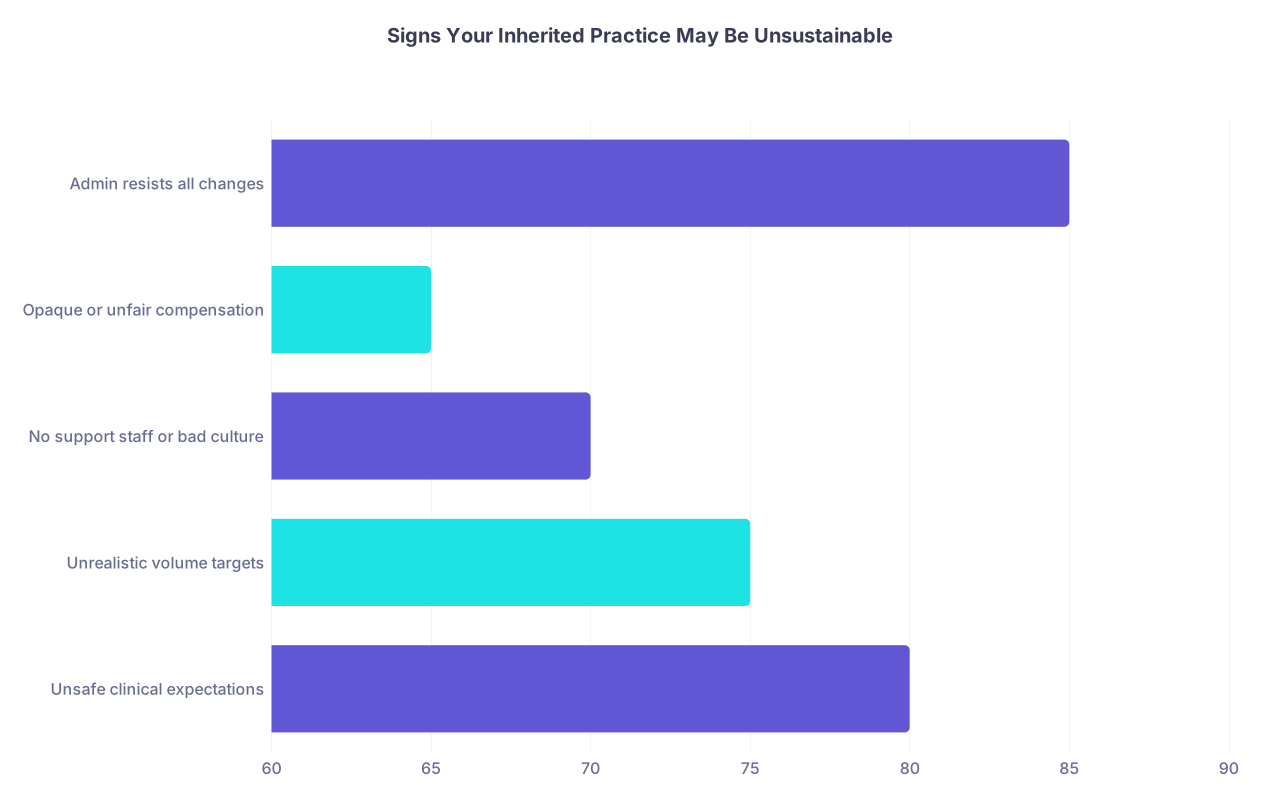
| Category | Value |
|---|---|
| Unsafe clinical expectations | 80 |
| Unrealistic volume targets | 75 |
| No support staff or bad culture | 70 |
| Opaque or unfair compensation | 65 |
| Admin resists all changes | 85 |
Here are the red flags that, if they persist after you’ve made good faith efforts to improve things, should make you consider leaving:
- You’re consistently booked beyond safe levels (e.g., 24–30 complex patients/day) with no flexibility.
- Admin refuses to adjust volume, template, or staffing despite your documented safety/quality concerns.
- Your compensation is heavily RVU-driven with impossible targets, given the panel complexity and visit lengths.
- Quality metrics are unrealistic, but the system offers no tools or staffing to meet them.
- You’re doing work that isn’t yours—paperwork, scheduling, chasing labs—because staffing is chronically inadequate.
Be honest with yourself: It’s easier to fix the structure early than after you’re embedded and exhausted.
If this is a private practice or small group you’re supposed to buy into, do not move toward partnership until:
- You’ve seen at least one full year of financials.
- You know the overhead structure and how profit is distributed.
- You know what happens when partners disagree.
“I’ll show you the numbers later” is not acceptable. That’s how people end up buying into a sinking ship.
Step 6: Communicate Change to Patients Without Creating Drama
Restructuring an inherited practice means patients will feel some change. New policies. Different prescribing. Different appointment rules.
You can do this without becoming “the new doctor who ruined everything.”
A. Use a consistent script for tough changes
For patients upset about fewer early refills, reduced benzos/opioids, or stricter follow-up rules, try:
“I understand this is different from what you’re used to. My job is to keep you safe and healthy long term, and the medical evidence has changed over the years. I want to work with you to find a plan that manages your symptoms and also protects your health.”
You’re not blaming the old doctor explicitly. You’re just saying you practice according to updated evidence and safety.
B. Set expectations up front
At “establish care” visits with inherited patients, use one minute to say:
- How you handle refills.
- How you handle messages (what’s appropriate for the portal, what requires a visit).
- How often you like to follow up for their main conditions.
Patients handle change better when it’s framed as intentional and consistent, not random.
Step 7: Build Yourself Breathing Room and Growth
Once you’ve stabilized things, you can actually make this panel work for you, not just to you.
A. Carve out real non-clinical time
Try to secure:
- A half-day per week of true admin time, not “chart until midnight.”
- Time for QI/committee work if that interests you—those give you leverage and voice later.
If they say there’s “no admin time,” that just means it’s unpaid and expected at home. Name it and negotiate it.
B. Shape the practice into what you actually want to do
Inherited practices tend to be random mixes of everything. Over time, you can steer:
- Interested in geriatrics? Start accepting more complex older adults and build systems for them.
- Interested in sports med? Highlight that skill, accept those referrals, build that niche.
- Interested in women’s health? Same idea.
You can’t change the panel overnight, but you can tilt it gradually. Saying “yes” slightly more often to what you like and “no” (or redirecting) to what you don’t is how you get there.
One Reality Check: You Cannot Fix Everything Alone
You can improve a lot: your personal boundaries, your schedule structure, your workflows. But if the organization or partners fundamentally believe physicians are infinitely elastic, you will eventually hit a wall.
Pay attention to:
- How they react when you raise concerns the first time.
- Whether any of your suggested changes actually happen.
- Whether other physicians look reasonably sane or chronically exhausted.
If multiple older docs say, “Yeah, this is just how it is, you’ll get used to it,” and they look dead behind the eyes—that is data.
What You Should Do Today
Do one concrete thing now: request a hard data packet on the panel or practice you’ve inherited (or are about to inherit).
Email your practice manager or admin and ask for:
- Active panel size (seen in last 18–24 months)
- Average visits/day over the past 6–12 months
- Payer mix
- List of patients on chronic opioids/benzos/stimulants
- Your current schedule template (with visit lengths and caps)
Once you have that in front of you, sit down for 20 minutes and mark three things:
- One safety issue you’ll address first (e.g., high-risk meds).
- One schedule change you’ll request (e.g., longer visits for complex inherited patients for 6 weeks).
- One workflow you’ll tighten with your staff (e.g., refills or inbox).
Then actually start the conversation with your manager or lead physician this week.
Don’t just survive the panel you inherited. Restructure it so it becomes a practice you can stand doing for more than two years.