
The most dangerous way to leave academic medicine is to “wing it.”
Physicians do this every year—give notice, sign a shiny private practice offer, and only later realize they misjudged income structure, call burden, partnership terms, or malpractice tail coverage. I have watched people lose six figures and years of career satisfaction because they treated this like a job change, not a full transition of how they practice medicine.
You are not just changing employers. You are changing incentives, workflows, and your professional identity. So you need a timeline. Month-by-month. Week-by-week near the end. Here is exactly how to run a 6–12 month transition from academic to private practice without blowing up your finances, your reputation, or your sanity.
Overview: Your 6–12 Month Transition Roadmap
First, zoom out. You have two realistic paths:
- Deliberate 12‑month runway – Ideal if you have flexibility, want to be meticulous with finances, kids’ schooling, location, and negotiation.
- Condensed 6‑month runway – Doable, but tight. Very little room for major delays (credentialing, licensing, contracts).
Here is how the phases usually stack:
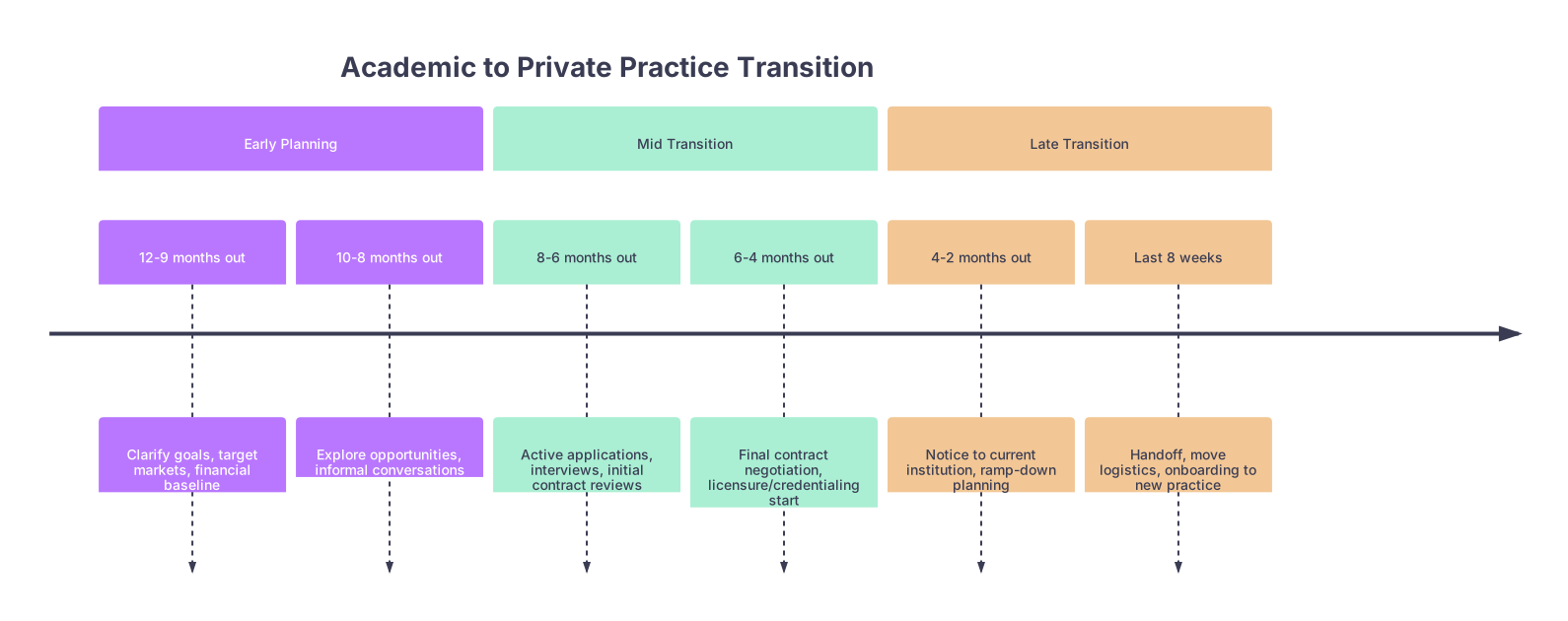
| Period | Event |
|---|---|
| Early Planning - 12-9 months out | Clarify goals, target markets, financial baseline |
| Early Planning - 10-8 months out | Explore opportunities, informal conversations |
| Mid Transition - 8-6 months out | Active applications, interviews, initial contract reviews |
| Mid Transition - 6-4 months out | Final contract negotiation, licensure/credentialing start |
| Late Transition - 4-2 months out | Notice to current institution, ramp-down planning |
| Late Transition - Last 8 weeks | Handoff, move logistics, onboarding to new practice |
If you are closer to 6 months than 12, you compress early phases, not the last 3 months. The back end—licensing, credentialing, notice periods—does not care that you are in a hurry.
9–12 Months Before Start Date: Get Very Clear and Very Honest
At this point you should define why you are leaving and what you will not compromise on. If you skip this, you are just running away from something, not moving toward something better.
Step 1: Clarify your “non‑negotiables”
Sit down once, for 60–90 minutes, without email or pager.
List:
- What you want to stop doing (e.g., constant committee work, unfunded research, 2-hour commute, 1:5 q4 in-house call).
- What you must preserve (autonomy, subspecialty procedures, academic affiliation, teaching opportunities).
- Hard constraints:
- Geographic (partner’s job, kids’ schools, aging parents)
- Visa status (if applicable)
- Board certification timelines and MOC requirements
Write 3–5 non‑negotiables. Example:
- No more than 1:6 home call, no in-house nights.
- Total expected weekly hours ≤ 55.
- Compensation model with at least 50–60% guaranteed base in year 1.
- Protected time or clear pathway for clinical leadership or limited teaching.
If a job cannot meet these, you walk.
Step 2: Build your financial baseline
At this point you should know what you cost to maintain and what you need to save.
- Pull the last 3–6 months of:
- Bank statements
- Credit card bills
- Loan payments
- Calculate:
- Monthly fixed expenses (mortgage/rent, loans, daycare, etc.)
- Variable but predictable (food, gas, utilities)
- Discretionary (travel, hobbies)
Create a 12‑month transition budget:
- Assume:
- Possible gap of 1–3 months between checks.
- Slight delay in bonus/collections in new job.
- Build:
- Emergency fund target: at least 3–6 months of expenses in cash.
- Plan for:
- Moving costs
- Increased malpractice or tail coverage
- License and DEA fees
- Board exam if it lands near transition

| Category | Value |
|---|---|
| Relocation | 8000 |
| Licensing/DEA | 1500 |
| Tail Coverage | 30000 |
| Temporary Housing | 6000 |
| Board/Exam Fees | 2000 |
These are not hypothetical numbers. I have seen tail bills in the $40–60k range ambush people who never read their academic contract closely.
Step 3: Map your target markets and practice types
At this point you should narrow your targets, not “see what is out there.”
Decide on:
- Practice structure:
- Large multispecialty group
- Single-specialty private group
- Hospital-employed but non-academic
- Concierge / direct primary care
- Geography:
- 3–5 metro areas or regions max, unless you are truly location-agnostic.
- Practice maturity:
- Established group vs. startup vs. practice purchase.
Make a simple grid:
| Option Type | Pros | Cons |
|---|---|---|
| Large Multispecialty Group | Stable, good benefits | Less autonomy, bureaucracy |
| Single-Specialty Private Group | Higher upside, partnership | Income volatility, politics |
| Hospital-Employed Clinic | Predictable paycheck | RVU pressure, less control |
| Concierge / DPC | Panel control, time per pt | Business risk, slower build |
Circle the 1–2 that fit you best.
6–9 Months Before Start Date: Move From Thinking to Action
At this point you should start behaving like a job-seeker with a plan.
Step 4: Quietly test the market
You do not announce to your chair yet.
Instead:
- Update your CV:
- Keep academics, but front-load clinical expertise and volume.
- Highlight procedures, patient care leadership, quality metrics.
- Reach out to:
- Former fellows or co-residents in private practice.
- Local physicians in your desired region (yes, cold emails work if they are specific).
- Have 20–30 minute “exploratory” calls:
- Ask about:
- Real call burden vs. advertised.
- Time to full panel.
- Payer mix.
- Compensation transparency.
- Ask about:
During this window, you should be:
- Responding to recruiter outreach selectively.
- Identifying 5–10 promising groups or systems.
- Learning the language of private practice: “wRVUs,” “collections,” “overhead,” “buy-in,” “ancillary revenue.”
Step 5: Start formal applications and initial interviews
By 7–8 months out, you should have at least 3–5 active processes going.
Your goals for this phase:
- On first calls and Zoom interviews, clarify:
- Are they replacing someone or growing?
- How long did the last person stay, and why did they leave?
- Expected first-year compensation range and structure.
- Filter hard:
- Any evasiveness about compensation or partnership track is a major red flag.
- “We will figure that out later” is how you end up trapped.
You are not negotiating yet. You are qualifying.
4–6 Months Before Start Date: Contracts, Licensing, and Hard Commitments
This is where people either run a tight process or get steamrolled.
At this point you should be moving from offers to signed contracts and starting all the slow bureaucratic tasks.
Step 6: Evaluate offers with a structured lens
When you get term sheets or draft contracts, do not skim. Use a structured comparison.
| Element | What to Look For |
|---|---|
| Base Salary | Amount, duration, guarantees |
| Bonus/Production | wRVU rate, collection %, timing |
| Call Coverage | Frequency, in-house vs home |
| Partnership Track | Timeline, buy-in amount, criteria |
| Malpractice | Claims-made vs occurrence, tail |
Specific landmines I see repeatedly:
- “Productivity bonus at group discretion.” Translation: maybe never.
- Undefined partnership terms. “Two-year track” with zero written details is meaningless.
- Non-competes that block huge geographic regions for 1–2 years.
- Tail coverage left out or pushed entirely onto you at departure.
If you do nothing else, pay for a healthcare attorney in the state where you will practice to review your top 1–2 contracts. They will see things you will not.
Step 7: Negotiate like a professional, not a supplicant
At this point—5–6 months before start—you should be:
- Down to your top 1–2 options.
- Clear on what you are asking to change.
You are negotiating:
- Start date
- Base salary and guarantee period
- Reasonable call expectations
- Protected time or structural supports if you are taking on leadership
You are not negotiating:
- Every petty detail
- Their entire comp model
- The existence of call itself in a small group
Pick 3–5 specific asks, backed by data (MGMA, specialty society benchmarks, or at least regional norms from peers). Then stop.
3–5 Months Before Start Date: Commit and Trigger the Bureaucracy
By now, one job should be clearly ahead. You should be ready to sign—or very close.
Step 8: Sign, then immediately start licensing and credentialing
Order matters. You should not start major licensing/credentialing for a job you have not signed.
Once you sign:
- Start or update:
- State medical license (if new state or lapsed)
- DEA registration (and state controlled substance if required)
- Hospital privileges applications
- Payer enrollment: Medicare, Medicaid, major commercial plans
This part is slow, especially payer enrollment. 90–180 days is common.
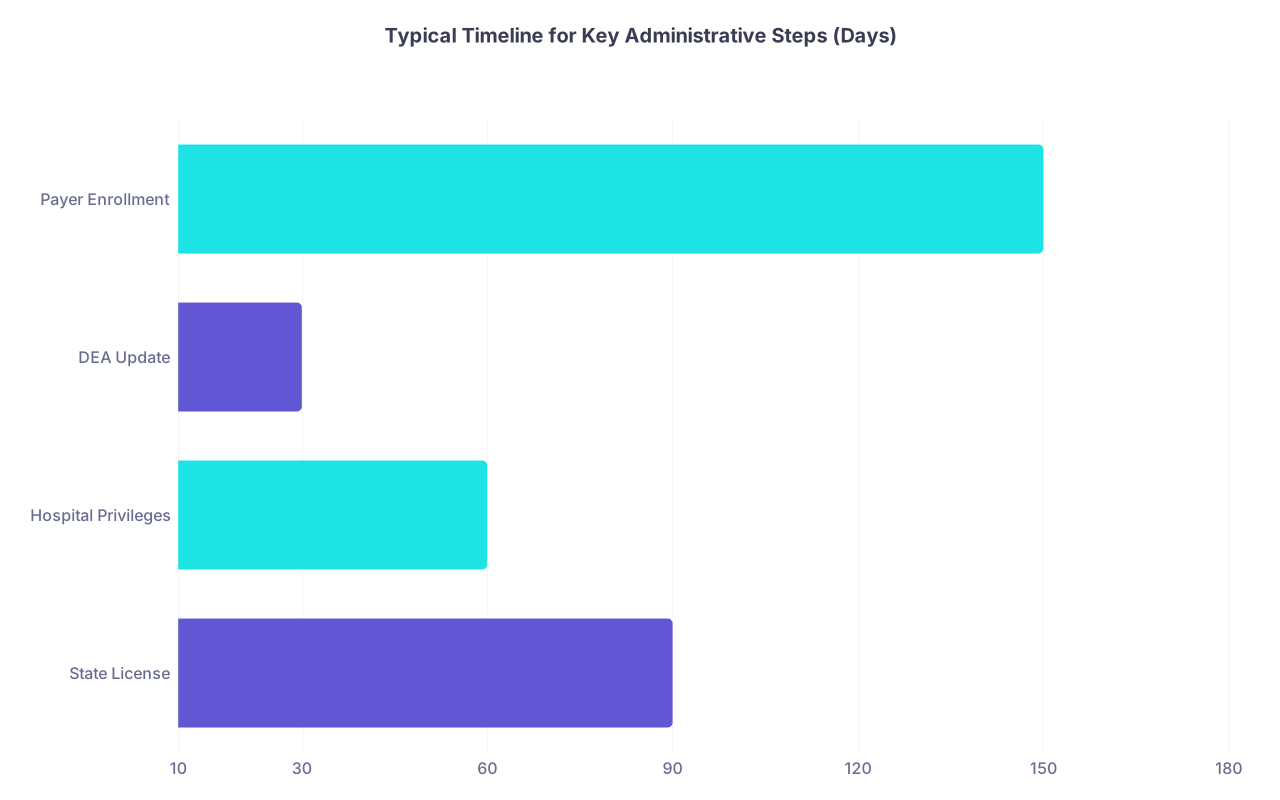
| Category | Value |
|---|---|
| State License | 90 |
| Hospital Privileges | 60 |
| DEA Update | 30 |
| Payer Enrollment | 150 |
If you are on a 6‑month total timeline, you start these almost immediately after serious interest, and you build in redundancy (multiple license applications if considering multiple states).
Step 9: Finally, tell your department
Timing depends on:
- Your contractual notice period (usually 60–90 days)
- How dependent they are on your clinical volume
- How much you care about ongoing collaborations
General rule: 3–4 months before your planned end date is a decent balance.
The conversation sequence:
- Chair/section chief first. In person if possible.
- Key collaborators: research partners, co-PIs, mentees.
- Admin leaders who need to plan: clinic managers, fellowship directors.
Be clear and non-apologetic:
- “I have accepted a position in private practice starting [date]. I am grateful for [X], and I want to work with you to ensure a smooth handoff of clinics, patients, and projects.”
Do not:
- Over-explain.
- Blame the system.
- Announce on social media before you tell your own leadership.
Last 2–3 Months: Exit Cleanly, Prepare to Hit the Ground Running
At this point you should be engineering your exit and staging your new start in parallel.
Step 10: Clinical and academic off‑ramp
Create a written 90‑day exit plan with your chair or division chief including:
- Final clinic dates by site.
- Cutoffs for:
- New patient visits
- New long-term procedures or trials
- Hand-off plans:
- Specific colleagues for high-risk patients.
- Clear notes in the EHR about follow-up plans.
- Academic work:
- Manuscripts to finish or formally hand off.
- Transition of PI responsibilities, IRB communications.
- Notification of trainees you supervise.
This is partly professional ethics, partly reputation management. Academic medicine is a small world. You might want an affiliation or part-time teaching role later.
Step 11: Life logistics and mental shift
In the same window, you should be:
- Handling relocation:
- Housing on the new end.
- School transfers.
- Partner job decisions.
- Insurance and benefits:
- When your academic benefits end.
- How new coverage starts (gap or overlap).
- How your retirement accounts will be handled (rollover, leave, etc.).
Mentally, you also need to shift from:
- “My value = publications, talks, grants”
to - “My value = patient access, clinical excellence, efficiency, patient/ referrer satisfaction.”
This does not mean you abandon academic skills. You just stop expecting them to be the main currency.
Last 4–8 Weeks: Micro-Planning Your Final Days and First Days
Now it is about details. You are either crisp here, or you are scrambling.
Step 12: Final month in academics – do not burn bridges
In your last 4 weeks:
- Clean your physical and digital footprint:
- Office: charts, personal items, teaching materials.
- EHR inbox: clear labs, messages, refill requests, pending notes.
- Shared drives: organize and label anything others will need.
- Communicate:
- Outgoing message for patients if appropriate (following institutional rules).
- Final notifications to collaborators, mentees, and staff who supported you.
You want people saying: “They left cleanly, professionally, and we would gladly work with them again.”
Step 13: First month in private practice – protect yourself from chaos
Plan your first 4–6 weeks in the new practice before you arrive.
Ask your new group for:
- Detailed onboarding schedule:
- EHR training
- Clinic flow and staff introductions
- Billing and coding overview
- Gradual ramp:
- Do not let them slam you with a full schedule on day 1.
- Aim for:
- Week 1: 50–60% of target volume.
- Week 2: 70–80%.
- Weeks 3–4: Full.
Clarify day‑one realities:
- Who handles your schedule template?
- Who manages your inbox / phone messages?
- What support staff you have (MA, RN, NP/PA)?
- How add‑ons and same‑days are handled.
You should also:
- Keep a simple daily list for the first month:
- “What is working?”
- “What keeps breaking?”
- “What I need to clarify/renegotiate after 60–90 days.”
Bring those observations to your practice leader early. Patterns are much easier to adjust in month 2 than year 2.
If You Only Have 6 Months Total
Some of you are already close to the edge. Maybe an academic contract is ending. Maybe politics or burnout forced your hand.
Here is how you compress, realistically:
- Months 6–5:
- Clarify non‑negotiables and financial baseline in 1–2 weeks, not months.
- Immediately start exploratory calls and applications in parallel.
- Months 5–4:
- Prioritize 2–3 serious opportunities only.
- Push for draft contract within 2–3 weeks of good interview.
- Get attorney review quickly; negotiate only the most critical items.
- Months 4–3:
- Sign. Immediately start licensing, credentialing, payer enrollment.
- Give notice to your institution as soon as start date is credible.
- Months 3–0:
- Aggressively manage exit and onboarding in parallel.
- Accept that you may have a brief period of lower income or delayed collections.
What you do not compress: contract review, tail coverage decisions, licensing/credentialing lead time. Those corners, if cut, are expensive.
The One Thing You Should Do Today
Open your current employment contract and find the sections on notice period, malpractice coverage, and tail.
Read those three sections carefully, line by line.
Highlight every date, dollar amount, and obligation. That single 20‑minute exercise will tell you exactly how much time and money you need to build into your 6–12 month transition plan—and whether you are actually ready to start the clock.