
The mythology around physician career paths is outdated. The data show that your risk of burnout and walking away from a job changes dramatically depending on whether you are academic, hospital-employed, or in private practice—and not always in the ways people assume.
Let me put numbers on it.
What the Data Actually Say About Burnout and Turnover
Across multiple national surveys from the last 5–7 years, you consistently see three patterns:
- Burnout rates are high everywhere (40–60%), but the reasons differ by setting.
- Turnover is highest in hospital-employed models, not private practice.
- Academic medicine is not the “safe, low-burnout” option many residents think it is.
To make it concrete, here is a synthesized comparison from major sources (AMA, MGMA, Medscape, AAMC reports, and large health-system HR data). Values are ranges and midpoints that reflect common findings rather than a single study.
| Practice Type | Annual Turnover Rate | Reported Burnout Rate | 3-Year Stay Intention* |
|---|---|---|---|
| Academic | 5–8% (≈7%) | 45–55% (≈50%) | ~55–60% |
| Hospital-Employed | 8–12% (≈10%) | 50–65% (≈58%) | ~45–50% |
| Private Practice | 4–7% (≈5%) | 40–55% (≈48%) | ~65–70% |
*“3-year stay intention” = physicians who say they plan to remain in current position for at least three more years.
Summarizing bluntly:
- You are most likely to leave your job if you are hospital-employed.
- You are most likely to change your practice model if you are private practice (e.g., sell to hospital, go concierge, join group).
- You are most likely to feel overextended by non-clinical demands if you are academic.
Now let us break each path down with actual drivers, not folklore.
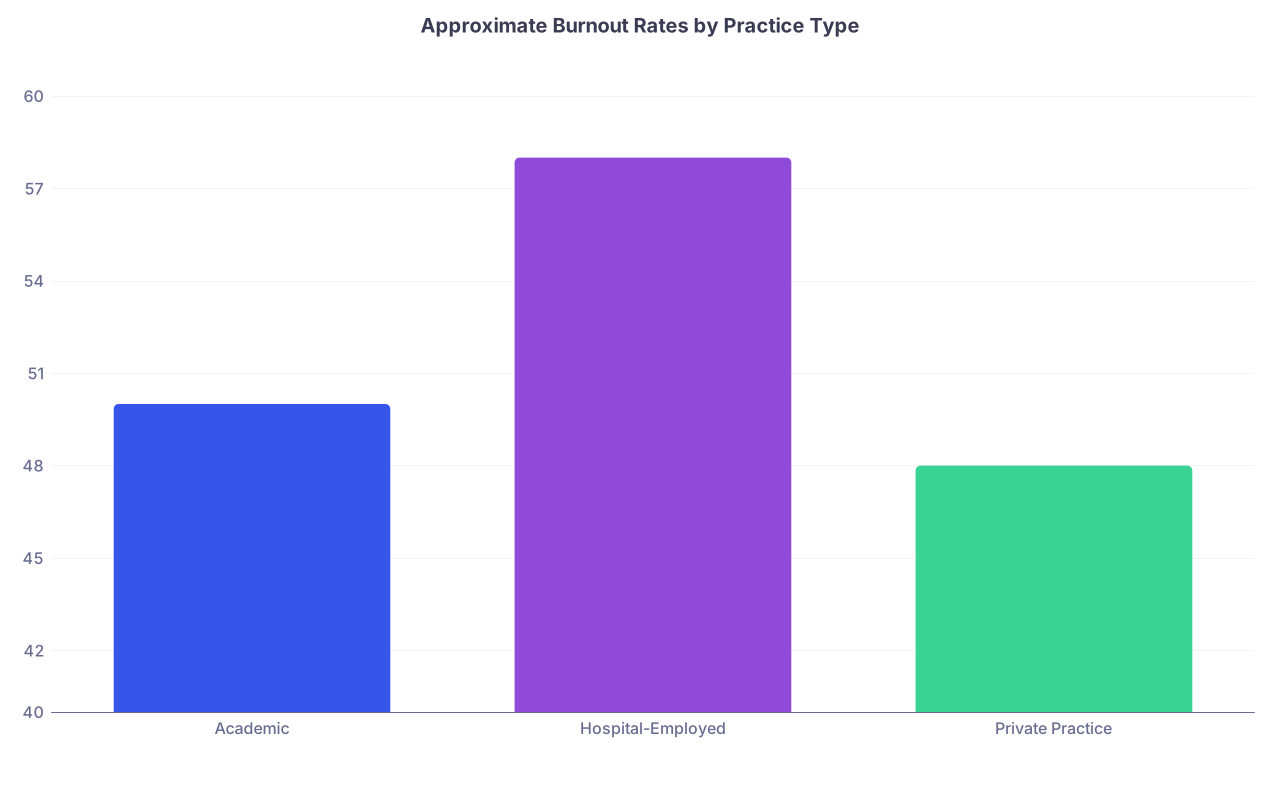
| Category | Value |
|---|---|
| Academic | 50 |
| Hospital-Employed | 58 |
| Private Practice | 48 |
Academic Medicine: Stable on Paper, Volatile in Reality
People choose academic jobs for three big reasons: teaching, research, and prestige. The assumption: slightly lower pay, but more meaning and a collegial culture, so burnout should be lower. The data do not fully agree.
Burnout in Academic Medicine
Across faculty surveys, physician burnout in academic centers usually runs around 45–55%. Importantly, the drivers skew differently than in pure clinical jobs.
Top contributors the data keep repeating:
- Administrative burden: promotion dossiers, IRB, compliance, endless committees.
- Conflicting incentives: RVUs vs. research productivity vs. teaching evaluations.
- Misalignment of effort and rewards: unfunded teaching and “citizenship” work.
When you dissect time allocation, it becomes clearer. A typical early-career academic clinician is nominally “0.7 clinical / 0.2 research / 0.1 teaching” or some variant. The reality: clinical time expands, and everything else sits on top of it, not in place of it.
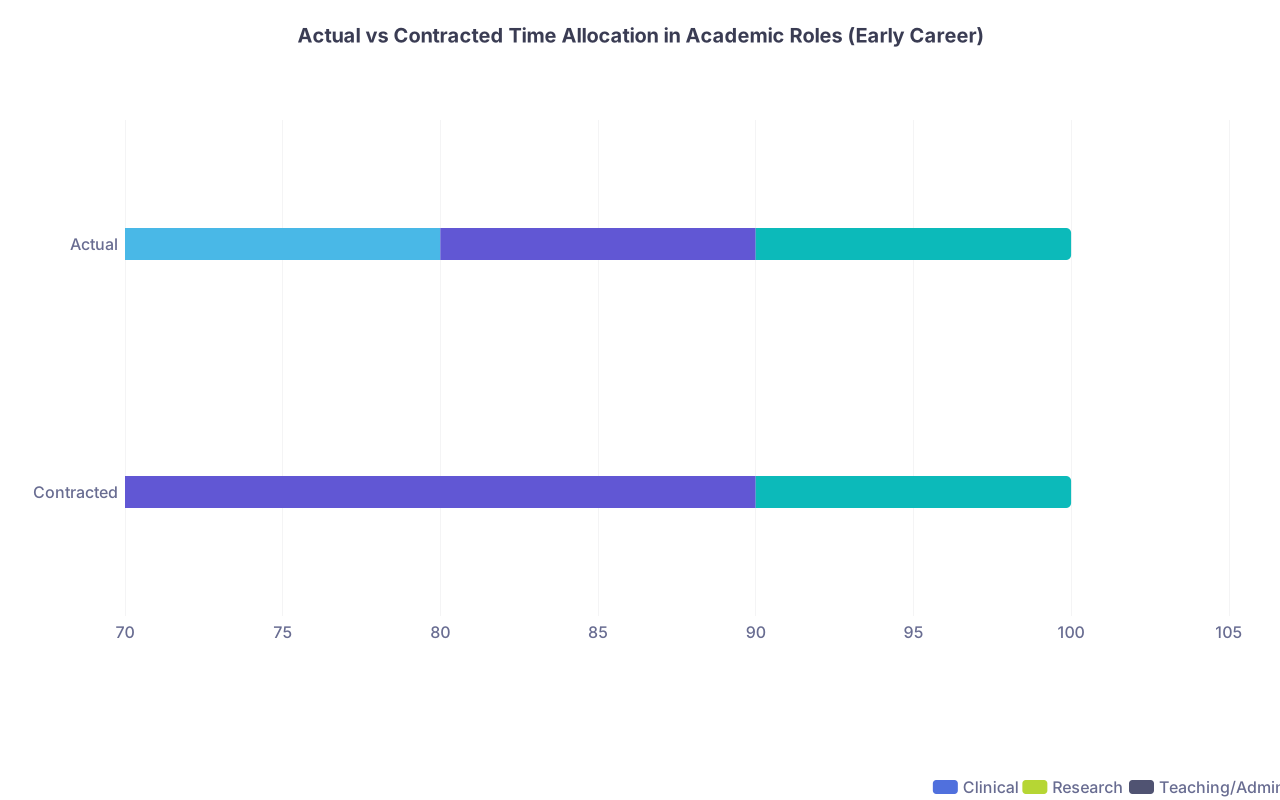
| Category | Clinical | Research | Teaching/Admin |
|---|---|---|---|
| Contracted | 70 | 20 | 10 |
| Actual | 80 | 10 | 10 |
You can see the misalignment: research is promised, but clinical work creeps.
This pattern shows up very concretely when you ask faculty: “Do you have sufficient protected time to meet expectations?” In large surveys, only about 30–40% of junior faculty say yes. The rest are essentially working a second shift for research and teaching.
Turnover and “Quiet Exits” from Academia
Pure job-to-job turnover in academic medicine looks modest on paper—around 5–8% annually. Administrators sometimes wave this around as proof of “stability.”
But look deeper:
- Many “stayers” mentally leave academia: they stop pursuing promotion, abandon research, and function as de facto hospital-employed clinicians.
- A noticeable chunk exit the institution but stay academic (lateral moves to another university due to local culture/leadership).
- Another chunk exit academia entirely within 5–7 years—especially in competitive specialties or high-RVU fields.
The early-career cliff is especially sharp. Among new academic faculty, several studies have found that 30–40% are gone (to another institution or to non-academic practice) by year 5–7. This is not a rounding error. It is a structural leak.
Who Tends to Burn Out Most in Academia?
The data show several consistently higher-risk subgroups:
- Junior faculty: juggling grants, promotion criteria, and heavy clinical loads.
- Women and underrepresented groups: more “invisible labor” (DEI work, mentoring) with less formal credit.
- Non-procedural specialties (e.g., general IM, pediatrics): high patient volume, lower RVUs, more “service” clinics.
So if you imagine academic medicine as a softer, slower lane, the analytics do not support that fantasy. It is stable institutionally, but often unstable at the individual level, particularly early on.
Hospital-Employed: High Burnout, Highest Turnover
Hospital employment is now the dominant model in many markets. In some specialties (e.g., hospitalist medicine, emergency medicine, neurology, oncology), employer-based models are the default. This is where the data get quite ugly.
Burnout Levels
Burnout rates in hospital-employed physicians frequently clock in around 50–65%, and in some high-intensity specialties and systems I have seen:
- Hospitalists: 60–70% reporting at least one symptom of burnout
- Emergency medicine: 60–65%
- Primary care in large systems: often 55–65%
Why? The pattern is consistent:
- High RVU pressure + fixed salary “with bonus” that rarely materializes as advertised.
- Minimal autonomy over scheduling, productivity targets, or support staff.
- Constant metric surveillance: door-to-doc times, length of stay, readmissions, patient satisfaction, portal message response times.
In large HR datasets, physicians in tightly managed, metric-heavy environments score significantly lower on autonomy and significantly higher on emotional exhaustion. This is not a mystery. It is the direct output of the operating model.
Turnover: The Invisible Cost Center
Hospital-employed practices often show 8–12% annual physician turnover, sometimes higher:
- Certain hospitalist groups are routinely above 15%.
- Newly acquired outpatient practices frequently see a spike in departures in year 2–3, once the honeymoon ends and productivity expectations ramp.
From a cost perspective, each departure is expensive:
- Recruiting + onboarding a physician in many specialties easily runs $250,000–$500,000 when you include recruiter fees, onboarding, lost productivity, and ramp-up.
- Multiply that by a 10% turnover rate in a 100-physician group: you are burning the equivalent of $2.5–5 million a year just on churn.
Administrators see this in the P&L. The tragedy is that the solution is almost always structural (autonomy, staffing, sane RVU expectations), not another resilience workshop.
Private Practice: Lower Turnover, Different Burnout Pressures
Private practice is constantly declared “dead.” The numbers disagree. It is shrinking, yes, but what remains tends to be more stable at the level of individual physicians.
Turnover: Surprisingly Low
True private practice—where physicians are owners or partners—shows the lowest annual job-to-job turnover: typically around 4–7%. When people leave, it is usually for:
- Relocation or family reasons
- Retirement or partial retirement
- Practice sale / acquisition by a hospital or PE group
- Total career change (rare, but it happens)
There is a key difference in the psychology: in private practice, leaving often means walking away from equity, relationships, and a brand you helped build. The switching cost is higher, so turnover stays lower.
Burnout: Not Absent, Just Different
Burnout in private practice is not low; it is merely differently structured. Survey data place private practice burnout around 40–55%, comparable to or slightly below academic and hospital-employed settings, depending on specialty.
The main stressors:
- Business risk: payer mix shifts, contract losses, rent, staff salaries.
- Regulatory and billing complexity: prior auths, denials management, audits.
- 24/7 ownership mindset: “If I am not worrying about the practice, who is?”
However, private physicians usually have meaningfully higher autonomy scores:
- More control over clinic schedule structure
- More say in staffing and workflow
- Ability to redesign the model (e.g., go concierge, hybrid, direct primary care, or sell to a group)
Autonomy is the strongest statistical counterweight to burnout in almost every dataset. When you run multivariable models, autonomy, perceived fairness, and workload are the big three levers. Salary is there, but it is weaker than most residents think.
Comparing the Three Paths Head-to-Head
Let us line them up in the dimensions that actually drive burnout and turnover.
| Factor | Academic | Hospital-Employed | Private Practice |
|---|---|---|---|
| Clinical Autonomy | Low–Moderate | Low | Moderate–High |
| Schedule Control | Low–Moderate | Low | Moderate–High |
| Non-Clinical Load | High | Moderate | High (business/admin) |
| Salary (median vs peers) | Lower | Moderate–High | Variable (wide range) |
| Burnout Rate (approx) | ≈50% | ≈58% | ≈48% |
| Annual Turnover | ≈7% | ≈10% | ≈5% |
This is oversimplified, of course, but your honest answers to “autonomy vs stability” and “interest in non-clinical work” explain a lot of the variance in burnout risk.
The Next Five Years: Where Are the Curves Heading?
Looking ahead, several trends are already measurable:
- Continued consolidation: hospital employment and corporate ownership will probably keep expanding, especially in primary care and some procedural fields.
- Private practice bifurcation: small, independent fee-for-service practices will keep shrinking, but concierge, direct primary care, and specialty micro-groups will grow.
- Academic role compression: more “clinical track” faculty with heavy RVU expectations and less real research time, which will push some people out of the ivory tower entirely.
Burnout rates will not magically drop just because people talk about them more. The structure of the job has to change:
- More control over schedule and panel size
- Real support staff and optimized workflows
- Honest accounting of non-clinical expectations
Until that happens, your best lever as an individual is matching yourself to the least structurally misaligned model for who you are and what you value.
You are not choosing between “good” and “bad” paths. You are choosing your problems. Academic, hospital-employed, private—each has a statistically predictable pattern of stress and churn. The smart move is to pick the pattern you are most willing to live with, eyes open, informed by the numbers rather than the sales pitch.
With this quantitative lens in place, you are in a far better position to interrogate offers and spot red flags. The next step is far more tactical: how you structure contracts, RVU expectations, call terms, and exit clauses to protect yourself. But that is a story for another day.