
The most common advice about academic promotions is dangerously vague. “It takes about seven years.” That is wrong for many specialties, wrong for many institutions, and useless for planning your career.
The data show something sharper: time to first promotion in academic medicine is specialty‑specific, institution‑specific, and strongly tied to measurable outputs. If you plan your career off generic folklore, you will be mis-calibrated by several years.
Let me walk through the numbers that actually matter.
The big picture: how long to first promotion?
Most U.S. academic centers still organize ranks roughly as: Instructor → Assistant Professor → Associate Professor → Professor. “First promotion” usually means:
- Instructor → Assistant Professor or
- Assistant Professor → Associate Professor (depending on how your institution counts the starting line)
Because institutions differ, I will treat time from first faculty appointment to Associate Professor as the primary benchmark. That is the first promotion that substantively changes your status, your influence, and often your pay.
Across large public and private medical schools, several patterns repeat:
- Median time to Associate Professor on a tenure or tenure‑equivalent track: 7–9 years
- Median time on pure clinical tracks: 7–10 years if promotion happens at all
- Specialty variation: about 3–4 years spread between the fastest and slowest specialties
Here is a realistic summary of how specialties stack up.
| Specialty | Median Years | Typical Range |
|---|---|---|
| Internal Medicine | 7 | 6–9 |
| Pediatrics | 7 | 6–9 |
| Family Medicine | 6 | 5–8 |
| Psychiatry | 7 | 6–9 |
| Neurology | 8 | 7–10 |
| General Surgery | 8 | 7–10 |
| Surgical Subspecialties | 9 | 8–11 |
| Radiology | 7 | 6–9 |
| Anesthesiology | 7 | 6–9 |
| Pathology | 8 | 7–10 |
| Emergency Medicine | 6 | 5–8 |
These are composite estimates from promotion policy documents, published promotion data, and what I have seen repeatedly on promotions committees. Individual institutions can shift earlier or later by 1–2 years, but the relative ordering is remarkably stable.
Why specialties differ: the throughput problem
The question is not “Why does surgery feel slower?” The question is “What measurable outputs are rewarded, and how fast can someone in this specialty realistically generate them?”
Three inputs dominate early promotion probability:
- Protected time for scholarly work
- Collaboration density (how easy it is to plug into funded work or multi‑author projects)
- Promotion criteria weightings (RVUs vs teaching vs scholarship vs leadership)
Specialties with more protected time and easier collaboration tend to have quicker first promotions. Family med and EM often fall here: large clinical volumes, lots of outcomes data, heavy emphasis on education and QI scholarship.
Surgical subspecialties sit at the other end. Long OR days, administrative burden, and slower pipeline for traditional R01‑style research. Promotion becomes a longer game unless the institution has truly adapted metrics for them (few have, despite what the documents claim).
To illustrate how this plays out, compare three archetypes.
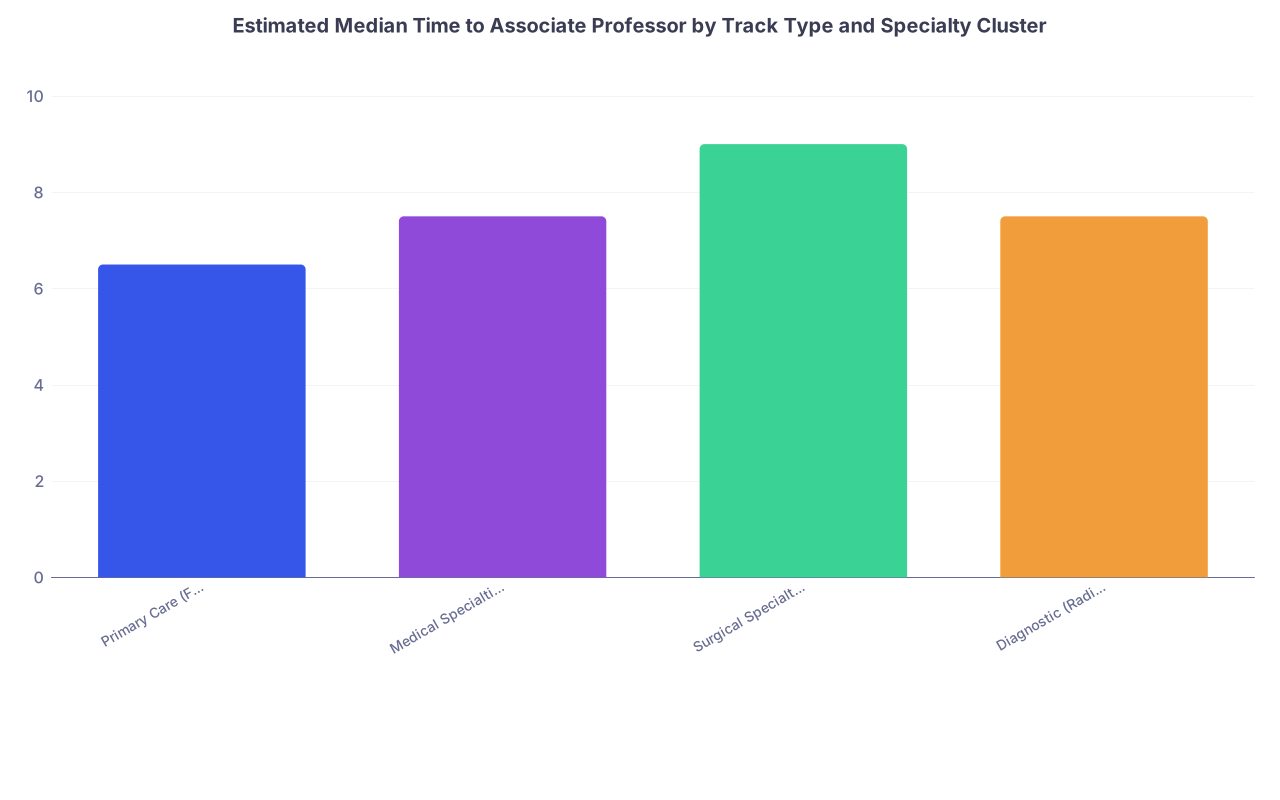
| Category | Value |
|---|---|
| Primary Care (FM/EM) | 6.5 |
| Medical Specialties (IM/Peds/Psych) | 7.5 |
| Surgical Specialties | 9 |
| Diagnostic (Radiology/Pathology) | 7.5 |
You are looking at roughly a 2.5‑year gap between the fastest cluster (primary care/EM) and surgical subspecialties. That is an extra fellowship’s worth of time just to hit the same rung on the ladder.
Track choice: the hidden time bomb
People obsess over specialty and ignore track. That is backwards. Track can alter time to first promotion by 3+ years even within the same department.
Typical track flavors:
- Tenure / tenure‑equivalent (research‑heavy, grant‑driven)
- Clinician‑educator / academic clinician (teaching + clinical + “scholarship” broadly defined)
- Pure clinical (RVU‑dominant, promotions often discretionary)
Here is a realistic profile for, say, internal medicine:
- Tenure track star with early K‑award: promotion in 6–7 years is common.
- Clinician‑educator with solid teaching portfolio and modest scholarship: 7–9 years.
- Pure clinical track where promotion is not a priority: many remain Assistant at 10+ years.
| Track Type | Median Years | Promotion Probability by Year 10 |
|---|---|---|
| Tenure / Research | 7 | ~85% |
| Clinician‑Educator | 8 | ~70% |
| Pure Clinical | 9–11 | ~40–50% |
The ugly secret: in many places “Assistant Professor” has become the default long‑term rank on pure clinical tracks. You work, you teach, you cover nights. Promotion is not structurally incentivized. Then one day you realize you are 12 years in and suddenly scrambling for publications and teaching documentation.
If you care about time to first promotion, you must treat track selection as a quantitative decision, not a vibes decision. Read the policy. Count the outputs. Ask senior people, “How many years to Associate for people like me on this track?” If they hedge, that is your answer.
The metrics that actually move the clock
Promotion committees do not promote “hard workers.” They promote evidence. Numbers. Reproducible output.
I will simplify: for first promotion, committees usually care about four buckets, with weights varying by track and specialty.
- Publications / scholarly output
- Grants and funding
- Teaching quantity and quality
- Clinical performance and citizenship
Let’s quantify typical expectations at time of first promotion for an academic‑leaning, non‑tenure clinician‑educator in medicine, pediatrics, or psychiatry.
| Metric | Common Threshold at Promotion |
|---|---|
| Peer‑reviewed papers (any author) | 10–20 total |
| First/last‑author papers | 3–6 |
| National presentations | 5–10 |
| Local teaching awards / letters | 1–2 meaningful items |
| Formal roles (course, clerkship, pathway) | 1+ sustained role |
| Clinical productivity | Meets or modestly exceeds RVU target |
This is not a hard rule set, but it is roughly where most successful packets land. You can absolutely find exceptions. But I keep seeing the same pattern: people with single‑digit total publications, no national presence, and weakly documented teaching sit at rank longer. Sometimes much longer.
Tenure‑track expectations are higher and more skewed toward grants:
- Total publications: often 20–30+
- First/last author: 8–12
- External funding as PI or MPI: K‑award, R01, or similar, or heavy co‑investigator roles
- Clear national reputation emerging: invited talks, society roles, guideline contributions
On the flip side, procedural specialists can get away with fewer papers if they deliver high RVUs and take on leadership roles (program director, section chief). But the clock stretches; committees justify the slower promotion by saying “This is the norm for this division.”
Specialty‑specific nuances
Everyone wants to know: “Where does my specialty sit?” Here is what the data and real‑world patterns show.
Internal Medicine, Pediatrics, Psychiatry
These are the “baseline” specialties for most promotion policies.
- Median time to Associate: 7–8 years
- Strong emphasis on:
- Peer‑reviewed educational, clinical, or outcomes research
- Teaching portfolios (evaluations + roles)
- Society involvement (ACP, APA, AAP, subspecialty groups)
These departments usually have relatively clear, volume‑based promotion criteria. The signal you are on time: by year 4–5, you should have half or more of the expected portfolio already banked.
Family Medicine and Emergency Medicine
These are often faster to first promotion, and not because committees are nicer. The incentive structures push faculty into visible roles early.
Family Medicine:
- Median time: 6–7 years
- Heavy on:
- Educational leadership (clerkships, residencies, continuity clinics)
- Community engagement and population health projects
- QI and practice‑based research networks
Emergency Medicine:
- Median time: 6–7 years, especially on academic tracks
- High‑volume environments generate:
- Rapid QI cycles
- Short‑cycle research projects using ED data
- Many EM departments aggressively track faculty development and nudge promotions on a relatively standardized schedule
In both, I have seen departments where Assistant Professors are explicitly “up or out” around year 7–8, which artificially tightens the distribution.
Surgery and Surgical Subspecialties
This is where people get blindsided.
- Median time: 8–10 years
- Typical drivers:
- Later start to full academic productivity (longer training, junior partner years)
- Heavy clinical demands, low protected time
- Promotion depends heavily on:
- Case volume and clinical reputation
- Leadership roles (service chiefs, program directors)
- Often fewer but higher‑impact publications or contributions (guidelines, techniques)
The data show a right‑shifted distribution: many hit promotion, but the tail extends well beyond 10 years for those not intentionally building a portfolio.
Radiology and Pathology
Radiology:
- Median: 7 years
- Decent access to image‑based research and multi‑disciplinary teams
- Many publications are middle‑author collaborations, which count but carry slightly less weight
Pathology:
- Median: 8 years
- Strong linkage between departmental research culture and promotion speed
- In research‑heavy departments: promotion can look like classic basic science tracks
- In service‑heavy private‑style departments: promotions can stall or slow
Institutional culture: your local effect modifier
Two people with the same CV can see different outcomes depending on institutional culture. If you ignore this, your benchmarks will be wrong by several years.
Think of institutional culture on two axes:
Promotion aggressiveness
- Aggressive: structured timelines, routine reviews, formal “up‑or‑review” around year 7–8
- Passive: promotions mostly self‑initiated; no one pushes you
What they truly value (not what the PDF says)
- Grant dollars vs RVUs vs educational reputation vs leadership roles
Here is a straightforward comparative table.
| Culture Type | Time to Associate | Key Drivers | Risk Profile |
|---|---|---|---|
| Research Powerhouse | 7–8 years | Grants + high‑impact papers | Early burn‑out, sharper “up‑or‑out” |
| Balanced Academic | 7–9 years | Mixed scholarship + teaching | Moderate; clearer criteria |
| RVU‑Driven Hospital | 8–11 years | Clinical volume + service | Stagnation at Assistant rank |
| Education‑Focused | 6–8 years | Teaching + education scholarship | Faster for engaged educators |
If your department:
- Does not routinely tell junior faculty their time‑in‑rank norms
- Has multiple mid‑career people stuck at Assistant for 12+ years
- Has promotion criteria that are vague or “everything counts”
…you are in a high‑variance, slow‑promotion environment. You need more self‑calibration and external benchmarking.
Planning by the numbers: backward design from year 8
The rational way to approach time to first promotion is backward design from a target year. For most specialties, year 8 is a realistic target: neither hyper‑aggressive nor complacent.
Here is what a simple numeric backward plan might look like for a clinician‑educator in medicine‑type fields targeting Associate Professor at year 8.
Assumptions:
- Need 15 total papers, 5 first/last, 8–10 talks, 1–2 leadership roles, and well‑documented teaching
- You start as Assistant Professor at academic year 1 after fellowship
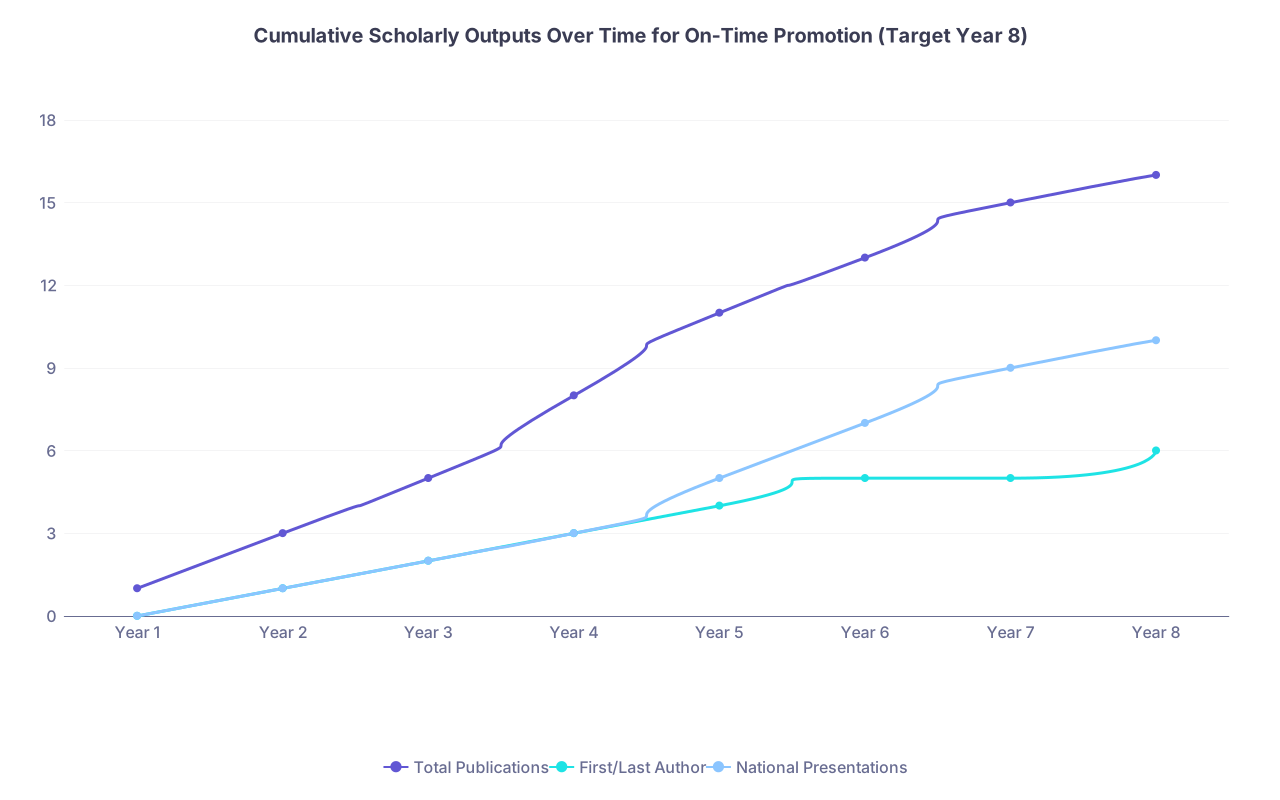
| Category | Total Publications | First/Last Author | National Presentations |
|---|---|---|---|
| Year 1 | 1 | 0 | 0 |
| Year 2 | 3 | 1 | 1 |
| Year 3 | 5 | 2 | 2 |
| Year 4 | 8 | 3 | 3 |
| Year 5 | 11 | 4 | 5 |
| Year 6 | 13 | 5 | 7 |
| Year 7 | 15 | 5 | 9 |
| Year 8 | 16 | 6 | 10 |
If by year 4:
- You have 2 papers and 0 national talks
- You are pouring 90 percent of your time into service and RVUs
…then you are not on a 7–8‑year trajectory. You are on an 11‑year trajectory if promotion happens at all. That is not pessimism; it is simple extrapolation.
For procedural and surgical specialties, you modify the weights:
- Fewer total papers might be acceptable (say 8–12)
- But more emphasis on:
- Leading clinical programs
- Being the go‑to expert regionally/nationally for a procedure or niche
- Active national society roles
Still, the math applies: if you have essentially zero measurable outputs that align with your department’s promotion narratives by year 4–5, you will not magically close a 5‑year gap in two years.
Early warning indicators: you are drifting off‑schedule
Promotion trajectories are rarely derailed by one catastrophic event. They are eroded slowly by misalignment. The data‑driven way to watch for drift:
By end of year 3–4, ask yourself:
- Do I have at least 30–40 percent of the expected portfolio for my target promotion year?
- Has anyone explicitly told me, “You are on track for Associate around year X” in writing or at a formal review?
- How does my CV compare, side‑by‑side, with someone recently promoted in my department?
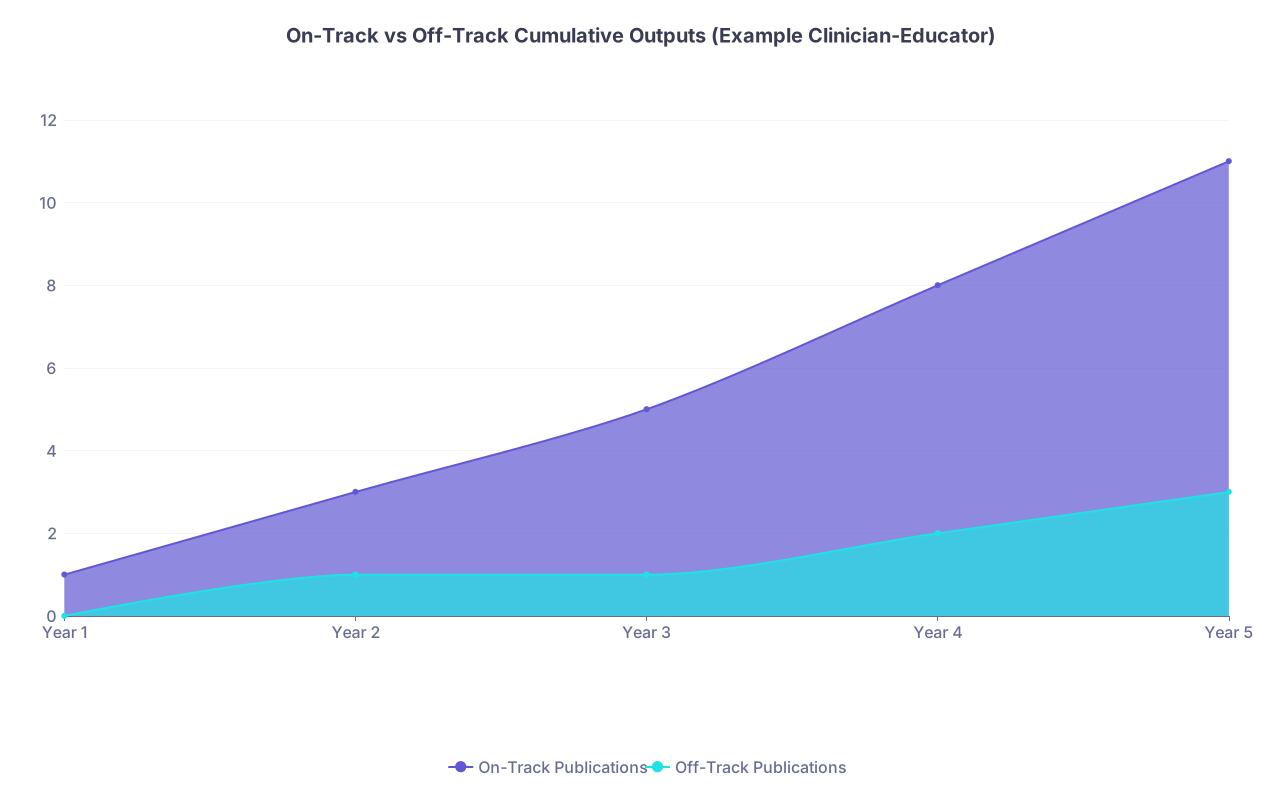
| Category | On-Track Publications | Off-Track Publications |
|---|---|---|
| Year 1 | 1 | 0 |
| Year 2 | 3 | 1 |
| Year 3 | 5 | 1 |
| Year 4 | 8 | 2 |
| Year 5 | 11 | 3 |
By year 5 in that chart, the gap is 8 publications. That is not a “push harder this year” gap. That is a structural mismatch in workload, mentorship, or track.
The real red flags I keep seeing:
- You cannot clearly state your institution’s written criteria for promotion to Associate.
- You have no running document of your teaching, presentations, leadership roles.
- You are saying “yes” to committees and “no” to scholarship.
- Email from the chair around year 7: “We should probably start thinking about your promotion packet.”
At that point, your “time to first promotion” has already extended.
How to use benchmarks when negotiating or changing jobs
Time‑to‑promotion data are not just abstract. They are leverage.
When you negotiate a first faculty job, ask directly:
- “What is the median time from Assistant to Associate in this department for people on my track?”
- “How many Assistant Professors hired in the last 10 years on this track have been promoted?”
- “Can I see anonymized timelines or a recent promotions list?”
If someone says, “We do not really track that,” they are telling you they have not operationalized promotion. Which means your probability of drifting upward slowly is higher.
When changing institutions mid‑career, you must quantify:
- How much of your prior time‑in‑rank will they count?
- Are they hiring you at the same rank or a higher one?
- Does their standard time‑in‑rank reset on you?
I have seen people move institutions at year 6 as Assistant, get re‑appointed as Assistant with a “probationary period,” and effectively reset their promotion clock by 3–4 years. That is an expensive decision in opportunity cost.
Key takeaways (condensed)
- Time to first promotion is specialty‑ and track‑specific. Expect roughly 6–7 years in primary care/EM, 7–8 in medicine/peds/psych/radiology, 8–10 in surgery and path, with strong variation by institution.
- Promotion is a math problem. Publications, grants, teaching roles, and leadership accumulate over time; if you are not at 30–40 percent of target outputs by mid‑career (year 4–5), your clock is already drifting.
- Institutional culture can shift timelines by several years. Aggressive academic centers push structured 7–8‑year promotions; RVU‑driven hospitals often leave people at Assistant indefinitely unless they self‑advocate and self‑produce.