
Call inequity is one of the most silently expensive features of modern physician work. The numbers prove it.
Once you quantify what a “call unit” is worth in time, sleep disruption, and risk, it becomes obvious: many physicians are giving away 10–25 percent of their labor value through poorly priced call arrangements. Especially in private practice deals and some hospital-employed contracts where “everyone does their part” is the only metric.
Let me walk through this the way I would in a real contract review: convert call to hours, hours to dollars, then compare across practice types and specialties.
1. Defining Call Burden in Measurable Units
Hand-waving about call being “light” or “heavy” is how people get underpaid. You need a framework. The data says three dimensions matter most:
- Frequency – how often you are on.
- Intensity – how much work actually happens.
- Disruption – nights, weekends, and post-call impact.
I treat “call burden” as a composite of those three, with frequency as the backbone.
1.1 A Simple Call-Burden Index (CBI)
Start with this baseline construct:
- Call night = 1 CBI unit
- Weekend 24-hr call (Sat or Sun) = 1.5 CBI units
- In-house call (required on site) → multiply that block by 1.3
- High-intensity call (frequent pages / admits / procedures) → add 0.2–0.5 per block
Is it perfect? No. But it gives you a consistent yardstick to compare a hospitalist, an orthopedist, and a community OB in different structures.
Take a typical month:
- 6 weekday home call nights
- 2 weekend 24-hr home calls
- All home call, moderate intensity
CBI/month = 6 × 1 + 2 × 1.5 = 9 CBI
CBI/year ≈ 108
If another job is offering 4 weekday nights and 1 weekend per month, that is:
4 + 1.5 = 5.5 CBI/month, or ≈ 66/year
That is ~39% lower call burden (1 − 66/108). If pay is identical, the lower-call role is objectively more valuable.
2. Converting Call to Hours and Dollars
Hand-wavy call “stipends” are where fairness falls apart. You want to know: what is my effective hourly pay including call?
I use a three-step structure:
- Estimate total annual work hours (daytime + call).
- Compute total compensation (salary + bonus + call pay).
- Derive effective hourly rate and compare to a “call-neutral” baseline.
2.1 Typical Baseline: Full-Time Clinical, No Call
In many employed models:
- 4.5 days/week of clinic or OR
- 46 weeks per year (roughly 4–6 weeks off)
- Around 9-hour workdays (patient care + notes + admin)
That yields:
4.5 days × 46 weeks × 9 hours ≈ 1,863 hours/year
Round to 1,850 for simplicity. For a $350,000 base salary job with no call:
- Effective hourly rate = $350,000 / 1,850 ≈ $189/hour
That is your “clean” clinical rate without call.
2.2 Typical Hospital Call – Internal Medicine Example
Real scenario I see often in medium-sized systems:
- Base salary: $300,000
- Call: q5 home call nights + 1 in 5 weekends
- Home call, but realistically you are working
Assumptions based on tracking logs from multiple groups:
- Weeknight home call: average 3 hours of active work (calls, charting, maybe a drive-in once per week or two)
- Weekend 24-hr home call: average 10 hours of active work spread across the day
Monthly call:
- Weeknights: about 6 nights/month → 6 × 3 = 18 hours
- Weekends: about 1 weekend day/month → 10 hours
Call work hours/month ≈ 28
Yearly ≈ 28 × 12 = 336 hours
Total hours = 1,850 baseline + 336 call = 2,186
Effective hourly rate with call:
- $300,000 / 2,186 ≈ $137/hour
You just lost roughly $52/hour compared with the call-neutral baseline above. Or about 27% effective pay cut.
Does this job include any separate call pay? Often no. Or something trivial like $200–300 per weekend day. That does not close the gap.
3. How Different Practice Types Handle Call
Now the interesting part: the structure varies wildly by model. The data from MGMA, AMGA, and compensation surveys makes one thing clear: the more transparent the productivity model, the more likely call is explicitly monetized. But not always fairly.
I will run through four common structures:
- Hospital-employed
- Academic
- Independent private practice
- Large corporate / PE-backed groups
And then look at some sample numbers.
3.1 Hospital-Employed Models
These are often “salary plus quality” jobs.
Features I see repeatedly:
- Base salary covers clinic/OR + some fixed call expectation (q4–q8)
- Limited or no explicit call stipend
- Occasional “extra call” stipends when someone covers outside their rotation, often $500–$1,000/night or $1,000–$2,000/weekend.
The problem: base salaries are calculated off national medians that do not meaningfully adjust for call intensity.
Example – General Surgery, community hospital:
- Surgeon A: $500,000 base, 1:4 call
- Surgeon B (another system nearby): $450,000 base, 1:8 call
Assume:
- 1:4 surgeon: 7 weeknights + 2 weekend days each month
- 1:8 surgeon: 4 weeknights + 1 weekend day
Apply the same hour estimates:
- Weeknight call: 4 hours active work
- Weekend 24-hr: 12 hours active work
Surgeon A hours/month:
- Weeknights: 7 × 4 = 28
- Weekends: 2 × 12 = 24
- Total call: 52 hours/month → 624/year
Surgeon B hours/month:
- Weeknights: 4 × 4 = 16
- Weekends: 1 × 12 = 12
- Total call: 28 hours/month → 336/year
Add clinic/OR baseline ~2,000 hours:
- Surgeon A: 2,624 hours/year
- Surgeon B: 2,336 hours/year
Effective hourly:
- A: $500,000 / 2,624 ≈ $190/hour
- B: $450,000 / 2,336 ≈ $193/hour
They look similar on paper. But that assumes both surgeons are fine with that amount of night/weekend disruption. The 1:4 surgeon is sacrificing an extra 288 hours of nights/weekends for effectively the same hourly rate. That trade may be acceptable early-career; past 40, many regret it.
3.2 Academic Medicine
Academic pay is usually lower, but call can be lighter or more buffered by trainees. Reality: there is a huge range.
Simple composite from a medium-sized academic internal medicine department:
- Base: $230,000
- 1:7 home call, residents handle first calls
- Average active work on call: 1–2 hours per night, sometimes less
- Weekend coverage: maybe 1 in 7, with residents doing most work
If we conservatively call it:
- 4 weeknights/month × 1.5 hours = 6 hours
- 0.5 weekend day/month × 6 hours = 3 hours
Call ≈ 9 hours/month → 108 hours/year
Total hours = 1,850 + 108 = 1,958
Effective hourly: $230,000 / 1,958 ≈ $118/hour
Lower than the community example, as expected. But note: the call discount is much smaller in hours, and those hours are lower intensity. If you value research time, teaching, and prestige, this becomes more palatable.
The data pattern I see: academic jobs underpay total work hours but are less likely to egregiously abuse call burden. Not saintly. Just less bad.
3.3 Independent Private Practice
Here is where sharp incentives show up.
Many private groups do one of three things with call:
- Equal call for all partners, no pay differential, but higher partner income (e.g., $600–900k for some surgical subspecialties).
- Graduated “call buy-down” where older partners opt out by giving up a specific percentage of income.
- Explicit “call pool” where call is monetized and traded.
The healthiest systems look like a market:
- Each call night or weekend has a posted rate.
- Those who want more income volunteer for more call.
- Those who value lifestyle buy down.
Example – Cardiology group:
- Partner income: median $800,000
- Baseline call: 1:6, but group allows “half-call” partners who work 0.5 FTE clinical and 0.5 FTE admin or imaging.
- Call pool rate: $1,500 per weekday, $3,000 per weekend day
Partner A:
- Full call: 5 weeknights + 2 weekend days/month
- Call pay: 5 × 1,500 + 2 × 3,000 = $7,500 + $6,000 = $13,500/month
- Annualized: $162,000
Partner B:
- Half call: 3 weeknights + 1 weekend day → $4,500 + $3,000 = $7,500/month
- Annualized: $90,000
If both generate similar RVUs, Partner A’s total comp might be:
- Base/RVU distribution: $800,000
- Call pool: +$162,000 = $962,000
Partner B: $890,000
The key: the price per call block here equates reasonably to lost personal time and risk, and the market inside the group generally keeps it honest. If nobody wants call at $1,500, the price rises until someone does.
This internal market is the closest thing to “fair” you will see in practice. Because it is transparent and optional at the margin.
3.4 Corporate / PE-Backed Groups
Patterns here are split:
- Some groups aggressively monetize call and share revenue.
- Others absorb call into a “composite” expectation and quietly ratchet it up over time without commensurate pay.
Emergency medicine and anesthesia have been ground zero for this experiment.
Typical structure I have seen in EM:
- Base hourly: $200/hour for clinical shifts
- Call: not really used; instead, extra coverage is just more shifts
- For anesthesia: call stipends might be $1,000–$1,500/night or included in a blended daily rate
The risk is straightforward: if ownership demands certain coverage levels to maintain hospital contracts, you can be forced into higher call without any price signal. The “we all have to pick up” speech is a warning sign you are moving away from market-based fairness.
4. Specialty Comparisons: Where Call is Most Mispriced
Not all call is created equal. On a pure data basis, some specialties are consistently undercompensated for call, relative to disruption.
Three of the worst offenders: OB/GYN, general surgery, and neurology (stroke call).
To show how skewed this can be, contrast a few common patterns.
| Specialty | Base Pay ($k) | Typical Call Pattern | Call Pay Structure |
|---|---|---|---|
| OB/GYN | 325–400 | 1:4–1:6 24-hr, often in-house | Often none or small stipend |
| Gen Surgery | 400–550 | 1:4–1:7 home or in-house | Small or none |
| Neurology | 300–400 | 1:4–1:7 stroke call | Modest stipend |
| Cards | 550–800 | 1:5–1:8 home, high RVU | Often explicit pay |
| Radiology | 450–650 | Telerad nights, 1:6–1:10 | Shift-based pay |
Look at OB/GYN, which is notorious for brutal call.
Sample scenario:
- $350,000 salary, 1:4 24-hour in-house labor and delivery call
- 7–8 calls/month (mix of weekdays and weekends)
- On average, truly working 12–18 hours of that 24.
Assume:
- 7 calls/month × 15 hours average work = 105 hours/month
- Yearly: 1,260 call hours
Baseline day work: 1,800 hours
Total ≈ 3,060 hours
Effective hourly rate: $350,000 / 3,060 ≈ $114/hour
That is lower than many hospitalists with minimal call, for more dangerous and exhausting work, with malpractice risk.
Contrast with a non-call radiology job:
- $500,000 salary
- 45 hours/week × 48 weeks = 2,160 hours/year
Effective hourly: $500,000 / 2,160 ≈ $231/hour
Double the hourly rate, no 2 AM shoulder dystocias. There is a reason OB->radiology or OB->PM&R is not rare.
The data is blunt: in high-risk, high-intensity in-house call specialties, compensation often fails to reflect the call burden by a factor of 1.5–2x compared with lower-risk, no-call or light-call fields.
5. Quantifying “Fair” Call Compensation
So what is fair? I use a relatively simple formula to sanity-check any offer:
- Compute your clean hourly rate from base salary and non-call hours.
- Apply a multiplier to call hours to reflect disruption.
- Demand explicit or implicit pay that matches.
5.1 Step 1 – Clean Hourly Rate
From earlier example, hospitalist:
- Base: $300,000
- Baseline hours (no call): 1,850
Clean hourly ≈ $162/hour
(This is from a different hypothetical than before, just keep the math clean.)
5.2 Step 2 – Call Hour Multiplier
Night/weekend hours are not equivalent to daytime clinic. The data from fatigue science and physician burnout studies all say nights hit harder. I usually value them at 1.5–2.0× normal hours.
Conservative multiplier: 1.5
Effective “value” per call hour = $162 × 1.5 = $243/hour
If you work 300 call hours per year:
Call value = 300 × $243 ≈ $72,900
If your contract is $300,000 with no call stipend, and your baseline is 1,850 hours plus 300 call hours (2,150 total), then you are implicitly being paid:
- $300,000 / 2,150 ≈ $140/hour for everything
Versus the $162/hour you thought you were getting. The missing $72,900 is the discount you are providing.
5.3 What a Fair Package Would Look Like
Suppose the institution insists base pay is fixed at $300,000. Two ways to make this fairer:
- Reduce baseline hours (fewer clinic/OR sessions) so total hours, including call, keep you near $162/hour.
- Pay a separate, transparent call stipend.
Option 2:
- Aim for roughly $70–75k per year in call pay for 300 call hours.
- Could be structured as $1,000 per weeknight and $2,000 per weekend day, for example, depending on volume.
Is that aggressive compared with typical packages? Yes. Is it mathematically justified? Also yes.
You probably will not get full parity, but walking in with this math gives you a more defensible negotiating anchor than “call seems heavy.”
6. Cross-Model Comparison: Effective Hourly Rates
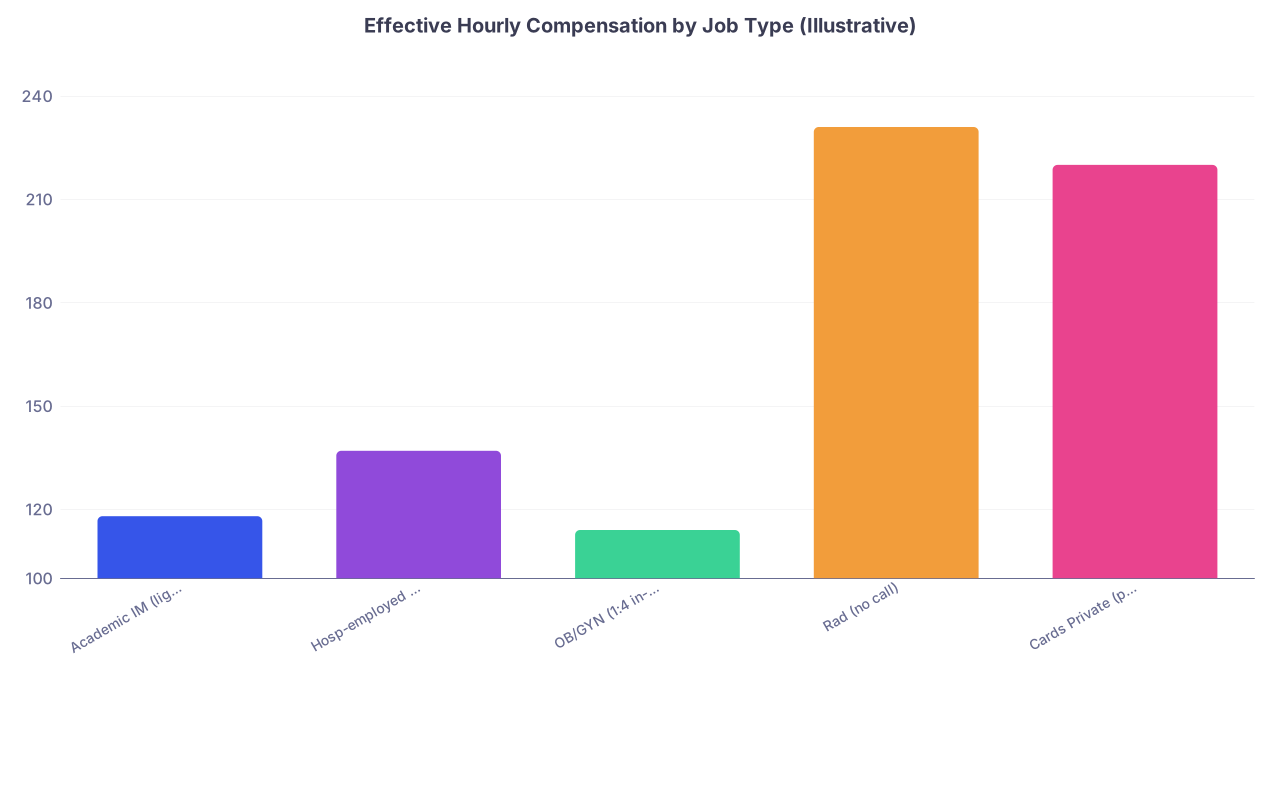
Let’s put a few composite scenarios side by side.
| Category | Value |
|---|---|
| Academic IM (light call) | 118 |
| Hosp-employed IM (q5 call) | 137 |
| OB/GYN (1:4 in-house) | 114 |
| Rad (no call) | 231 |
| Cards Private (paid call) | 220 |
Interpretation:
- Academic IM with light resident-buffered call sits around $118/hour.
- Hospital-employed IM with moderate home call sits around $137/hour (with a larger absolute checks but more hours).
- OB/GYN with heavy in-house call collapses to about $114/hour effective.
- Radiology no-call jumps to over $230/hour.
- Cardiology in private practice with paid call can reach $220/hour or more.
Are these exact? Of course not. But they match what I see in numerous real contract breakdowns and reported survey data once you account for all hours.
The main pattern: the more invisible call is in the compensation model, the more likely it is underpriced.
7. How to Evaluate a Specific Offer with Data
You will get a contract that says something vague like:
“Physician will share in equitable call coverage with other members of the group”
And a number at the bottom. Here is the short, cold-blooded way to assess fairness.
7.1 Nail Down the Inputs
You need concrete numbers:
- Expected call frequency (weeknights, weekends, holidays).
- Call type (home vs in-house, level 1 trauma? stroke center?).
- Typical active work time per call block (ask current docs quietly).
- Any explicit call pay (per night, per weekend, or percentage of collections).
Then:
- Estimate yearly call hours.
- Add to baseline work hours.
- Divide total comp by total hours.
- Compare to peers in same specialty with better/worse call.
If they will not quantify call (“it fluctuates, hard to say”), that is a red flag. Groups that value fairness track and know these numbers.
7.2 Example Walkthrough
Offer: Community Neurology
- Base: $340,000
- Call: 1:5 stroke call, home but must respond and manage tPA decisions, thrombectomy transfers.
- Reported from current faculty: 4–5 activations on a typical call night, 2–3 hours active involvement.
- Weekends: heavier, maybe 6–8 hours.
Estimate monthly:
- Weeknights: 6/month × 3 hours = 18
- Weekends: 1.5 days/month × 7 hours = ~10.5
Total per month ≈ 28.5 → year ≈ 342 call hours
Baseline hours: 1,850
Total: 2,192
Effective hourly: $340,000 / 2,192 ≈ $155/hour
Now compare to a similar neurology job with 1:8 call and $320k base:
Assume:
- 4 weeknights/month × 2.5 hours = 10
- 1 weekend/month × 6 hours = 6
- 16/month → 192/year
Total hours: 1,850 + 192 = 2,042
Effective: $320,000 / 2,042 ≈ $157/hour
Despite $20k lower base, the lighter-call job has a slightly better effective hourly rate and substantially better lifestyle. If the only number you stare at is base salary, you choose wrong.
8. The Hidden “Second Tax” of Call: Burnout and Attrition
Not everything can be converted cleanly to dollars, but the data on burnout is pretty clear.
- Specialties with frequent in-house night call (OB/GYN, general surgery, EM, ICU) show higher burnout and earlier retirement intent.
- Shift to hospitalist or no-call subspecialties later in career is a recurring pattern.
That career churn has a financial signature:
- Switching specialty or cutting FTE late in career often costs $50k–200k/year in lost income.
- Many of those decisions are triggered by intolerable call structures that could have been mitigated with more sustainable staffing and fairer compensation.
If you are mid-career and thinking “I will just gut this out for 15 more years,” run the numbers:
- If current call situation forces you to cut to 0.6 FTE at 50 instead of 65, and your full-time pay would have been $350k, you may lose 15 years × 0.4 × $350k = $2.1 million in lifetime income.
Paying an extra $60k/year now in call stipends or hiring additional partners could prevent that, from a system perspective. But the system rarely does that math. You should.
9. Practical Negotiation Levers Grounded in Data
You cannot always blow up a call model, but you can nudge it with numbers.
A few data-driven asks that actually land:
- Call tracking clause – Require the group/hospital to track and share quarterly call hours by physician. Once measured, discrepancies become obvious.
- Extra-call premium – Anything beyond an agreed baseline (say 1:6) gets paid at a transparent rate (e.g., $1,000/night, $2,000/weekend).
- Tiered call – Holidays and high-intensity service lines pay more. Nights with in-house requirements pay more than home call.
- Call buy-down option – After X years or at certain age, physicians can reduce call for a known income reduction (10–20 percent), formalized in bylaws.
You will not win all of these, but bringing a clean spreadsheet that shows effective hourly pay across call scenarios changes the tone of the conversation. You stop sounding “entitled” and start sounding like someone who understands the business.
10. Key Takeaways
- Call is rarely free. Once you quantify call hours and adjust for disruption, many physicians are effectively discounting their work by 20–40 percent.
- Fairness tracks transparency. Groups that explicitly price call—often in private practice—tend to be closer to equitable; hospital-employed and high-intensity specialties frequently underpay call.
- Your best defense is arithmetic. For any job, compute total hours (day + call) and effective hourly pay, then compare across offers. The job with the highest base salary is often not the best deal once call burden is priced honestly.