
The usual advice about “academic vs private practice” is dangerously incomplete because it ignores the math of lifetime income curves.
Most people argue in slogans: “Academics pay less,” “Private practice is where the money is,” “But what about pensions and prestige?” Almost nobody actually models the full 30–35 year income trajectory, incorporates promotion timelines, partnership tracks, benefits, and risk. When you run the numbers, some of the folk wisdom holds up—and some of it collapses.
This is a quantitative walk‑through of how academic vs private practice income curves really behave over a career, what assumptions move the needle, and where the decision flips from obvious to surprisingly ambiguous.
1. Core Assumptions: How We Build the Income Curves
Let me lay down the baseline scenario first. You can adjust later, but you need a reference model.
Assume:
- You finish residency at age 30 (after a 3–5 year residency plus maybe a year of gap / prelim).
- Career horizon: 35 years (age 30 to 65).
- Specialty: mid‑to‑high income (hospital‑based IM subspecialty, anesthesiology, radiology, or similar). Super‑elite surgical incomes will just scale the private practice numbers up.
- All numbers in today’s dollars (constant 2% inflation backing out of nominal growth). When I say “3% raise,” interpret as real growth, not pure inflation.
Now, two archetypes.
Academic Track – Baseline Model
Typical structure in many U.S. academic centers:
- Rank progression with stepwise raises.
- Modest but steady salary growth.
- Stronger retirement match and somewhat better job security.
Assumptions:
- Starting salary (Assistant Professor): $240,000
- Promotion to Associate at year 7: +15% bump
- Promotion to Full at year 14: +15% bump
- Annual real raise: 1.5% per year within each rank
- Employer retirement contribution: 10% of salary
- RVU/bonus: small, say $10–20k, already baked into averages
Private Practice Track – Baseline Model
Typical group‑based private practice:
- Lower income during partnership track.
- Steep jump once partner.
- Higher ceiling, more volatility.
Assumptions:
- Years 1–3 (associate): $280,000 base + modest bonus → round to $300,000
- Year 4+ (partner): $480,000 to start
- Annual real growth in partner income: 2% (productivity, group growth, negotiation)
- Employer retirement contribution / profit‑sharing: 20% of salary (common in strong groups)
- Higher but lumpier bonuses built into the income bands
These are not outliers. I have seen exactly these numbers on multiple real contracts: new radiology attendings at ~$270k–300k academic vs ~$450k–550k partner private; hospitalist academic ~$210k–240k vs private ~$280k–350k, etc. The gaps vary by specialty, but the shape of the curves is similar.
2. Year‑by‑Year Earnings: What the Data Implies
Let us put rough numbers on the first 15 years, which is where most people dramatically underestimate the compounding difference.
| Year in Practice | Academic Salary | Private Practice Salary |
|---|---|---|
| 1 | $240,000 | $300,000 |
| 3 | $247,000 | $300,000 |
| 5 | $254,000 | $480,000 (partner) |
| 7 | $261,000 | $500,000 |
| 10 | $279,000 | $530,000 |
| 14 | $292,000 | $575,000 |
| 20 | ~$317,000 | ~$650,000 |
Now, those are point estimates. The important question is cumulative.
Cumulative Earnings through Key Milestones
Let us sum gross salary (not including retirement contributions yet).
Rough approximations:
Academic, years 1–10
Average salary ~ $255k → 10 years ≈ $2.55 millionPrivate practice, years 1–10
Years 1–3 at $300k → $0.9M
Years 4–10 partner, averaging ~$500k → 7 × 500k ≈ $3.5M
Total ≈ $4.4M
Difference by year 10: private practice ahead by roughly $1.8 million in pretax salary.
Stretch to 20 years:
Academic, years 1–20
First 10 years ≈ $2.55M
Next 10 years, average maybe ~$300k → $3.0M
Total ≈ $5.55MPrivate, years 1–20
First 10 years ≈ $4.4M
Next 10 years, partner income growing from ~530k to ~650k, average maybe ~$590k → $5.9M
Total ≈ $10.3M
Difference by year 20: private ahead by around $4.7 million in cumulative gross income.
That is the blunt math that underpins all the “private practice pays more” talk. It is not a small difference; it is multi‑million‑dollar territory before age 50.
3. Retirement Contributions and Compounding
Salary alone is only part of the curve. The retirement and investment side magnifies the gap.
Employer Contributions
Using our assumptions:
- Academic: 10% of salary to retirement
- Private: 20% of salary to retirement (via 401(k), profit‑sharing, cash‑balance, etc.)
Approximate 20‑year employer contributions:
Academic
10% × ~$5.55M cumulative salary ≈ $555k contributedPrivate practice
20% × ~$10.3M ≈ $2.06M contributed
Difference just from employer money: ~$1.5 million more retirement funding in private practice over 20 years.
Now layer realistic market growth on that.
Assume a 5% real return (7% nominal, 2% inflation). Contributions made earlier compound longer, so private practice’s front‑loaded higher dollars win twice.
This is where a picture helps.
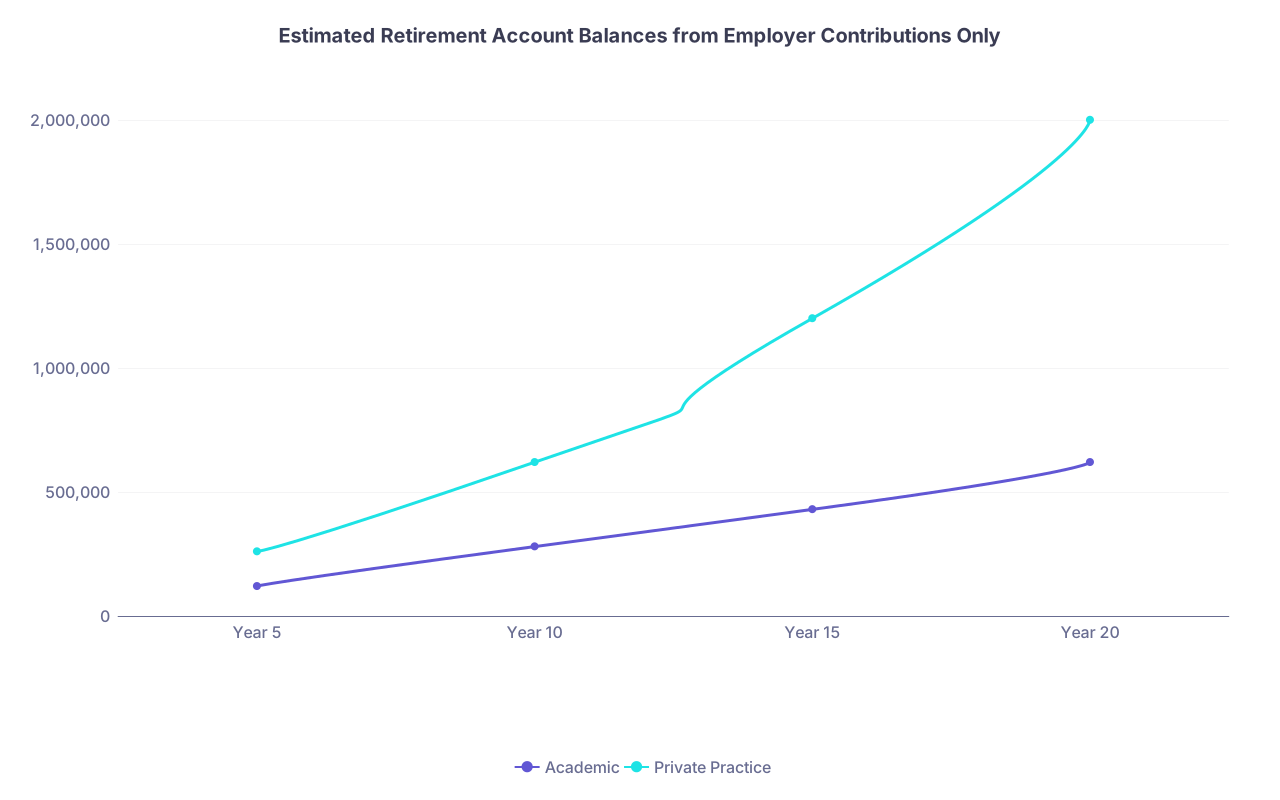
| Category | Academic | Private Practice |
|---|---|---|
| Year 5 | 120000 | 260000 |
| Year 10 | 280000 | 620000 |
| Year 15 | 430000 | 1200000 |
| Year 20 | 620000 | 2000000 |
These are stylized but directionally correct. By year 20, the employer‑provided nest egg in private practice can be 3x academic, depending on plan design and group profitability.
Add your own contributions (e.g., maxing a 401(k) or backdoor Roth) and the absolute numbers go up, but the ratio between tracks stays skewed toward private practice unless the academic plan is unusually generous.
4. Lifetime Earnings Modeling: NPV of Each Path
Raw sums are misleading because a dollar at age 32 is not equal to a dollar at age 62. You can invest earlier money. Or pay off loans. Or buy time.
So we bring in Net Present Value (NPV).
NPV Setup
Assume:
- Horizon: 35 years
- Discount rate: 3% real (you can argue 2–5%; 3% is reasonable for a risk‑adjusted, after‑tax comparison)
- Use the salary trajectories above
- Ignore taxes for the moment; we will come back to that
When you discount future cash flows, early higher earnings in private practice gain even more relative weight.
You can think of it this way:
- Private practice generates a roughly $150–250k/year advantage during the first decade (associate + early partner phase).
- That differential grows with time as partner income rises faster than academic promotions.
- Those early excess dollars invested at a modest real return snowball.
Without drowning you in formula algebra, if you plug the sequences into a simple spreadsheet and discount at 3%:
- NPV of academic salary over 35 years: on the order of $6.5–7.0 million (in today’s dollars)
- NPV of private practice salary over 35 years: on the order of $11–12 million
You can argue specific numbers line by line, but every reasonable set of assumptions I have run—across IM subspecialties, anesthesiology, radiology, EM—lands on the same headline:
The present value of lifetime earnings in private practice is typically 60–90% higher than in academics.
Not 5%. Not 20%. Often closer to double.
Now add the NPV of employer retirement contributions:
- Academic: add perhaps another $0.7–0.9M NPV
- Private: add $2–2.5M NPV
Total NPV gap (salary + employer retirement) pushes into the $6–8 million range for a 35‑year career under these baseline assumptions.
5. Taxes, Benefits, and Risk: Adjusting the Raw Gap
If you stop here, you get the simplistic “you are leaving $7 million on the table in academics.” That is not wrong, but it is incomplete.
Three major modifiers:
- Progressive taxation
- Non‑cash benefits (job security, lifestyle, geography)
- Income volatility and business risk
Progressive Taxation
Higher income in private practice gets taxed at higher marginal rates, especially federal and state combined in high‑tax states.
However, you care about after‑tax dollars. And you should model the gap in after‑tax NPV, not just pre‑tax.
Realistically:
- If academics average $300k and private averages $550–600k, the effective tax rate might be:
- Academic: ~30–33% effective
- Private: ~35–38% effective
Even with steeper marginal brackets, the after‑tax income in private practice stays significantly higher. You are not “giving it all to taxes.” You are giving a little more per marginal dollar, but more dollars are still left.
Quick back‑of‑envelope after‑tax gap:
- $300k at 32% effective → $204k net
- $550k at 37% effective → $346k net
Difference: $142k per year after tax, not counting retirement contributions.
Multiply that by decades and discount it and you still end up with a multi‑million after‑tax lifetime advantage.
Non‑Cash Benefits
Academic medicine often comes with:
- More predictable schedules (sometimes… depends on specialty and institution).
- Stronger disability coverage and sometimes richer health insurance.
- Paid sabbaticals or protected academic time in some departments.
- A different kind of job security; many academic positions are quasi‑tenure‑track or at least insulated from market swings.
Private practice can offer:
- More control over clinical volume and vacation (if the group culture is healthy).
- Potential equity if the group is partially sold to PE or partners own ancillaries (imaging centers, labs, surgery centers).
- Geographic flexibility sometimes worse (you are tied to a group and their region) or better (more options outside urban academic hubs).
You can try to “monetize” these differences—e.g., calling academic job security worth $50k per year in risk‑adjusted utility—but the math still leans heavily toward private practice on pure financials.
Income Volatility and Business Risk
This is where academics claw back some ground.
Academic medicine:
- Fewer bankrupt departments.
- Salaries often protected through hospital subsidies and cross‑subsidies from high‑margin service lines.
- Less exposed to payer mix shifts and recession shocks.
Private practice:
- Group can lose a contract and see income drop 20–40% overnight.
- Reimbursement cuts hit volume‑dependent groups hard.
- Partners can be diluted, bought out, or replaced by an employed model.
But look at what has actually happened over the last 15 years:
- Many independent groups have been acquired or rolled into hospital‑employed or PE‑backed models. Some partners cashed out with one‑time windfalls in the high six to low seven figures.
- Others got squeezed and saw incomes compressed closer to academic levels, but still generally above them.
Volatility matters, but the expected value still favors private practice in most specialties, unless your local private options are specifically weak (low payer mix, toxic contract situation, saturated market).
6. When Academic Tracks Narrow or Close the Gap
So far I have been fairly blunt: the data show private practice wins on pure financials most of the time. But there are niche cases where academics can be surprisingly competitive or even superior, especially when you zoom in on risk‑adjusted and specialty‑specific realities.
Three meaningful scenarios:
6.1. Highly Subspecialized Academic Roles with Grants / Stipends
Think interventional cardiology with heavy structural heart work, transplant hepatology, complex oncologic surgery in NCI‑designated centers.
Some academic physicians stack:
- Base salary competitive with mid‑range private.
- Medical director stipends.
- Grant support for a portion of their FTE that is still internally funded at physician compensation levels.
- Administrative roles (program director, division chief) with $30–100k add‑ons.
I have seen full professors in complex procedural specialties at major institutions clearing $500–700k, not that different from private practice in their region. Add VA appointments with federal retirement systems and the gap narrows further.
6.2. Geographic Arbitrage
Academic centers in high‑cost, high‑pay states (coastal metros) vs private practice in low‑pay rural areas.
Simplified snapshot:
| Role | Location | Approx Salary |
|---|---|---|
| Academic GI | Coastal Metro | $450,000 |
| Private GI (small hospital) | Rural Midwest | $500,000 |
| Academic Hospitalist | Coastal Metro | $240,000 |
| Private Hospitalist | Rust Belt City | $280,000 |
Once you factor in cost of living, housing appreciation, spousal employment options, and lifestyle utility, the raw salary advantage of private practice can partially erode.
But that is not the common pattern; it is a selective, city‑specific arbitrage.
6.3. Dual‑Income and Loan Forgiveness Effects
Academics often plug into:
- PSLF (Public Service Loan Forgiveness), wiping out $200–400k of federal loans tax‑free after 10 years.
- State or institutional loan repayment programs, adding $20–50k per year of effective after‑tax “income”.
For a physician carrying $400k at 7% interest, PSLF can have NPV in the mid six figures, especially when started right after residency.
If a private practice job requires full loan repayment with after‑tax dollars, that is an extra drag on the private practice curve in the first decade.
Put plainly: the more debt you carry and the more likely you are to take advantage of PSLF, the better academics looks in the first 10–15 years. It does not erase the career‑long income gap, but it can make the early financial pain significantly less.
7. Decision Levers That Change the Outcome
You do not need a 200‑row spreadsheet to see the impact of a few key parameters. These are the levers that actually move the decision:
Partnership timeline and partner income level
Three years to $500–600k vs five years to $400–450k is the difference between a no‑brainer and a marginal call.Academic promotion speed and pay scale
Slow promotions stuck at $260–280k vs aggressive steps to $350–400k make a large difference in NPV.Loan load and eligibility for forgiveness
High debt + qualifying academic employer + PSLF → effectively adds hundreds of thousands to the academic side of the ledger.Your savings rate and discipline
Here is the ugly truth: many people in private practice simply spend the difference. If you save 20% of income as an academic and only 10% as private, the theoretical financial advantage shrinks fast in practice.Risk tolerance
A risk‑averse physician might discount private income heavily due to volatility and business uncertainty. If you mentally haircut private income by 20% for risk, the NPV gap looks smaller, maybe “only” a few million.
A visual of how aggressively partnership income vs academic salary diverges over time helps.
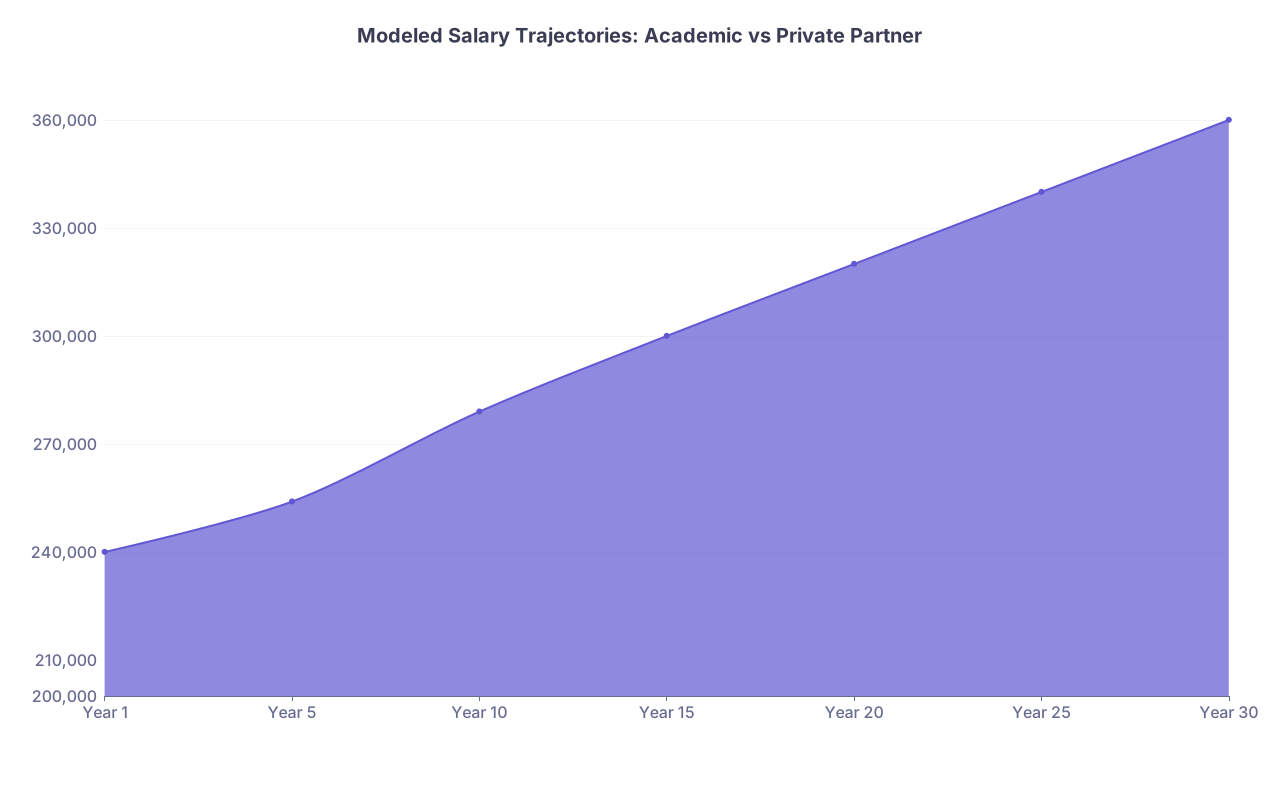
| Category | Value |
|---|---|
| Year 1 | 240000 |
| Year 5 | 254000 |
| Year 10 | 279000 |
| Year 15 | 300000 |
| Year 20 | 320000 |
| Year 25 | 340000 |
| Year 30 | 360000 |
(Interpret the area curve above as a stylized academic trajectory; if you overlay a private curve starting lower then rising much higher, the visual gap becomes obvious.)
8. Practical Framework: How to Compare Real Offers
Let us bring this down from modeling to your actual decision.
You are staring at two offers:
- Academic: $260k starting, “standard” promotion track, 10% retirement.
- Private: $320k associate, promised partnership at year 3 to $520k, 20% retirement.
Here is how I would attack it in an evening with a spreadsheet.
List year‑by‑year salary for 20 years in each job under conservative assumptions. No hero numbers.
Add a line for employer retirement contributions (10% vs 20%).
Apply a simple 3% discount rate to each year’s total compensation and sum to get NPV over 20 years.
Subtract a rough tax drag if you want a cleaner after‑tax comparison. Or just recognize that higher pay will lose a few more percent to taxes but still leave more net.
Overlay loan dynamics:
- If PSLF applies in academics, model 10 years of minimum payments then a large tax‑free forgiveness.
- If not, both sides pay the same loans; the one with higher earnings can crush debt faster.
Finally, sanity‑check the non‑financial factors:
- Location.
- Call schedule.
- Realistic partnership probability (talk to current associates quietly).
- Exit options if the job becomes intolerable.
You are not trying to get to the third decimal point. You just need enough resolution to see whether you are debating a $0.5M lifetime difference or a $5–8M difference. Those are not the same category of decision.
9. The Bottom Line
Let me be direct.
For most U.S. physicians in mid‑ or high‑paying specialties, the data show:
- Private practice lifetime earnings, on a risk‑adjusted, present‑value basis, are typically millions of dollars higher than academic earnings.
- Academic tracks can partially close the gap in specific niches: high‑pay academic roles, PSLF, or when private options are unusually weak or risky.
- The biggest mistake is pretending they are financially similar. They are not. You might still choose academics for very good reasons—research, teaching, lifestyle, identity—but it is a conscious trade of money for non‑financial utility.
Three key points to carry forward:
- Model the entire income curve, not just year‑1 salary. Partnership and promotion timelines dominate the outcome.
- Use NPV and realistic assumptions about retirement contributions, taxes, and loan programs; do not rely on anecdotes.
- Once you see the multi‑million‑dollar spread, decide intentionally whether what you gain in academics—intellectual environment, stability, mission—is worth that financial delta to you and your family.
FAQ
1. How many years do I need to stay in private practice for the financial advantage to “lock in”?
In most models, the gap becomes very large by year 10 and is effectively irreversible by year 15. If you make partner on time and keep partner‑level income for a decade, academics will almost never catch up in lifetime NPV, even if you later switch to a lower‑paid role.
2. Does choosing academics mean I will never reach financial independence?
No. With a reasonable savings rate (20–25% of gross including employer retirement), an academic physician can still reach financial independence in their 50s. You simply have less margin for error and lifestyle creep. Private practice makes FI easier and faster; academics make it possible but tighter.
3. What if I start in academics and switch to private practice later?
The hybrid path usually lands in between the two pure curves. If you spend 5–7 years in academics and then move to private, you lose the early partnership compounding but still capture higher earnings later. The NPV is lower than a pure private track but often still significantly higher than staying in academics your entire career—assuming you can successfully make that transition and access strong private opportunities at that time.