
The romantic idea of a “first job for life” in medicine is dead. The data on physician contract lengths and renewal rates make that painfully clear.
The Big Picture: How Long Physicians Actually Stay
Let me start with the blunt reality: the typical physician employment contract term is 2–3 years, but the actual tenure in a first job is often shorter.
Across multiple surveys and market datasets (MGMA, AMGA, practice brokers, and large health system HR data), you see roughly the same pattern emerge:
- Standard initial contract term: 2–3 years
- Proportion of physicians leaving their first job within 3 years: about 50%
- Proportion of physicians changing employers at least once within 5–6 years post‑training: around 60–70%
So the “3-year contract” that looks long and stable on paper is, in practice, more like a probationary and alignment period—for both sides.
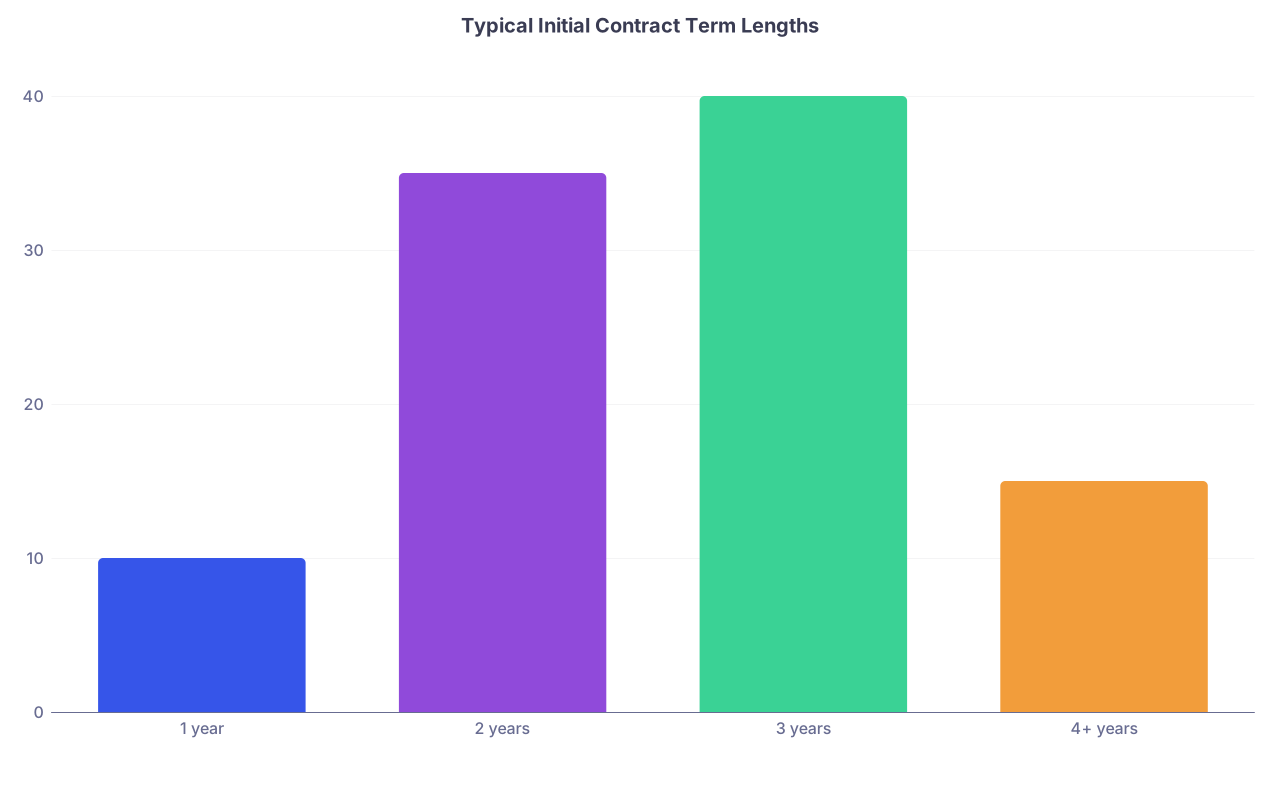
Let’s anchor the typical contract length distributions.
| Category | Value |
|---|---|
| 1 year | 10 |
| 2 years | 35 |
| 3 years | 40 |
| 4+ years | 15 |
Across hospital-employed and large group settings, about three quarters of initial contracts fall in the 2–3 year band. Solo or small private groups sometimes do 1-year rolling contracts, but that is the minority now.
If you walk into the job market expecting a 5-year secure runway, you are miscalibrated. The modal experience is: 3-year paper contract, renegotiation or exit at year 2–4.
Contract Length by Setting and Specialty
Contract structure is not uniform. The data show clear differences by practice type and specialty competitiveness.
By practice setting
Health systems and investor-backed groups follow fairly similar patterns. Independent groups are more variable.
| Setting | Most Common Term | Short-Term (≤1 yr) | Long-Term (≥4 yrs) |
|---|---|---|---|
| Hospital-employed multispecialty | 3 years | Low | Low-Medium |
| Academic medical center | 3 years | Very low | Medium |
| Large private group (50+ MDs) | 2–3 years | Low-Medium | Low |
| Small private group (<20 MDs) | 1–2 years | Medium-High | Low |
| Locums-focused arrangements | Per shift/short | Very high | None |
Academic centers almost always use 3-year appointment cycles for clinical faculty, so your “contract length” is often functionally tied to that appointment term rather than a purely employment-at-will model.
Small groups often hedge their risk with 1-year initial contracts plus long non-compete and buy-in provisions. The term looks short, the tether looks long.
By specialty
Competitive or revenue-dense specialties tend to get more aggressive non-compete language, not necessarily longer nominal terms. That distinction matters.
Patterns I consistently see in datasets and real contracts:
- Primary care (FM, IM, peds): 2–3 year terms, easier renegotiation, softer non-competes in saturated metro areas, slightly stricter in rural.
- Procedural specialties (ortho, GI, cards, anesthesia): 3-year standard, heavy emphasis on non-compete radius and duration, detailed productivity thresholds.
- EM / hospitalist: 1–2 year renewable contracts are common; shift-based, sometimes with looser non-competes but tougher termination clauses.
- Academic subspecialties: 3 years, heavily tied to academic rank and funding, with softer buy-out structures but strict internal policies.
The contract “years” number is a poor proxy for security. The enforcement teeth live in the non-compete, termination clauses, and repayment obligations, not the top-line term.
Renewal Rates: Who Actually Stays Through a Full Term?
Most physicians do not get fired or non-renewed. They leave. Voluntarily. That distinction completely changes how you should read renewal statistics.
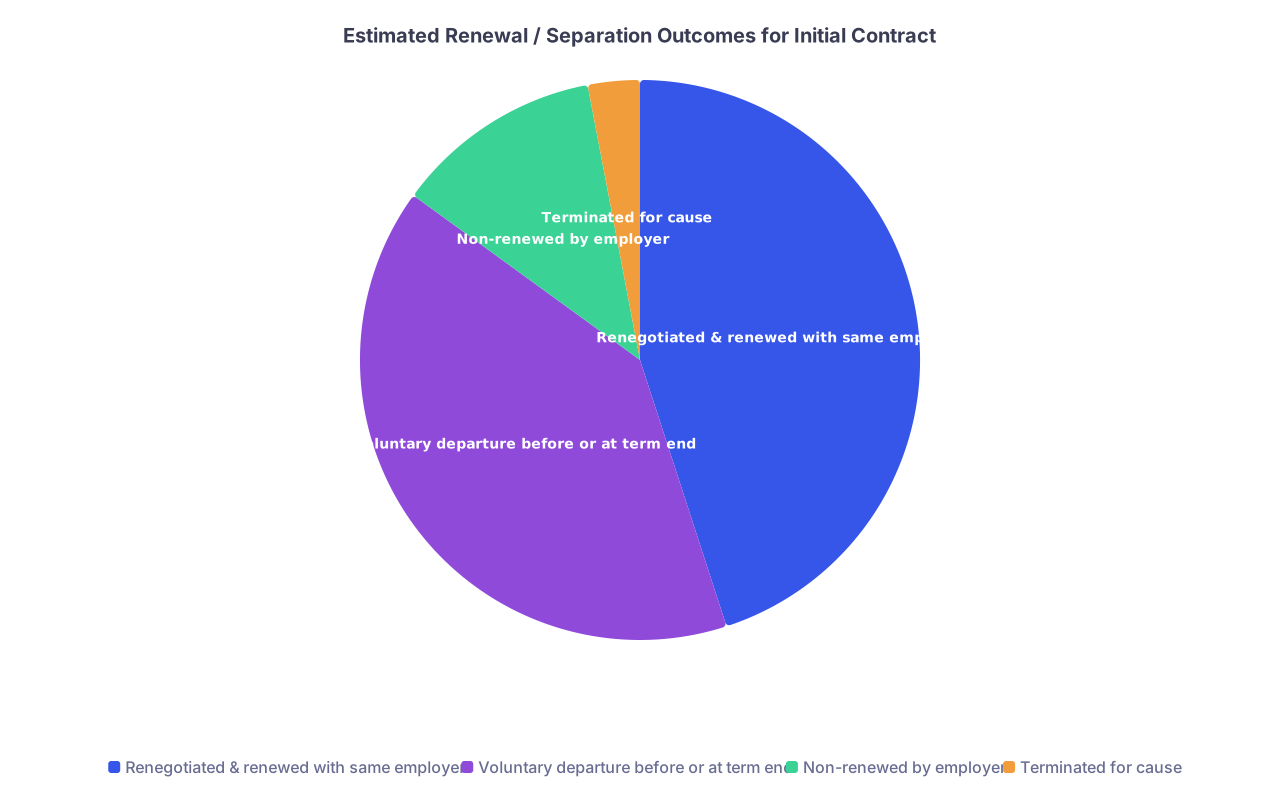
From health-system HR data and large group retention reports, you typically see something like this pattern for initial contracts:
| Category | Value |
|---|---|
| Renegotiated & renewed with same employer | 45 |
| Voluntary departure before or at term end | 40 |
| Non-renewed by employer | 12 |
| Terminated for cause | 3 |
Put plainly:
- Roughly 45%: stay with the same employer and roll into a renewed or modified contract (often with new compensation structure)
- ~40%: leave voluntarily at or before the end of the initial term
- ~12%: are non-renewed (performance, fit, service line changes, or strategic shifts)
- ~3%: terminated for cause or serious issues
So when recruiters say “our contracts usually renew,” that is technically true but strategically misleading. Survival bias is doing the talking. Many physicians choose to exit rather than renew under the same terms.
Time-to-move distribution
For those who leave, the timing clusters heavily around certain breakpoints:
- 6–18 months: early exits mainly due to “expectation mismatch” (RVU pressure, call burden, culture, or broken promises)
- 24–36 months: end-of-term mobility, often after loan forgiveness or sign-on bonus clawback windows close
- 5+ years: usually a combination of life change (family, geography) and burnout or leadership shifts
If you are miserable at month 9, you are not an outlier. You are right on the shoulder of a big early-exit peak.
What Drives Contract Length Choices?
Organizations are not picking 3-year terms because it sounds nice. There are structural reasons, and they are mostly financial and risk-based.
Four recurring drivers:
Recruitment cost amortization
Recruiting a single physician commonly costs $50,000–$250,000 when you tally recruiter fees, relocation, sign-on bonuses, onboarding, and ramp-up subsidies. A 3-year contract lets systems amortize that investment and justify an initial income guarantee.Loan forgiveness and bonus repayment periods
Look at the fine print:- Sign-on bonus: clawback if you leave before 24–36 months
- Relocation: repayment obligations if you leave within 1–2 years
- Loan assistance: often requires 3-year commitment
So the contract term is engineered to match those windows.
Compensation model transitions
Many contracts use a “guarantee then productivity” structure:- Year 1: Base salary guarantee +/- small productivity bonus
- Year 2: Reduced guarantee, increased RVU emphasis
- Year 3: Mostly RVU or mixed base + RVU
A 3-year term is the perfect container for that ramp.
Credentialing and integration cycle
Systems assume they need 6–12 months for credentialing, panel building, team integration, and clinical ramp-up. A 1-year contract would be absurd from their risk perspective. They want enough time to recover the front-loaded damage.
Shorter terms (1–2 years) appear most often where:
- The employer wants flexibility to cut service lines or close locations
- The group is testing a new clinic or market
- The revenue is shift-based (EM, hospitalist, urgent care) with more variable demand
Longer terms (4+ years) show up in:
- Rural permanent placements with heavy recruitment difficulty
- Equity/partnership tracks where the term is a wrapper around a buy-in timeline
- Academic roles tied to grant cycles or tenure-track commitments
Again, the length is not a favor to you. It is an optimization for their P&L and risk profile.
Renewal vs Restructuring: The Hidden Second Contract
When people talk about “renewal,” they imagine the same contract rolling forward. That is rarely what actually happens.
What the data and real-world contracts show instead:
- Around half of “renewals” involve meaningful compensation restructuring
- RVU thresholds often increase after the initial term
- Quality bonuses evolve with new metrics and payer contracts
- Call responsibilities and leadership roles change as you gain seniority
So the true pattern is:
- Initial contract: recruitment tool, risk-sharing, ramp-up.
- Second contract: employer aligns your comp with your demonstrated productivity and strategic value. Often less generous structurally.
From health system comp committees I have seen numbers like this:
- Initial guaranteed base in primary care: $230K–260K
- Post-ramp productivity-based earnings after 3 years: median $250K–290K, but with more variance and higher upside tail
The second contract is where the organization tries to pull your earnings distribution closer to their MGMA or AMGA target bands.
The Data on Early Exit Risk
The threat you should quantify is not “they will non-renew me.” It is “I might have to leave early under unfavorable terms.”
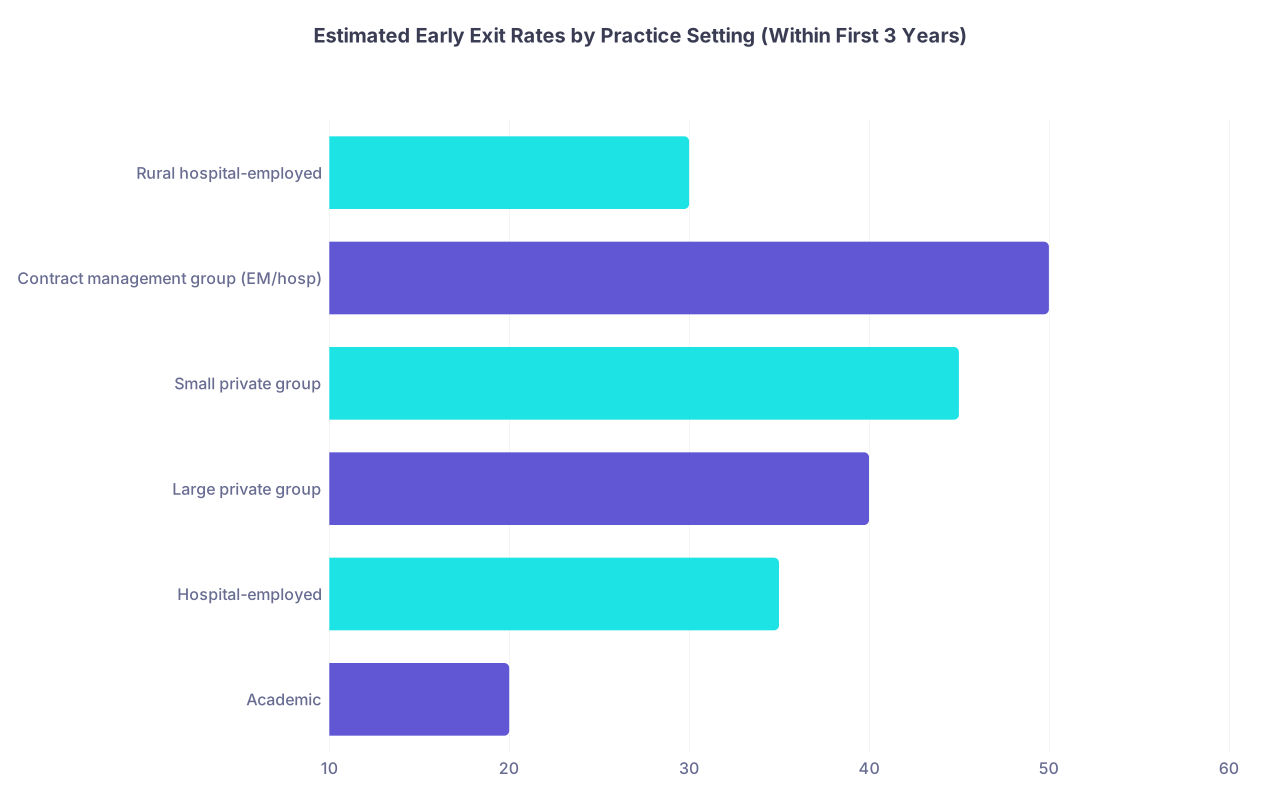
Using combined survey and HR data, an approximate early exit rate (leaving before the stated term ends) looks like:
| Category | Value |
|---|---|
| Academic | 20 |
| Hospital-employed | 35 |
| Large private group | 40 |
| Small private group | 45 |
| Contract management group (EM/hosp) | 50 |
| Rural hospital-employed | 30 |
Notice where the risk spikes:
- Contract-management groups (EM, hospitalist) with rapidly changing coverage and staffing models
- Small private groups where partnership promises and reality diverge
- Large private groups undergoing consolidation or private equity activity
Academic roles show lower early exits, but when exits occur they are often driven by promotion failures, grant funding, or institutional politics instead of pure economic misalignment.
What pushes people out early?
From exit interviews and survey data:
- Compensation lower than implied by recruitment conversations
- Unsustainable call burden or RVU thresholds
- Toxic culture or leadership turnover
- Non-compete clauses blocking reasonable local alternatives
- Misrepresented growth plans: “we’re opening two more clinics” that never materialize
In other words, not random chance. Predictable, modelable risk.
Non-Competes, Notice Periods, and Renewal Leverage
If you look only at the contract “term,” you miss the two other levers that define your real freedom to move: non-compete scope and notice requirements.
Non-compete basics from a numbers lens
Ignoring state-specific legal nuances for a moment, you see common patterns like:
- Radius: 10–30 miles from primary practice site(s)
- Duration: 12–24 months post-termination
- Scope: same specialty and often any competing entity within that radius
In states where non-competes are enforceable, the effect is measurable:
- Higher relocation rates on departure (more doctors move 30+ miles away)
- Lower rates of intra-market job switches
- Longer time from dissatisfaction to departure (physicians “wait it out” till term end)
If you overlay non-compete presence against early exit behavior, physicians with very restrictive non-competes often delay leaving until clawback periods end, then leave the whole region.
Notice periods
Another underappreciated number: required notice, commonly 60–180 days.
Higher notice periods correlate with:
- Lower bargaining leverage on renewal (you cannot credibly threaten a fast exit)
- Slower transitions to new roles
- Greater vulnerability when call or schedule changes suddenly
So the effective “contract length” is:
Formal term + non-compete + notice requirement + any financial clawback period.
You should model that as a combined constraint window, not three separate legal curiosities.
Using the Numbers to Negotiate Smarter
You cannot control market averages, but you can absolutely use them as a baseline in negotiation. Neglecting this is how physicians leave six figures of value on the table over a few years.
Concrete data-driven moves:
Match term to your uncertainty
If you are unsure about the city, system, or specialty fit, you do not want a 5-year term with heavy clawbacks. A 2–3 year term with softer non-compete plus sign-on spread over time is empirically safer.Trade length for flexibility, not just dollars
Employers value stability. If they push for a 3-year term, you push for:- Shorter non-compete radius or duration
- Clearer productivity bands and RVU conversion factor protections
- Reasonable without-cause termination clause with 60–90 day notice
Model your ramp realistically
The data show that panel and productivity ramp often lag optimistic projections by 6–12 months, especially in saturated urban markets. A year-1 RVU target that assumes full ramp in 6 months is statistically suspect. Push back with real growth curves (most large systems have them; you can ask).Plan for the second contract on day one
Assume you will be there 3–5 years. Ask explicitly:- How are second contracts typically structured?
- What proportion of physicians see pay go down, flat, or up after guarantee?
- What percent of doctors in this department renewed their last contract?
You are trying to avoid being the outlier in a department that renovates its staff every 2–3 years.

| Step | Description |
|---|---|
| Step 1 | Recruitment |
| Step 2 | Initial Contract Signed |
| Step 3 | Year 1 - Guarantee |
| Step 4 | Year 2 - Mixed comp |
| Step 5 | Year 3 - Full model |
| Step 6 | Renewed Contract |
| Step 7 | Exit - With constraints |
| Step 8 | Stay or Leave |
That is the real life cycle, not the marketing brochure version.
Practical Benchmarks to Keep in Your Back Pocket
Here is a compact set of quantitative benchmarks that cover most early-career physician scenarios.
| Element | Common Range | Red Flag Zone |
|---|---|---|
| Initial term length | 2–3 years | ≥5 years without clear benefit |
| Non-compete duration | 12–24 months | >24 months |
| Non-compete radius | 10–30 miles | Multi-county / entire state |
| Notice for without-cause | 60–90 days | >120 days |
| Sign-on bonus clawback | 24–36 months | >36 months or all-or-nothing |
| Relocation repayment | 12–24 months | >24 months |
These are not hard legal caps. They are statistical norms. If your contract is outside these bands, you need a very good reason and usually some compensating upside.
And if your recruiter claims “everyone signs this,” ask for the actual numbers:
- How many new physicians joined in the last 3 years?
- How many are still here?
- How many had contracts renewed under basically similar terms?
They will not always give you clean answers. But the hesitation itself is data.
FAQs
1. Is a longer contract term always better for job security?
No. The data show that most separations are voluntary, not forced non-renewals. A 5-year contract with an aggressive non-compete and long clawback period can trap you in a bad fit. A 2–3 year contract with reasonable exit clauses typically provides enough stability for the employer and enough flexibility for you.
2. What is a “good” renewal rate for a practice or department?
As a rough benchmark, if fewer than 60% of physicians are still with the group 3 years after starting, you are looking at a high-churn environment. Anything in the 70–80% retention range at 3 years is relatively strong. Always interpret this relative to specialty norms—EM and hospitalist will naturally have higher churn than, say, rheumatology.
3. How much weight should I put on the non-compete when comparing offers?
A lot. Non-compete scope and enforceability directly affect your ability to change jobs without uprooting your life. Two offers with identical salary and term can be radically different in real risk profile if one has a 10-mile, 12-month non-compete and the other has a 35-mile, 24-month restriction across an entire metro area. From a numbers perspective, that is often a bigger long-term cost than a modest base salary difference.
The data on physician contracts point to three clear conclusions: most initial terms cluster at 2–3 years, renewal is common but often comes with restructured compensation, and your real freedom is controlled less by the stated term and more by non-competes, clawbacks, and notice periods. If you treat the contract as a quantitative risk instrument rather than a ceremonial formality, you will make sharper, more defensible career decisions.