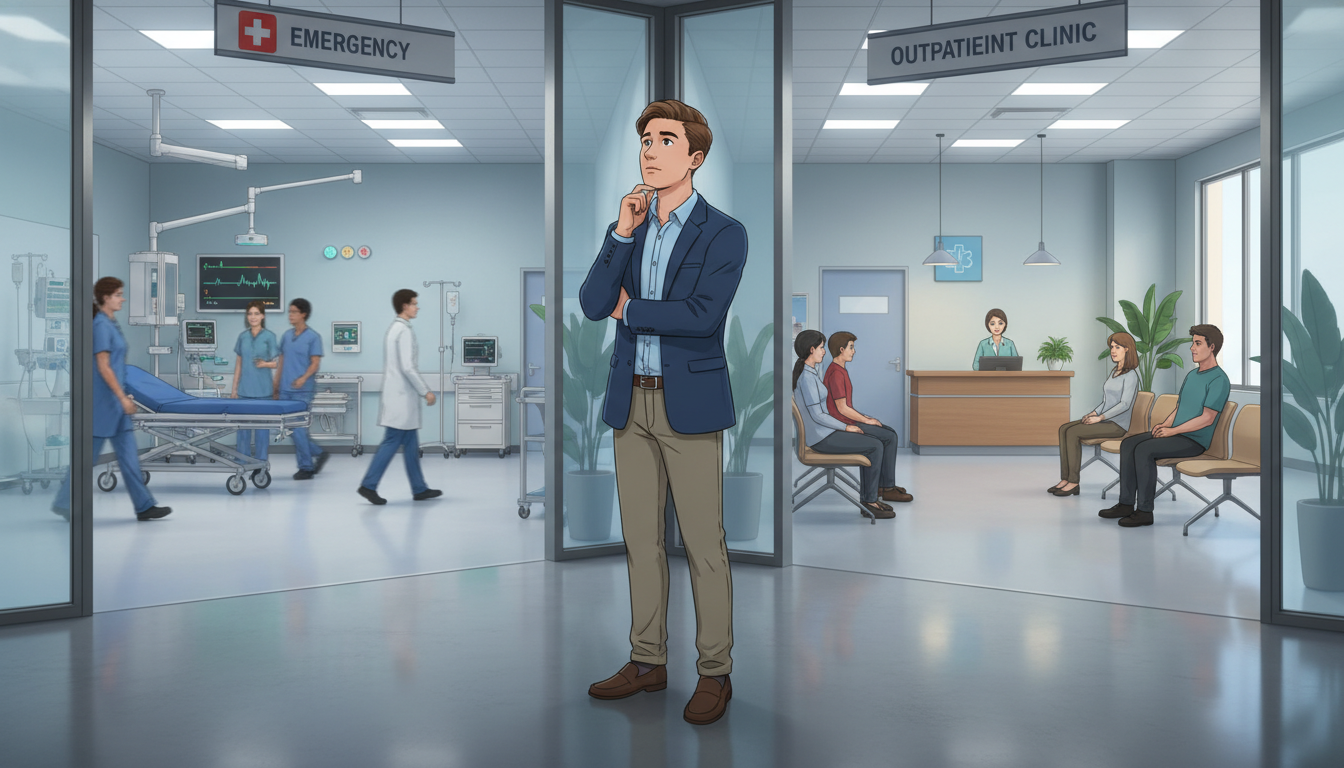
Last week, a premed sat in my office with two volunteer offers in hand: one in a level 1 trauma ER, the other in a quiet community clinic. Her question was simple: “Which one looks better for med school?”
I’ll tell you exactly what I told her: program directors and admissions committees do not see “clinical volunteering” as one big generic box. ER vs outpatient paints two very different stories about who you are, how you work, and what kind of future physician you might become—and committees absolutely read those signals.
How Adcoms Actually Read “Clinical Volunteering”
(See also: Volunteer Stories That Win Interviewers Over for insights on impactful volunteering experiences.)
Let me strip away the brochure language you’ve heard a hundred times.
When admissions committees scan your application, they are not thinking:
“Wow, 200 clinical hours. Check.”
They’re thinking:
- Where did those hours happen?
- What does that environment say about this applicant’s temperament and priorities?
- Did they seek intensity or continuity? Chaos or relationship-building?
- Does their story match the environments they chose—or do the choices feel random?
A rushed reviewer might only see “hospital volunteer” and move on. But the people in the room making final decisions—especially MD/PhD and MD-only faculty—think in patterns. Every year, they see:
- ER-heavy applications that scream, “I love adrenaline, but I barely know any patient beyond a wristband number.”
- Clinic-heavy applications that whisper, “I care deeply and consistently, but I’ve never seen acute medicine up close.”
- Balanced applications that tell a much more sophisticated story.
Your volunteering location is not neutral. It silently broadcasts your comfort zone, your default professional behavior, and how you’ll likely function when the stakes rise.
Let’s pull back the curtain on how each setting really shapes your image.
What ER Volunteering Actually Signals (Not What You Think)
Students love to say: “I volunteer in the ER. It’s so exciting.”
Faculty quietly translate that to: “This person likes high-stimulation environments, but I wonder how much they’re actually doing.”
Behind the scenes: what ER means to faculty
When a faculty member sees sustained ER volunteering on an application, they infer several things—sometimes unconsciously:
You’re comfortable with chaos and unpredictability
The ER is interruptions on top of interruptions. Blood draws, trauma activations, psych holds, constant noise. Choosing to spend your limited free time here tells us you’re not easily rattled by intensity. That matters when faculty imagine you on busy inpatient rotations.You’ve seen real acuity—even if you weren’t doing “high-level” tasks
Admissions people know most premeds in ERs are:- Running labs and specimens
- Restocking supplies
- Transporting patients
- Sitting with patients as “sitters” You aren’t leading codes—but you are physically present around strokes, sepsis, overdoses, chest pain workups. That exposure counts. It makes your understanding of “sick” vs “stable” more than theoretical.
You may have lots of breadth, little depth
In many busy ERs, volunteers touch many patients for minutes at a time. You wheel them, grab them warm blankets, help with discharge instructions. You rarely follow them over weeks or months.Faculty notice when your stories are all:
“I helped many different patients briefly in high-stress situations.”
That’s breadth-heavy, depth-light. Not bad—but not complete.
You’re comfortable as part of a large, hierarchical team
The ER functions like a military unit. Attending, residents, nurses, techs, clerks, paramedics, social workers, security. You are somewhere near the bottom. If you’ve lasted multiple semesters there, faculty infer:- You understand chain of command
- You don’t demand attention to feel valuable
- You’ve seen what fast, coordinated care looks like
Whether they say it out loud or not, that reassures them about how you’ll behave as an MS3.
Two very different ER narratives: which one are you building?
From years of reading applications, I can tell you there are two classic ER volunteer archetypes.
1. The Spectator
They write about:
- “Watching” a trauma
- “Observing” a code
- “Seeing” how doctors handled emergencies
They sound impressed, even awed, but strangely distant. We never actually hear what they did, how they interacted, or how they changed.
How adcoms read it:
Curious, but passive. Likes the theater of medicine, not necessarily the grind. Good for shadowing hours. Not impressive for 150+ claimed “clinical” hours.
2. The Quiet Operator
They write about:
- Sitting with a confused elderly patient for hours while their daughter drove in from out of state
- Learning to communicate bad news logistics (“The doctor will be in shortly, but here’s what I can tell you now…”) without overstepping
- Noticing patterns: “By week 10, I could tell which ‘chest pains’ would likely be admitted before the labs came back, based on…”
They speak less about the dramatic moments and more about the mundane, human pieces of emergency care.
How adcoms read it:
Grounded. Observant. Able to see the human experience inside the chaos. Someone who will not be useless on call.
If you choose ER volunteering, your image is shaped less by the setting itself and more by which of those narratives you end up telling.
What Outpatient Volunteering Signals (And Why Committees Quietly Value It)
A lot of premeds treat outpatient clinics as the “boring” alternative. No trauma activations, no sirens, no heart-stopping drama.
Faculty read it very differently.
The hidden value of clinic work
When we see long-term outpatient volunteering, especially in primary care, specialty clinics (oncology, cardiology, diabetes), or free clinics, we infer:
You understand continuity of care
You’ve watched:- A diabetic patient come back every 3 months to tweak meds
- A cancer patient move from diagnosis to chemo to remission or decline
- A hypertensive patient struggle with adherence and side effects
That longitudinal exposure is gold. It tells us you know that medicine is not just “fix the crisis and move on.” It’s “circle back, re-evaluate, coax, remind, encourage.”
You’ve seen the reality of chronic disease and social determinants
Outsiders underestimate this.
Inside clinics, faculty see who actually shows up, who no-shows, who can’t afford meds, who needs a faxed note to keep their job.When your essays talk about:
- A patient who missed appointments because of childcare
- Someone who stopped meds because of side effects and fear
- Language barriers, insurance denials, pharmacy struggles
We know: you understand that patient care is not just prescriptions. It’s logistics, trust, and system navigation—things many residents still don’t fully grasp.
You’re patient with slower, relationship-based work
Clinic flow is different:- 15–30 minute visits
- Same faces
- Less drama, more repetition
Committing to that as a volunteer signals you are not addicted to adrenaline. You can stay engaged in quieter settings. A lot of medicine looks like this, not like TV dramas.
You have more opportunity for real responsibility
Clinics are where students often get to:- Room patients
- Take vitals
- Translate (if certified and language-proficient)
- Do basic counseling (diet, med schedules, referrals under supervision)
- Manage paperwork, follow-up calls, scheduling
Letters from clinic supervisors tend to read like:
“We trusted her to independently manage intake and triage basic concerns before I saw the patient.”
That kind of trust—written in detail—carries weight.
The outpatient narrative committees admire
The strongest outpatient volunteering applications share certain themes:
- A single clinic or patient population over many months or years
- Specific patient stories that show growth in understanding, not just “I felt grateful to help”
- Reflections on barriers to care, not just “It’s important to treat the whole patient”
- Clear evidence that you were not just a warm body in a chair
If your file says “Volunteer, Cardiology Clinic, 2.5 years, 4 hrs/week” and your letters back that up with specific responsibilities, a lot of faculty quietly move you into the “maturity and commitment” column long before interview day.
How ER vs Outpatient Shapes Your Image Side by Side
Let me spell out how people in the room actually compare these two when they see them on paper.
Imagine two applicants, same GPA, same MCAT:
Applicant A: ER-Heavy
- 250 hours in Level 1 trauma center ER
- Sporadic shadowing in various specialties
- Minimal longitudinal clinic exposure
Applicant B: Clinic-Heavy
- 250 hours at a free primary care clinic
- 60 hours shadowing in hospitalist and ER settings
- Occasional weekend ER volunteering, maybe 30–40 hours total
In committee:
Applicant A looks like someone who has seen severity and high-stress medicine, but may not fully grasp the slow, chronic, “forever” side of care. Sometimes reads as thrill-seeking if their stories are all adrenaline.
Applicant B looks like someone who understands how patients live with illness over time, and has at least tasted acute care settings. Often reads as thoughtful, patient, and grounded.
Neither is automatically “better.” But they evoke very different gut impressions when faculty picture you on wards.
The strongest applications do this:
- Start with one environment deeply (clinic or ER)
- Then add the other in a targeted way to round out the story
Committees are not looking for perfect symmetry; they want coherence. Your choices should line up with the narrative you’re selling about who you are and what kind of physician you’re becoming.
Choosing ER vs Outpatient Based on Your Emerging “Story”
Here’s the part almost no one tells you: the “right” choice depends not just on what’s available, but on what your file already says about you.
If your file already screams “high achiever, head in the clouds”
If you’re:
- High GPA, high MCAT
- Heavy on lab research
- Minimal service or long-term commitments
ER volunteering can actually reinforce a negative stereotype: “smart, loves drama, not sure about real patient lives.”
You’d be better served by:
- A consistent outpatient or free clinic role
- Showing you can build relationships and tolerate slower, less glamorous work
If your file already screams “service-oriented, community-focused”
If you’re:
- Lots of community service
- Leadership in health outreach or advocacy
- Strong narrative around underserved populations
You might benefit from adding ER volunteering to:
- Demonstrate comfort with acuity and hospital environments
- Avoid looking like you’ve only seen medicine at the margins, not the core clinical setting
If you’re genuinely drawn to emergency medicine
Here’s the trap: premeds say they love EM, then only ever sit at a front desk in the ER.
If you want EM cred:
- Have some substantial ER time, but also
- Get longitudinal exposure in outpatient follow-up settings (urgent care, continuity clinics, primary care where patients land after ED visits)
- Show you understand what happens after the ER visit, not just the moment of crisis
How to Maximize Each Setting So It Actually Helps You
You can make either environment powerful—or meaningless. The tricks are slightly different.
Making ER volunteering count
You tilt your image in the right direction when you:
- Stay long enough to be known by name by multiple nurses and techs
- Ask for more responsibility gradually (transport, stocking, then maybe assisting with non-invasive tasks, running labs)
- Learn to read the room: when to talk, when to disappear, when to offer help without getting in the way
- Keep a memory log of specific patients and moments—not gory details, but human situations that actually changed your understanding of illness, fear, family dynamics
Letters from ER staff that say, “We’d hire this person as a tech tomorrow” are very different from letters that say, “They always showed up on time and were respectful.”
The former moves decisions.
Making outpatient volunteering count
You get disproportionate value when you:
- Commit for at least 6–12 months consistently
- Take on roles that put you in front of patients: intake, vitals, rooming, patient education, phone follow-ups
- Understand the clinic’s payor mix (Medicaid-heavy? Uninsured? Private? Student health?), so you can speak intelligently about barriers patients face
- Learn how the team works—who the MA is, the RN, NP/PA, attending, social worker—and how information moves between them
Letters that say, “We trusted him with intake and basic triage; he caught several issues we might have missed without his careful questioning,” make faculty lean forward.
The Hybrid Strategy Most Committees Quietly Respect
Here’s the pattern that reliably impresses insiders:
Anchor experience in one setting
150–250 hours over 1–2 years in either ER or outpatient, with clear progression in responsibility.Supplement with 30–80 hours in the complementary setting
Enough to credibly say, “I’ve seen both acute and longitudinal care. Here’s what I learned from each.”Reflect with nuance, not slogans
When you talk about these experiences in your personal statement or secondaries, avoid:- “I learned how important empathy is.”
- “I learned to treat the patient as a whole.”
- “I learned teamwork.”
Everyone writes that.
Instead, say:
- “In the ER, I saw how often social crises masqueraded as medical emergencies. In clinic, I saw the same patients reappear months later, sometimes stabilized, sometimes not. That shift in perspective changed how I think about ‘fixing’ problems in healthcare.”
- “I expected to love the chaos of the ER and be bored in clinic. The reality was almost the opposite, and that forced me to reconsider what kind of physician I might become.”
Those kinds of reflections tell faculty: this person is not just logging hours. They’re thinking like a future colleague.
Common Mistakes That Quietly Hurt You
I’ve watched applicants sink their own image by how they talk about their experiences, not just where they did them.
A few pitfalls:
ER as entertainment
Writing about “exciting cases” with a tone closer to a Netflix recap than a professional reflection. Readers will not say it out loud, but they will move you into the “lacks maturity” category.Clinic as martyrdom
Framing outpatient work as purely tragic: “So many uninsured, the system is broken, nothing ever works.”
That reads as naïve or cynical if not balanced with examples of things that do help and why you still want to practice in that environment.Fragmented dabbling
Four different volunteering sites, 40–60 hours each, across 2–3 years. That screams “checkbox” to seasoned reviewers. One deep commitment beats four superficial ones, every time.No narrative connection
ER volunteering on one side of the app, clinic volunteering on the other, but no essay or interview answer that ties them together. It feels random, like you just said yes to everything.
Your goal is not to impress with volume. It’s to present a coherent growth trajectory.
So, Which Should You Choose?
If you’re standing between an ER offer and an outpatient clinic role, and both are equally available, here’s the insider calculus:
- If you’re early in college and unsure about medicine at all, ER can give you fast clarity—you’ll know quickly whether clinical environments energize or drain you.
- If you’re already sold on medicine but want to develop depth, humility, and stronger patient-interaction skills, outpatient is usually the better anchor.
- If you already have strong non-clinical service with vulnerable populations, ER adds a valuable acute-care dimension.
- If you have lots of shadowing in hospital settings but no longitudinal patient relationships, clinic closes that gap.
But the real question committees are asking is not “ER or clinic?”
It’s: “Given what you chose, do you understand what those environments taught you, and can you connect that to the kind of physician you’re trying to become?”
Answer that clearly, and the specific setting becomes a tool, not a trap.
With that clarity, your next decision—where to put your feet on the ground—becomes much less about guessing what looks good, and much more about deliberately crafting the story you want your application to tell. And once those foundations are laid, you’re ready for the next stage: turning these raw experiences into personal statements and secondaries that sound like no one else’s. But that’s a conversation for another day.